第3章直線上の運動
3.2 Instantaneous Velocity and Speed3.2 瞬間速度と速さ
Learning Objectives学習目標
Learning Objectives学習目標
By the end of this section, you will be able to:
英語のヒント
この節を終えると、次のことができるようになる。
- Explain the difference between average velocity and instantaneous velocity.
英語のヒント
平均速度と瞬間速度の違いを説明する。 - Describe the difference between velocity and speed.
英語のヒント
速度と速さの違いを述べる。 - Calculate the instantaneous velocity given the mathematical equation for the position.
英語のヒント
位置を表す数式から瞬間速度を計算する。 - Calculate the speed given the instantaneous velocity.
英語のヒント
瞬間速度から速さを計算する。
We have now seen how to calculate the average velocity between two positions. However, since objects in the real world move continuously through space and time, we would like to find the velocity of an object at any single point. We can find the velocity of the object anywhere along its path by using some fundamental principles of calculus. This section gives us better insight into the physics of motion and will be useful in later chapters.
英語のヒント
二つの位置の間の平均速度の求め方を見てきた。しかし、現実の物体は空間と時間の中を連続的に動くため、任意の一点での速度を知りたい。微積分の基本原理を使えば、経路上のどこでも物体の速度を求められる。本節は運動の物理をより深く理解する助けとなり、後の章でも役立つ。
Instantaneous Velocity瞬間速度
The quantity that tells us how fast an object is moving anywhere along its path is the instantaneous velocity, usually called simply velocity. It is the average velocity between two points on the path in the limit that the time (and therefore the displacement) between the two events approaches zero. To illustrate this idea mathematically, we need to express position x as a continuous function of t denoted by x(t). The expression for the average velocity between two points using this notation is . To find the instantaneous velocity at any position, we let and . After inserting these expressions into the equation for the average velocity and taking the limit as , we find the expression for the instantaneous velocity:
英語のヒント
経路上のどこでも、物体がどれだけ速く動くかを示す量が瞬間速度であり、普通は単に速度という。これは、経路上の二点間の平均速度で、その二つの出来事の時間差(したがって変位も)が0に近づくときの極限である。この考えを数式で示すため、位置xを時刻tの連続関数x(t)で表す。この記法では、二点間の平均速度はとなる。任意の位置での瞬間速度を求めるため、、とおく。これらを平均速度の式へ代入し、の極限を取ると、瞬間速度の式を得る。
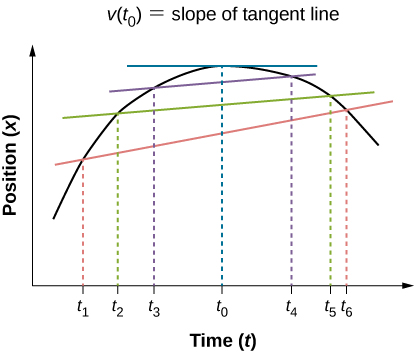
Like average velocity, instantaneous velocity is a vector with dimension of length per time. The instantaneous velocity at a specific time point is the rate of change of the position function, which is the slope of the position function at . Figure 3.6 shows how the average velocity between two times approaches the instantaneous velocity at The instantaneous velocity is shown at time , which happens to be at the maximum of the position function. The slope of the position graph is zero at this point, and thus the instantaneous velocity is zero. At other times, , and so on, the instantaneous velocity is not zero because the slope of the position graph would be positive or negative. If the position function had a minimum, the slope of the position graph would also be zero, giving an instantaneous velocity of zero there as well. Thus, the zeros of the velocity function give the minimum and maximum of the position function.
英語のヒント
平均速度と同様に、瞬間速度は長さを時間で割った次元を持つベクトルである。ある時刻の瞬間速度は、位置関数の変化率、すなわちでの位置関数の傾きである。図3.6は、二つの時刻の間の平均速度が、における瞬間速度へ近づく様子を示す。図には時刻での瞬間速度が示されており、たまたま位置関数が最大となる時刻に当たる。この点で位置グラフの傾きは0なので、瞬間速度も0である。など、ほかの時刻では、位置グラフの傾きが正か負となるため、瞬間速度は0ではない。位置関数に最小値があれば、そこでの傾きも0となり、瞬間速度も0になる。したがって、速度関数が0となる点から、位置関数の最小値と最大値が得られる。
OpenStax / Rice University, University Physics Volume 1, CC BY 4.0. Source-book artwork retained. · CC BY 4.0 · Source出典

Figure 3.6図 3.6
In a graph of position versus time, the instantaneous velocity is the slope of the tangent line at a given point. The average velocities between times are shown. When , the average velocity approaches the instantaneous velocity at .
英語のヒント
位置と時間のグラフでは、ある点の接線の傾きが瞬間速度である。時間間隔に対する平均速度を示す。のとき、平均速度はでの瞬間速度に近づく。
Example 3.2例題 3.2
Finding Velocity from a Position-Versus-Time Graph位置と時間のグラフから速度を求める
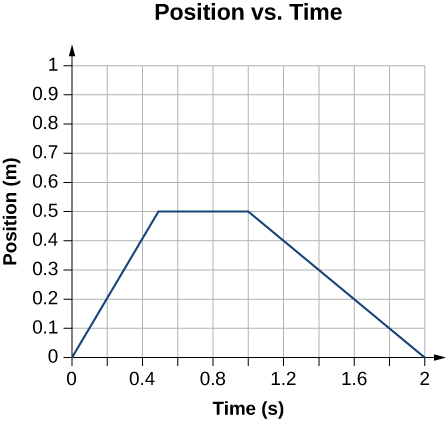
Given the position-versus-time graph of Figure 3.7, find the velocity-versus-time graph.
英語のヒント
図3.7の位置と時間のグラフから、速度と時間のグラフを求めよ。
OpenStax / Rice University, University Physics Volume 1, CC BY 4.0. Source-book artwork retained. · CC BY 4.0 · Source出典

Figure 3.7図 3.7
The object starts out in the positive direction, stops for a short time, and then reverses direction, heading back toward the origin. Notice that the object comes to rest instantaneously, which would require an infinite force. Thus, the graph is an approximation of motion in the real world. (The concept of force is discussed in Newton’s Laws of Motion.)
英語のヒント
物体は正方向へ動き出し、短時間止まった後、方向を逆にして原点へ戻る。瞬間的に停止していることに注意しよう。それには無限大の力が必要になる。したがって、このグラフは現実の運動の近似である。(力の概念は「ニュートンの運動法則」で論じる。)
Strategy方針
The graph contains three straight lines during three time intervals. We find the velocity during each time interval by taking the slope of the line using the grid.
英語のヒント
グラフは、三つの時間区間それぞれで直線となっている。目盛りを使って直線の傾きを求め、各時間区間の速度を得る。
Solution解答
Time interval 0 s to 0.5 s:
英語のヒント
0 sから0.5 sの時間区間:
Time interval 0.5 s to 1.0 s:
英語のヒント
0.5 sから1.0 sの時間区間:
Time interval 1.0 s to 2.0 s:
英語のヒント
1.0 sから2.0 sの時間区間:
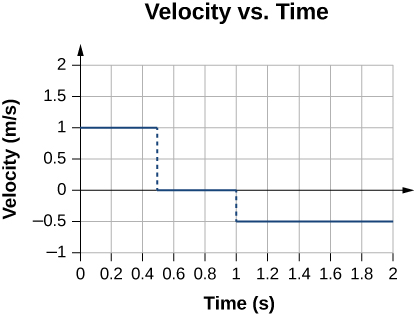
The graph of these values of velocity versus time is shown in Figure 3.8.
英語のヒント
これらの速度を時間に対して描いたグラフを図3.8に示す。
OpenStax / Rice University, University Physics Volume 1, CC BY 4.0. Source-book artwork retained. · CC BY 4.0 · Source出典

Figure 3.8図 3.8
The velocity is positive for the first part of the trip, zero when the object is stopped, and negative when the object reverses direction.
英語のヒント
速度は移動の最初の部分で正、停止中は0、方向を逆にすると負になる。
Significance意味の検討
During the time interval between 0 s and 0.5 s, the object’s position is moving away from the origin and the position-versus-time curve has a positive slope. At any point along the curve during this time interval, we can find the instantaneous velocity by taking its slope, which is +1 m/s, as shown in Figure 3.8. In the subsequent time interval, between 0.5 s and 1.0 s, the position doesn’t change and we see the slope is zero. From 1.0 s to 2.0 s, the object is moving back toward the origin and the slope is −0.5 m/s. The object has reversed direction and has a negative velocity.
英語のヒント
0 sから0.5 sの区間では、物体の位置は原点から離れており、位置と時間の曲線は正の傾きを持つ。この区間の曲線上のどの点でも、傾きを取れば瞬間速度が求まり、図3.8のように+1 m/sとなる。続く0.5 sから1.0 sの区間では、位置が変わらず、傾きは0である。1.0 sから2.0 sでは、物体は原点へ戻っており、傾きは−0.5 m/sである。物体は向きを逆にし、負の速度を持っている。