第3章直線上の運動
Getting a Feel for Acceleration加速度の感覚をつかむ
You are probably used to experiencing acceleration when you step into an elevator, or step on the gas pedal in your car. However, acceleration is happening to many other objects in our universe with which we don’t have direct contact. Table 3.2 presents the acceleration of various objects. We can see the magnitudes of the accelerations extend over many orders of magnitude.
英語のヒント
エレベーターに乗ったり、自動車のアクセルペダルを踏んだりするとき、加速度を感じる経験には慣れているだろう。しかし、直接触れることのない宇宙の多くの物体にも加速度が生じている。表3.2に、さまざまな物体の加速度を示す。加速度の大きさが非常に多くの桁にわたることが分かる。
Acceleration 加速度 |
Value (m/s2) 値(m/s2) |
|---|---|
High-speed train 高速列車 |
0.25 |
Elevator エレベーター |
2 |
Cheetah チーター |
5 |
Object in a free fall without air resistance near the surface of Earth 地表近くで空気抵抗を受けずに自由落下する物体 |
9.8 |
Space shuttle maximum during launch 打ち上げ中のスペースシャトルの最大値 |
29 |
Parachutist peak during normal opening of parachute パラシュートが通常どおり開くときの降下者の最大値 |
59 |
F16 aircraft pulling out of a dive 急降下から機首を起こすF16戦闘機 |
79 |
Explosive seat ejection from aircraft 飛行機からの火薬式座席射出 |
147 |
Sprint missile スプリントミサイル |
982 |
Fastest rocket sled peak acceleration 最速のロケットそりの最大加速度 |
1540 |
Jumping flea 跳ぶノミ |
3200 |
Baseball struck by a bat バットで打たれる野球のボール |
30,000 |
Closing jaws of a trap-jaw ant 顎を閉じるアギトアリ |
1,000,000 |
Proton in the large Hadron collider 大型ハドロン衝突型加速器内の陽子 |
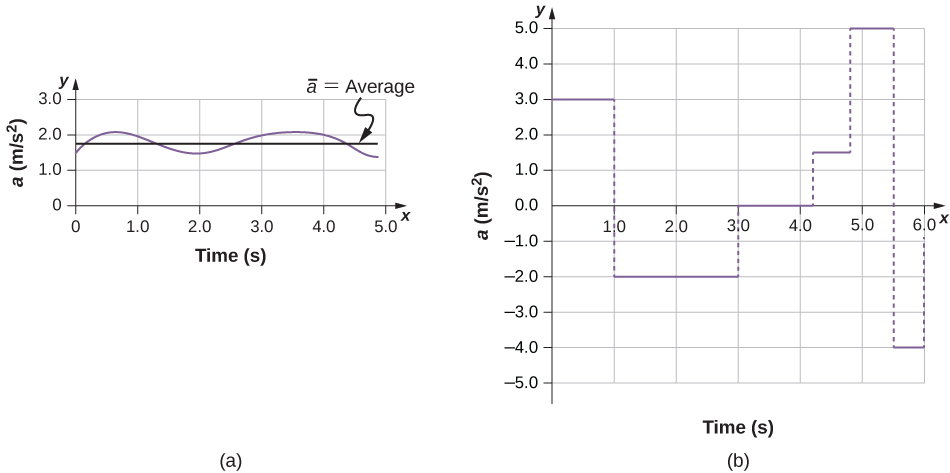
In this table, we see that typical accelerations vary widely with different objects and have nothing to do with object size or how massive it is. Acceleration can also vary widely with time during the motion of an object. A drag racer has a large acceleration just after its start, but then it tapers off as the vehicle reaches a constant velocity. Its average acceleration can be quite different from its instantaneous acceleration at a particular time during its motion. Figure 3.17 compares graphically average acceleration with instantaneous acceleration for two very different motions.
英語のヒント
この表から、代表的な加速度は物体によって大きく異なり、物体の大きさや質量とは関係がないことが分かる。加速度は、物体の運動中に時間とともに大きく変化することもある。ドラッグレースの車は発進直後には大きな加速度を持つが、一定の速度に近づくにつれて加速度は次第に小さくなる。その平均加速度は、運動中のある時刻の瞬間加速度とは大きく異なることがある。図3.17は、非常に異なる二つの運動について、平均加速度と瞬間加速度をグラフで比較している。
OpenStax / Rice University, University Physics Volume 1, CC BY 4.0. Source-book artwork retained. · CC BY 4.0 · Source出典
Figure 3.17図 3.17
Graphs of instantaneous acceleration versus time for two different one-dimensional motions. (a) Acceleration varies only slightly and is always in the same direction, since it is positive. The average over the interval is nearly the same as the acceleration at any given time. (b) Acceleration varies greatly, perhaps representing a package on a post office conveyor belt that is accelerated forward and backward as it bumps along. It is necessary to consider small time intervals (such as from 0–1.0 s) with constant or nearly constant acceleration in such a situation.
英語のヒント
異なる二つの1次元運動について、瞬間加速度と時間の関係を示したグラフ。(a)加速度の変動は小さく、正なので常に同じ向きである。区間内の平均値は、任意の時刻の加速度とほぼ等しい。(b)加速度は大きく変動する。例えば、郵便局のベルトコンベヤー上の荷物が、がたがたと運ばれながら前後に加速される場合に相当する。このような状況では、加速度が一定、またはほぼ一定とみなせる短い時間区間(例えば0〜1.0 s)を考える必要がある。
Additional Resources追加教材
Summaryまとめ
- Acceleration is the rate at which velocity changes. The SI unit for acceleration is meters per second squared.
英語のヒント
加速度は速度の変化率である。加速度のSI単位はメートル毎秒毎秒である。 - Acceleration is a vector. It has both magnitude and direction and so can be the rate of change of the magnitude or direction of the velocity, or both.
英語のヒント
加速度はベクトルである。大きさと向きを持ち、速度の大きさ、向き、またはその両方の変化率となる。 - Instantaneous acceleration a(t) is a continuous function of time and gives the acceleration at any specific time during the motion. It is calculated from the derivative of the velocity function. Instantaneous acceleration is the slope of the velocity-versus-time graph.
英語のヒント
瞬間加速度a(t)は時間の連続関数であり、運動中の任意の時刻における加速度を与える。これは速度関数の導関数から計算される。瞬間加速度は、速度と時間のグラフの傾きである。 - Negative acceleration (sometimes called deceleration) is acceleration in the negative direction in the chosen coordinate system.
英語のヒント
負の加速度(減速と呼ばれることもある)は、選んだ座標系の負方向の加速度である。
Conceptual Questions概念を確かめる問題
Exercises 24–28練習問題 24–28
Exercise 24問題 24
Is it possible for speed to be constant while acceleration is not zero?
英語のヒント
速さが一定なのに加速度が0ではないことはありうるか。
Solution解き方
No, in one dimension constant speed requires zero acceleration.
英語のヒント
ない。1次元では、速さが一定であるためには加速度が0でなければならない。
Exercise 25問題 25
Is it possible for velocity to be constant while acceleration is not zero? Explain.
英語のヒント
速度が一定なのに加速度が0ではないことはありうるか。説明せよ。
Exercise 26問題 26
Give an example in which velocity is zero yet acceleration is not.
英語のヒント
速度が0なのに加速度が0ではない例を挙げよ。
Solution解き方
A ball is thrown into the air and its velocity is zero at the apex of the throw, but acceleration is not zero.
英語のヒント
空中へ投げたボールは、軌道の頂点で速度が0になるが、加速度は0ではない。
Exercise 27問題 27
If a subway train is moving to the left (has a negative velocity) and then comes to a stop, what is the direction of its acceleration? Is the acceleration positive or negative?
英語のヒント
地下鉄の列車が左へ動き(負の速度を持ち)、その後停止する場合、加速度はどの向きか。加速度は正か負か。
Exercise 28問題 28
Plus and minus signs are used in one-dimensional motion to indicate direction. What is the sign of an acceleration that reduces the magnitude of a negative velocity? Of a positive velocity?
英語のヒント
1次元運動では、正負の符号で向きを示す。負の速度の大きさを減らす加速度の符号は何か。正の速度の場合はどうか。
Solution解き方
Plus, minus
英語のヒント
正、負。
Exercises 29–34練習問題 29–34
Exercise 29問題 29
A cheetah can accelerate from rest to a speed of 30.0 m/s in 7.00 s. What is its acceleration?
英語のヒント
チーターは7.00 sで静止状態から30.0 m/sまで加速できる。その加速度はいくらか。
Solution解き方
Exercise 30問題 30
Dr. John Paul Stapp was a U.S. Air Force officer who studied the effects of extreme acceleration on the human body. On December 10, 1954, Stapp rode a rocket sled, accelerating from rest to a top speed of 282 m/s (1015 km/h) in 5.00 s and was brought jarringly back to rest in only 1.40 s. Calculate his (a) acceleration in his direction of motion and (b) acceleration opposite to his direction of motion. Express each in multiples of g (9.80 m/s2) by taking its ratio to the acceleration of gravity.
英語のヒント
ジョン・ポール・スタップ博士は米国空軍の将校で、極端な加速度が人体へ及ぼす影響を研究した。1954年12月10日、スタップはロケットそりに乗り、5.00 sで静止状態から最高速度282 m/s(1015 km/h)まで加速し、その後わずか1.40 sで激しい衝撃とともに静止状態へ戻された。(a)運動方向の加速度と、(b)運動と逆向きの加速度を求めよ。重力加速度との比を取り、それぞれg(9.80 m/s2)の何倍かで表せ。
Exercise 31問題 31
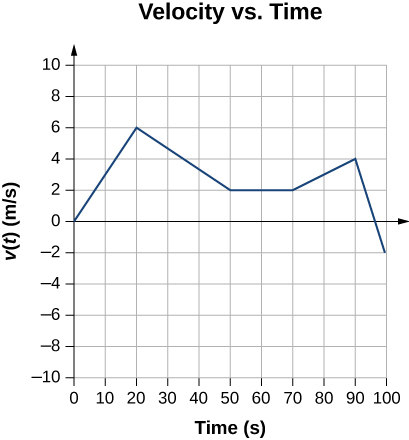
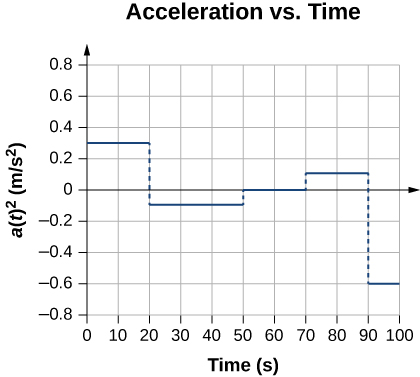
Sketch the acceleration-versus-time graph from the following velocity-versus-time graph.
英語のヒント
次の速度と時間のグラフから、加速度と時間のグラフの概形を描け。


Exercise 32問題 32
A commuter backs her car out of her garage with an acceleration of 1.40 m/s2. (a) How long does it take her to reach a speed of 2.00 m/s? (b) If she then brakes to a stop in 0.800 s, what is her acceleration?
英語のヒント
通勤する人が、車庫から自動車を1.40 m/s2の加速度で後退させる。(a)速さ2.00 m/sに達するまでにどれだけかかるか。(b)その後ブレーキをかけ、0.800 sで停止する場合、加速度はいくらか。
Exercise 33問題 33
Assume an intercontinental ballistic missile goes from rest to a suborbital speed of 6.50 km/s in 60.0 s (the actual speed and time are classified). What is its average acceleration in meters per second squared and in multiples of g (9.80 m/s2)?
英語のヒント
大陸間弾道ミサイルが、60.0 sで静止状態から弾道飛行時の速さ6.50 km/sに達するとする(実際の速さと時間は機密である)。平均加速度をm/s²と、g(9.80 m/s2)の倍数で求めよ。
Solution解き方
Exercise 34問題 34
An airplane, starting from rest, moves down the runway at constant acceleration for 18 s and then takes off at a speed of 60 m/s. What is the average acceleration of the plane?
英語のヒント
飛行機が静止状態から一定の加速度で滑走路を18 s進み、速さ60 m/sで離陸する。この飛行機の平均加速度はいくらか。
average acceleration
平均加速度
the rate of change in velocity; the change in velocity over time
英語のヒント
速度の変化率。時間に対する速度の変化。
instantaneous acceleration
瞬間加速度
acceleration at a specific point in time
英語のヒント
特定の時刻の加速度。