第3章直線上の運動
3.5 Free Fall3.5 自由落下
Learning Objectives学習目標
Learning Objectives学習目標
By the end of this section, you will be able to:
英語のヒント
この節を終えると、次のことができるようになる。
- Use the kinematic equations with the variables y and g to analyze free-fall motion.
英語のヒント
変数yとgを使う運動学の式によって、自由落下運動を分析する。 - Describe how the values of the position, velocity, and acceleration change during a free fall.
英語のヒント
自由落下の間、位置、速度、加速度の値がどう変化するかを述べる。 - Solve for the position, velocity, and acceleration as functions of time when an object is in a free fall.
英語のヒント
物体が自由落下するとき、位置、速度、加速度を時間の関数として求める。
An interesting application of Equation 3.4 through Equation 3.14 is called free fall, which describes the motion of an object falling in a gravitational field, such as near the surface of Earth or other celestial objects of planetary size. Let’s assume the body is falling in a straight line perpendicular to the surface, so its motion is one-dimensional. For example, we can estimate the depth of a vertical mine shaft by dropping a rock into it and listening for the rock to hit the bottom. But “falling,” in the context of free fall, does not necessarily imply the body is moving from a greater height to a lesser height. If a ball is thrown upward, the equations of free fall apply equally to its ascent as well as its descent.
英語のヒント
Gravity重力
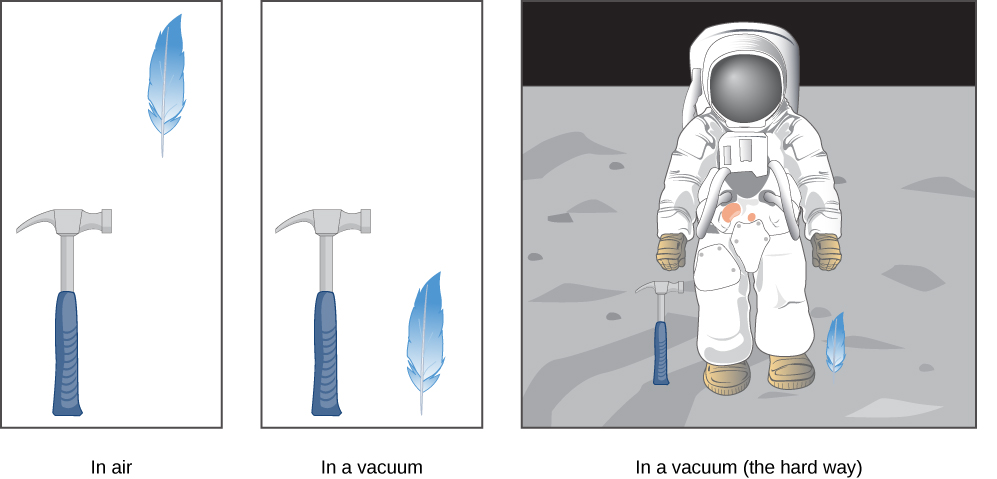
The most remarkable and unexpected fact about falling objects is that if air resistance and friction are negligible, then in a given location all objects fall toward the center of Earth with the same constant acceleration, independent of their mass. This experimentally determined fact is unexpected because we are so accustomed to the effects of air resistance and friction that we expect light objects to fall slower than heavy ones. Until Galileo Galilei (1564–1642) proved otherwise, people believed that a heavier object has a greater acceleration in a free fall. We now know this is not the case. In the absence of air resistance, heavy objects arrive at the ground at the same time as lighter objects when dropped from the same height Figure 3.26.
英語のヒント
落下する物体について最も注目すべき意外な事実は、空気抵抗と摩擦が無視できれば、同じ場所では質量に関係なく、すべての物体が同じ一定の加速度で地球の中心へ向かって落ちることである。この実験で確かめられた事実が意外なのは、私たちが空気抵抗や摩擦の影響に慣れすぎていて、軽い物体は重い物体よりゆっくり落ちると予想するためである。ガリレオ・ガリレイ(1564〜1642年)がそうではないと証明するまで、人々は、自由落下では重い物体ほど加速度が大きいと信じていた。今では、そうではないと分かっている。空気抵抗がなければ、同じ高さから落とした重い物体と軽い物体は、同時に地面へ達する(図3.26)。
OpenStax / Rice University, University Physics Volume 1, CC BY 4.0. Source-book artwork retained. · CC BY 4.0 · Source出典

Figure 3.26図 3.26
A hammer and a feather fall with the same constant acceleration if air resistance is negligible. This is a general characteristic of gravity not unique to Earth, as astronaut David R. Scott demonstrated in 1971 on the Moon, where the acceleration from gravity is only 1.67 m/s2 and there is no atmosphere.
英語のヒント
空気抵抗が無視できれば、ハンマーと羽根は同じ一定の加速度で落下する。これは地球に固有ではない、重力の一般的な性質である。宇宙飛行士デイヴィッド・R・スコットは1971年、大気がなく、重力による加速度がわずか1.67 m/s2の月面で、このことを実演した。
In the real world, air resistance can cause a lighter object to fall slower than a heavier object of the same size. A tennis ball reaches the ground after a baseball dropped at the same time. (It might be difficult to observe the difference if the height is not large.) Air resistance opposes the motion of an object through the air, and friction between objects—such as between clothes and a laundry chute or between a stone and a pool into which it is dropped—also opposes motion between them.
英語のヒント
現実には、空気抵抗によって、同じ大きさの重い物体より軽い物体がゆっくり落ちることがある。同時に落としたテニスボールは、野球のボールより後に地面へ達する。(高さがあまりなければ、違いを観察するのは難しいかもしれない。)空気抵抗は空気中を進む物体の運動を妨げる。また、衣服と洗濯物用の投入口、あるいは石とその落ちるプールなどの物体間の摩擦も、互いの運動を妨げる。
For the ideal situations of these first few chapters, an object falling without air resistance or friction is defined to be in free fall. The force of gravity causes objects to fall toward the center of Earth. The acceleration of free-falling objects is therefore called acceleration due to gravity. Acceleration due to gravity is constant, which means we can apply the kinematic equations to any falling object where air resistance and friction are negligible. This opens to us a broad class of interesting situations.
英語のヒント
初めの数章で扱う理想的な状況では、空気抵抗や摩擦を受けずに落ちる物体を、自由落下していると定義する。重力は物体を地球の中心へ向かって落下させる。そのため、自由落下する物体の加速度を重力加速度と呼ぶ。重力加速度は一定なので、空気抵抗と摩擦が無視できる落下物体には、運動学の式を適用できる。これにより、広い範囲の興味深い状況を扱える。
Acceleration due to gravity is so important that its magnitude is given its own symbol, g. It is constant at any given location on Earth and has the average value
英語のヒント
重力加速度はとても重要なので、その大きさに専用の記号gを与える。地球上の同じ場所では一定で、その平均値は次のとおりである。
Although g varies from 9.78 m/s2 to 9.83 m/s2, depending on latitude, altitude, underlying geological formations, and local topography, let’s use an average value of 9.8 m/s2 rounded to two significant figures in this text unless specified otherwise. Neglecting these effects on the value of g as a result of position on Earth’s surface, as well as effects resulting from Earth’s rotation, we take the direction of acceleration due to gravity to be downward (toward the center of Earth). In fact, its direction defines what we call vertical. Note that whether acceleration a in the kinematic equations has the value +g or −g depends on how we define our coordinate system. If we define the upward direction as positive, then and if we define the downward direction as positive, then .
英語のヒント
gは、緯度、高度、地下の地質構造、その場所の地形によって9.78 m/s2から9.83 m/s2まで変わる。本書では特に指定しない限り、有効数字2桁に丸めた平均値9.8 m/s2を使おう。地表の位置によるgの値への影響と、地球の自転による影響を無視し、重力加速度の向きは下向き、すなわち地球の中心へ向かう向きとする。実際、この向きによって鉛直方向が定義される。運動学の式の加速度aが+gか−gかは、座標系の定め方に依存することに注意しよう。上向きを正とすればであり、下向きを正とすればとなる。