第3章直線上の運動
Conceptual Questions概念を確かめる問題
Exercises 35–36練習問題 35–36
Exercise 35問題 35
When analyzing the motion of a single object, what is the required number of known physical variables that are needed to solve for the unknown quantities using the kinematic equations?
英語のヒント
一つの物体の運動を分析するとき、運動学の式を使って未知量を求めるには、既知の物理変数がいくつ必要か。
Exercise 36問題 36
State two scenarios of the kinematics of single object where three known quantities require two kinematic equations to solve for the unknowns.
英語のヒント
一つの物体の運動学で、三つの既知量から未知量を求めるために二つの運動学の式が必要になる状況を、二つ述べよ。
Solution解き方
If the acceleration, time, and displacement are the knowns, and the initial and final velocities are the unknowns, then two kinematic equations must be solved simultaneously. Also if the final velocity, time, and displacement are the knowns then two kinematic equations must be solved for the initial velocity and acceleration.
英語のヒント
加速度、時間、変位が既知量で、初速度と最終速度が未知量なら、二つの運動学の式を連立して解かなければならない。また、最終速度、時間、変位が既知量の場合も、初速度と加速度を求めるには二つの運動学の式を解かなければならない。
Problems問題
Exercises 37–59練習問題 37–59
Exercise 37問題 37
A particle moves in a straight line at a constant velocity of 30 m/s. What is its displacement between t = 0 and t = 5.0 s?
英語のヒント
粒子が直線上を一定の速度30 m/sで動く。t = 0からt = 5.0 sまでの変位はいくらか。
Solution解き方
150 m
Exercise 38問題 38
A particle moves in a straight line with an initial velocity of 0 m/s and a constant acceleration of 30 m/s2. If , what is the particle’s position at t = 5 s?
英語のヒント
粒子が初速度0 m/s、一定の加速度30 m/s2で直線上を動く。である場合、t = 5 sでの粒子の位置はいくらか。
Exercise 39問題 39
A particle moves in a straight line with an initial velocity of 30 m/s and constant acceleration 30 m/s2. (a) What is its displacement at t = 5 s? (b) What is its velocity at this same time?
英語のヒント
粒子が初速度30 m/s、一定の加速度30 m/s2で直線上を動く。(a)t = 5 sでの変位はいくらか。(b)同じ時刻の速度はいくらか。
Solution解き方
a. 525 m;
b.
b.
(a)525 m。(b)。
Exercise 40問題 40
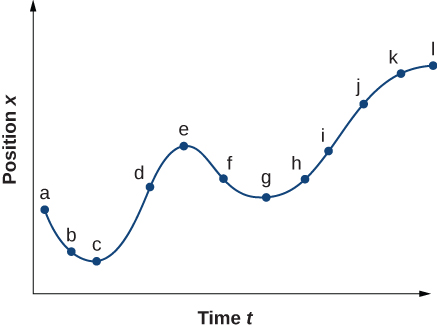
(a) Sketch a graph of velocity versus time corresponding to the graph of displacement versus time given in the following figure. (b) Identify the time or times (ta, tb, tc, etc.) at which the instantaneous velocity has the greatest positive value. (c) At which times is it zero? (d) At which times is it negative?
英語のヒント
(a)次の図の変位と時間のグラフに対応する、速度と時間のグラフの概形を描け。(b)瞬間速度が最大の正の値を取る時刻(ta、tb、tcなど)をすべて求めよ。(c)どの時刻に0になるか。(d)どの時刻に負になるか。
Exercise 41問題 41
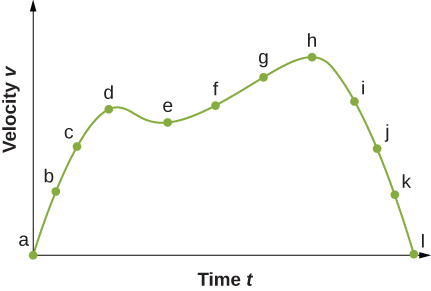
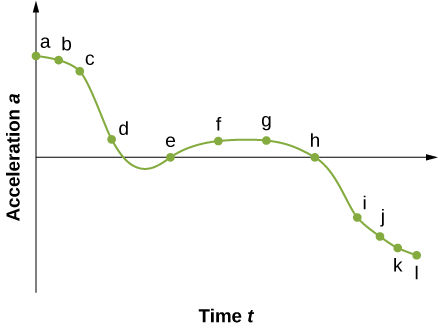
(a) Sketch a graph of acceleration versus time corresponding to the graph of velocity versus time given in the following figure. (b) Identify the time or times (ta, tb, tc, etc.) at which the acceleration has the greatest positive value. (c) At which times is it zero? (d) At which times is it negative?
英語のヒント
(a)次の図の速度と時間のグラフに対応する、加速度と時間のグラフの概形を描け。(b)加速度が最大の正の値を取る時刻(ta、tb、tcなど)をすべて求めよ。(c)どの時刻に0になるか。(d)どの時刻に負になるか。
Solution解き方
Exercise 42問題 42
A particle has a constant acceleration of 6.0 m/s2. (a) If its initial velocity is 2.0 m/s, at what time is its displacement 5.0 m? (b) What is its velocity at that time?
英語のヒント
粒子の加速度は一定で6.0 m/s2である。(a)初速度が2.0 m/sなら、どの時刻に変位が5.0 mとなるか。(b)その時刻の速度はいくらか。
Exercise 43問題 43
At t = 10 s, a particle is moving from left to right with a speed of 5.0 m/s. At t = 20 s, the particle is moving right to left with a speed of 8.0 m/s. Assuming the particle’s acceleration is constant, determine (a) its acceleration, (b) its initial velocity, and (c) the instant when its velocity is zero.
英語のヒント
t = 10 sで、粒子は左から右へ速さ5.0 m/sで動いている。t = 20 sでは、右から左へ速さ8.0 m/sで動いている。粒子の加速度が一定と仮定し、(a)加速度、(b)初速度、(c)速度が0となる瞬間を求めよ。
Solution解き方
a. ;
b. ;
c.
b. ;
c.
(a)。(b)。(c)。
Exercise 44問題 44
A well-thrown ball is caught in a well-padded mitt. If the acceleration of the ball is, and 1.85 ms elapses from the time the ball first touches the mitt until it stops, what is the initial velocity of the ball?
英語のヒント
しっかり投げられたボールを、十分にクッションの入ったミットで捕球する。ボールの加速度がで、初めてミットへ触れてから停止するまでに1.85 msかかる場合、ボールの初速度はいくらか。
Exercise 45問題 45
A bullet in a gun is accelerated from the firing chamber to the end of the barrel at an average rate of for . What is its muzzle velocity (that is, its final velocity)?
英語のヒント
銃の弾丸が、薬室から銃身の端まで、の間、平均の加速度で加速される。銃口速度、すなわち最終速度はいくらか。
Solution解き方
Exercise 46問題 46
(a) A light-rail commuter train accelerates at a rate of 1.35 m/s2. How long does it take to reach its top speed of 80.0 km/h, starting from rest? (b) The same train ordinarily accelerates opposite to the motion at a rate of 1.65 m/s2. How long does it take to come to a stop from its top speed? (c) In emergencies, the train can accelerate opposite to the motion more rapidly, coming to rest from 80.0 km/h in 8.30 s. What is its emergency acceleration in meters per second squared?
英語のヒント
(a)路面電車型の通勤列車が1.35 m/s2で加速する。静止状態から最高速度80.0 km/hに達するまでにどれだけかかるか。(b)この列車は通常、運動と逆向きに1.65 m/s2で加速する。最高速度から停止するまでにどれだけかかるか。(c)緊急時には、運動と逆向きにさらに急激に加速し、80.0 km/hから8.30 sで停止できる。この緊急時の加速度をm/s²で求めよ。
Exercise 47問題 47
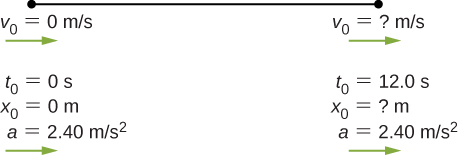
While entering a freeway, a car accelerates from rest at a rate of 2.40 m/s2 for 12.0 s. (a) Draw a sketch of the situation. (b) List the knowns in this problem. (c) How far does the car travel in those 12.0 s? To solve this part, first identify the unknown, then indicate how you chose the appropriate equation to solve for it. After choosing the equation, show your steps in solving for the unknown, check your units, and discuss whether the answer is reasonable. (d) What is the car’s final velocity? Solve for this unknown in the same manner as in (c), showing all steps explicitly.
英語のヒント
高速道路へ入る自動車が、静止状態から2.40 m/s2で12.0 s加速する。(a)状況の略図を描け。(b)この問題の既知量を列挙せよ。(c)この12.0 sでどれだけ進むか。まず未知量を確認し、それを求めるのに適した式をどのように選んだかを述べよ。式を選んだ後、未知量を求める手順を示し、単位を確認し、答えが合理的かを論じよ。(d)自動車の最終速度はいくらか。(c)と同じ方法を使い、すべての手順を明示して求めよ。
Exercise 48問題 48
Unreasonable results At the end of a race, a runner accelerates opposite to the motion from a velocity of 9.00 m/s at a rate of 2.00 m/s2. (a) How far does she travel in the next 5.00 s? (b) What is her final velocity? (c) Evaluate the result. Does it make sense?
英語のヒント
不合理な結果。レースの終わりに、走者が速度9.00 m/sから、運動と逆向きに2.00 m/s2で加速する。(a)続く5.00 sでどれだけ進むか。(b)最終速度はいくらか。(c)結果を評価せよ。筋の通った結果になっているか。
Exercise 49問題 49
Blood is accelerated from rest to 30.0 cm/s in a distance of 1.80 cm by the left ventricle of the heart. (a) Make a sketch of the situation. (b) List the knowns in this problem. (c) How long does the acceleration take? To solve this part, first identify the unknown, then discuss how you chose the appropriate equation to solve for it. After choosing the equation, show your steps in solving for the unknown, checking your units. (d) Is the answer reasonable when compared with the time for a heartbeat?
英語のヒント
心臓の左心室が、1.80 cmの距離で血液を静止状態から30.0 cm/sまで加速する。(a)状況の略図を描け。(b)この問題の既知量を列挙せよ。(c)加速にはどれだけの時間がかかるか。まず未知量を確認し、それを求めるのに適した式をどのように選んだかを論じよ。式を選んだ後、単位を確認しながら未知量を求める手順を示せ。(d)心拍の時間と比べて、答えは合理的か。
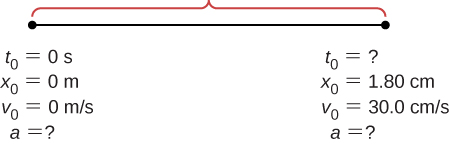


Exercise 50問題 50
During a slap shot, a hockey player accelerates the puck from a velocity of 8.00 m/s to 40.0 m/s in the same direction. If this shot takes , what is the distance over which the puck accelerates?
英語のヒント
ホッケー選手がスラップショットで、パックを速度8.00 m/sから同じ向きの40.0 m/sまで加速する。ショットにかかるなら、パックはどれだけの距離にわたって加速されるか。
Exercise 51問題 51
A powerful motorcycle can accelerate from rest to 26.8 m/s (100 km/h) in only 3.90 s. (a) What is its average acceleration? (b) Assuming constant acceleration, how far does it travel in that time?
英語のヒント
高性能のオートバイは、静止状態から26.8 m/s(100 km/h)まで、わずか3.90 sで加速できる。(a)平均加速度はいくらか。(b)加速度が一定と仮定すると、この間にどれだけ進むか。
Solution解き方
a. 6.87 m/s2; b.
(a)6.87 m/s2。(b)。
Exercise 52問題 52
Freight trains can produce only relatively small accelerations. (a) What is the final velocity of a freight train that accelerates at a rate of for 8.00 min, starting with an initial velocity of 4.00 m/s? (b) If the train can slow down at a rate of , how long will it take to come to a stop from this velocity? (c) How far will it travel in each case?
英語のヒント
貨物列車が出せる加速度は比較的小さい。(a)初速度4.00 m/sから、で8.00 min加速する貨物列車の最終速度はいくらか。(b)で減速できる場合、この速度から停止するまでにどれだけかかるか。(c)それぞれの場合、どれだけ進むか。
Exercise 53問題 53
A fireworks shell is accelerated from rest to a velocity of 65.0 m/s over a distance of 0.250 m. (a) Calculate the acceleration. (b) How long did the acceleration last?
英語のヒント
打ち上げ花火の玉が、0.250 mの距離で静止状態から速度65.0 m/sまで加速される。(a)加速度を計算せよ。(b)加速はどれだけ続いたか。
Solution解き方
a. ;
b.
b.
(a)。(b)。
Exercise 54問題 54
A swan on a lake gets airborne by flapping its wings and running on top of the water. (a) If the swan must reach a velocity of 6.00 m/s to take off and it accelerates from rest at an average rate of , how far will it travel before becoming airborne? (b) How long does this take?
英語のヒント
湖の白鳥が、翼を羽ばたかせ、水面を走って飛び立つ。(a)離水するには速度6.00 m/sに達する必要があり、静止状態から平均で加速するとき、空中へ浮くまでにどれだけ進むか。(b)これにどれだけの時間がかかるか。
Exercise 55問題 55
A woodpecker’s brain is specially protected from large accelerations by tendon-like attachments inside the skull. While pecking on a tree, the woodpecker’s head comes to a stop from an initial velocity of 0.600 m/s in a distance of only 2.00 mm. (a) Find the acceleration in meters per second squared and in multiples of g, where g = 9.80 m/s2. (b) Calculate the stopping time. (c) The tendons cradling the brain stretch, making its stopping distance 4.50 mm (greater than the head and, hence, less acceleration of the brain). What is the brain’s acceleration, expressed in multiples of g?
英語のヒント
キツツキの脳は、頭蓋骨内の腱のような付着組織によって、大きな加速度から特別に保護されている。木をつつくとき、頭は初速度0.600 m/sから、わずか2.00 mmの距離で停止する。(a)加速度をメートル毎秒毎秒と、gの倍数で求めよ。ただしg = 9.80 m/s2である。(b)停止までの時間を計算せよ。(c)脳を支える腱が伸びるため、脳の停止距離は4.50 mmになる(頭より長いので、脳の加速度は小さくなる)。脳の加速度をgの倍数で求めよ。
Solution解き方
a.
b. ;
c.
b. ;
c.
(a) (b)。(c)。
Exercise 56問題 56
An unwary football player collides with a padded goalpost while running at a velocity of 7.50 m/s and comes to a full stop after compressing the padding and his body 0.350 m. (a) What is his acceleration? (b) How long does the collision last?
英語のヒント
不注意なアメリカンフットボール選手が、速度7.50 m/sで走っていて、保護パッド付きのゴールポストへ衝突する。パッドと自分の体が0.350 m圧縮され、完全に停止する。(a)加速度はいくらか。(b)衝突はどれだけ続くか。
Exercise 57問題 57
A care package is dropped out of a cargo plane and lands in the forest. If we assume the care package speed on impact is 54 m/s (123 mph), then what is its acceleration? Assume the trees and snow stops it over a distance of 3.0 m.
英語のヒント
貨物機から救援物資の包みが投下され、森へ落ちる。衝突時の速さを54 m/s(123 mph)とすると、加速度はいくらか。木々と雪によって3.0 mの距離で停止すると仮定せよ。
Solution解き方
Knowns: . We want a, so we can use this equation: .
英語のヒント
既知量:。求めるのはaなので、次の式を使える:。
Exercise 58問題 58
An express train passes through a station. It enters with an initial velocity of 22.0 m/s and accelerates opposite to the motion at a rate of as it goes through. The station is 210.0 m long. (a) How fast is it going when the nose leaves the station? (b) How long is the nose of the train in the station? (c) If the train is 130 m long, what is the velocity of the end of the train as it leaves? (d) When does the end of the train leave the station?
英語のヒント
急行列車が駅を通過する。初速度22.0 m/sで駅へ入り、通過中は運動と逆向きにで加速する。駅の長さは210.0 mである。(a)先頭が駅を出るときの速さはいくらか。(b)先頭が駅の中にいる時間はどれだけか。(c)列車の長さが130 mの場合、最後尾が駅を出るときの速度はいくらか。(d)最後尾が駅を出るのはいつか。
Exercise 59問題 59
Unreasonable results Dragsters can actually reach a top speed of 145.0 m/s in only 4.45 s. (a) Calculate the average acceleration for such a dragster. (b) Find the final velocity of this dragster starting from rest and accelerating at the rate found in (a) for 402.0 m (a quarter mile) without using any information on time. (c) Why is the final velocity greater than that used to find the average acceleration? (Hint: Consider whether the assumption of constant acceleration is valid for a dragster. If not, discuss whether the acceleration would be greater at the beginning or end of the run and what effect that would have on the final velocity.)
英語のヒント
不合理な結果。ドラッグレーサーは実際に、わずか4.45 sで最高速度145.0 m/sへ達することができる。(a)このような車の平均加速度を計算せよ。(b)静止状態から(a)で求めた加速度で402.0 m(4分の1マイル)加速したときの最終速度を、時間の情報を使わずに求めよ。(c)最終速度が、平均加速度を求める際に使った速度より大きいのはなぜか。(ヒント:ドラッグレーサーに対して加速度一定の仮定が妥当かを考えよ。妥当でない場合、走行の初めと終わりのどちらで加速度が大きいか、また、それが最終速度へどのように影響するかを論じよ。)
Solution解き方
a. ;
b. ;
c. , because the assumption of constant acceleration is not valid for a dragster. A dragster changes gears and would have a greater acceleration in first gear than second gear than third gear, and so on. The acceleration would be greatest at the beginning, so it would not be accelerating at during the last few meters, but substantially less, and the final velocity would be less than .
b. ;
c. , because the assumption of constant acceleration is not valid for a dragster. A dragster changes gears and would have a greater acceleration in first gear than second gear than third gear, and so on. The acceleration would be greatest at the beginning, so it would not be accelerating at during the last few meters, but substantially less, and the final velocity would be less than .
英語のヒント
(a)。(b)。(c)。ドラッグレーサーでは加速度一定の仮定が妥当ではないためである。ドラッグレーサーはギアを変え、加速度は1速が2速より大きく、2速が3速より大きい、というようになる。加速度は走行開始時に最大となるため、最後の数メートルではで加速しているのではなく、それよりかなり小さい。したがって最終速度はより小さくなる。
two-body pursuit problem
二つの物体の追跡問題
a kinematics problem in which the unknowns are calculated by solving the kinematic equations simultaneously for two moving objects
英語のヒント
二つの動く物体について、運動学の式を連立して解くことで未知量を求める運動学の問題。