第3章直線上の運動
Two-Body Pursuit Problems二つの物体の追跡問題
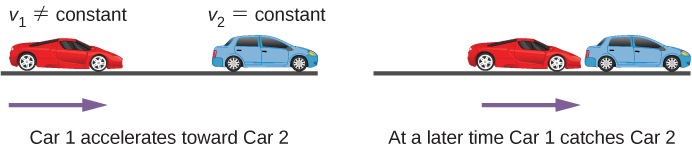
Up until this point we have looked at examples of motion involving a single body. Even for the problem with two cars and the stopping distances on wet and dry roads, we divided this problem into two separate problems to find the answers. In a two-body pursuit problem, the motions of the objects are coupled—meaning, the unknown we seek depends on the motion of both objects. To solve these problems we write the equations of motion for each object and then solve them simultaneously to find the unknown. This is illustrated in Figure 3.25.
英語のヒント
ここまでは、一つの物体の運動を扱う例を見てきた。乾いた路面と濡れた路面における2台の自動車の停止距離の問題でも、二つの独立した問題に分けて答えを求めた。二つの物体の追跡問題では、物体の運動どうしが結びついている。つまり、求める未知量が両方の物体の運動に依存する。このような問題では、それぞれの物体の運動の式を立て、それらを連立して解くことで未知量を求める。図3.25に例を示す。
OpenStax / Rice University, University Physics Volume 1, CC BY 4.0. Source-book artwork retained. · CC BY 4.0 · Source出典

Figure 3.25図 3.25
A two-body pursuit scenario where car 2 has a constant velocity and car 1 is behind with a constant acceleration. Car 1 catches up with car 2 at a later time.
英語のヒント
一定の速度で進む自動車2を、後方の自動車1が一定の加速度で追う状況。後の時刻に自動車1が自動車2へ追いつく。
The time and distance required for car 1 to catch car 2 depends on the initial distance car 1 is from car 2 as well as the velocities of both cars and the acceleration of car 1. The kinematic equations describing the motion of both cars must be solved to find these unknowns.
英語のヒント
自動車1が自動車2へ追いつくまでの時間と距離は、2台の初めの距離に加え、両車の速度と自動車1の加速度に依存する。これらの未知量を求めるには、両車の運動を記述する運動学の式を解かなければならない。
Consider the following example.
英語のヒント
次の例を考えよう。
Example 3.13例題 3.13
Cheetah Catching a Gazelleガゼルに追いつくチーター
A cheetah waits in hiding behind a bush. The cheetah spots a gazelle running past at 10 m/s. At the instant the gazelle passes the cheetah, the cheetah accelerates from rest at 4 m/s2 to catch the gazelle. (a) How long does it take the cheetah to catch the gazelle? (b) What is the displacement of the gazelle and cheetah?
英語のヒント
チーターが茂みの陰に隠れて待っている。10 m/sで走り過ぎるガゼルを見つけ、ガゼルが自分の位置を通過した瞬間に、静止状態から4 m/s2で加速して追いかける。(a)チーターがガゼルへ追いつくまでにどれだけかかるか。(b)ガゼルとチーターの変位はいくらか。
Strategy方針
We use the set of equations for constant acceleration to solve this problem. Since there are two objects in motion, we have separate equations of motion describing each animal. But what links the equations is a common parameter that has the same value for each animal. If we look at the problem closely, it is clear the common parameter to each animal is their position x at a later time t. Since they both start at , their displacements are the same at a later time t, when the cheetah catches up with the gazelle. If we pick the equation of motion that solves for the displacement for each animal, we can then set the equations equal to each other and solve for the unknown, which is time.
英語のヒント
等加速度運動の式の組を使ってこの問題を解く。動く物体が二つあるため、それぞれの動物を記述する別々の運動の式を立てる。ただし、これらの式は、両方の動物について同じ値を取る共通のパラメーターで結びつく。問題を詳しく見ると、共通のパラメーターが、後の時刻tでの位置xであると分かる。どちらもから出発するので、後の時刻tにチーターがガゼルへ追いついたとき、両者の変位は等しい。それぞれの変位を求める運動の式を選び、両者を等しいと置けば、未知量である時間を求められる。
Solution解答
- Equation for the gazelle: The gazelle has a constant velocity, which is its average velocity, since it is not accelerating. Therefore, we use Equation 3.10 with :
英語のヒント
ガゼルの式:ガゼルは加速していないため、速度は一定で、その平均速度に等しい。したがって、として式3.10を使う。Equation for the cheetah: The cheetah is accelerating from rest, so we use Equation 3.13 with and :英語のヒント
チーターの式:チーターは静止状態から加速するので、、として式3.13を使う。Now we have an equation of motion for each animal with a common parameter, which can be eliminated to find the solution. In this case, we solve for t:英語のヒント
これで、共通のパラメーターを持つ各動物の運動の式が得られた。このパラメーターを消去すれば解を求められる。この場合、tについて解く。The gazelle has a constant velocity of 10 m/s, which is its average velocity. The acceleration of the cheetah is 4 m/s2. Evaluating t, the time for the cheetah to reach the gazelle, we have英語のヒント
ガゼルの一定の速度10 m/sは、その平均速度である。チーターの加速度は4 m/s2である。チーターがガゼルへ追いつくまでの時間tを計算すると、次のようになる。 - To get the displacement, we use either the equation of motion for the cheetah or the gazelle, since they should both give the same answer.
Displacement of the cheetah:英語のヒント
変位を求めるには、チーターとガゼルのどちらの運動の式を使ってもよい。両方とも同じ答えになるはずだからである。チーターの変位は、Displacement of the gazelle:英語のヒント
ガゼルの変位は、We see that both displacements are equal, as expected.英語のヒント
予想どおり、両方の変位が等しいことが分かる。
Significance意味の検討
It is important to analyze the motion of each object and to use the appropriate kinematic equations to describe the individual motion. It is also important to have a good visual perspective of the two-body pursuit problem to see the common parameter that links the motion of both objects.
英語のヒント
それぞれの物体の運動を分析し、適切な運動学の式で個々の運動を記述することが重要である。また、追跡問題を視覚的に把握し、二つの物体の運動を結びつける共通のパラメーターを見つけることも重要である。
Summaryまとめ
- When analyzing one-dimensional motion with constant acceleration, identify the known quantities and choose the appropriate equations to solve for the unknowns. Either one or two of the kinematic equations are needed to solve for the unknowns, depending on the known and unknown quantities.
英語のヒント
1次元の等加速度運動を分析するときは、既知量を確認し、未知量を求めるのに適した式を選ぶ。既知量と未知量に応じて、一つまたは二つの運動学の式が必要になる。 - Two-body pursuit problems always require two equations to be solved simultaneously for the unknowns.
英語のヒント
二つの物体の追跡問題では、未知量を求めるために常に二つの式を連立して解く必要がある。