第3章直線上の運動
One-Dimensional Motion Involving Gravity重力が関わる1次元運動
The best way to see the basic features of motion involving gravity is to start with the simplest situations and then progress toward more complex ones. So, we start by considering straight up-and-down motion with no air resistance or friction. These assumptions mean the velocity (if there is any) is vertical. If an object is dropped, we know the initial velocity is zero when in free fall. When the object has left contact with whatever held or threw it, the object is in free fall. When the object is thrown, it has the same initial speed in free fall as it did before it was released. When the object comes in contact with the ground or any other object, it is no longer in free fall and its acceleration of g is no longer valid. Under these circumstances, the motion is one-dimensional and has constant acceleration of magnitude g. We represent vertical displacement with the symbol y.
英語のヒント
重力が関わる運動の基本的な特徴を見るには、最も簡単な状況から始め、徐々に複雑な状況へ進むのがよい。そこで、空気抵抗や摩擦のない、真っすぐな上下運動から考える。この仮定のもとでは、速度が存在するなら、その向きは鉛直である。物体を静かに落とすと、自由落下の初速度は0になる。物体が、それを支えたり投げたりしたものとの接触を離れると、自由落下に入る。投げた場合、自由落下の初めの速さは、放される直前の速さと同じである。地面やほかの物体へ触れると、もはや自由落下ではなくなり、加速度がgという条件は成り立たない。ここで考える条件では、運動は1次元で、加速度の大きさは一定のgである。鉛直方向の変位は記号yで表す。
Example 3.14例題 3.14
Free Fall of a Ballボールの自由落下
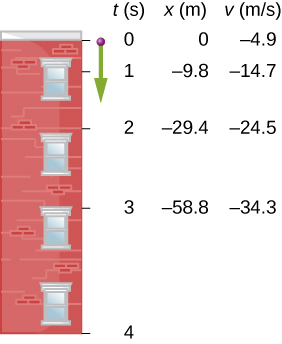
Figure 3.27 shows the positions of a ball, at 1-s intervals, with an initial velocity of 4.9 m/s downward, that is thrown from the top of a 98-m-high building. (a) How much time elapses before the ball reaches the ground? (b) What is the velocity when it arrives at the ground?
英語のヒント
図3.27は、高さ98 mの建物の屋上から初速度4.9 m/sで下向きに投げたボールの位置を、1 s間隔で示す。(a)ボールが地面へ達するまでにどれだけの時間がかかるか。(b)地面へ達したときの速度はいくらか。
OpenStax / Rice University, University Physics Volume 1, CC BY 4.0. Source-book artwork retained. · CC BY 4.0 · Source出典

Figure 3.27図 3.27
The positions and velocities at 1-s intervals of a ball thrown downward from a tall building at 4.9 m/s.
英語のヒント
高い建物から下向きに4.9 m/sで投げたボールの、1 s間隔の位置と速度。
Strategy方針
Choose the origin at the top of the building with the positive direction upward and the negative direction downward. To find the time when the position is −98 m, we use Equation 3.16, with .
英語のヒント
建物の屋上を原点とし、上向きを正、下向きを負とする。位置が−98 mとなる時刻を求めるため、として式3.16を使う。
Solution解答
- Substitute the given values into the equation:
英語のヒント
与えられた値を式へ代入する。This simplifies to英語のヒント
これを簡単にすると、This is a quadratic equation with roots . The positive root is the one we are interested in, since time is the time when the ball is released at the top of the building. (The time represents the fact that a ball thrown upward from the ground would have been in the air for 5.0 s when it passed by the top of the building moving downward at 4.9 m/s.)英語のヒント
これは2次方程式で、根はである。時刻は屋上でボールを放した時刻なので、ここで求めるのは正の根である。(時刻は、地面から上向きに投げたボールが、5.0 s後に下向き4.9 m/sで建物の屋上を通過することに対応する。) -
Significance意味の検討
For situations when two roots are obtained from a quadratic equation in the time variable, we must look at the physical significance of both roots to determine which is correct. Since corresponds to the time when the ball was released, the negative root would correspond to a time before the ball was released, which is not physically meaningful. When the ball hits the ground, its velocity is not immediately zero, but as soon as the ball interacts with the ground, its acceleration is not g and it accelerates with a different value over a short time to zero velocity. This problem shows how important it is to establish the correct coordinate system and to keep the signs of g in the kinematic equations consistent.
英語のヒント
時間を変数とする2次方程式から二つの根を得た場合、どちらが正しいかを決めるには、両方の根の物理的な意味を考えなければならない。はボールを放した時刻なので、負の根は放す前の時刻に対応し、この問題では物理的な意味を持たない。ボールが地面へ当たったとき、速度は瞬時に0になるわけではない。地面と相互作用し始めた時点で加速度はgではなくなり、短時間、別の加速度を受けて速度0へ達する。この問題は、適切な座標系を設定し、運動学の式におけるgの符号を一貫させることの重要性を示す。
Example 3.15例題 3.15
Vertical Motion of a Baseball野球のボールの鉛直運動
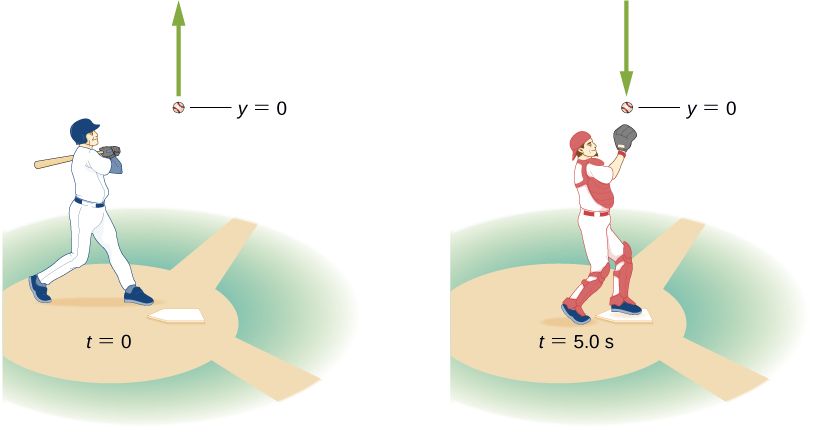
A batter hits a baseball straight upward at home plate and the ball is caught 5.0 s after it is struck (Figure 3.28). (a) What is the initial velocity of the ball? (b) What is the maximum height the ball reaches? (c) How long does it take to reach the maximum height? (d) What is the acceleration at the top of its path? (e) What is the velocity of the ball when it is caught? Assume the ball is hit and caught at the same location.
英語のヒント
打者がホームベースでボールを真上へ打ち上げ、打った5.0 s後に捕球される(図3.28)。(a)ボールの初速度はいくらか。(b)到達する最高点の高さはいくらか。(c)最高点へ達するまでにどれだけかかるか。(d)軌道の頂点での加速度はいくらか。(e)捕球時の速度はいくらか。打つ位置と捕る位置は同じとする。
OpenStax / Rice University, University Physics Volume 1, CC BY 4.0. Source-book artwork retained. · CC BY 4.0 · Source出典

Figure 3.28図 3.28
A baseball hit straight up is caught by the catcher 5.0 s later.
英語のヒント
真上へ打ち上げられた野球のボールを、捕手が5.0 s後に捕る。
Strategy方針
Choose a coordinate system with a positive y-axis that is straight up and with an origin that is at the spot where the ball is hit and caught.
英語のヒント
y軸の正方向を真上に取り、ボールを打って捕る位置を原点とする座標系を選ぶ。
Solution解答
-
which gives .
英語のヒント
これよりを得る。 -
or
英語のヒント
すなわち、 -
This gives . Since the ball rises for 2.5 s, the time to fall is 2.5 s.
英語のヒント
これよりを得る。上昇に2.5 sかかるので、下降にも2.5 sかかる。 - The acceleration is 9.8 m/s2 everywhere, even when the velocity is zero at the top of the path. Although the velocity is zero at the top, it is changing at the rate of 9.8 m/s2 downward.
英語のヒント
加速度はどこでも9.8 m/s2であり、軌道の頂点で速度が0のときも変わらない。頂点での速度は0だが、下向きに9.8 m/s2の割合で変化している。 -
Significance意味の検討
The ball returns with the speed it had when it left. This is a general property of free fall for any initial velocity. We used a single equation to go from throw to catch, and did not have to break the motion into two segments, upward and downward. We are used to thinking that the effect of gravity is to create free fall downward toward Earth. It is important to understand, as illustrated in this example, that objects moving upward away from Earth are also in a state of free fall.
英語のヒント
ボールは出発時と同じ速さで戻る。これは、どのような初速度に対しても成り立つ自由落下の一般的な性質である。投げてから捕るまでを一つの式で扱い、運動を上昇と下降の二つに分ける必要はなかった。私たちは重力の効果を、地球へ向かう下向きの自由落下を生じさせることだと考えがちである。しかしこの例が示すように、地球から離れる上向きの運動をする物体も自由落下の状態にあることを理解するのが重要である。
Example 3.16例題 3.16
Rocket Boosterロケットのブースター
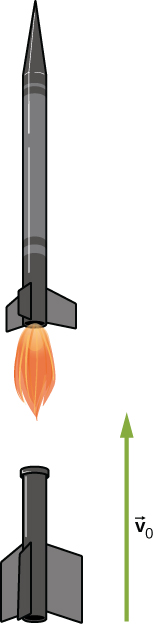
A small rocket with a booster blasts off and heads straight upward. When at a height of and velocity of 200.0 m/s, it releases its booster. (a) What is the maximum height the booster attains? (b) What is the velocity of the booster at a height of 6.0 km? Neglect air resistance.
英語のヒント
ブースター付きの小型ロケットが打ち上がり、真上へ進む。高さ、速度200.0 m/sに達したところで、ブースターを切り離す。(a)ブースターが到達する最高点の高さはいくらか。(b)高さ6.0 kmでのブースターの速度はいくらか。空気抵抗は無視せよ。
OpenStax / Rice University, University Physics Volume 1, CC BY 4.0. Source-book artwork retained. · CC BY 4.0 · Source出典

Figure 3.29図 3.29
A rocket releases its booster at a given height and velocity. How high and how fast does the booster go?
英語のヒント
ロケットが、ある高さと速度でブースターを切り離す。ブースターはどこまで高く、どれほど速く進むか。
Strategy方針
We need to select the coordinate system for the acceleration of gravity, which we take as negative downward. We are given the initial velocity of the booster and its height. We consider the point of release as the origin. We know the velocity is zero at the maximum position within the acceleration interval; thus, the velocity of the booster is zero at its maximum height, so we can use this information as well. From these observations, we use Equation 3.17, which gives us the maximum height of the booster. We also use Equation 3.17 to give the velocity at 6.0 km. The initial velocity of the booster is 200.0 m/s.
英語のヒント
Solution解答
-
This solution gives the maximum height of the booster in our coordinate system, which has its origin at the point of release, so the maximum height of the booster is roughly 7.0 km.
英語のヒント
この解は、切り離した位置を原点とする座標系でのブースターの最高点を示す。したがって、ブースターの最高到達高度は約7.0 kmである。 - An altitude of 6.0 km corresponds to in the coordinate system we are using. The other initial conditions are.
We have, from Equation 3.17,英語のヒント
高度6.0 kmは、この座標系ではに対応する。ほかの初期条件はである。式3.17から、
Significance意味の検討
We have both a positive and negative solution in (b). Since our coordinate system has the positive direction upward, the +142.8 m/s corresponds to a positive upward velocity at 6000 m during the upward leg of the trajectory of the booster. The value v = −142.8 m/s corresponds to the velocity at 6000 m on the downward leg. This example is also important in that an object is given an initial velocity at the origin of our coordinate system, but the origin is at an altitude above the surface of Earth, which must be taken into account when forming the solution.
英語のヒント
(b)では正と負の両方の解が得られる。この座標系は上向きが正なので、+142.8 m/sは、ブースターの軌道の上昇部分で高さ6000 mを通るときの上向きの速度に対応する。v = −142.8 m/sは、下降部分で高さ6000 mを通るときの速度に対応する。この例では、物体が座標系の原点で初速度を与えられる一方、その原点自体が地表より高い場所にある。この点を解答に考慮しなければならないという意味でも重要である。