第5章ニュートンの運動法則
Development of the Force Concept力の概念の発展
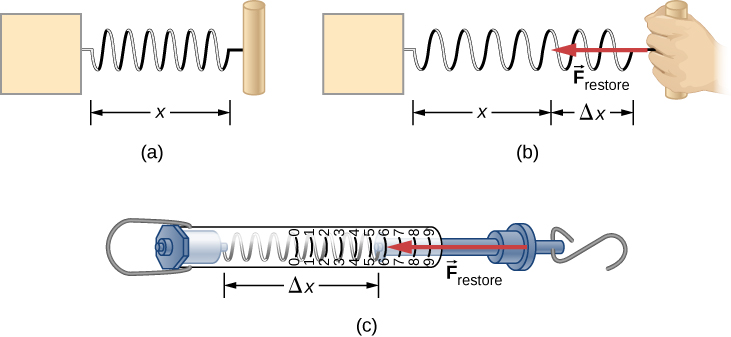
A quantitative definition of force can be based on some standard force, just as distance is measured in units relative to a standard length. One possibility is to stretch a spring a certain fixed distance (Figure 5.5) and use the force it exerts to pull itself back to its relaxed shape—called a restoring force—as a standard. The magnitude of all other forces can be considered as multiples of this standard unit of force. Many other possibilities exist for standard forces. Some alternative definitions of force will be given later in this chapter.
英語のヒント
距離を標準の長さに対する単位で測るのと同じように、力も標準となる力に基づいて定量的に定義できる。例えば、ばねを一定の長さだけ伸ばし(図5.5)、元の形に戻ろうとするときに及ぼす力、すなわち復元力を標準として使う方法がある。ほかのあらゆる力の大きさは、この標準的な力の単位の何倍かとして表せる。標準の力には、ほかにも多くの選択肢がある。この章の後半では、力の別の定義をいくつか示す。
OpenStax / Rice University, University Physics Volume 1, CC BY 4.0. Source-book artwork retained. · CC BY 4.0 · Source出典

Figure 5.5図 5.5
The force exerted by a stretched spring can be used as a standard unit of force. (a) This spring has a length x when undistorted. (b) When stretched a distance , the spring exerts a restoring force which is reproducible. (c) A spring scale is one device that uses a spring to measure force. The force is exerted on whatever is attached to the hook. Here, this force has a magnitude of six units of the force standard being employed.
英語のヒント
伸ばしたばねが及ぼす力は、力の標準単位として使える。(a) このばねは、変形していないときの長さがxである。(b) 距離だけ伸ばすと、ばねは再現可能な復元力を及ぼす。(c) ばねばかりは、ばねを使って力を測る装置の一つである。フックにつないだものには、何であっても力が作用する。ここでは、この力の大きさは、採用した力の標準単位の6倍である。
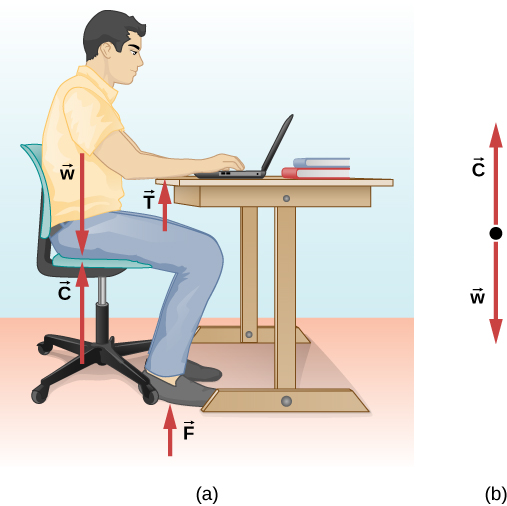
Let’s analyze force more deeply. Suppose a physics student sits at a table, working diligently on his homework (Figure 5.6). What external forces act on him? Can we determine the origin of these forces?
英語のヒント
力をもう少し深く解析しよう。物理学を学ぶ学生が机に向かって座り、熱心に宿題に取り組んでいるとする(図5.6)。この学生には、どのような外力が働くか。それらの力の発生源を特定できるか。
OpenStax / Rice University, University Physics Volume 1, CC BY 4.0. Source-book artwork retained. · CC BY 4.0 · Source出典

Figure 5.6図 5.6
(a) The forces acting on the student are due to the chair, the table, the floor, and Earth’s gravitational attraction. (b) In solving a problem involving the student, we may want to consider only the forces acting along the line running through his torso. A free-body diagram for this situation is shown.
英語のヒント
(a) 学生に働く力は、椅子、机、床、および地球の重力によるものである。(b) 学生に関する問題を解く際には、胴体を通る線に沿って働く力だけを考えたい場合がある。その場合の力の図を示す。
In most situations, forces are grouped into two categories: contact forces and field forces. As you might guess, contact forces are due to direct physical contact between objects. For example, the student in Figure 5.6 experiences the contact forces , , and , which are exerted by the chair on his posterior, the floor on his feet, and the table on his forearms, respectively. Field forces, however, act without the necessity of physical contact between objects. They depend on the presence of a “field” in the region of space surrounding the body under consideration. Since the student is in Earth’s gravitational field, he feels a gravitational force ; in other words, he has weight.
英語のヒント
ほとんどの場合、力は接触力と場の力の二つに分けられる。想像できるように、接触力は物体どうしの直接の接触によって生じる。例えば、図5.6の学生には、接触力、、が働く。これらは、それぞれ椅子が尻に、床が足に、机が前腕に及ぼす力である。これに対し、場の力は物体どうしが接触しなくても働く。対象の物体の周囲の空間に存在する「場」による力である。この学生は地球の重力場の中にいるので、重力を受ける。言い換えれば、学生には重さがある。
You can think of a field as a property of space that is detectable by the forces it exerts. Scientists think there are only four fundamental force fields in nature. These are the gravitational, electromagnetic, strong nuclear, and weak fields (we consider these four forces in nature later in this text). As noted for in Figure 5.6, the gravitational field is responsible for the weight of a body. The forces of the electromagnetic field include those of static electricity and magnetism; they are also responsible for the attraction among atoms in bulk matter. Both the strong nuclear and the weak force fields are effective only over distances roughly equal to a length of scale no larger than an atomic nucleus (). Their range is so small that neither field has influence in the macroscopic world of Newtonian mechanics.
英語のヒント
場は、その場が及ぼす力によって検出できる空間の性質と考えられる。科学者は、自然界の基本的な力の場は四つだけだと考えている。重力場、電磁場、強い核力の場、弱い力の場である。自然界のこれら四つの力は、本書の後の部分で扱う。図5.6のについて述べたように、物体の重さは重力場によって生じる。電磁場による力には、静電気力や磁力が含まれ、物質中の原子どうしを引き付ける力も電磁場による。強い核力の場と弱い力の場は、原子核の大きさ()以下の長さにほぼ等しい距離でしか有効に働かない。その到達距離はきわめて短いため、どちらの場もニュートン力学が扱う巨視的な世界には影響しない。
Contact forces are fundamentally electromagnetic. While the elbow of the student in Figure 5.6 is in contact with the tabletop, the atomic charges in his skin interact electromagnetically with the charges in the surface of the table. The net (total) result is the force . Similarly, when adhesive tape sticks to a piece of paper, the atoms of the tape are intermingled with those of the paper to cause a net electromagnetic force between the two objects. However, in the context of Newtonian mechanics, the electromagnetic origin of contact forces is not an important concern.
英語のヒント
接触力は、本質的には電磁気的な力である。図5.6の学生の肘が机の天板に触れているとき、皮膚の原子に含まれる電荷は、机の表面の電荷と電磁気的に相互作用している。その全体としての結果が力である。同様に、粘着テープが紙に付くとき、テープの原子と紙の原子が入り交じり、二つの物体の間に全体として電磁気的な力が生じる。ただし、ニュートン力学の枠組みでは、接触力の電磁気的な起源は重要な問題ではない。
Vector Notation for Force力のベクトル表記
As previously discussed, force is a vector; it has both magnitude and direction. The SI unit of force is called the newton (abbreviated N), and 1 N is the force needed to accelerate an object with a mass of 1 kg at a rate of : An easy way to remember the size of a newton is to imagine holding a small apple; it has a weight of about 1 N.
英語のヒント
すでに述べたように、力は大きさと向きをもつベクトルである。力のSI単位はニュートンと呼ばれ、Nと略記する。1 Nは、質量1 kgの物体をの加速度で加速するのに必要な力である。1ニュートンの大きさを覚えるには、小さなリンゴを持つところを思い浮かべるとよい。その重さは約1 Nである。
We can thus describe a two-dimensional force in the form (the unit vectors indicate the direction of these forces along the x-axis and the y-axis, respectively) and a three-dimensional force in the form In Figure 5.3, let’s suppose that ice skater 1, on the left side of the figure, pushes horizontally with a force of 30.0 N to the right; we represent this as Similarly, if ice skater 2 pushes with a force of 40.0 N in the positive vertical direction shown, we would write The resultant of the two forces causes a mass to accelerate—in this case, the third ice skater. This resultant is called the net external force and is found by taking the vector sum of all external forces acting on an object or system (thus, we can also represent net external force as ):
英語のヒント
したがって、二次元の力はの形で表せる。単位ベクトルは、それぞれx軸とy軸に沿った力の向きを示す。三次元の力はの形で表せる。図5.3で、図の左側のスケーター1が、水平方向右向きに30.0 Nの力で押すとしよう。これはと表す。同様に、スケーター2が図の鉛直方向の正の向きに40.0 Nの力で押すなら、と書く。二つの力の合力によって、ある質量をもつ物体、この場合は3人目のスケーターが加速する。この合力を外力の合力と呼び、物体や系に作用するすべての外力のベクトル和を取って求める。したがって、外力の合力をと表すこともできる。
This equation can be extended to any number of forces.
英語のヒント
この式は、力がいくつあっても適用できる。
In this example, we have . The hypotenuse of the triangle shown in Figure 5.3 is the resultant force, or net force. It is a vector. To find its magnitude (the size of the vector, without regard to direction), we use the rule given in Vectors, taking the square root of the sum of the squares of the components:
英語のヒント
The direction is given by
英語のヒント
向きは次の式で与えられる。
measured from the positive x-axis, as shown in the free-body diagram in Figure 5.3(b).
英語のヒント
この角度は、図5.3(b)の力の図に示すように、x軸の正の向きから測る。
Let’s suppose the ice skaters now push the third ice skater with and . What is the resultant of these two forces? We must recognize that force is a vector; therefore, we must add using the rules for vector addition:
英語のヒント
今度は、スケーターたちが3人目をとの力で押すとしよう。これら二つの力の合力は何か。力はベクトルであることを認識し、ベクトルの加算の規則に従って加えなければならない。