第5章ニュートンの運動法則
5.1 Forces5.1 力
Learning Objectives学習目標
Learning Objectives学習目標
By the end of this section, you will be able to:
英語のヒント
この節を終えると、次のことができるようになる。
- Distinguish between kinematics and dynamics
英語のヒント
運動学と動力学を区別する。 - Understand the definition of force
英語のヒント
力の定義を理解する。 - Identify simple free-body diagrams
英語のヒント
簡単な力の図を識別する。 - Define the SI unit of force, the newton
英語のヒント
力のSI単位であるニュートンを定義する。 - Describe force as a vector
英語のヒント
力をベクトルとして記述する。
The study of motion is called kinematics, but kinematics only describes the way objects move—their velocity and their acceleration. Dynamics is the study of how forces affect the motion of objects and systems. It considers the causes of motion of objects and systems of interest, where a system is anything being analyzed. The foundation of dynamics are the laws of motion stated by Isaac Newton (1642–1727). These laws provide an example of the breadth and simplicity of principles under which nature functions. They are also universal laws in that they apply to situations on Earth and in space.
英語のヒント
運動を研究する分野は運動学と呼ばれる。ただし、運動学が記述するのは物体の運動の仕方、すなわち速度と加速度だけである。動力学は、力が物体や系の運動にどのような影響を与えるかを研究する分野である。対象となる物体や系の運動の原因を扱う。ここで系とは、解析の対象となるものを指す。動力学の基礎は、アイザック・ニュートン(1642–1727年)が述べた運動の法則である。これらの法則は、自然の働きを支配する原理が広い適用範囲と単純さをもつことを示している。また、地上にも宇宙にも適用できるという意味で、普遍的な法則である。
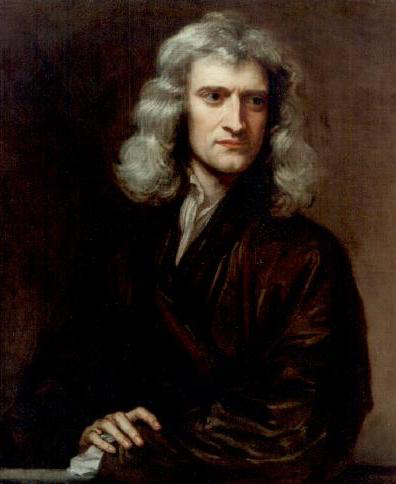
Newton’s laws of motion were just one part of the monumental work that has made him legendary (Figure 5.2). The development of Newton’s laws marks the transition from the Renaissance to the modern era. Not until the advent of modern physics was it discovered that Newton’s laws produce a good description of motion only when the objects are moving at speeds much less than the speed of light and when those objects are larger than the size of most molecules (about m in diameter). These constraints define the realm of Newtonian mechanics. At the beginning of the twentieth century, Albert Einstein (1879–1955) developed the theory of relativity and, along with many other scientists, quantum mechanics. Quantum mechanics does not have the constraints present in Newtonian physics. All of the situations we consider in this chapter, and all those preceding the introduction of relativity in Relativity, are in the realm of Newtonian physics.
英語のヒント
ニュートンの運動の法則は、彼の名を不朽のものにした大業績の一部にすぎない(図5.2)。これらの法則の成立は、ルネサンスから近代への移行を画する。現代物理学が登場して初めて、ニュートンの法則が運動をよく記述するのは、物体の速さが光速に比べて十分に小さく、物体の大きさがほとんどの分子の大きさ(直径約 m)より大きい場合に限られると分かった。この制約が、ニュートン力学の適用範囲を定めている。20世紀初めに、アルベルト・アインシュタイン(1879–1955年)は相対性理論を発展させ、さらに多くの科学者とともに量子力学の発展に貢献した。量子力学には、ニュートン物理学にある制約がない。この章で考えるすべての状況と、「相対性理論」で相対論を導入するまでに扱うすべての状況は、ニュートン物理学の範囲内にある。
OpenStax / Rice University, University Physics Volume 1, CC BY 4.0. Source-book artwork retained. · CC BY 4.0 · Source出典

Figure 5.2図 5.2
Isaac Newton (1642–1727) published his amazing work, Philosophiae Naturalis Principia Mathematica, in 1687. It proposed scientific laws that still apply today to describe the motion of objects (the laws of motion). Newton also discovered the law of gravity, invented calculus, and made great contributions to the theories of light and color.
英語のヒント
アイザック・ニュートン(1642–1727年)は、1687年に画期的な著作『自然哲学の数学的諸原理』を出版した。この著作では、物体の運動を記述するために今日でも適用される科学法則、すなわち運動の法則が提唱された。ニュートンは万有引力の法則も発見し、微積分を考案し、光と色の理論にも大きく貢献した。
Working Definition of Force力の実用的な定義
Dynamics is the study of the forces that cause objects and systems to move. To understand this, we need a working definition of force. An intuitive definition of force—that is, a push or a pull—is a good place to start. We know that a push or a pull has both magnitude and direction (therefore, it is a vector quantity), so we can define force as the push or pull on an object with a specific magnitude and direction. Force can be represented by vectors or expressed as a multiple of a standard force.
英語のヒント
動力学は、物体や系を動かす力を研究する分野である。これを理解するには、力について実際に使える定義が必要になる。力を「押すこと、または引くこと」とする直観的な定義が、よい出発点となる。押したり引いたりする作用には大きさと向きの両方があるので、ベクトル量である。そこで、力を、ある大きさと向きをもって物体を押す作用または引く作用と定義できる。力はベクトルで表したり、標準となる力の何倍かとして表したりできる。
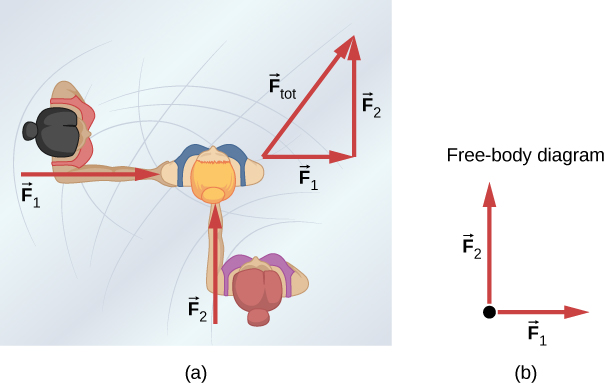
The push or pull on an object can vary considerably in either magnitude or direction. For example, a cannon exerts a strong force on a cannonball that is launched into the air. In contrast, Earth exerts only a tiny downward pull on a flea. Our everyday experiences also give us a good idea of how multiple forces add. If two people push in different directions on a third person, as illustrated in Figure 5.3, we might expect the total force to be in the direction shown. Since force is a vector, it adds just like other vectors. Forces, like other vectors, are represented by arrows and can be added using the familiar head-to-tail method or trigonometric methods. These ideas were developed in Vectors.
英語のヒント
OpenStax / Rice University, University Physics Volume 1, CC BY 4.0. Source-book artwork retained. · CC BY 4.0 · Source出典

Figure 5.3図 5.3
(a) An overhead view of two ice skaters pushing on a third skater. Forces are vectors and add like other vectors, so the total force on the third skater is in the direction shown. (b) A free-body diagram representing the forces acting on the third skater.
英語のヒント
(a) 2人のスケーターが別のスケーターを押している様子を上から見た図。力はベクトルであり、ほかのベクトルと同様に加算するため、3人目のスケーターに働く合力の向きは図のようになる。(b) 3人目のスケーターに働く力を表す力の図。
Figure 5.3(b) is our first example of a free-body diagram, which is a sketch showing all external forces acting on an object or system. The object or system is represented by a single isolated point (or free body), and only those forces acting on it that originate outside of the object or system—that is, external forces—are shown. (These forces are the only ones shown because only external forces acting on the free body affect its motion. We can ignore any internal forces within the body.) The forces are represented by vectors extending outward from the free body.
英語のヒント
図5.3(b)は、ここで初めて登場する力の図である。これは、物体や系に働くすべての外力を示す略図である。物体や系は、切り離された一つの点、すなわち自由物体として表す。そこに作用する力のうち、物体や系の外部に由来するもの、すなわち外力だけを描く。自由物体の運動に影響するのは、その物体に働く外力だけなので、この図に示すのも外力だけである。物体内部の内力は無視できる。力は自由物体から外側へ伸びるベクトルで表す。
Free-body diagrams are useful in analyzing forces acting on an object or system, and are employed extensively in the study and application of Newton’s laws of motion. You will see them throughout this text and in all your studies of physics. The following steps briefly explain how a free-body diagram is created; we examine this strategy in more detail in Drawing Free-Body Diagrams.
英語のヒント
力の図は、物体や系に作用する力を解析する際に役立ち、ニュートンの運動の法則を学び、応用する際に広く使われる。本書全体でも、今後の物理学の学習でも繰り返し登場する。以下に力の図を作る手順を簡潔に示す。この方法は「力の図の描き方」でさらに詳しく調べる。
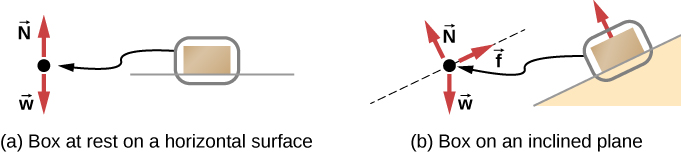
We illustrate this strategy with two examples of free-body diagrams (Figure 5.4). The terms used in this figure are explained in more detail later in the chapter.
英語のヒント
この方法を、二つの力の図の例で示す(図5.4)。図で使っている用語は、この章の後半で詳しく説明する。
OpenStax / Rice University, University Physics Volume 1, CC BY 4.0. Source-book artwork retained. · CC BY 4.0 · Source出典

Figure 5.4図 5.4
In these free-body diagrams, is the normal force, is the weight of the object, and is the friction.
英語のヒント
これらの力の図で、は垂直抗力、は物体の重力、は摩擦力である。
The steps given here are sufficient to guide you in this important problem-solving strategy. The final section of this chapter explains in more detail how to draw free-body diagrams when working with the ideas presented in this chapter.
英語のヒント
ここで示した手順に従えば、この重要な問題解決法を使える。この章の最後の節では、ここで学ぶ考え方を適用する際に、力の図をどのように描くかをさらに詳しく説明する。