第5章ニュートンの運動法則
Component Form of Newton’s Second Lawニュートンの第2法則の成分表示
We have developed Newton’s second law and presented it as a vector equation in Equation 5.3. This vector equation can be written as three component equations:
英語のヒント
ここまでニュートンの第2法則を考え、式5.3にベクトルの方程式として示した。このベクトルの方程式は、三つの成分の方程式として書ける。
The second law is a description of how a body responds mechanically to its environment. The influence of the environment is the net force the body’s response is the acceleration and the strength of the response is inversely proportional to the mass m. The larger the mass of an object, the smaller its response (its acceleration) to the influence of the environment (a given net force). Therefore, a body’s mass is a measure of its inertia, as we explained in Newton’s First Law.
英語のヒント
第2法則は、物体が周囲の環境に対して力学的にどう応答するかを表す。環境の影響は合力であり、物体の応答は加速度である。応答の強さは質量mに反比例する。物体の質量が大きいほど、環境の影響(一定の合力)に対する応答(加速度)は小さい。したがって、「ニュートンの第1法則」で説明したように、質量は物体の慣性の尺度である。
Example 5.5例題 5.5
Force on a Soccer Ballサッカーボールに働く力
A 0.400-kg soccer ball is kicked across the field by a player; it undergoes acceleration given by Find (a) the resultant force acting on the ball and (b) the magnitude and direction of the resultant force.
英語のヒント
質量0.400 kgのサッカーボールを選手がフィールド上で蹴る。その加速度はで与えられる。(a) ボールに働く合力、(b) その合力の大きさと向きを求めよ。
Strategy方針
The vectors in and format, which indicate force direction along the x-axis and the y-axis, respectively, are involved, so we apply Newton’s second law in vector form.
英語のヒント
力の向きをそれぞれx軸とy軸に沿って表すとの形のベクトルを扱うので、ニュートンの第2法則をベクトルの形で適用する。
Solution解答
- We apply Newton’s second law:
英語のヒント
ニュートンの第2法則を適用する。 - Magnitude and direction are found using the components of :
英語のヒント
大きさと向きは、の成分を使って求める。
Significance考察
We must remember that Newton’s second law is a vector equation. In (a), we are multiplying a vector by a scalar to determine the net force in vector form. While the vector form gives a compact representation of the force vector, it does not tell us how “big” it is, or where it goes, in intuitive terms. In (b), we are determining the actual size (magnitude) of this force and the direction in which it travels.
英語のヒント
ニュートンの第2法則がベクトルの方程式であることを忘れてはならない。(a)では、ベクトルにスカラーを掛け、ベクトルの形で合力を求めている。ベクトルの形は力ベクトルを簡潔に表すが、どれほど「大きい」か、どちらへ向くかを直感的には教えてくれない。(b)では、この力の実際の大きさと、その向きを求めている。
Example 5.6例題 5.6
Mass of a Car車の質量
Find the mass of a car if a net force of produces an acceleration of .
英語のヒント
の合力がの加速度を生じさせるとき、車の質量を求めよ。
Strategy方針
Vector division is not defined, so cannot be performed. However, mass m is a scalar, so we can use the scalar form of Newton’s second law, .
英語のヒント
ベクトルの除算は定義されていないので、は計算できない。しかし、質量mはスカラーなので、ニュートンの第2法則のスカラー表示を使える。
Solution解答
We use and substitute the magnitudes of the two vectors: and Therefore,
英語のヒント
を使い、二つのベクトルの大きさとを代入する。したがって、次のようになる。
Significance考察
Force and acceleration were given in the and format, but the answer, mass m, is a scalar and thus is not given in and form.
英語のヒント
力と加速度はとの形で与えられたが、答えである質量mはスカラーなので、との形では表さない。
Example 5.7例題 5.7
Several Forces on a Particle粒子に働く複数の力
A particle of mass is acted upon by four forces of magnitudes. , with the directions as shown in the free-body diagram in Figure 5.15. What is the acceleration of the particle?
英語のヒント
質量の粒子に、大きさがの四つの力が働いている。向きは図5.15の力の図に示すとおりである。粒子の加速度はいくらか。
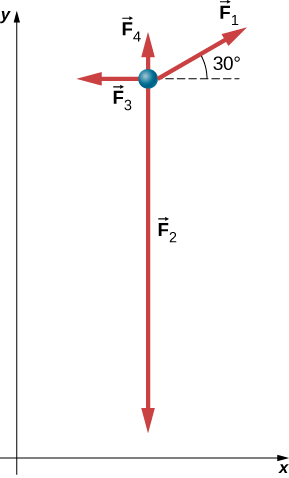
OpenStax / Rice University, University Physics Volume 1, CC BY 4.0. Source-book artwork retained. · CC BY 4.0 · Source出典

Figure 5.15図 5.15
Four forces in the xy-plane are applied to a 4.0-kg particle.
英語のヒント
xy平面内の四つの力を、質量4.0 kgの粒子に加える。
Strategy方針
Because this is a two-dimensional problem, we must use a free-body diagram. First, must be resolved into x- and y-components. We can then apply the second law in each direction.
英語のヒント
これは二次元の問題なので、力の図を使う必要がある。まずをx成分とy成分に分解する。その後、それぞれの方向に第2法則を適用する。
Solution解答
We draw a free-body diagram as shown in Figure 5.15. Now we apply Newton’s second law. We consider all vectors resolved into x- and y-components:
英語のヒント
図5.15のように力の図を描き、ニュートンの第2法則を適用する。すべてのベクトルをx成分とy成分に分けて考える。
Thus, the net acceleration is
英語のヒント
したがって、全体の加速度は次のようになる。
which is a vector of magnitude directed at to the positive x-axis.
英語のヒント
これは大きさのベクトルで、x軸の正方向に対しての向きを向いている。
Significance考察
Numerous examples in everyday life can be found that involve three or more forces acting on a single object, such as cables running from the Golden Gate Bridge or a football player being tackled by three defenders. We can see that the solution of this example is just an extension of what we have already done.
英語のヒント
ゴールデンゲートブリッジから伸びるケーブルや、三人の守備選手からタックルを受けるフットボール選手など、一つの物体に三つ以上の力が働く例は、日常生活に数多くある。この例の解法は、すでに行ったことを拡張したものにすぎない。
Newton’s Second Law and Momentumニュートンの第2法則と運動量
Newton actually stated his second law in terms of momentum: “The instantaneous rate at which a body’s momentum changes is equal to the net force acting on the body.” (“Instantaneous rate” implies that the derivative is involved.) This can be given by the vector equation
英語のヒント
ニュートンは実際には、第2法則を運動量によって述べた。「物体の運動量が変化する瞬間の割合は、その物体に働く合力に等しい」。「瞬間の割合」とは微分を使うことを意味する。これは次のベクトルの方程式で表せる。
This means that Newton’s second law addresses the central question of motion: What causes a change in motion of an object? Momentum was described by Newton as “quantity of motion,” a way of combining both the velocity of an object and its mass. We devote Linear Momentum and Collisions to the study of momentum.
英語のヒント
これは、ニュートンの第2法則が、運動に関する中心的な問い、すなわち「何が物体の運動を変えるのか」に答えることを意味する。ニュートンは運動量を「運動の量」と表現した。運動量は、物体の速度と質量を組み合わせる方法である。「運動量と衝突」では、運動量を詳しく学ぶ。
For now, it is sufficient to define momentum as the product of the mass of the object m and its velocity :
英語のヒント
今のところは、運動量を、物体の質量mと速度の積として定義すれば十分である。
(5.7)
Since velocity is a vector, so is momentum.
英語のヒント
速度はベクトルなので、運動量もベクトルである。
It is easy to visualize momentum. A train moving at 10 m/s has more momentum than one that moves at 2 m/s. In everyday life, we speak of one sports team as “having momentum” when they score points against the opposing team.
英語のヒント
運動量はイメージしやすい。毎秒10 mで走る列車は、毎秒2 mで走る列車より大きい運動量をもつ。日常では、スポーツのチームが相手から得点を重ねているとき、そのチームには「勢い(momentum)がある」と言う。
When m is constant, we have
英語のヒント
mが一定ならば、次の式が得られる。
Thus, we see that the momentum form of Newton’s second law reduces to the form given earlier in this section.
英語のヒント
このように、ニュートンの第2法則を運動量で表した形は、この節で先に示した形に帰着する。