第5章ニュートンの運動法則
Summaryまとめ
- An external force acts on a system from outside the system, as opposed to internal forces, which act between components within the system.
英語のヒント
外力は系の外部から系に働く力であり、系の内部の構成要素どうしの間に働く内力と区別される。 - Newton’s second law of motion says that the net external force on an object with a certain mass is directly proportional to and in the same direction as the acceleration of the object.
英語のヒント
ニュートンの運動の第2法則によれば、一定の質量をもつ物体に働く外力の合力は、物体の加速度に正比例し、同じ向きを向く。 - Newton’s second law can also describe net force as the instantaneous rate of change of momentum. Thus, a net external force causes nonzero acceleration.
英語のヒント
ニュートンの第2法則は、合力を運動量の瞬間の変化率として表すこともできる。したがって、外力の合力は0でない加速度を生じさせる。
Conceptual Questions概念に関する問題
Exercises 9–10練習問題 9–10
Exercise 9問題 9
Why can we neglect forces such as those holding a body together when we apply Newton’s second law?
英語のヒント
ニュートンの第2法則を適用するとき、物体を一つに結び付けている力のようなものを無視できるのはなぜか。
Exercise 10問題 10
A rock is thrown straight up. At the top of the trajectory, the velocity is momentarily zero. Does this imply that the force acting on the object is zero? Explain your answer.
英語のヒント
石を真上に投げる。軌道の最高点で、速度は瞬間的に0になる。これは、物体に働く力が0であることを意味するか。理由を説明せよ。
Solution解き方
No. If the force were zero at this point, then there would be nothing to change the object’s momentary zero velocity. Since we do not observe the object hanging motionless in the air, the force could not be zero.
英語のヒント
意味しない。この点で力が0ならば、物体の瞬間的に0となった速度を変えるものが何もなくなる。しかし、物体が空中で静止したまま浮いていることはないので、力は0ではありえない。
Problems問題
Exercises 11–27練習問題 11–27
Exercise 11問題 11
Andrea, a 63.0-kg sprinter, starts a race with an acceleration of . What is the net external force on her?
英語のヒント
質量63.0 kgの短距離走者アンドレアが、の加速度で走り始める。彼女に働く外力の合力はいくらか。
Exercise 12問題 12
If the sprinter from the previous problem accelerates at that rate for 20.00 m and then maintains that velocity for the remainder of a 100.00-m dash, what will her time be for the race?
英語のヒント
前問の走者が、その加速度で20.00 m進んだ後、100.00 m走の残りを一定の速度で走るとする。レースの所要時間はいくらか。
Solution解き方
Running from rest, the sprinter attains a velocity of , at end of acceleration. We find the time for acceleration using , or For maintained velocity, , or . .
英語のヒント
静止状態から走り始め、加速が終わる時点で走者の速度はに達する。加速に要した時間はより、となる。一定の速度で走る間についてはより、である。。
Exercise 13問題 13
A cleaner pushes a 4.50-kg laundry cart in such a way that the net external force on it is 60.0 N. Calculate the magnitude of his cart’s acceleration.
英語のヒント
清掃員が質量4.50 kgの洗濯物用カートを押し、カートに働く外力の合力が60.0 Nとなっている。カートの加速度の大きさを求めよ。
Exercise 14問題 14
Astronauts in orbit are apparently weightless. This means that a clever method of measuring the mass of astronauts is needed to monitor their mass gains or losses, and adjust their diet. One way to do this is to exert a known force on an astronaut and measure the acceleration produced. Suppose a net external force of 50.0 N is exerted, and an astronaut’s acceleration is measured to be . (a) Calculate her mass. (b) By exerting a force on the astronaut, the vehicle in which she orbits experiences an equal and opposite force. Use this knowledge to find equations for the acceleration of the spaceship and for the apparent acceleration of the spaceship and for the apparent acceleration that would be measured by an observer at rest relative to the spaceship. (c) Discuss how this would affect the measurement of the astronaut’s acceleration. Propose a method by which recoil of the vehicle is avoided.
英語のヒント
軌道上の宇宙飛行士は、見かけ上無重量である。したがって、質量の増減を把握して食事を調整するには、質量を測る工夫が必要になる。一つの方法は、宇宙飛行士に既知の力を加え、生じる加速度を測ることである。50.0 Nの外力の合力を加えたとき、宇宙飛行士の加速度がと測定されたとする。(a) 彼女の質量を求めよ。(b) 宇宙飛行士に力を及ぼすことで、彼女を乗せて軌道を回る宇宙船は、同じ大きさで逆向きの力を受ける。このことから、宇宙船の加速度と、宇宙船の見かけの加速度、および宇宙船に対して静止した観測者が測る見かけの加速度を表す式を求めよ。(c) これは宇宙飛行士の加速度の測定にどう影響するかを論じ、宇宙船の反動を避ける方法を提案せよ。
Solution解き方
a. ; b. ; c. If the force could be exerted on the astronaut by another source (other than the spaceship), then the spaceship would not experience a recoil.
英語のヒント
a. 。b. 。c. 宇宙船以外のものから宇宙飛行士に力を及ぼすことができれば、宇宙船は反動を受けない。
Exercise 15問題 15
In Figure 5.12, the net external force on the 24-kg mower is given as 51 N. If the force of friction opposing the motion is 24 N, what force F (in newtons) is the person exerting on the mower? Suppose the mower is moving at 1.5 m/s when the force F is removed. How far will the mower go before stopping?
英語のヒント
図5.12で、質量24 kgの芝刈り機に働く外力の合力は51 Nである。運動に逆らう摩擦力が24 Nならば、人が芝刈り機に及ぼす力Fは何ニュートンか。力Fを取り除いた瞬間、芝刈り機は毎秒1.5 mで動いていたとする。止まるまでにどれだけ進むか。
Exercise 16問題 16
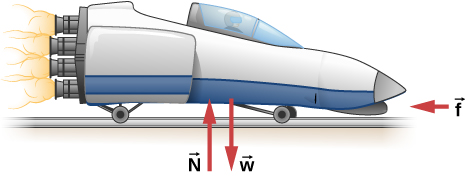
The rocket sled shown below accelerates opposite to the motion at a rate of . What force is necessary to produce this acceleration opposite to the motion? Assume that the rockets are off. The mass of the system is kg.
英語のヒント
下図のロケットそりは、運動と反対向きにの加速度をもつ。この加速度を生じさせるのに必要な力はいくらか。ロケットは停止しているものとする。系の質量は kgである。
Solution解き方
Exercise 17問題 17
If the rocket sled shown in the previous problem starts with only one rocket burning, what is the magnitude of this acceleration? Assume that the mass of the system is kg, the thrust T is and the force of friction opposing the motion is 650.0 N. (b) Why is the acceleration not one-fourth of what it is with all rockets burning?
英語のヒント
前問のロケットそりが、ロケットを一基だけ燃焼させて発進するとき、加速度の大きさはいくらか。系の質量は kg、推力Tは、運動に逆らう摩擦力は650.0 Nとする。(b) 加速度が、すべてのロケットを燃焼させる場合の4分の1にならないのはなぜか。
Exercise 18問題 18
What is the acceleration opposite to the motion of the rocket sled if it comes to rest in 1.10 s from a speed of 1000.0 km/h? (Such acceleration opposite to the motion caused one test subject to black out and have temporary blindness.)
英語のヒント
ロケットそりが時速1000.0 kmから1.10 sで停止するとき、運動と反対向きの加速度はいくらか。このような減速によって、ある被験者は意識を失い、一時的に視力を失った。
Solution解き方
Exercise 19問題 19
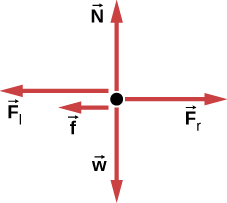
Suppose two children push horizontally, but in exactly opposite directions, on a third child in a wagon. The first child exerts a force of 75.0 N, the second exerts a force of 90.0 N, friction is 12.0 N, and the mass of the third child plus wagon is 23.0 kg. (a) What is the system of interest if the acceleration of the child in the wagon is to be calculated? (See the free-body diagram.) (b) Calculate the acceleration. (c) What would the acceleration be if friction were 15.0 N?
英語のヒント
二人の子どもが、ワゴンに乗った三人目の子どもを、水平方向の正反対から押す。一人目の力は75.0 N、二人目は90.0 N、摩擦力は12.0 Nで、三人目の子どもとワゴンの合計質量は23.0 kgである。(a) ワゴンに乗った子どもの加速度を求める場合、着目する系は何か。力の図を参照せよ。(b) 加速度を求めよ。(c) 摩擦力が15.0 Nならば、加速度はいくらになるか。
Exercise 20問題 20
A powerful motorcycle can produce an acceleration of while traveling at 90.0 km/h. At that speed, the forces resisting motion, including friction and air resistance, total 400.0 N. (Air resistance is analogous to air friction. It always opposes the motion of an object.) What is the magnitude of the force that motorcycle exerts backward on the ground to produce its acceleration if the mass of the motorcycle with rider is 245 kg?
英語のヒント
高出力のオートバイは、時速90.0 kmで走っているときの加速度を生じる。この速さでは、摩擦や空気抵抗を含め、運動に逆らう力の合計は400.0 Nである。空気抵抗は空気との摩擦に相当し、常に物体の運動と逆向きに働く。運転者を含むオートバイの質量が245 kgのとき、この加速度を生じさせるため、オートバイが地面に後ろ向きに及ぼす力の大きさはいくらか。
Solution解き方
Exercise 21問題 21
A car with a mass of 1000.0 kg accelerates from 0 to 90.0 km/h in 10.0 s. (a) What is its acceleration? (b) What is the net force on the car?
英語のヒント
質量1000.0 kgの車が、10.0 sで静止状態から時速90.0 kmまで加速する。(a) 加速度はいくらか。(b) 車に働く合力はいくらか。
Exercise 22問題 22
The driver in the previous problem applies the brakes when the car is moving at 90.0 km/h, and the car comes to rest after traveling 40.0 m. What is the net force on the car during its acceleration opposite to the motion?
英語のヒント
前問の運転者が時速90.0 kmで走行中にブレーキをかけ、車は40.0 m進んで停止する。運動と反対向きに加速している間、車に働く合力はいくらか。
Solution解き方
Exercise 23問題 23
An 80.0-kg passenger in an SUV traveling at km/h is wearing a seat belt. The driver slams on the brakes and the SUV stops in 45.0 m. Find the force of the seat belt on the passenger.
英語のヒント
時速 kmで走るSUVに、質量80.0 kgの乗客がシートベルトを着けて乗っている。運転者が急ブレーキをかけ、SUVは45.0 mで停止する。シートベルトが乗客に及ぼす力を求めよ。
Exercise 24問題 24
A particle of mass 2.0 kg is acted on by a single force (a) What is the particle’s acceleration? (b) If the particle starts at rest, how far does it travel in the first 5.0 s?
英語のヒント
質量2.0 kgの粒子に、一つの力が働く。(a) 粒子の加速度はいくらか。(b) 粒子が静止状態から動き始めるならば、最初の5.0 sでどれだけ進むか。
Solution解き方
a. ; b. The acceleration has magnitude , so .
英語のヒント
a. 。b. 加速度の大きさはなので、である。
Exercise 25問題 25
Suppose that the particle of the previous problem also experiences forces and What is its acceleration in this case?
英語のヒント
前問の粒子に、さらにとの力も働くとする。この場合の加速度はいくらか。
Exercise 26問題 26
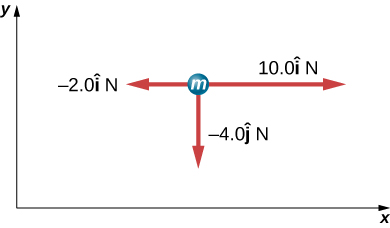
Find the acceleration of the body of mass 5.0 kg shown below.
英語のヒント
下図の質量5.0 kgの物体の加速度を求めよ。
Solution解き方
Exercise 27問題 27
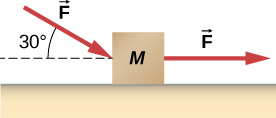
In the following figure, the horizontal surface on which this block slides is frictionless. If the two forces acting on it each have magnitude and , what is the magnitude of the resulting acceleration of the block?
英語のヒント
下図で、物体が滑る水平面には摩擦がない。物体に働く二つの力の大きさがそれぞれで、のとき、生じる加速度の大きさはいくらか。


Newton’s second law of motion
ニュートンの運動の第2法則
acceleration of a system is directly proportional to and in the same direction as the net external force acting on the system and is inversely proportional to its mass
英語のヒント
系の加速度は、系に働く外力の合力に正比例して同じ向きを向き、系の質量に反比例するという法則。