第5章ニュートンの運動法則
Gravitation and Inertia重力と慣性
Regardless of the scale of an object, whether a molecule or a subatomic particle, two properties remain valid and thus of interest to physics: gravitation and inertia. Both are connected to mass. Roughly speaking, mass is a measure of the amount of matter in something. Gravitation is the attraction of one mass to another, such as the attraction between yourself and Earth that holds your feet to the floor. The magnitude of this attraction is your weight, and it is a force.
英語のヒント
物体が分子であれ、原子より小さい粒子であれ、その尺度にかかわらず成り立ち、物理学の対象となる性質が二つある。重力と慣性である。どちらも質量と結び付いている。大まかに言えば、質量は物体中の物質の量を表す尺度である。重力とは、ある質量が別の質量を引き付ける作用である。例えば、人と地球との間の引力は、人の足を床につなぎ留める。この引力の大きさが重さであり、重さは力である。
Mass is also related to inertia, the ability of an object to resist changes in its motion—in other words, to resist acceleration. Newton’s first law is often called the law of inertia. As we know from experience, some objects have more inertia than others. It is more difficult to change the motion of a large boulder than that of a basketball, for example, because the boulder has more mass than the basketball. In other words, the inertia of an object is measured by its mass. The relationship between mass and weight is explored later in this chapter.
英語のヒント
質量は慣性とも関係する。慣性とは、物体が運動の変化、言い換えれば加速度に抵抗する性質である。ニュートンの第1法則は、しばしば慣性の法則と呼ばれる。経験から分かるように、慣性の大きい物体も小さい物体もある。例えば、大きな岩の運動を変えるのは、バスケットボールの運動を変えるより難しい。岩のほうが質量が大きいからである。つまり、物体の慣性はその質量によって測られる。質量と重さの関係は、この章の後半で調べる。
Inertial Reference Frames慣性基準系
Earlier, we stated Newton’s first law as “A body at rest remains at rest or, if in motion, remains in motion at constant velocity unless acted on by a net external force.” It can also be stated as “Every body remains in its state of uniform motion in a straight line unless it is compelled to change that state by forces acting on it.” To Newton, “uniform motion in a straight line” meant constant velocity, which includes the case of zero velocity, or rest. Therefore, the first law says that the velocity of an object remains constant if the net force on it is zero.
英語のヒント
先ほど、ニュートンの第1法則を「外力の合力が作用しない限り、静止している物体は静止を続け、運動している物体は一定の速度で運動を続ける」と述べた。この法則は、「物体は、作用する力によってその状態を変えさせられない限り、直線に沿った一様な運動の状態を保つ」と表すこともできる。ニュートンが言う「直線に沿った一様な運動」とは、速度が一定の運動を指し、速度が0の場合、すなわち静止も含む。したがって第1法則は、物体に働く合力が0ならば、物体の速度は一定に保たれると述べている。
Newton’s first law is usually considered to be a statement about reference frames. It provides a method for identifying a special type of reference frame: the inertial reference frame. In principle, we can make the net force on a body zero. If its velocity relative to a given frame is constant, then that frame is said to be inertial. So by definition, an inertial reference frame is a reference frame in which Newton’s first law is valid. Newton’s first law applies to objects with constant velocity. From this fact, we can infer the following statement.
英語のヒント
ニュートンの第1法則は、通常、基準系に関する記述と考えられる。この法則は、慣性基準系という特別な種類の基準系を識別する方法を与える。原理的には、物体に働く合力を0にできる。このとき、ある基準系に対する物体の速度が一定ならば、その基準系は慣性系であるという。つまり、定義上、慣性基準系とはニュートンの第1法則が成り立つ基準系である。第1法則は速度が一定の物体に適用される。この事実から、次のことを推論できる。
Are inertial frames common in nature? It turns out that well within experimental error, a reference frame at rest relative to the most distant, or “fixed,” stars is inertial. All frames moving uniformly with respect to this fixed-star frame are also inertial. For example, a nonrotating reference frame attached to the Sun is, for all practical purposes, inertial, because its velocity relative to the fixed stars does not vary by more than one part in Earth accelerates relative to the fixed stars because it rotates on its axis and revolves around the Sun; hence, a reference frame attached to its surface is not inertial. For most problems, however, such a frame serves as a sufficiently accurate approximation to an inertial frame, because the acceleration of a point on Earth’s surface relative to the fixed stars is rather small (). Thus, unless indicated otherwise, we consider reference frames fixed on Earth to be inertial.
英語のヒント
慣性系は自然界で一般的に見られるだろうか。最も遠い恒星、すなわち「固定された」星に対して静止する基準系は、実験誤差の範囲内で十分に慣性系とみなせることが分かっている。この恒星基準系に対して一様に動くすべての基準系も慣性系である。例えば、太陽に固定した回転しない基準系は、実用上は慣性系である。恒星に対するその速度の変化が分の1を超えないからである。地球は自転し、太陽のまわりを公転するため、恒星に対して加速している。したがって、地表に固定した基準系は慣性系ではない。しかし、ほとんどの問題では、この基準系を慣性系の十分に正確な近似として使える。地表の点が恒星に対してもつ加速度はかなり小さいからである()。そこで、特に断らない限り、地球に固定した基準系を慣性系とみなす。
Finally, no particular inertial frame is more special than any other. As far as the laws of nature are concerned, all inertial frames are equivalent. In analyzing a problem, we choose one inertial frame over another simply on the basis of convenience.
英語のヒント
最後に、どの慣性系も、ほかの慣性系より特別なものではない。自然法則に関する限り、すべての慣性系は同等である。問題を解析するとき、どの慣性系を選ぶかは、単に扱いやすさによって決める。
Newton’s First Law and Equilibriumニュートンの第1法則とつり合い
Newton’s first law tells us about the equilibrium of a system, which is the state in which the forces on the system are balanced. Returning to Forces and the ice skaters in Figure 5.3, we know that the forces and combine to form a resultant force, or the net external force: To create equilibrium, we require a balancing force that will produce a net force of zero. This force must be equal in magnitude but opposite in direction to which means the vector must be Referring to the ice skaters, for which we found to be , we can determine the balancing force by simply finding See the free-body diagram in Figure 5.3(b).
英語のヒント
We can give Newton’s first law in vector form:
英語のヒント
ニュートンの第1法則は、ベクトルを使って次のように表せる。
This equation says that a net force of zero implies that the velocity of the object is constant. (The word “constant” can indicate zero velocity.)
英語のヒント
この式は、合力が0ならば物体の速度が一定であることを意味する。「一定」には、速度が0の場合も含まれる。
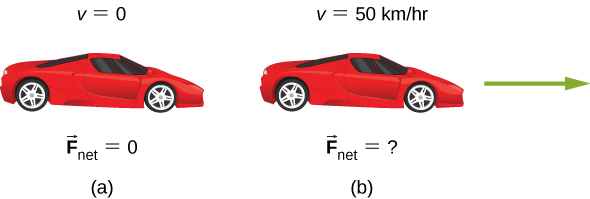
Newton’s first law is deceptively simple. If a car is at rest, the only forces acting on the car are weight and the contact force of the pavement pushing up on the car (Figure 5.9). It is easy to understand that a nonzero net force is required to change the state of motion of the car. As a car moves with constant velocity, the friction force propels the car forward and opposes the drag force against it.
英語のヒント
ニュートンの第1法則は、一見したほど単純ではない。車が静止している場合、車に働く力は、重力と、路面が車を押し上げる接触力だけである(図5.9)。車の運動状態を変えるには、0でない合力が必要だと理解するのは難しくない。車が一定の速度で動くとき、摩擦力が車を前方へ進め、車に働く抵抗力と反対向きに作用する。
OpenStax / Rice University, University Physics Volume 1, CC BY 4.0. Source-book artwork retained. · CC BY 4.0 · Source出典

Figure 5.9図 5.9
A car is shown (a) parked and (b) moving at constant velocity. How do Newton’s laws apply to the parked car? What does the knowledge that the car is moving at constant velocity tell us about the net horizontal force on the car?
英語のヒント
(a) 駐車中の車と、(b) 一定の速度で動く車。駐車中の車にはニュートンの法則がどのように当てはまるか。車が一定の速度で動いているという事実から、車に働く水平方向の合力について何が分かるか。
Example 5.1例題 5.1
When Does Newton’s First Law Apply to Your Car?ニュートンの第1法則は車にいつ当てはまるか
Newton’s laws can be applied to all physical processes involving force and motion, including something as mundane as driving a car.
英語のヒント
ニュートンの法則は、車の運転のような日常的なことも含め、力と運動に関わるあらゆる物理過程に適用できる。
(a) Your car is parked outside your house. Does Newton’s first law apply in this situation? Why or why not?
英語のヒント
(a) 車を家の外に駐車している。この状況にニュートンの第1法則は当てはまるか。その理由を述べよ。
(b) Your car moves at constant velocity down the street. Does Newton’s first law apply in this situation? Why or why not?
英語のヒント
(b) 車が道を一定の速度で進んでいる。この状況にニュートンの第1法則は当てはまるか。その理由を述べよ。
Strategy方針
In (a), we are considering the first part of Newton’s first law, dealing with a body at rest; in (b), we look at the second part of Newton’s first law for a body in motion.
英語のヒント
(a)では、静止した物体を扱う第1法則の前半を考える。(b)では、運動している物体を扱う後半を考える。
Solution解答
- When your car is parked, all forces on the car must be balanced; the vector sum is 0 N. Thus, the net force is zero, and Newton’s first law applies. The acceleration of the car is zero, and in this case, the velocity is also zero.
英語のヒント
駐車中の車に働くすべての力はつり合っており、そのベクトル和は0 Nでなければならない。したがって、合力は0で、第1法則が当てはまる。車の加速度は0であり、この場合は速度も0である。 - When your car is moving at constant velocity down the street, the net force must also be zero according to Newton’s first law. The car’s frictional force between the road and tires opposes the drag force on the car with the same magnitude, producing a net force of zero. The body continues in its state of constant velocity until the net force becomes nonzero. Realize that a net force of zero means that an object is either at rest or moving with constant velocity, that is, it is not accelerating. What do you suppose happens when the car accelerates? We explore this idea in the next section.
英語のヒント
車が一定の速度で道を進むときも、第1法則によれば合力は0でなければならない。路面とタイヤの間の摩擦力は、車の抵抗力と同じ大きさで逆向きに作用し、合力を0にする。物体は、合力が0でなくなるまで、一定の速度で動き続ける。合力が0であるということは、物体が静止しているか、一定の速度で動いているということ、すなわち加速していないということである。車が加速すると何が起きると考えられるか。この点を次の節で調べる。
Significance考察
As this example shows, there are two kinds of equilibrium. In (a), the car is at rest; we say it is in static equilibrium. In (b), the forces on the car are balanced, but the car is moving; we say that it is in dynamic equilibrium. (We examine this idea in more detail in Static Equilibrium and Elasticity.) Again, it is possible for two (or more) forces to act on an object yet for the object to move. In addition, a net force of zero cannot produce acceleration.
英語のヒント
この例が示すように、つり合いには二つの種類がある。(a)では車は静止しており、静的つり合いにあるという。(b)では車に働く力はつり合っているが、車は動いている。これは動的つり合いにあるという。この考え方は「静的つり合いと弾性」で詳しく調べる。繰り返すと、二つ以上の力が物体に作用していても、物体が運動している場合がある。また、合力が0ならば、加速度は生じない。