第5章ニュートンの運動法則
5.4 Mass and Weight5.4 質量と重さ
Learning Objectives学習目標
Learning Objectives学習目標
By the end of this section, you will be able to:
英語のヒント
この節を終えると、次のことができるようになる。
- Explain the difference between mass and weight
英語のヒント
質量と重さの違いを説明する。 - Explain why objects falling through the air are never truly in free fall
英語のヒント
空気中を落下する物体が厳密には自由落下しない理由を説明する。 - Describe the concept of weightlessness
英語のヒント
無重量の概念を説明する。
Mass and weight are often used interchangeably in everyday conversation. For example, our medical records often show our weight in kilograms but never in the correct units of newtons. In physics, however, there is an important distinction. Weight is the pull of Earth on an object. It depends on the distance from the center of Earth. Unlike weight, mass does not vary with location. The mass of an object is the same on Earth, in orbit, or on the surface of the Moon.
英語のヒント
日常会話では、質量と重さが同じ意味で使われることが多い。たとえば、医療記録の体重はキログラムで記され、重さの正しい単位であるニュートンでは記されない。しかし、物理学では両者を明確に区別する。重さは、地球が物体を引く力であり、地球の中心からの距離によって変わる。それに対して、質量は場所によって変わらない。物体の質量は、地上でも、軌道上でも、月面でも同じである。
Units of Force力の単位
The equation is used to define net force in terms of mass, length, and time. As explained earlier, the SI unit of force is the newton. Since
英語のヒント
式を使い、質量、長さ、時間によって合力を定義する。先に説明したように、力のSI単位はニュートンである。なので、次の関係が成り立つ。
Although almost the entire world uses the newton for the unit of force, in the United States, the most familiar unit of force is the pound (lb), where 1 N = 0.225 lb. Thus, a 225-lb person weighs 1000 N.
英語のヒント
世界のほぼ全域で力の単位にニュートンを使っているが、米国で最もなじみのある力の単位はポンド(lb)であり、1 N=0.225 lbである。したがって、重さ225 lbの人の重さは1000 Nである。
Weight and Gravitational Force重さと重力
When an object is dropped, it accelerates toward the center of Earth. Newton’s second law says that a net force on an object is responsible for its acceleration. If air resistance is negligible, the net force on a falling object is the gravitational force, commonly called its weight , or its force due to gravity acting on an object of mass m. Weight can be denoted as a vector because it has a direction; down is, by definition, the direction of gravity, and hence, weight is a downward force. The magnitude of weight is denoted as w. Galileo was instrumental in showing that, in the absence of air resistance, all objects fall with the same acceleration g. Using Galileo’s result and Newton’s second law, we can derive an equation for weight.
英語のヒント
物体を落とすと、地球の中心に向かって加速する。ニュートンの第2法則によれば、物体に働く合力が加速度の原因である。空気抵抗を無視できる場合、落下する物体に働く合力は重力であり、通常はその物体の重さと呼ぶ。これは、質量mの物体に働く重力による力である。重さには向きがあるので、ベクトルで表せる。定義上、下向きは重力の向きなので、重さは下向きの力である。重さの大きさはwで表す。空気抵抗がないとすべての物体が同じ加速度gで落下することを示すうえで、ガリレオは重要な役割を果たした。ガリレオの結果とニュートンの第2法則を使い、重さを表す式を導ける。
Consider an object with mass m falling toward Earth. It experiences only the downward force of gravity, which is the weight . Newton’s second law says that the magnitude of the net external force on an object is We know that the acceleration of an object due to gravity is or . Substituting these into Newton’s second law gives us the following equations.
英語のヒント
質量mの物体が地球へ向かって落下する場合を考える。物体には、下向きの重力、すなわち重さだけが働く。ニュートンの第2法則によれば、物体に働く外力の合力の大きさはである。重力による物体の加速度は、またはと分かっている。これらをニュートンの第2法則に代入すると、次の式が得られる。
Since on Earth, the weight of a 1.00-kg object on Earth is 9.80 N:
英語のヒント
地球上ではなので、質量1.00 kgの物体の重さは9.80 Nである。
When the net external force on an object is its weight, we say that it is in free fall, that is, the only force acting on the object is gravity. However, when objects on Earth fall downward through the air, they are never truly in free fall because there is always some upward resistance force from the air acting on the object.
英語のヒント
物体に働く外力の合力がその物体の重さであるとき、物体は自由落下しているという。つまり、物体に働く力は重力だけである。しかし、地球上で物体が空気中を落下するときは、常に空気による上向きの抵抗力がいくらか働くため、厳密には自由落下ではない。
Acceleration due to gravity g varies slightly over the surface of Earth, so the weight of an object depends on its location and is not an intrinsic property of the object. Weight varies dramatically if we leave Earth’s surface. On the Moon, for example, acceleration due to gravity is only . A 1.0-kg mass thus has a weight of 9.8 N on Earth and only about 1.6 N on the Moon.
英語のヒント
重力加速度gは地表の場所によって少し変わるため、物体の重さは場所に依存し、物体固有の性質ではない。地表を離れると、重さは大きく変わる。たとえば月の重力加速度はしかない。したがって、質量1.0 kgの物体の重さは、地球上では9.8 Nだが、月面では約1.6 Nにすぎない。
The broadest definition of weight in this sense is that the weight of an object is the gravitational force on it from the nearest large body, such as Earth, the Moon, or the Sun. This is the most common and useful definition of weight in physics. It differs dramatically, however, from the definition of weight used by NASA and the popular media in relation to space travel and exploration. When they speak of “weightlessness” and “microgravity,” they are referring to the phenomenon we call “free fall” in physics. We use the preceding definition of weight, force due to gravity acting on an object of mass m, and we make careful distinctions between free fall and actual weightlessness.
英語のヒント
この意味で重さを最も広く定義すると、地球、月、太陽など、最も近い大きな天体から物体に働く重力となる。物理学では、これが最も一般的で有用な重さの定義である。しかし、宇宙旅行や探査に関連してNASAや一般のメディアが使う重さの定義とは大きく異なる。「無重量」や「微小重力」というとき、それらが指しているのは、物理学で「自由落下」と呼ぶ現象である。本書では、重さを質量mの物体に働く重力による力とする先の定義を使い、自由落下と真の無重量を慎重に区別する。
Be aware that weight and mass are different physical quantities, although they are closely related. Mass is an intrinsic property of an object: It is a quantity of matter. The quantity or amount of matter of an object is determined by the numbers of atoms and molecules of various types it contains. Because these numbers do not vary, in Newtonian physics, mass does not vary; therefore, its response to an applied force does not vary. In contrast, weight is the gravitational force acting on an object, so it does vary depending on gravity. For example, a person closer to the center of Earth, at a low elevation such as New Orleans, weighs slightly more than a person who is located in the higher elevation of Denver, even though they may have the same mass.
英語のヒント
重さと質量は密接に関係しているが、異なる物理量であることに注意しよう。質量は物体固有の性質であり、物質の量である。物体を構成する物質の量は、そこに含まれるさまざまな種類の原子や分子の数で決まる。ニュートン力学ではこれらの数は変わらないので、質量も変わらず、加えられた力に対する応答も変わらない。それに対して、重さは物体に働く重力なので、重力に応じて変わる。たとえばニューオーリンズのような標高の低い場所にいる人は、地球の中心により近いため、より標高の高いデンバーにいる人と質量が同じでも、重さはわずかに大きい。
It is tempting to equate mass to weight, because most of our examples take place on Earth, where the weight of an object varies only a little with the location of the object. In addition, it is difficult to count and identify all of the atoms and molecules in an object, so mass is rarely determined in this manner. If we consider situations in which is a constant on Earth, we see that weight is directly proportional to mass m, since that is, the more massive an object is, the more it weighs. Operationally, the masses of objects are determined by comparison with the standard kilogram, as we discussed in Units and Measurement. But by comparing an object on Earth with one on the Moon, we can easily see a variation in weight but not in mass. For instance, on Earth, a 5.0-kg object weighs 49 N; on the Moon, where g is , the object weighs 8.4 N. However, the mass of the object is still 5.0 kg on the Moon.
英語のヒント
本書の例の大半は地球上で起こり、物体の重さは場所によってわずかにしか変わらないため、質量と重さを同じものと考えたくなる。また、物体内の原子や分子をすべて特定して数えるのは難しく、その方法で質量を決めることはめったにない。地球上でを一定とみなせる状況では、なので、重さは質量mに正比例する。すなわち、質量が大きい物体ほど重い。実際の測定では、「単位と測定」で述べたように、標準のキログラムとの比較によって物体の質量を決める。しかし、地球上の物体と月面の物体を比較すれば、質量は変わらず重さだけが変わることが容易に分かる。たとえば、地球上で質量5.0 kgの物体の重さは49 Nだが、gがである月面では8.4 Nである。それでも、月面での質量は5.0 kgのままである。
Example 5.8例題 5.8
Clearing a Field畑から石を取り除く
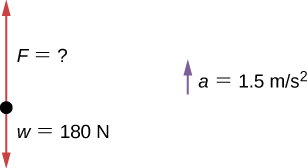
A farmer is lifting some moderately heavy rocks from a field to plant crops. He lifts a stone that weighs 40.0 lb. (about 180 N). What force does he apply if the stone accelerates at a rate of
英語のヒント
農夫が作物を植えるため、畑からやや重い石を持ち上げている。重さ40.0 lb(約180 N)の石を、の加速度で持ち上げるとき、加える力はいくらか。
Strategy方針
We were given the weight of the stone, which we use in finding the net force on the stone. However, we also need to know its mass to apply Newton’s second law, so we must apply the equation for weight, , to determine the mass.
英語のヒント
石の重さが与えられており、これを使って石に働く合力を求める。ただし、ニュートンの第2法則を適用するには質量も必要なので、重さの式によって質量を求める。
Solution解答
No forces act in the horizontal direction, so we can concentrate on vertical forces, as shown in the following free-body diagram. We label the acceleration to the side; technically, it is not part of the free-body diagram, but it helps to remind us that the object accelerates upward (so the net force is upward).
英語のヒント
水平方向には力が働かないので、次の力の図のように、鉛直方向の力に集中できる。図の横に加速度を記す。厳密には加速度は力の図の一部ではないが、物体が上向きに加速し、したがって合力も上向きであることを確認するのに役立つ。
OpenStax / Rice University, University Physics Volume 1, CC BY 4.0. Source-book artwork retained. · CC BY 4.0 · Source出典

Significance考察
To apply Newton’s second law as the primary equation in solving a problem, we sometimes have to rely on other equations, such as the one for weight or one of the kinematic equations, to complete the solution.
英語のヒント
ニュートンの第2法則を主要な式として問題を解くとき、解答を完成させるため、重さの式や運動学の式など、別の式も使う必要がある場合がある。