第5章ニュートンの運動法則
In Applications of Newton’s Laws, we extend the discussion on tension in a cable to include cases in which the angles shown are not equal.
英語のヒント
「ニュートンの法則の応用」では、ケーブルの張力について、図に示す二つの角が等しくない場合まで議論を広げる。
Friction摩擦
Friction is a resistive force opposing motion or its tendency. Imagine an object at rest on a horizontal surface. The net force acting on the object must be zero, leading to equality of the weight and the normal force, which act in opposite directions. If the surface is tilted, the normal force balances the component of the weight perpendicular to the surface. If the object does not slide downward, the component of the weight parallel to the inclined plane is balanced by friction. Friction is discussed in greater detail in the next chapter.
英語のヒント
摩擦は、運動や動こうとする傾向に逆らう抵抗力である。水平面上に静止した物体を考えよう。合力は0なので、逆向きに働く重さと垂直抗力の大きさは等しい。面を傾けると、垂直抗力は重さの面に垂直な成分とつり合う。物体が下へ滑らない場合、重さの斜面に平行な成分は摩擦力とつり合っている。摩擦は次の章で詳しく扱う。
Spring forceばねの力
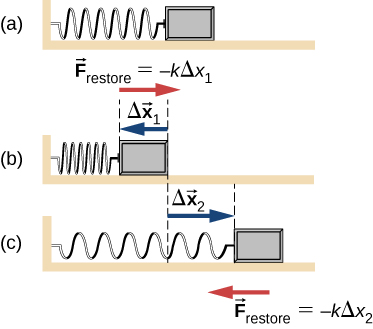
A spring is a special medium with a specific atomic structure that has the ability to restore its shape, if deformed. To restore its shape, a spring exerts a restoring force that is proportional to and in the opposite direction in which it is stretched or compressed. This is the statement of a law known as Hooke’s law, which has the mathematical form
英語のヒント
ばねは特定の原子構造をもつ特殊な媒介物で、変形しても元の形に戻る性質がある。形を元に戻すため、ばねは伸ばされたり圧縮されたりした変位に比例し、それと逆向きの復元力を及ぼす。これはフックの法則と呼ばれ、次の数式で表される。
The constant of proportionality k is a measure of the spring’s stiffness. The line of action of this force is parallel to the spring axis, and the sense of the force is in the opposite direction of the displacement vector (Figure 5.29). The displacement must be measured from the relaxed position; when the spring is relaxed.
英語のヒント
比例定数kは、ばねの硬さの尺度である。この力の作用線はばねの軸に平行で、力の向きは変位ベクトルと逆である(図5.29)。変位はばねが自然な長さの位置から測らなければならず、その状態ではである。
OpenStax / Rice University, University Physics Volume 1, CC BY 4.0. Source-book artwork retained. · CC BY 4.0 · Source出典

Figure 5.29図 5.29
A spring exerts its force proportional to a displacement, whether it is compressed or stretched. (a) The spring is in a relaxed position and exerts no force on the block. (b) The spring is compressed by displacement of the object and exerts restoring force (c) The spring is stretched by displacement of the object and exerts restoring force
英語のヒント
ばねは、圧縮されても伸ばされても、変位に比例する力を及ぼす。(a) 自然な長さのばねは、物体に力を及ぼさない。(b) 物体の変位によってばねが圧縮され、復元力を及ぼす。(c) 物体の変位によってばねが伸ばされ、復元力を及ぼす。
Real Forces and Inertial Frames実在の力と慣性系
There is another distinction among forces: Some forces are real, whereas others are not. Real forces have some physical origin, such as a gravitational pull. In contrast, fictitious forces arise simply because an observer is in an accelerating or noninertial frame of reference, such as one that rotates (like a merry-go-round) or undergoes linear acceleration (like a car slowing down). For example, if a satellite is heading due north above Earth’s Northern Hemisphere, then to an observer on Earth, it will appear to experience a force to the west that has no physical origin. Instead, Earth is rotating toward the east and moves east under the satellite. In Earth’s frame, this looks like a westward force on the satellite, or it can be interpreted as a violation of Newton’s first law (the law of inertia). We can identify a fictitious force by asking the question, “What is the reaction force?” If we cannot name the reaction force, then the force we are considering is fictitious. In the example of the satellite, the reaction force would have to be an eastward force on Earth. Recall that an inertial frame of reference is one in which all forces are real and, equivalently, one in which Newton’s laws have the simple forms given in this chapter.
英語のヒント
力には、実在する力とそうでない力という別の区別もある。実在の力には、重力の引力のような物理的な起源がある。それに対して見かけの力は、観測者が加速する基準系、すなわち非慣性系にいることだけで生じる。メリーゴーラウンドのように回転する系や、減速中の車のように直線加速度をもつ系が例である。たとえば、人工衛星が北半球の上空を真北へ進んでいるとする。地球上の観測者には、衛星が物理的な起源のない西向きの力を受けているように見える。実際には、地球が東へ自転し、衛星の下で東へ動いている。地球の基準系では、これが衛星に働く西向きの力に見える。あるいは、ニュートンの第1法則、すなわち慣性の法則への違反と解釈することもできる。「反作用は何か」と問うことで、見かけの力を見分けられる。反作用を挙げられなければ、考えている力は見かけの力である。衛星の例ならば、反作用は地球に働く東向きの力でなければならない。慣性基準系とは、すべての力が実在する系であり、それと同じことだが、ニュートンの法則がこの章で示した単純な形で成り立つ系である。
Earth’s rotation is slow enough that Earth is nearly an inertial frame. You ordinarily must perform precise experiments to observe fictitious forces and the slight departures from Newton’s laws, such as the effect just described. On a large scale, such as for the rotation of weather systems and ocean currents, the effects can be easily observed (Figure 5.30).
英語のヒント
地球の自転は十分に遅いため、地球はほぼ慣性系とみなせる。今述べた効果のような、見かけの力やニュートンの法則からのわずかなずれを観測するには、通常は精密な実験が必要である。気象系や海流の回転のように大きな規模では、その効果を容易に観測できる(図5.30)。
Image omitted because its reuse rights could not be verified.権利の確認ができないため画像を割愛。
Figure 5.30図 5.30
Hurricane Fran is shown heading toward the southeastern coast of the United States in September 1996. Notice the characteristic “eye” shape of the hurricane. This is a result of the Coriolis effect, which is the deflection of objects (in this case, air) when considered in a rotating frame of reference, like the spin of Earth. This hurricane shows a counter-clockwise rotation because it is a low pressure storm. (credit "runner": modification of work by "Greenwich Photography"/Flickr)
英語のヒント
1996年9月、米国南東部の海岸へ向かうハリケーン・フラン。特徴的な「目」の形に注目しよう。これは、地球の自転のような回転する基準系で考えたとき、物体、この場合は空気の進路が曲がるコリオリ効果による。このハリケーンは低気圧なので反時計回りに回転している。(「走者」の画像:「Greenwich Photography」/Flickrの作品を改変)
The crucial factor in determining whether a frame of reference is inertial is whether it accelerates or rotates relative to a known inertial frame. Unless stated otherwise, all phenomena discussed in this text are in inertial frames.
英語のヒント
基準系が慣性系かどうかを決めるうえで重要なのは、既知の慣性系に対して加速または回転しているかどうかである。特に断りがない限り、本書で扱うすべての現象は慣性系内のものである。
The forces discussed in this section are real forces, but they are not the only real forces. Lift and thrust, for example, are more specialized real forces. In the long list of forces, are some more basic than others? Are some different manifestations of the same underlying force? The answer to both questions is yes, as you will see in the treatment of modern physics later in the text.
英語のヒント
この節で扱った力は実在の力だが、それがすべてではない。揚力や推力も、より特殊な実在の力である。多くの力の中には、他より基本的なものがあるだろうか。同じ根底の力が、異なる形で現れたものもあるだろうか。どちらの答えも「ある」であり、本書の後半で現代物理学を学ぶ際に分かる。