第5章ニュートンの運動法則
Summaryまとめ
- Newton’s third law of motion represents a basic symmetry in nature, with an experienced force equal in magnitude and opposite in direction to an exerted force.
英語のヒント
ニュートンの運動の第3法則は、自然界の基本的な対称性を表す。受ける力は、及ぼした力と大きさが等しく、向きが逆である。 - Two equal and opposite forces do not cancel because they act on different systems.
英語のヒント
大きさが等しく向きが逆の二つの力は、異なる系に働くため打ち消し合わない。 - Action-reaction pairs include a swimmer pushing off a wall, helicopters creating lift by pushing air down, and an octopus propelling itself forward by ejecting water from its body. Rockets, airplanes, and cars are pushed forward by a thrust reaction force.
英語のヒント
作用・反作用の対の例には、壁を蹴る泳者、空気を下に押して揚力を生じるヘリコプター、体から水を噴出して前進するタコがある。ロケット、飛行機、車は、推力という反作用によって前へ押される。 - Choosing a system is an important analytical step in understanding the physics of a problem and solving it.
英語のヒント
系を選ぶことは、問題の物理を理解し、解くうえで重要な分析の手順である。
Conceptual Questions概念に関する問題
Exercises 43–45練習問題 43–45
Exercise 43問題 43
Identify the action and reaction forces in the following situations: (a) Earth attracts the Moon, (b) a boy kicks a football, (c) a rocket accelerates upward, (d) a car accelerates forward, (e) a high jumper leaps, and (f) a bullet is shot from a gun.
英語のヒント
次の状況で、作用と反作用の力をそれぞれ示せ。(a) 地球が月を引く。(b) 少年がフットボールを蹴る。(c) ロケットが上向きに加速する。(d) 車が前向きに加速する。(e) 走高跳の選手が跳び上がる。(f) 銃から弾丸が発射される。
Solution解き方
a. action: Earth pulls on the Moon, reaction: Moon pulls on Earth; b. action: foot applies force to ball, reaction: ball applies force to foot; c. action: rocket pushes on gas, reaction: gas pushes back on rocket; d. action: car tires push backward on road, reaction: road pushes forward on tires; e. action: jumper pushes down on ground, reaction: ground pushes up on jumper; f. action: gun pushes forward on bullet, reaction: bullet pushes backward on gun.
英語のヒント
a. 作用:地球が月を引く。反作用:月が地球を引く。b. 作用:足がボールに力を加える。反作用:ボールが足に力を加える。c. 作用:ロケットが気体を押す。反作用:気体がロケットを押し返す。d. 作用:車のタイヤが路面を後ろ向きに押す。反作用:路面がタイヤを前向きに押す。e. 作用:選手が地面を下向きに押す。反作用:地面が選手を上向きに押す。f. 作用:銃が弾丸を前向きに押す。反作用:弾丸が銃を後ろ向きに押す。
Exercise 44問題 44
Suppose that you are holding a cup of coffee in your hand. Identify all forces on the cup and the reaction to each force.
英語のヒント
手でコーヒーカップを持っているとする。カップに働くすべての力と、それぞれの反作用を示せ。
Exercise 45問題 45
(a) Why does an ordinary rifle recoil (kick backward) when fired? (b) The barrel of a recoilless rifle is open at both ends. Describe how Newton’s third law applies when one is fired. (c) Can you safely stand close behind one when it is fired?
英語のヒント
(a) 通常のライフルを撃つと、なぜ後ろ向きに反動を受けるのか。(b) 無反動砲の砲身は両端が開いている。発射時にニュートンの第3法則がどのように働くかを説明せよ。(c) 発射時、砲のすぐ後ろに安全に立っていられるか。
Solution解き方
a. The rifle (the shell supported by the rifle) exerts a force to expel the bullet; the reaction to this force is the force that the bullet exerts on the rifle (shell) in opposite direction. b. In a recoilless rifle, the shell is not secured in the rifle; hence, as the bullet is pushed to move forward, the shell is pushed to eject from the opposite end of the barrel. c. It is not safe to stand behind a recoilless rifle.
英語のヒント
a. ライフル、すなわちライフルに支えられた薬莢が、弾丸を押し出す力を及ぼす。この力への反作用は、弾丸がライフル(薬莢)に逆向きに及ぼす力である。b. 無反動砲では薬莢が砲内に固定されていない。そのため、弾丸が前へ押し出されると、薬莢は砲身の反対側の端から押し出される。c. 無反動砲の後ろに立つことは安全ではない。
Problems問題
Exercises 46–49練習問題 46–49
Exercise 46問題 46
(a) What net external force is exerted on a 1100.0-kg artillery shell fired from a battleship if the shell is accelerated at (b) What is the magnitude of the force exerted on the ship by the artillery shell, and why?
英語のヒント
(a) 戦艦から発射される質量1100.0 kgの砲弾の加速度がのとき、砲弾に働く外力の合力はいくらか。(b) 砲弾が艦に及ぼす力の大きさはいくらか。その理由も述べよ。
Solution解き方
a. b. The force exerted on the ship is also because it is opposite the shell’s direction of motion.
英語のヒント
a. 。b. 艦に働く力もであり、砲弾の運動と逆向きである。
Exercise 47問題 47
A rugby player is being pushed backward by an opposing player who is exerting a force of 800.0 N on him. The mass of the losing player plus equipment is 90.0 kg, and he is accelerating backward at . (a) What is the force of friction between the losing player’s feet and the grass? (b) What force does the winning player exert on the ground to move forward if his mass plus equipment is 110.0 kg?
英語のヒント
ラグビー選手が、800.0 Nの力を加える相手選手によって後ろへ押されている。押し負けている選手と装備の合計質量は90.0 kgで、後ろ向きの加速度はである。(a) 押し負けている選手の足と芝生の間の摩擦力はいくらか。(b) 押し勝っている選手と装備の合計質量が110.0 kgならば、前進するため地面に及ぼす力はいくらか。
Exercise 48問題 48
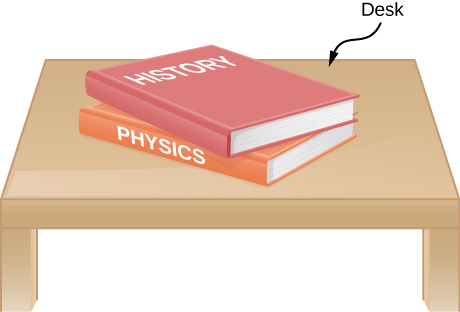
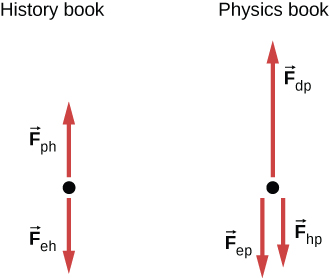
A history book is lying on top of a physics book on a desk, as shown below; a free-body diagram is also shown. The history and physics books weigh 14 N and 18 N, respectively. Identify each force on each book with a double subscript notation (for instance, the contact force of the history book pressing against physics book can be described as ), and determine the value of each of these forces, explaining the process used.
英語のヒント
下図のように、机の上の物理学の本に歴史の本が重ねられ、力の図も示されている。歴史の本と物理学の本の重さは、それぞれ14 Nと18 Nである。それぞれの本に働く力を、二つの添字を使って表せ。たとえば、歴史の本が物理学の本を押す接触力はと表せる。各力の大きさを求め、使った手順を説明せよ。


Solution解き方
Because the weight of the history book is the force exerted by Earth on the history book, we represent it as Aside from this, the history book interacts only with the physics book. Because the acceleration of the history book is zero, the net force on it is zero by Newton’s second law: where is the force exerted by the physics book on the history book. Thus, We find that the physics book exerts an upward force of magnitude 14 N on the history book. The physics book has three forces exerted on it: due to Earth, due to the history book, and due to the desktop. Since the physics book weighs 18 N, From Newton’s third law, so Newton’s second law applied to the physics book gives or so The desk exerts an upward force of 32 N on the physics book. To arrive at this solution, we apply Newton’s second law twice and Newton’s third law once.
英語のヒント
歴史の本の重さは、地球が歴史の本に及ぼす力なので、と表す。このほかに歴史の本が相互作用する相手は物理学の本だけである。歴史の本の加速度は0なので、ニュートンの第2法則から合力は0、すなわちである。は物理学の本が歴史の本に及ぼす力なので、となる。物理学の本は、歴史の本に上向き14 Nの力を及ぼしている。物理学の本には三つの力が働く。地球による、歴史の本による、机によるである。物理学の本の重さは18 Nなので、となる。ニュートンの第3法則より、したがってである。物理学の本に第2法則を適用すると、すなわちとなり、である。机は物理学の本に上向き32 Nの力を及ぼす。この解答を得るため、第2法則を二回、第3法則を一回適用した。
Exercise 49問題 49
A truck collides with a car, and during the collision, the net force on each vehicle is essentially the force exerted by the other. Suppose the mass of the car is 550 kg, the mass of the truck is 2200 kg, and the magnitude of the truck’s acceleration is . Find the magnitude of the car’s acceleration.
英語のヒント
トラックが車に衝突し、衝突中、それぞれの車両に働く合力はほぼ相手の車両が及ぼす力である。車の質量は550 kg、トラックの質量は2200 kg、トラックの加速度の大きさはとする。車の加速度の大きさを求めよ。
Newton’s third law of motion
ニュートンの運動の第3法則
whenever one body exerts a force on a second body, the first body experiences a force that is equal in magnitude and opposite in direction to the force that it exerts
英語のヒント
ある物体が別の物体に力を及ぼすとき、最初の物体は、自分が及ぼした力と大きさが等しく向きが逆の力を必ず受けるという法則。
thrust
推力
reaction force that pushes a body forward in response to a backward force
英語のヒント
後ろ向きの力に応じて、物体を前へ押す反作用。