第5章ニュートンの運動法則
5.7 Drawing Free-Body Diagrams5.7 力の図の描き方
Learning Objectives学習目標
Learning Objectives学習目標
By the end of this section, you will be able to:
英語のヒント
この節を終えると、次のことができるようになる。
- Explain the rules for drawing a free-body diagram
英語のヒント
力の図を描く規則を説明する。 - Construct free-body diagrams for different situations
英語のヒント
さまざまな状況の力の図を描く。
The first step in describing and analyzing most phenomena in physics involves the careful drawing of a free-body diagram. Free-body diagrams have been used in examples throughout this chapter. Remember that a free-body diagram must only include the external forces acting on the body of interest. Once we have drawn an accurate free-body diagram, we can apply Newton’s first law if the body is in equilibrium (balanced forces; that is, ) or Newton’s second law if the body is accelerating (unbalanced force; that is, ).
英語のヒント
物理学の多くの現象を記述・分析する最初の手順は、力の図を注意深く描くことである。この章の例でも、繰り返し力の図を使ってきた。力の図に含めるのは、着目する物体に働く外力だけである。正確な力の図を描いたら、物体がつり合っていればニュートンの第1法則を適用する。これは力がつり合い、である場合に当たる。物体が加速していれば第2法則を適用する。この場合は力がつり合わず、である。
In Forces, we gave a brief problem-solving strategy to help you understand free-body diagrams. Here, we add some details to the strategy that will help you in constructing these diagrams.
英語のヒント
「力」では、力の図を理解するための簡単な問題解決の手順を示した。ここでは、その手順に、図を描くのに役立つ詳しい説明を加える。
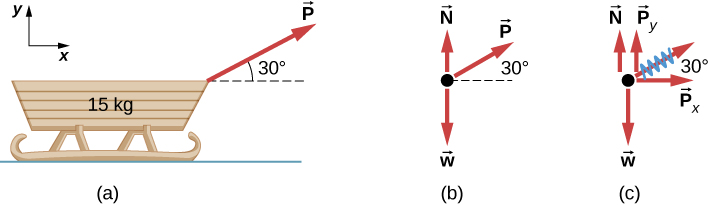
Let’s apply the problem-solving strategy in drawing a free-body diagram for a sled. In Figure 5.31(a), a sled is pulled by force P at an angle of . In part (b), we show a free-body diagram for this situation, as described by steps 1 and 2 of the problem-solving strategy. In part (c), we show all forces in terms of their x- and y-components, in keeping with step 3.
英語のヒント
この問題解決の手順を使い、そりの力の図を描こう。図5.31(a)では、そりを角の向きの力Pで引いている。(b)は、手順1と2に従ってこの状況を力の図にしたものである。(c)は、手順3に従い、すべての力をx成分とy成分で示している。
OpenStax / Rice University, University Physics Volume 1, CC BY 4.0. Source-book artwork retained. · CC BY 4.0 · Source出典

Figure 5.31図 5.31
(a) A moving sled is shown as (b) a free-body diagram and (c) a free-body diagram with force components.
英語のヒント
(a) 運動するそりを、(b) 力の図と、(c) 力の成分を加えた力の図で表す。
Example 5.14例題 5.14
Two Blocks on an Inclined Plane斜面上の二つの物体
Construct the free-body diagram for object A and object B in Figure 5.32. Assume that the rope pulls object A so that it slides upward, and that object B is sliding down the slope.
英語のヒント
図5.32の物体AとBについて、力の図を描け。ロープに引かれたAは斜面を上向きに滑り、Bは斜面を下向きに滑っていると仮定する。
Strategy方針
We follow the four steps listed in the problem-solving strategy.
英語のヒント
問題解決の方針に挙げた四つの手順に従う。
Solution解答
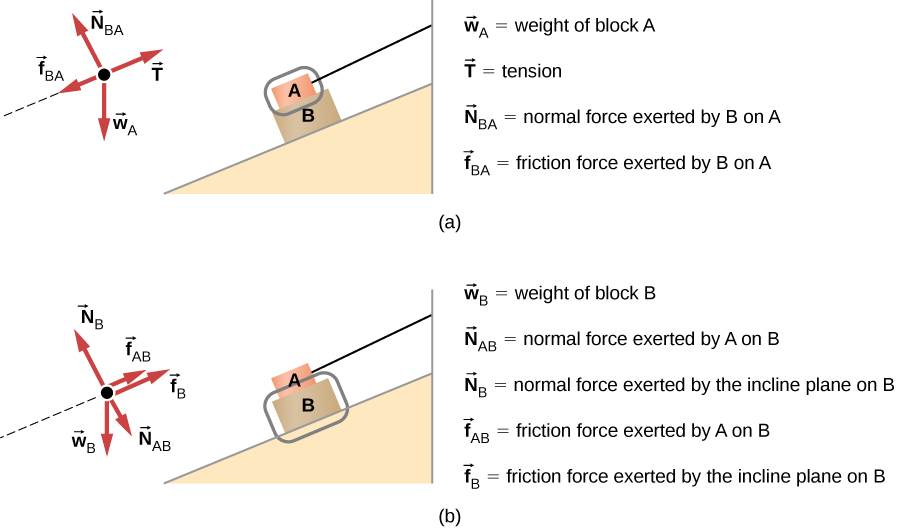
We start by creating a diagram for the first object of interest. In Figure 5.32(a), object A is isolated (circled) and represented by a dot.
英語のヒント
まず、一つ目の着目する物体について図を作る。図5.32(a)では物体Aを円で囲んで取り出し、点で表している。
OpenStax / Rice University, University Physics Volume 1, CC BY 4.0. Source-book artwork retained. · CC BY 4.0 · Source出典

Figure 5.32図 5.32
(a) The free-body diagram for isolated object A. (b) The free-body diagram for isolated object B. Comparing the two drawings, we see that friction acts in the opposite direction in the two figures. Friction always acts opposite the direction of motion or intended motion. Because object A is moving to the right, friction by B must act to the left. Object B is moving to the left relative to B, so the friction by A on B is to the right. The friction force by object A on object B is the third law pair of the friction force by B on A, and therefore these two forces must be in opposite directions. Because object B is sliding down the incline, the friction force by the ramp must oppose it and act up the ramp.
英語のヒント
(a) 取り出した物体Aの力の図。(b) 取り出した物体Bの力の図。二つの図を比べると、摩擦力が逆向きに働くことが分かる。摩擦は常に、運動または動こうとする向きに逆らう。Aは右へ動くので、Bが及ぼす摩擦力は左向きである。BはBに対して左へ動くので、AがBに及ぼす摩擦力は右向きである。AがBに及ぼす摩擦力は、BがAに及ぼす摩擦力と第3法則の対をなすため、二つの力は逆向きである。また、Bは斜面を滑り降りるので、斜面による摩擦力は運動に逆らい、斜面を上る向きに働く。
We now include any force that acts on the body. Here, no applied force is present. The weight of the object acts as a force pointing vertically downward, and the presence of the cord indicates a force of tension pointing away from the object. Object A has one interface and hence experiences a normal force, directed away from the interface. The source of this force is object B, and this normal force is labeled accordingly. Since object B s sliding down and object A s sliding up with respect to the interface, so the friction is directed downward parallel to the inclined plane.
英語のヒント
次に、物体に働く力をすべて含める。ここでは、別に加えた力はない。重さは鉛直下向きに働き、ひもがあることから、物体から離れる向きの張力がある。Aには接触面が一つあり、その面から離れる向きの垂直抗力を受ける。この力を及ぼすのはBなので、それに応じた記号を付ける。接触面に対してBは下向き、Aは上向きに滑るため、摩擦力は斜面に平行で下向きである。
As noted in step 4 of the problem-solving strategy, we then construct the free-body diagram in Figure 5.32(b) using the same approach. Object B experiences two normal forces and two friction forces due to the presence of two contact surfaces. The interface with the inclined plane exerts external forces of and , and the interface with object B exerts the normal force and friction ; is directed away from object B, and is opposing the tendency of the relative motion of object B with respect to object A.
英語のヒント
問題解決の手順4で述べたとおり、同じ方法で図5.32(b)の力の図を作る。Bには接触面が二つあるため、二つの垂直抗力と二つの摩擦力が働く。斜面との接触面は外力とを及ぼし、物体Bとの接触面は垂直抗力と摩擦力を及ぼす。はBから離れる向き、はAに対するBの相対運動の傾向に逆らう向きである。
Significance考察
The object under consideration in each part of this problem was circled in gray. When you are first learning how to draw free-body diagrams, you will find it helpful to circle the object before deciding what forces are acting on that particular object. This focuses your attention, preventing you from considering forces that are not acting on the body. If the objects were not sliding as described, we would need to know more about the strength of the tension force in order to determine the directions of the friction forces.
英語のヒント
この問題では、各小問で考える物体を灰色の円で囲んだ。力の図を描き始めるときは、働く力を判断する前に物体を囲むとよい。意識をその物体に集中させ、そこに働かない力まで考えるのを防げる。物体が記述のようには滑っていなかった場合、摩擦力の向きを決めるには、張力の強さについてさらに情報が必要になる。
Example 5.15例題 5.15
Two Blocks in Contact接した二つの物体
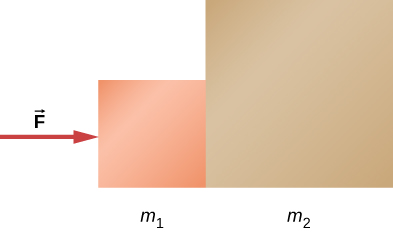
A force is applied to two blocks in contact, as shown. Draw the reaction forces between the two blocks.
英語のヒント
図のように、接した二つの物体に力を加える。物体間の作用・反作用の力を描け。
Strategy方針
Draw a free-body diagram for each block. Be sure to consider Newton’s third law at the interface where the two blocks touch.
英語のヒント
それぞれの物体について力の図を描く。二つの物体が接する面では、ニュートンの第3法則を必ず考える。
OpenStax / Rice University, University Physics Volume 1, CC BY 4.0. Source-book artwork retained. · CC BY 4.0 · Source出典

Solution解答
OpenStax / Rice University, University Physics Volume 1, CC BY 4.0. Source-book artwork retained. · CC BY 4.0 · Source出典

Significance考察
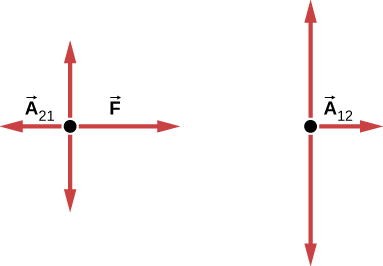
is the action force of block 2 on block 1. is the reaction force of block 1 on block 2. We use these free-body diagrams in Applications of Newton’s Laws.
英語のヒント
は物体2が物体1に及ぼす作用、は物体1が物体2に及ぼす反作用である。これらの力の図は「ニュートンの法則の応用」で使う。
Example 5.16例題 5.16
Block on the Table (Coupled Blocks)机上の物体(連結された物体)
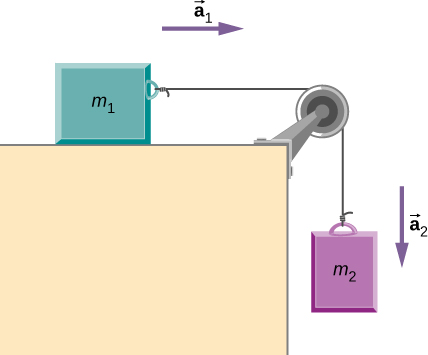
A block rests on the table, as shown. A light rope is attached to it and runs over a pulley. The other end of the rope is attached to a second block. The two blocks are said to be coupled. Block exerts a force due to its weight, which causes the system (two blocks and a string) to accelerate.
英語のヒント
図のように、物体が机上に置かれている。物体に軽いロープがつながり、滑車を越えて伸びている。他端は二つ目の物体につながっている。この二つの物体は連結されているという。物体は重さによる力を及ぼし、二つの物体とひもからなる系を加速させる。
Strategy方針
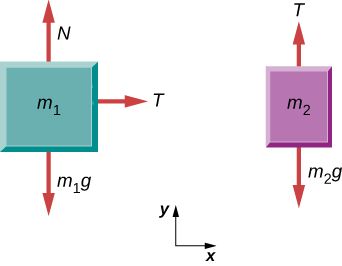
We assume that the string has no mass so that we do not have to consider it as a separate object. Draw a free-body diagram for each block.
英語のヒント
ひもを別の物体として考える必要がないよう、その質量は0と仮定する。それぞれの物体の力の図を描く。
OpenStax / Rice University, University Physics Volume 1, CC BY 4.0. Source-book artwork retained. · CC BY 4.0 · Source出典

Solution解答
OpenStax / Rice University, University Physics Volume 1, CC BY 4.0. Source-book artwork retained. · CC BY 4.0 · Source出典

Significance考察
Each block accelerates (notice the labels shown for and ); however, assuming the string remains taut, the magnitudes of acceleration are equal. Thus, we have . If we were to continue solving the problem, we could simply call the acceleration . Also, we use two free-body diagrams because we are usually finding tension T, which may require us to use a system of two equations in this type of problem. The tension is the same on both .
英語のヒント
各物体は加速する。図のとの記号に注目しよう。ただし、ひもが張ったままならば、加速度の大きさは等しく、となる。この先も問題を解くならば、加速度を単にと置ける。また、この種類の問題では張力Tを求めることが多く、二つの方程式を連立する必要がある場合があるため、力の図を二つ使う。に働く張力は、どちらも同じである。