第5章ニュートンの運動法則
5.5 Newton’s Third Law5.5 ニュートンの第3法則
Learning Objectives学習目標
Learning Objectives学習目標
By the end of this section, you will be able to:
英語のヒント
この節を終えると、次のことができるようになる。
- State Newton’s third law of motion
英語のヒント
ニュートンの運動の第3法則を述べる。 - Identify the action and reaction forces in different situations
英語のヒント
さまざまな状況で作用と反作用の力を特定する。 - Apply Newton’s third law to define systems and solve problems of motion
英語のヒント
ニュートンの第3法則を使って系を定め、運動の問題を解く。
We have thus far considered force as a push or a pull; however, if you think about it, you realize that no push or pull ever occurs by itself. When you push on a wall, the wall pushes back on you. This brings us to Newton’s third law.
英語のヒント
ここまでは、力を押すことや引くこととして考えてきた。しかし、考えてみれば、押す力や引く力が単独で生じることはない。壁を押すと、壁もこちらを押し返す。このことから、ニュートンの第3法則へ進もう。
Newton’s third law represents a certain symmetry in nature: Forces always occur in pairs, and one body cannot exert a force on another without experiencing a force itself. We sometimes refer to this law loosely as “action-reaction,” where the force exerted is the action and the force experienced as a consequence is the reaction. Newton’s third law has practical uses in analyzing the origin of forces and understanding which forces are external to a system.
英語のヒント
ニュートンの第3法則は、自然界のある種の対称性を表す。力は常に対になって生じ、一方の物体は、自分も力を受けずに他方へ力を及ぼすことはできない。この法則は、おおまかに「作用・反作用」と呼ばれることがある。及ぼした力を作用、その結果として受ける力を反作用とする呼び方である。ニュートンの第3法則は、力がどこから生じるかを分析し、どの力が系にとって外力なのかを理解する際に役立つ。
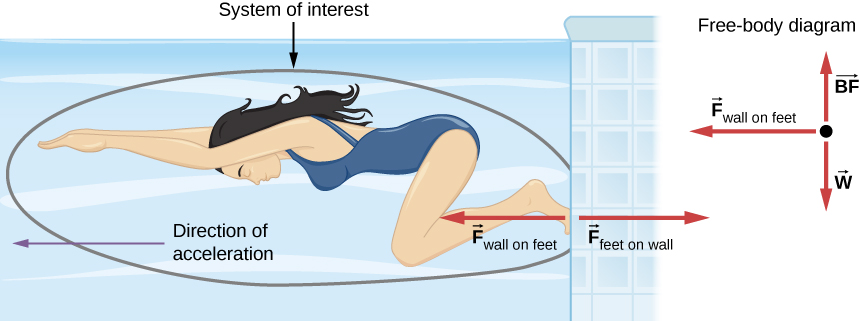
We can readily see Newton’s third law at work by taking a look at how people move about. Consider a swimmer pushing off the side of a pool (Figure 5.16). She pushes against the wall of the pool with her feet and accelerates in the direction opposite that of her push. The wall has exerted an equal and opposite force on the swimmer. You might think that two equal and opposite forces would cancel, but they do not because they act on different systems. In this case, there are two systems that we could investigate: the swimmer and the wall. If we select the swimmer to be the system of interest, as in the figure, then is an external force on this system and affects its motion. The swimmer moves in the direction of this force. In contrast, the force acts on the wall, not on our system of interest. Thus, does not directly affect the motion of the system and does not cancel The swimmer pushes in the direction opposite that in which she wishes to move. The reaction to her push is thus in the desired direction. In a free-body diagram, such as the one shown in Figure 5.16, we never include both forces of an action-reaction pair; in this case, we only use , not .
英語のヒント
人がどのように動くかを見ると、ニュートンの第3法則の働きがよく分かる。プールの壁を蹴って泳ぎ出す人を考えよう(図5.16)。足で壁を押すと、その人は押した向きと逆向きに加速する。壁が泳者に、同じ大きさで逆向きの力を及ぼしたためである。同じ大きさで逆向きの二つの力は打ち消し合うと思うかもしれないが、異なる系に働くため、そうはならない。この場合に調べられる系は、泳者と壁の二つである。図のように泳者を着目する系に選ぶと、はその系に働く外力であり、その運動に影響する。泳者は、この力の向きに動く。それに対して、は壁に働き、着目する系には働かない。したがって、は系の運動に直接影響せず、を打ち消さない。泳者は、進みたい向きと反対に押す。その反作用は、進みたい向きに働く。図5.16のような力の図には、作用・反作用の対をなす二つの力を両方とも描くことはない。この場合はだけを使い、は使わない。
OpenStax / Rice University, University Physics Volume 1, CC BY 4.0. Source-book artwork retained. · CC BY 4.0 · Source出典

Figure 5.16図 5.16
When the swimmer exerts a force on the wall, she accelerates in the opposite direction; in other words, the net external force on her is in the direction opposite of This opposition occurs because, in accordance with Newton’s third law, the wall exerts a force on the swimmer that is equal in magnitude but in the direction opposite to the one she exerts on it. The line around the swimmer indicates the system of interest. Thus, the free-body diagram shows only w (the gravitational force), and BF, which is the buoyant force of the water supporting the swimmer’s weight. The vertical forces w and BF cancel because there is no vertical acceleration.
英語のヒント
泳者が壁に力を及ぼすと、泳者は逆向きに加速する。言い換えると、泳者に働く外力の合力は、と逆向きである。これは、ニュートンの第3法則に従い、壁が泳者に力を及ぼすためである。この力は、泳者が壁に及ぼす力と同じ大きさで、逆向きに働く。泳者の周りの線が、着目する系を示す。したがって、力の図には、w(重力)、BF(水が泳者の重さを支える浮力)だけを示す。鉛直方向の加速度がないため、鉛直方向の力wとBFは打ち消し合う。
Other examples of Newton’s third law are easy to find:
英語のヒント
ニュートンの第3法則の例は、ほかにも容易に見つかる。
- As a professor paces in front of a whiteboard, he exerts a force backward on the floor. The floor exerts a reaction force forward on the professor that causes him to accelerate forward.
英語のヒント
教授がホワイトボードの前を歩くとき、床に後ろ向きの力を及ぼす。床は教授に前向きの反作用を及ぼし、教授を前向きに加速させる。 - A car accelerates forward because the ground pushes forward on the drive wheels, in reaction to the drive wheels pushing backward on the ground. You can see evidence of the wheels pushing backward when tires spin on a gravel road and throw the rocks backward.
英語のヒント
車が前向きに加速するのは、駆動輪が地面を後ろ向きに押すことに対する反作用として、地面が駆動輪を前向きに押すためである。砂利道でタイヤが空転して石を後ろに飛ばすとき、車輪が後ろ向きに押している証拠が見える。 - Rockets move forward by expelling gas backward at high velocity. This means the rocket exerts a large backward force on the gas in the rocket combustion chamber; therefore, the gas exerts a large reaction force forward on the rocket. This reaction force, which pushes a body forward in response to a backward force, is called thrust. It is a common misconception that rockets propel themselves by pushing on the ground or on the air behind them. They actually work better in a vacuum, where they can more readily expel the exhaust gases.
英語のヒント
ロケットは、気体を後ろ向きに高速で噴出して前進する。つまり、ロケットは燃焼室内の気体に大きな後ろ向きの力を及ぼし、その結果、気体がロケットに大きな前向きの反作用を及ぼす。後ろ向きの力に応じて物体を前へ押すこの反作用を、推力と呼ぶ。ロケットが地面や後方の空気を押して進むというのは、よくある誤解である。実際には、排気をより容易に噴出できる真空中のほうが、よく働く。 - Helicopters create lift by pushing air down, thereby experiencing an upward reaction force.
英語のヒント
ヘリコプターは空気を下に押し、それによって上向きの反作用を受けて揚力を生じる。 - Birds and airplanes also fly by exerting force on the air in a direction opposite that of whatever force they need. For example, the wings of a bird force air downward and backward to get lift and move forward.
英語のヒント
鳥や飛行機も、必要な力とは逆向きに空気へ力を及ぼすことで飛ぶ。たとえば鳥の翼は、揚力を得て前進するため、空気を下向きかつ後ろ向きに押す。 - An octopus propels itself in the water by ejecting water through a funnel from its body, similar to a jet ski.
英語のヒント
タコは水上バイクと同じように、体から漏斗を通して水を噴き出し、水中を進む。 - When a person pulls down on a vertical rope, the rope pulls up on the person (Figure 5.17).
英語のヒント
人が鉛直のロープを下向きに引くと、ロープはその人を上向きに引く(図5.17)。
Image omitted because its reuse rights could not be verified.権利の確認ができないため画像を割愛。
Figure 5.17図 5.17
When the mountain climber pulls down on the rope, the rope pulls up on the mountain climber. (credit left: modification of work by Cristian Bortes)
英語のヒント
登山者がロープを下に引くと、ロープは登山者を上に引く。(左の画像:Cristian Bortesの作品を改変)
There are two important features of Newton’s third law. First, the forces exerted (the action and reaction) are always equal in magnitude but opposite in direction. Second, these forces are acting on different bodies or systems: A’s force acts on B and B’s force acts on A. In other words, the two forces are distinct forces that do not act on the same body. Thus, they do not cancel each other.
英語のヒント
ニュートンの第3法則には二つの重要な特徴がある。第一に、作用と反作用の力は、常に大きさが等しく、向きが逆である。第二に、これらの力は異なる物体または系に働く。Aが及ぼす力はBに、Bが及ぼす力はAに働く。言い換えると、二つの力は別々の力であり、同じ物体には働かない。したがって、互いに打ち消し合わない。
For the situation shown in Figure 5.6, the third law indicates that because the chair is pushing upward on the boy with force he is pushing downward on the chair with force Similarly, he is pushing downward with forces and on the floor and table, respectively. Finally, since Earth pulls downward on the boy with force he pulls upward on Earth with force . If that student were to angrily pound the table in frustration, he would quickly learn the painful lesson (avoidable by studying Newton’s laws) that the table hits back just as hard.
英語のヒント
図5.6の状況では、第3法則によると、いすが少年を力で上向きに押すので、少年はいすを力で下向きに押している。同様に、少年は床と机を、それぞれとの力で下向きに押す。また、地球が少年を力で下向きに引くので、少年は地球を力で上向きに引く。もし少年がいら立って怒りに任せて机をたたけば、机もまったく同じ強さでたたき返すという、痛い教訓をすぐに学ぶことになる。ニュートンの法則を学んでいれば、その痛みは避けられる。
A person who is walking or running applies Newton’s third law instinctively. For example, the runner in Figure 5.18 pushes backward on the ground so that it pushes him forward.
英語のヒント
歩いたり走ったりする人は、無意識にニュートンの第3法則を使っている。たとえば図5.18の走者は地面を後ろ向きに押し、地面から前向きに押してもらう。
Image omitted because its reuse rights could not be verified.権利の確認ができないため画像を割愛。
Figure 5.18図 5.18
The runner experiences Newton’s third law. (a) A force is exerted by the runner on the ground. (b) The reaction force of the ground on the runner pushes him forward. (credit "runner": modification of work by "Greenwich Photography"/Flickr)
英語のヒント
走者にもニュートンの第3法則が働く。(a) 走者が地面に力を及ぼす。(b) 地面が走者に及ぼす反作用が、走者を前へ押す。(「走者」の画像:「Greenwich Photography」/Flickrの作品を改変)
Example 5.9例題 5.9
Forces on a Stationary Object静止した物体に働く力
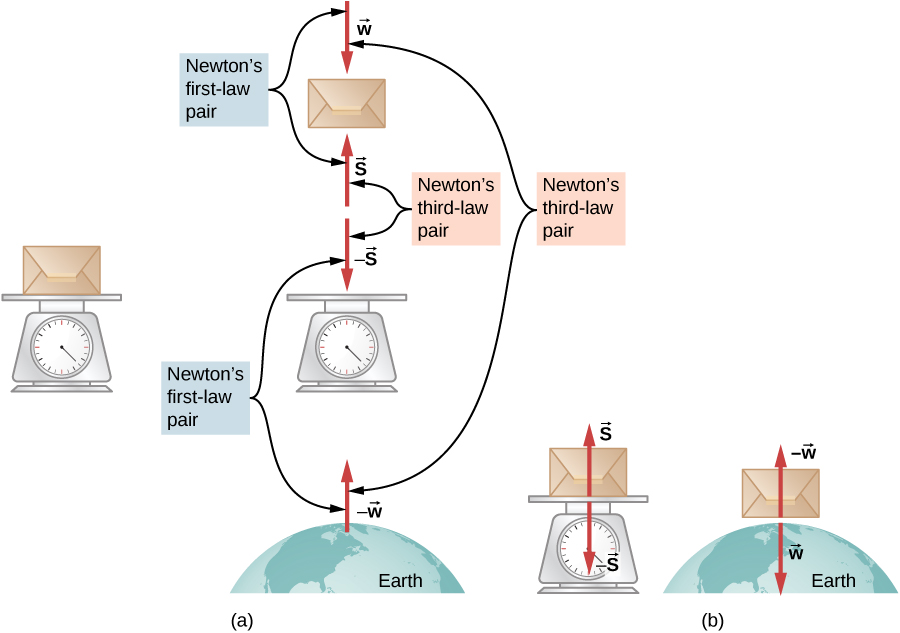
The package in Figure 5.19 is sitting on a scale. For the scale and package at rest (i.e., not accelerating), show that the scale indicates the weight of the package.
英語のヒント
図5.19の荷物が、はかりの上に置かれている。はかりと荷物が静止し、加速していない場合、はかりが荷物の重さを示すことを示せ。
OpenStax / Rice University, University Physics Volume 1, CC BY 4.0. Source-book artwork retained. · CC BY 4.0 · Source出典

Figure 5.19図 5.19
(a) The forces on a package sitting on a scale, along with their reaction forces. The force is the weight of the package (the force due to Earth’s gravity) and is the force of the scale on the package. (b) Isolation of the package-scale system and the package-Earth system makes the action and reaction pairs clear.
英語のヒント
(a) はかりの上の荷物に働く力と、それぞれの反作用。は荷物の重さ、すなわち地球の重力による力で、ははかりが荷物に及ぼす力である。(b) 荷物とはかりの系、荷物と地球の系をそれぞれ取り出すと、作用と反作用の対が明確になる。
Strategy方針
The forces on the package are which is due to the scale, and which is due to Earth’s gravitational field. The reaction forces that the package exerts are on the scale and on Earth. Because the package is not accelerating, application of the second law yields
英語のヒント
荷物に働く力は、はかりによると、地球の重力場によるである。荷物が及ぼす反作用は、はかりに対すると、地球に対するである。荷物は加速していないので、第2法則を適用すると次のようになる。
so
英語のヒント
したがって、
The scale reading indicates the magnitude of the force , which is equal to the magnitude of the package’s weight.
英語のヒント
はかりの読みは力の大きさを示し、それは荷物の重さの大きさに等しい。
Significance考察
The scale actually does not measure the weight of the package; it measures the force on its surface. If the system is accelerating, and would not be equal, as explained in Applications of Newton’s Laws.
英語のヒント
実際には、はかりは荷物の重さそのものではなく、はかりの面に働く力を測っている。系が加速していると、「ニュートンの法則の応用」で説明するように、とは等しくならない。
Example 5.10例題 5.10
Getting Up to Speed: Choosing the Correct System速度を上げる:適切な系を選ぶ
A physics professor pushes a cart of demonstration equipment to a lecture hall (Figure 5.20). Her mass is 65.0 kg, the cart’s mass is 12.0 kg, and the equipment’s mass is 7.0 kg. Calculate the acceleration produced when the professor exerts a backward force of 150 N on the floor. All forces opposing the motion, such as friction on the cart’s wheels and air resistance, total 24.0 N.
英語のヒント
物理学の教授が、実演用の器具を載せた台車を講義室まで押している(図5.20)。教授の質量は65.0 kg、台車は12.0 kg、器具は7.0 kgである。教授が床に後ろ向きの力150 Nを及ぼすとき、生じる加速度を求めよ。台車の車輪の摩擦や空気抵抗など、運動に逆らう力の合計は24.0 Nである。
OpenStax / Rice University, University Physics Volume 1, CC BY 4.0. Source-book artwork retained. · CC BY 4.0 · Source出典

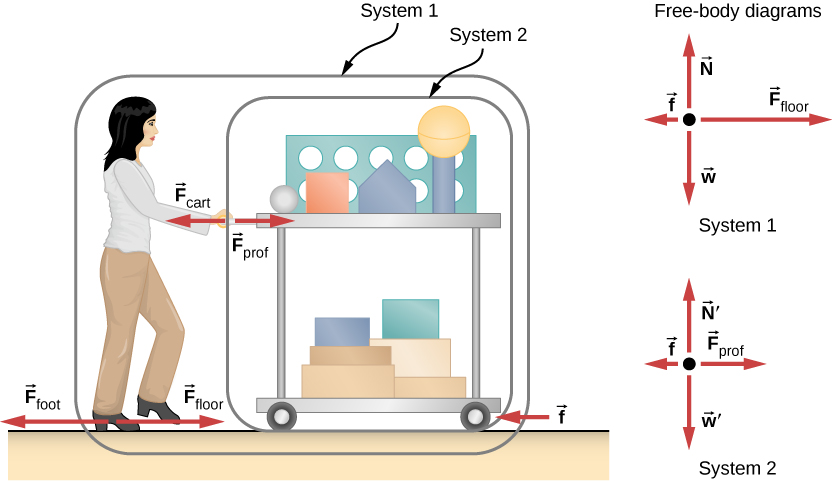
Figure 5.20図 5.20
A professor pushes the cart with her demonstration equipment. The lengths of the arrows are proportional to the magnitudes of the forces (except for because it is too small to be drawn to scale). System 1 is appropriate for this example, because it asks for the acceleration of the entire group of objects. Only and are external forces acting on System 1 along the line of motion. All other forces either cancel or act on the outside world. System 2 is chosen for the next example so that is an external force and enters into Newton’s second law. The free-body diagrams, which serve as the basis for Newton’s second law, vary with the system chosen.
英語のヒント
教授が実演用の器具を載せた台車を押している。矢印の長さは力の大きさに比例する。ただし、は小さすぎて縮尺どおりに描けないため例外である。この例では物体全体の加速度を求めるので、系1が適している。系1に働く外力のうち、運動方向に沿うものはとだけである。他の力は打ち消し合うか、系の外部に働く。次の例では系2を選び、が外力としてニュートンの第2法則に入るようにする。第2法則の基礎となる力の図は、選ぶ系によって変わる。
Strategy方針
Since they accelerate as a unit, we define the system to be the professor, cart, and equipment. This is System 1 in Figure 5.20. The professor pushes backward with a force of 150 N. According to Newton’s third law, the floor exerts a forward reaction force of 150 N on System 1. Because all motion is horizontal, we can assume there is no net force in the vertical direction. Therefore, the problem is one-dimensional along the horizontal direction. As noted, friction f opposes the motion and is thus in the opposite direction of We do not include the forces or because these are internal forces, and we do not include because it acts on the floor, not on the system. There are no other significant forces acting on System 1. If the net external force can be found from all this information, we can use Newton’s second law to find the acceleration as requested. See the free-body diagram in the figure.
英語のヒント
教授、台車、器具は一体となって加速するので、それらをまとめて系と定める。図5.20の系1である。教授は床を150 Nの力で後ろ向きに押す。ニュートンの第3法則によれば、床は系1に前向きの反作用を150 N及ぼす。運動はすべて水平方向なので、鉛直方向の合力は0と仮定できる。したがって、水平方向に沿った一次元の問題となる。先に述べたように、摩擦力fは運動に逆らい、と逆向きである。とは内力なので含めず、も系ではなく床に働くため含めない。系1には、このほかに無視できない力は働かない。これらの情報から外力の合力を求めれば、ニュートンの第2法則を使って、求められた加速度を計算できる。図中の力の図を参照しよう。
Solution解答
Newton’s second law is given by
英語のヒント
ニュートンの第2法則は、次の式で表される。
The net external force on System 1 is deduced from Figure 5.20 and the preceding discussion to be
英語のヒント
図5.20とここまでの考察から、系1に働く外力の合力は次のように求まる。
The mass of System 1 is
英語のヒント
系1の質量は、次のとおりである。
These values of and m produce an acceleration of
英語のヒント
とmのこれらの値から、加速度は次のようになる。
Significance考察
None of the forces between components of System 1, such as between the professor’s hands and the cart, contribute to the net external force because they are internal to System 1. Another way to look at this is that forces between components of a system cancel because they are equal in magnitude and opposite in direction. For example, the force exerted by the professor on the cart results in an equal and opposite force back on the professor. In this case, both forces act on the same system and therefore cancel. Thus, internal forces (between components of a system) cancel. Choosing System 1 was crucial to solving this problem.
英語のヒント
教授の手と台車の間の力のように、系1の構成要素間に働く力は、系1の内力なので、外力の合力には寄与しない。別の見方をすると、系の構成要素間の力は大きさが等しく向きが逆なので、打ち消し合う。たとえば、教授が台車に力を及ぼすと、教授には同じ大きさで逆向きの力が返る。この場合、両方の力は同じ系に働くため、打ち消し合う。こうして、系の構成要素間の内力は打ち消し合う。この問題を解くうえでは、系1を選ぶことが決定的に重要だった。
Example 5.11例題 5.11
Force on the Cart: Choosing a New System台車に働く力:新しい系を選ぶ
Calculate the force the professor exerts on the cart in Figure 5.20, using data from the previous example if needed.
英語のヒント
必要に応じて前の例のデータを使い、図5.20で教授が台車に及ぼす力を求めよ。
Strategy方針
If we define the system of interest as the cart plus the equipment (System 2 in Figure 5.20), then the net external force on System 2 is the force the professor exerts on the cart minus friction. The force she exerts on the cart, , is an external force acting on System 2. was internal to System 1, but it is external to System 2 and thus enters Newton’s second law for this system.
英語のヒント
台車と器具を着目する系(図5.20の系2)と定めると、系2に働く外力の合力は、教授が台車に及ぼす力から摩擦力を引いたものになる。教授が台車に及ぼす力は、系2に働く外力である。は系1では内力だったが、系2では外力となり、この系のニュートンの第2法則に入る。
Solution解答
Newton’s second law can be used to find We start with
英語のヒント
ニュートンの第2法則を使ってを求められる。次の式から始める。
The magnitude of the net external force on System 2 is
英語のヒント
系2に働く外力の合力の大きさは、次のようになる。
We solve for , the desired quantity:
英語のヒント
求めたい量について解く。
The value of f is given, so we must calculate net That can be done because both the acceleration and the mass of System 2 are known. Using Newton’s second law, we see that
英語のヒント
fの値は与えられているので、合力を求める必要がある。系2の加速度と質量はどちらも既知なので、計算できる。ニュートンの第2法則から、次のようになる。
where the mass of System 2 is 19.0 kg () and its acceleration was found to be in the previous example. Thus,
英語のヒント
系2の質量は19.0 kg()で、加速度は前の例でと求めた。したがって、次のようになる。
Now we can find the desired force:
英語のヒント
これで、求める力が得られる。
Significance考察
This force is significantly less than the 150-N force the professor exerted backward on the floor. Not all of that 150-N force is transmitted to the cart; some of it accelerates the professor. The choice of a system is an important analytical step both in solving problems and in thoroughly understanding the physics of the situation (which are not necessarily the same things).
英語のヒント
この力は、教授が床に後ろ向きに及ぼした150 Nよりかなり小さい。150 Nの力のすべてが台車に伝わるわけではなく、一部は教授自身を加速する。系を選ぶことは、問題を解くうえでも、その状況の物理を十分に理解するうえでも、重要な分析の手順である。この二つは、必ずしも同じことではない。