第5章ニュートンの運動法則
5.6 Common Forces5.6 よく現れる力
Learning Objectives学習目標
Learning Objectives学習目標
By the end of this section, you will be able to:
英語のヒント
この節を終えると、次のことができるようになる。
- Define normal and tension forces
英語のヒント
垂直抗力と張力を定義する。 - Distinguish between real and fictitious forces
英語のヒント
実在の力と見かけの力を区別する。 - Apply Newton’s laws of motion to solve problems involving a variety of forces
英語のヒント
ニュートンの運動の法則を適用し、さまざまな力が関わる問題を解く。
Forces are given many names, such as push, pull, thrust, and weight. Traditionally, forces have been grouped into several categories and given names relating to their source, how they are transmitted, or their effects. Several of these categories are discussed in this section, together with some interesting applications. Further examples of forces are discussed later in this text.
英語のヒント
力には、押す力、引く力、推力、重さなど、多くの名前がある。従来、力はいくつかの種類に分けられ、その起源、伝わり方、効果にちなんだ名前が付けられてきた。この節では、そのいくつかを興味深い応用とともに扱う。力のさらに多くの例は、本書の後半で取り上げる。
A Catalog of Forces: Normal, Tension, and Other Examples of Forces力の一覧:垂直抗力、張力、その他の力
A catalog of forces will be useful for reference as we solve various problems involving force and motion. These forces include normal force, tension, friction, and spring force.
英語のヒント
力と運動に関わるさまざまな問題を解く際には、力の一覧が参考になる。ここでは、垂直抗力、張力、摩擦力、ばねの力を扱う。
Normal force垂直抗力
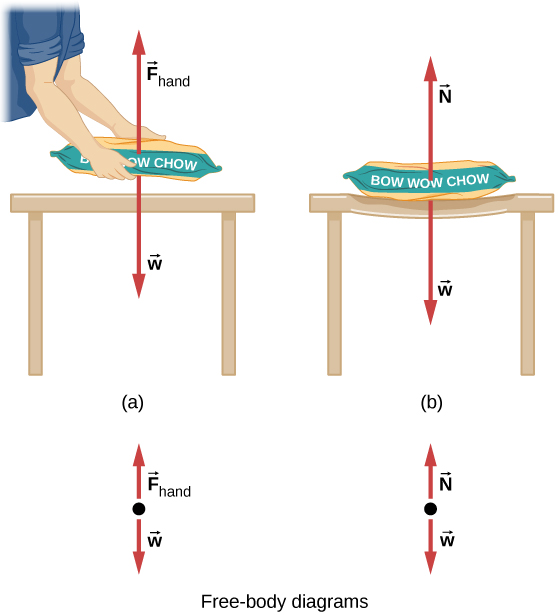
Weight (also called the force of gravity) is a pervasive force that acts at all times and must be counteracted to keep an object from falling. You must support the weight of a heavy object by pushing up on it when you hold it stationary, as illustrated in Figure 5.21(a). But how do inanimate objects like a table support the weight of a mass placed on them, such as shown in Figure 5.21(b)? When the bag of dog food is placed on the table, the table sags slightly under the load. This would be noticeable if the load were placed on a card table, but even a sturdy oak table deforms when a force is applied to it. Unless an object is deformed beyond its limit, it will exert a restoring force much like a deformed spring (or a trampoline or diving board). The greater the deformation, the greater the restoring force. Thus, when the load is placed on the table, the table sags until the restoring force becomes as large as the weight of the load. At this point, the net external force on the load is zero. That is the situation when the load is stationary on the table. The table sags quickly and the sag is slight, so we do not notice it. But it is similar to the sagging of a trampoline when you climb onto it.
英語のヒント
重さ、すなわち重力は、至るところで常に働いており、物体を落とさずにおくには、それに対抗する必要がある。図5.21(a)のように重い物体を静止させて持つには、上向きに押して重さを支えなければならない。では、図5.21(b)のような机などの無生物は、上に載せた物体の重さをどう支えるのだろうか。ドッグフードの袋を机に置くと、机は荷重によってわずかにたわむ。カードゲーム用の軽い机なら気付きやすいが、頑丈なオーク材の机でも、力が加わると変形する。限界を超えて変形していなければ、物体は変形したばね、トランポリン、飛び込み板と同じように復元力を及ぼす。変形が大きいほど、復元力も大きくなる。したがって、荷物を机に載せると、復元力が荷物の重さと同じになるまで机はたわむ。この時点で、荷物に働く外力の合力は0である。荷物が机の上で静止しているのは、この状態である。机のたわみはすばやく生じ、ごく小さいため、目には付かない。しかし、トランポリンに乗ったときのたわみと同じ仕組みである。
OpenStax / Rice University, University Physics Volume 1, CC BY 4.0. Source-book artwork retained. · CC BY 4.0 · Source出典

Figure 5.21図 5.21
(a) The person holding the bag of dog food must supply an upward force equal in magnitude and opposite in direction to the weight of the food so that it doesn’t drop to the ground. (b) The card table sags when the dog food is placed on it, much like a stiff trampoline. Elastic restoring forces in the table grow as it sags until they supply a force equal in magnitude and opposite in direction to the weight of the load.
英語のヒント
(a) ドッグフードの袋を持つ人は、袋が地面に落ちないよう、重さと大きさが等しく逆向きの上向きの力を加える必要がある。(b) 袋を載せると、カードゲーム用の机は硬いトランポリンのようにたわむ。机の弾性復元力はたわむほど大きくなり、荷物の重さと大きさが等しく逆向きの力を及ぼす。
We must conclude that whatever supports a load, be it animate or not, must supply an upward force equal to the weight of the load, as we assumed in a few of the previous examples. If the force supporting the weight of an object, or a load, is perpendicular to the surface of contact between the load and its support, this force is defined as a normal force and here is given by the symbol (This is not the newton unit for force, or N.) The word normal means perpendicular to a surface. This means that the normal force experienced by an object resting on a horizontal surface can be expressed in vector form as follows:
英語のヒント
荷物を支えるものが生物であろうとなかろうと、先のいくつかの例で仮定したように、荷物の重さに等しい上向きの力を及ぼすはずである。物体や荷物の重さを支える力が、荷物と支えるものとの接触面に垂直ならば、その力を垂直抗力と定義し、ここでは記号で表す。これは、力の単位ニュートンを表すNではない。normalという語は、面に垂直という意味である。したがって、水平面上に静止した物体が受ける垂直抗力は、次のベクトルの形で書ける。
In scalar form, this becomes
英語のヒント
スカラーの形では、次のようになる。
The normal force can be less than the object’s weight if the object is on an incline.
英語のヒント
物体が斜面上にあるとき、垂直抗力は物体の重さより小さい場合がある。
Example 5.12例題 5.12
Weight on an Incline斜面上の重さ
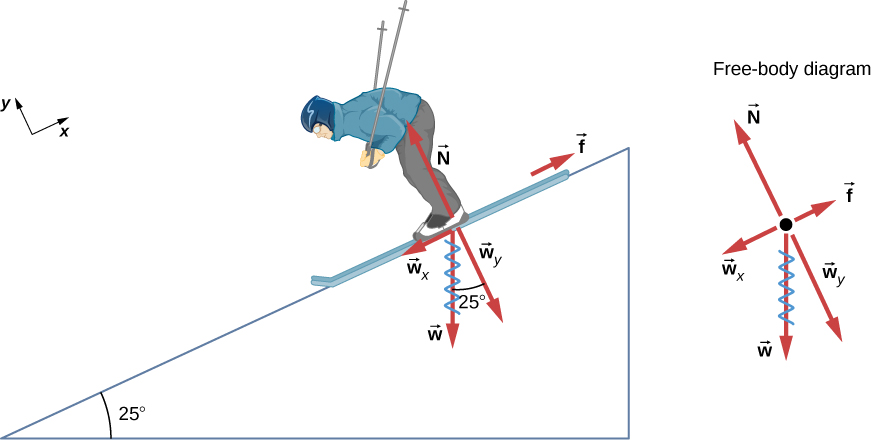
Consider the skier on the slope in Figure 5.22. Her mass including equipment is 60.0 kg. (a) What is her acceleration if friction is negligible? (b) What is her acceleration if friction is 45.0 N?
英語のヒント
図5.22の斜面上のスキーヤーを考える。装備を含めた質量は60.0 kgである。(a) 摩擦を無視できるとき、加速度はいくらか。(b) 摩擦力が45.0 Nのとき、加速度はいくらか。
OpenStax / Rice University, University Physics Volume 1, CC BY 4.0. Source-book artwork retained. · CC BY 4.0 · Source出典

Figure 5.22図 5.22
Since the acceleration is parallel to the slope and acting down the slope, it is most convenient to project all forces onto a coordinate system where one axis is parallel to the slope and the other is perpendicular to it (axes shown to the left of the skier). is perpendicular to the slope and is parallel to the slope, but has components along both axes, namely, and . Here, has a squiggly line to show that it has been replaced by these components. The force is equal in magnitude to , so there is no acceleration perpendicular to the slope, but f is less than , so there is a downslope acceleration (along the axis parallel to the slope).
英語のヒント
加速度は斜面に平行で下向きなので、一方の軸を斜面に平行、他方を垂直にした座標系に力を投影すると便利である。軸はスキーヤーの左側に示す。は斜面に垂直、は平行だが、には両軸に沿う成分とがある。には波線を付け、これらの成分で置き換えたことを示している。はと大きさが等しいため、斜面に垂直な加速度はない。しかし、fはより小さいので、斜面に沿って下向きの加速度が生じる。
Strategy方針
This is a two-dimensional problem, since not all forces on the skier (the system of interest) are parallel. The approach we have used in two-dimensional kinematics also works well here. Choose a convenient coordinate system and project the vectors onto its axes, creating two one-dimensional problems to solve. The most convenient coordinate system for motion on an incline is one that has one coordinate parallel to the slope and one perpendicular to the slope. (Motions along mutually perpendicular axes are independent.) We use x and y for the parallel and perpendicular directions, respectively. This choice of axes simplifies this type of problem, because there is no motion perpendicular to the slope and the acceleration is downslope. Regarding the forces, friction is drawn in opposition to motion (friction always opposes forward motion) and is always parallel to the slope, is drawn parallel to the slope and downslope (it causes the motion of the skier down the slope), and is drawn as the component of weight perpendicular to the slope. Then, we can consider the separate problems of forces parallel to the slope and forces perpendicular to the slope.
英語のヒント
着目する系であるスキーヤーに働くすべての力が平行というわけではないので、これは二次元の問題である。二次元の運動学で使った方法が、ここでも役立つ。都合のよい座標系を選び、ベクトルを各軸に投影すれば、二つの一次元の問題として解ける。斜面上の運動では、一方の軸が斜面に平行で、他方が垂直な座標系が最も便利である。互いに垂直な軸に沿う運動は独立している。平行な方向をx、垂直な方向をyとする。斜面に垂直な運動はなく、加速度は斜面に沿って下向きなので、この軸の選び方によって問題が簡単になる。力については、摩擦力を運動に逆らう向きに描く。摩擦は常に前向きの運動に逆らい、斜面に平行である。は斜面に平行な下向きで、スキーヤーを滑り降りさせる。は重さのうち斜面に垂直な成分として描く。これにより、斜面に平行な力と垂直な力を別々の問題として考えられる。
Solution解答
The magnitude of the component of weight parallel to the slope is
英語のヒント
重さの斜面に平行な成分の大きさは、次のようになる。
and the magnitude of the component of the weight perpendicular to the slope is
英語のヒント
重さの斜面に垂直な成分の大きさは、次のようになる。
a. Neglect friction. Since the acceleration is parallel to the slope, we need only consider forces parallel to the slope. (Forces perpendicular to the slope add to zero, since there is no acceleration in that direction.) The forces parallel to the slope are the component of the skier’s weight parallel to slope and friction f. Using Newton’s second law, with subscripts to denote quantities parallel to the slope,
英語のヒント
a. 摩擦を無視する。加速度は斜面に平行なので、平行な力だけを考えればよい。垂直方向には加速度がないため、その方向の力の和は0である。斜面に平行な力は、重さの平行成分と摩擦力fである。斜面に平行な量を添字で表し、ニュートンの第2法則を使うと、次のようになる。
where assuming no friction for this part. Therefore,
英語のヒント
この小問では摩擦がないと仮定するため、である。したがって、
is the acceleration.
英語のヒント
が加速度である。
b. Include friction. We have a given value for friction, and we know its direction is parallel to the slope and it opposes motion between surfaces in contact. So the net external force is
英語のヒント
b. 摩擦を含める。摩擦力の値は与えられており、その向きは斜面に平行で、接する面どうしの運動に逆らう。したがって、外力の合力は次のようになる。
Substituting this into Newton’s second law, gives
英語のヒント
これをニュートンの第2法則に代入すると、次のようになる。
We substitute known values to obtain
英語のヒント
既知の値を代入すると、
This gives us
英語のヒント
次の値が得られる。
which is the acceleration parallel to the incline when there is 45.0 N of opposing friction.
英語のヒント
これは、運動に逆らう摩擦力が45.0 Nであるときの、斜面に平行な加速度である。
Significance考察
Since friction always opposes motion between surfaces, the acceleration is smaller when there is friction than when there is none. It is a general result that if friction on an incline is negligible, then the acceleration down the incline is , regardless of mass. As discussed previously, all objects fall with the same acceleration in the absence of air resistance. Similarly, all objects, regardless of mass, slide down a frictionless incline with the same acceleration (if the angle is the same).
英語のヒント
摩擦は常に面どうしの運動に逆らうので、摩擦があるときの加速度は、ないときより小さい。一般に、斜面上の摩擦を無視できれば、下向きの加速度は質量に関係なくとなる。先に述べたように、空気抵抗がなければ、どの物体も同じ加速度で落下する。同様に、摩擦のない斜面でも、角度が同じならば、どの物体も質量に関係なく同じ加速度で滑り降りる。
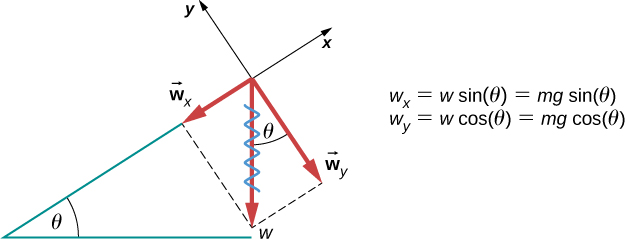
When an object rests on an incline that makes an angle with the horizontal, the force of gravity acting on the object is divided into two components: a force acting perpendicular to the plane, , and a force acting parallel to the plane, (Figure 5.23). The normal force is typically equal in magnitude and opposite in direction to the perpendicular component of the weight . The force acting parallel to the plane, , causes the object to accelerate down the incline.
英語のヒント
水平と角をなす斜面に物体を置くと、物体に働く重力を、斜面に垂直な成分と平行な成分に分けられる(図5.23)。垂直抗力は、通常、重さの垂直成分と大きさが等しく、逆向きに働く。平行成分は、物体を斜面に沿って下向きに加速させる。
OpenStax / Rice University, University Physics Volume 1, CC BY 4.0. Source-book artwork retained. · CC BY 4.0 · Source出典

Figure 5.23図 5.23
An object rests on an incline that makes an angle with the horizontal.
英語のヒント
水平と角をなす斜面上にある物体。
Be careful when resolving the weight of the object into components. If the incline is at an angle to the horizontal, then the magnitudes of the weight components are
英語のヒント
重さを成分に分解するときは注意が必要である。斜面が水平と角をなすならば、重さの各成分の大きさは、
and
英語のヒント
および
We use the second equation to write the normal force experienced by an object resting on an inclined plane:
英語のヒント
二つ目の式を使うと、斜面上の物体が受ける垂直抗力を、次のように書ける。
object at rest or sliding on an inclined plane. Instead of memorizing these equations, it is helpful to be able to determine them from reason. To do this, we draw the right angle formed by the three weight vectors. The angle of the incline is the same as the angle formed between w and . Knowing this property, we can use trigonometry to determine the magnitude of the weight components:
英語のヒント
これは、物体が斜面上で静止しているか、滑っている場合である。式を暗記するよりも、理由を考えて導けるようになるほうが役立つ。そのため、重さの三つのベクトルがつくる直角を描く。斜面の角は、wとのなす角と同じである。この性質を使うと、三角法によって重さの各成分の大きさを求められる。