第5章ニュートンの運動法則
Tension張力
A tension is a force along the length of a medium; in particular, it is a pulling force that acts along a stretched flexible connector, such as a rope or cable. The word “tension” comes from a Latin word meaning “to stretch.” Not coincidentally, the flexible cords that carry muscle forces to other parts of the body are called tendons.
英語のヒント
張力は、ある媒介物の長さ方向に働く力である。とくに、ロープやケーブルなど、張った柔軟な連結物に沿って働く引く力を指す。tensionという語は、「伸ばす」を意味するラテン語に由来する。筋肉の力を体の他の部分へ伝える柔軟なひも状の組織がtendon(腱)と呼ばれるのも、偶然ではない。
Any flexible connector, such as a string, rope, chain, wire, or cable, can only exert a pull parallel to its length; thus, a force carried by a flexible connector is a tension with a direction parallel to the connector. Tension is a pull in a connector. Consider the phrase: “You can’t push a rope.” Instead, tension force pulls outward along the two ends of a rope.
英語のヒント
糸、ロープ、鎖、針金、ケーブルなどの柔軟な連結物は、その長さに平行な引く力しか及ぼせない。したがって、柔軟な連結物によって伝わる力は、それに平行な張力である。張力は連結物を引っ張る力である。「ロープを押すことはできない」という言葉を考えよう。張力は、ロープの両端に沿って外向きに引く。
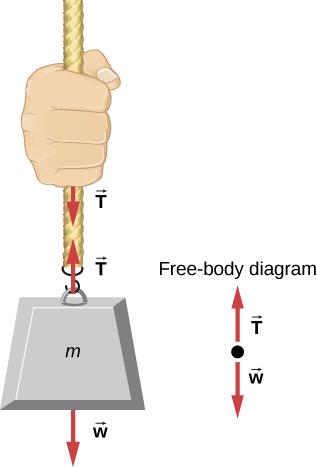
Consider a person holding a mass on a rope, as shown in Figure 5.24. If the 5.00-kg mass in the figure is stationary, then its acceleration is zero and the net force is zero. The only external forces acting on the mass are its weight and the tension supplied by the rope. Thus,
英語のヒント
図5.24のように、人がロープで物体をつり下げて支えている場合を考える。図の質量5.00 kgの物体が静止していれば、加速度は0で、合力も0である。物体に働く外力は、重さとロープによる張力だけなので、次の式が成り立つ。
where T and w are the magnitudes of the tension and weight, respectively, and their signs indicate direction, with up being positive. As we proved using Newton’s second law, the tension equals the weight of the supported mass:
英語のヒント
Tとwはそれぞれ張力と重さの大きさで、符号が向きを表し、上向きを正とする。ニュートンの第2法則で示したように、張力はつり下げた物体の重さに等しい。
object hanging at rest. Thus, for a 5.00-kg mass (neglecting the mass of the rope), we see that
英語のヒント
これは、物体がつり下げられて静止している場合である。したがって、質量5.00 kgの物体について、ロープの質量を無視すると、次のようになる。
If we cut the rope and insert a spring, the spring would extend a length corresponding to a force of 49.0 N, providing a direct observation and measure of the tension force in the rope.
英語のヒント
ロープを切ってばねを挿入すれば、ばねは49.0 Nの力に対応する長さだけ伸び、ロープの張力を直接観察し、測定できる。
OpenStax / Rice University, University Physics Volume 1, CC BY 4.0. Source-book artwork retained. · CC BY 4.0 · Source出典

Figure 5.24図 5.24
When a perfectly flexible connector (one requiring no force to bend it) such as this rope transmits a force that force must be parallel to the length of the rope, as shown. By Newton’s third law, the rope pulls with equal force but in opposite directions on the hand and the supported mass (neglecting the weight of the rope). The rope is the medium that carries the equal and opposite forces between the two objects. The tension anywhere in the rope between the hand and the mass is equal. Once you have determined the tension in one location, you have determined the tension at all locations along the rope.
英語のヒント
このロープのように、曲げるのに力を必要としない完全に柔軟な連結物が力を伝えるとき、その力は図のようにロープの長さ方向に平行でなければならない。ロープの重さを無視すると、ニュートンの第3法則により、ロープは手とつり下げた物体を、同じ大きさで逆向きに引く。ロープは二つの物体間で、同じ大きさで逆向きの力を伝える媒介物である。手と物体の間のロープでは、どの場所でも張力は等しい。一か所の張力が求まれば、ロープ全体の各点の張力が求まる。
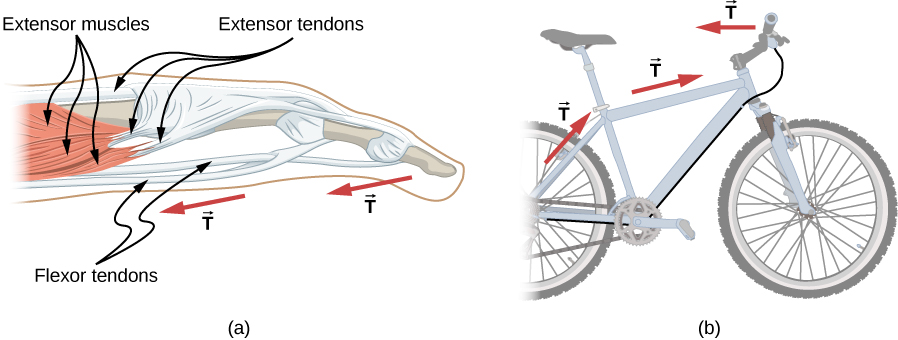
Flexible connectors are often used to transmit forces around corners, such as in a hospital traction system, a tendon, or a bicycle brake cable. If there is no friction, the tension transmission is undiminished; only its direction changes, and it is always parallel to the flexible connector, as shown in Figure 5.25.
英語のヒント
柔軟な連結物は、病院の牽引装置、腱、自転車のブレーキケーブルなどで、曲がった経路に沿って力を伝えるためによく使われる。摩擦がなければ、張力の大きさは減らずに伝わる。変わるのは向きだけであり、図5.25のように、張力は常に連結物に平行である。
OpenStax / Rice University, University Physics Volume 1, CC BY 4.0. Source-book artwork retained. · CC BY 4.0 · Source出典

Figure 5.25図 5.25
(a) Tendons in the finger carry force T from the muscles to other parts of the finger, usually changing the force’s direction but not its magnitude (the tendons are relatively friction free). (b) The brake cable on a bicycle carries the tension T from the brake lever on the handlebars to the brake mechanism. Again, the direction but not the magnitude of T is changed.
英語のヒント
(a) 指の腱は、筋肉から指の他の部分へ力Tを伝える。腱の摩擦は比較的小さいため、通常は力の向きだけを変え、大きさは変えない。(b) 自転車のブレーキケーブルは、ハンドル上のブレーキレバーからブレーキ機構へ張力Tを伝える。この場合もTの向きだけが変わり、大きさは変わらない。
Example 5.13例題 5.13
What Is the Tension in a Tightrope?綱渡りの綱に働く張力はいくらか
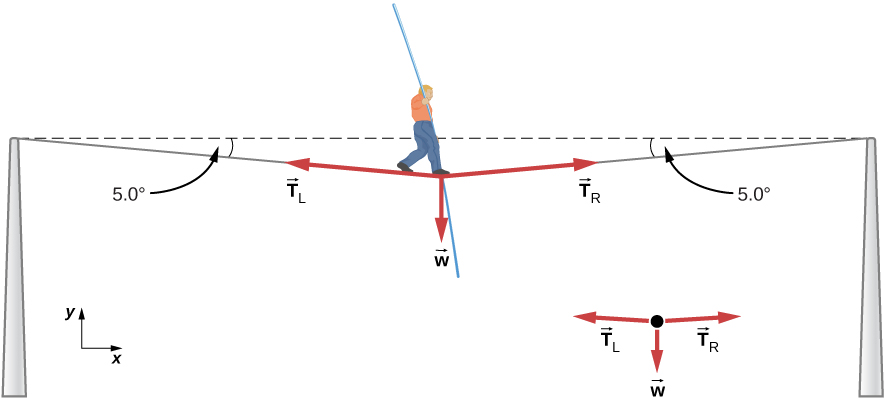
Calculate the tension in the wire supporting the 70.0-kg tightrope walker shown in Figure 5.26.
英語のヒント
図5.26の質量70.0 kgの綱渡り師を支えるワイヤーの張力を求めよ。
OpenStax / Rice University, University Physics Volume 1, CC BY 4.0. Source-book artwork retained. · CC BY 4.0 · Source出典

Figure 5.26図 5.26
The weight of a tightrope walker causes a wire to sag by . The system of interest is the point in the wire at which the tightrope walker is standing.
英語のヒント
綱渡り師の重さによって、ワイヤーはだけたわむ。着目する系は、ワイヤーのうち綱渡り師が立つ点である。
Strategy方針
As you can see in Figure 5.26, the wire is bent under the person’s weight. Thus, the tension on either side of the person has an upward component that can support his weight. As usual, forces are vectors represented pictorially by arrows that have the same direction as the forces and lengths proportional to their magnitudes. The system is the tightrope walker, and the only external forces acting on him are his weight and the two tensions (left tension) and (right tension). It is reasonable to neglect the weight of the wire. The net external force is zero, because the system is static. We can use trigonometry to find the tensions. One conclusion is possible at the outset—we can see from Figure 5.26(b) that the magnitudes of the tensions and must be equal. We know this because there is no horizontal acceleration in the rope and the only forces acting to the left and right are and . Thus, the magnitude of those horizontal components of the forces must be equal so that they cancel each other out.
英語のヒント
図5.26のように、ワイヤーは人の重さで曲がる。そのため、左右の張力には、人の重さを支えられる上向きの成分がある。いつものように、力は矢印で表すベクトルであり、矢印の向きは力の向き、長さは力の大きさに比例する。系は綱渡り師で、そこに働く外力は重さと二つの張力(左側)、(右側)だけである。ワイヤーの重さは無視してよい。系は静止しているので、外力の合力は0である。張力は三角法で求められる。初めから分かることが一つある。図5.26(b)から、張力との大きさは等しいはずである。ロープには水平方向の加速度がなく、左右に働く力はとだけだからである。したがって、これらの水平成分は互いに打ち消し合うよう、大きさが等しくなければならない。
Whenever we have two-dimensional vector problems in which no two vectors are parallel, the easiest method of solution is to pick a convenient coordinate system and project the vectors onto its axes. In this case, the best coordinate system has one horizontal axis (x) and one vertical axis (y).
英語のヒント
どの二つのベクトルも平行でない二次元の問題では、都合のよい座標系を選び、ベクトルを各軸に投影するのが最も簡単な方法である。この場合は、水平軸xと鉛直軸yを使う座標系が最も適している。
Solution解答
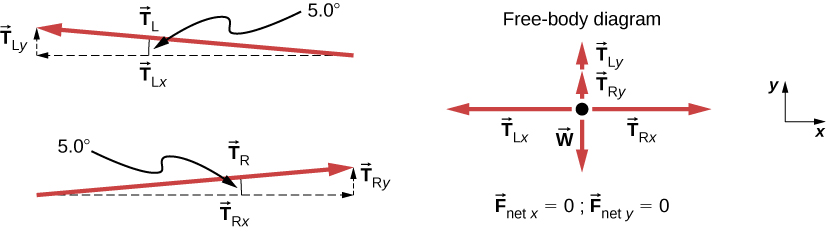
First, we need to resolve the tension vectors into their horizontal and vertical components. It helps to look at a new free-body diagram showing all horizontal and vertical components of each force acting on the system (Figure 5.27).
英語のヒント
まず、張力ベクトルを水平成分と鉛直成分に分解する必要がある。系に働く各力のすべての水平成分と鉛直成分を示した、新しい力の図を見ると分かりやすい(図5.27)。
OpenStax / Rice University, University Physics Volume 1, CC BY 4.0. Source-book artwork retained. · CC BY 4.0 · Source出典

Figure 5.27図 5.27
When the vectors are projected onto vertical and horizontal axes, their components along these axes must add to zero, since the tightrope walker is stationary. The small angle results in T being much greater than w.
英語のヒント
綱渡り師は静止しているので、ベクトルを鉛直軸と水平軸へ投影した各成分の和は、どちらも0でなければならない。角度が小さいため、Tはwよりはるかに大きくなる。
Consider the horizontal components of the forces (denoted with a subscript x):
英語のヒント
力の水平成分(添字xで表す)を考える。
The net external horizontal force since the person is stationary. Thus,
英語のヒント
人が静止しているので、外力の水平成分の合計はである。したがって、
Now observe Figure 5.27. You can use trigonometry to determine the magnitude of and :
英語のヒント
図5.27を見よう。三角法を使うと、との大きさを求められる。
Equating TLx and TRx:
英語のヒント
TLxとTRxを等しいと置くと、
Thus,
英語のヒント
したがって、
as predicted. Now, considering the vertical components (denoted by a subscript y), we can solve for T. Again, since the person is stationary, Newton’s second law implies that . Thus, as illustrated in the free-body diagram,
英語のヒント
となり、予想と一致する。次に、添字yで表す鉛直成分を考えると、Tを求められる。人は静止しているので、ここでもニュートンの第2法則からとなる。したがって、力の図に示すように、
We can use trigonometry to determine the relationships among and T. As we determined from the analysis in the horizontal direction, :
英語のヒント
三角法を使い、とTの関係を求められる。水平方向の分析から分かったようになので、
Now we can substitute the vales for and , into the net force equation in the vertical direction:
英語のヒント
ここで、との値を、鉛直方向の合力の式に代入できる。
and
英語のヒント
そして、
so
英語のヒント
よって、
and the tension is
英語のヒント
張力は、
Significance考察
The vertical tension in the wire acts as a force that supports the weight of the tightrope walker. The tension is almost six times the 686-N weight of the tightrope walker. Since the wire is nearly horizontal, the vertical component of its tension is only a fraction of the tension in the wire. The large horizontal components are in opposite directions and cancel, so most of the tension in the wire is not used to support the weight of the tightrope walker.
英語のヒント
ワイヤーの張力の鉛直成分が、綱渡り師の重さを支える力として働く。張力そのものは、綱渡り師の重さ686 Nのほぼ6倍である。ワイヤーがほぼ水平なので、張力の鉛直成分は全体の一部にすぎない。大きい水平成分どうしは逆向きで打ち消し合うため、ワイヤーの張力の大部分は、綱渡り師の重さを支えることには使われていない。
If we wish to create a large tension, all we have to do is exert a force perpendicular to a taut flexible connector, as illustrated in Figure 5.26. As we saw in Example 5.13, the weight of the tightrope walker acts as a force perpendicular to the rope. We saw that the tension in the rope is related to the weight of the tightrope walker in the following way:
英語のヒント
We can extend this expression to describe the tension T created when a perpendicular force is exerted at the middle of a flexible connector:
英語のヒント
この式を拡張すると、柔軟な連結物の中央に垂直な力を加えたときに生じる張力Tを、次のように表せる。
The angle between the horizontal and the bent connector is represented by . In this case, T becomes large as approaches zero. Even the relatively small weight of any flexible connector will cause it to sag, since an infinite tension would result if it were horizontal (i.e., and sin ). For example, Figure 5.28 shows a situation where we wish to pull a car out of the mud when no tow truck is available. Each time the car moves forward, the chain is tightened to keep it as straight as possible. The tension in the chain is given by and since is small, T is large. This situation is analogous to the tightrope walker, except that the tensions shown here are those transmitted to the car and the tree rather than those acting at the point where is applied.
英語のヒント
水平と曲がった連結物のなす角をで表す。この場合、が0に近づくとTは大きくなる。連結物自体の比較的小さい重さでも、たわみは生じる。完全に水平ならば、かつsin となり、張力が無限大になってしまうためである。たとえば図5.28は、牽引車がないときに泥にはまった車を引き出す状況である。車が前へ動くたびに鎖を張り直し、できるだけ真っすぐにする。鎖の張力はで与えられ、が小さいためTは大きい。これは綱渡り師の場合と似ているが、ここで示す張力は、を加える点に働く力ではなく、車と木に伝わる力である。

OpenStax / Rice University, University Physics Volume 1, CC BY 4.0. Source-book artwork retained. · CC BY 4.0 · Source出典

Figure 5.28図 5.28
We can create a large tension in the chain—and potentially a big mess—by pushing on it perpendicular to its length, as shown.
英語のヒント
図のように鎖を長さ方向に垂直に押すことで、大きな張力を生じさせられる。大きな騒ぎを引き起こす可能性もある。