第5章ニュートンの運動法則
5.2 Newton's First Law5.2 ニュートンの第1法則
Learning Objectives学習目標
Learning Objectives学習目標
By the end of this section, you will be able to:
英語のヒント
この節を終えると、次のことができるようになる。
- Describe Newton's first law of motion
英語のヒント
ニュートンの運動の第1法則を説明する。 - Recognize friction as an external force
英語のヒント
摩擦を外力として認識する。 - Define inertia
英語のヒント
慣性を定義する。 - Identify inertial reference frames
英語のヒント
慣性基準系を識別する。 - Calculate equilibrium for a system
英語のヒント
系のつり合いを計算する。
Experience suggests that an object at rest remains at rest if left alone and that an object in motion tends to slow down and stop unless some effort is made to keep it moving. However, Newton’s first law gives a deeper explanation of this observation.
英語のヒント
経験上、静止している物体は放っておけば静止し続け、運動している物体は、動き続けるよう何らかの働きかけをしない限り、減速して止まるように思われる。しかし、ニュートンの第1法則は、この観察をもっと深いところから説明する。
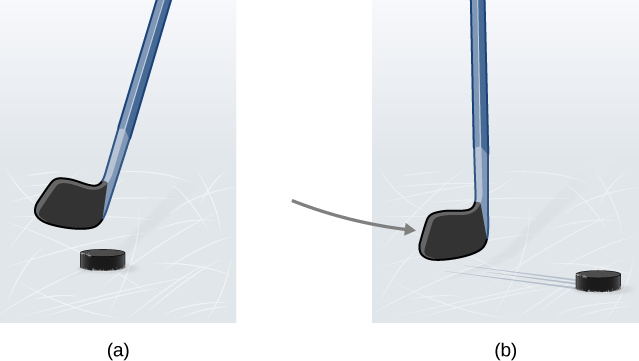
Note the repeated use of the verb “remains.” We can think of this law as preserving the status quo of motion. Also note the expression “constant velocity;” this means that the object maintains a path along a straight line, since neither the magnitude nor the direction of the velocity vector changes. We can use Figure 5.7 to consider the two parts of Newton’s first law.
英語のヒント
「〜し続ける(remains)」という動詞が繰り返されている点に注意しよう。この法則は、運動の現状を維持する法則と考えられる。「一定の速度」という表現にも注意が必要である。これは、速度ベクトルの大きさも向きも変わらず、物体が直線に沿って進み続けることを意味する。図5.7を使って、ニュートンの第1法則の二つの部分を考えてみよう。
OpenStax / Rice University, University Physics Volume 1, CC BY 4.0. Source-book artwork retained. · CC BY 4.0 · Source出典

Figure 5.7図 5.7
(a) A hockey puck is shown at rest; it remains at rest until an outside force such as a hockey stick changes its state of rest; (b) a hockey puck is shown in motion; it continues in motion in a straight line until an outside force causes it to change its state of motion. Although it is slick, an ice surface provides some friction that slows the puck.
英語のヒント
(a) 静止しているホッケーのパック。スティックなどによる外部からの力が静止状態を変えるまで、静止を続ける。(b) 運動しているパック。外部からの力が運動状態を変えるまで、直線に沿った運動を続ける。氷面は滑りやすいが、パックを減速させる摩擦がいくらか存在する。
Rather than contradicting our experience, Newton’s first law says that there must be a cause for any change in velocity (a change in either magnitude or direction) to occur. This cause is a net external force, which we defined earlier in the chapter. An object sliding across a table or floor slows down due to the net force of friction acting on the object. If friction disappears, will the object still slow down?
英語のヒント
ニュートンの第1法則は、私たちの経験と矛盾するものではない。速度の変化、すなわち大きさか向きの変化が生じるには、必ず原因があると述べている。その原因が、この章の前半で定義した外力の合力である。机や床の上を滑る物体が減速するのは、物体に作用する摩擦力の合力による。摩擦がなくなっても、物体は減速するだろうか。
The idea of cause and effect is crucial in accurately describing what happens in various situations. For example, consider what happens to an object sliding along a rough horizontal surface. The object quickly grinds to a halt. If we spray the surface with talcum powder to make the surface smoother, the object slides farther. If we make the surface even smoother by rubbing lubricating oil on it, the object slides farther yet. Extrapolating to a frictionless surface and ignoring air resistance, we can imagine the object sliding in a straight line indefinitely. Friction is thus the cause of slowing (consistent with Newton’s first law). The object would not slow down if friction were eliminated.
英語のヒント
さまざまな状況で起こることを正確に記述するには、原因と結果という考え方が欠かせない。例えば、粗い水平面に沿って滑る物体を考えよう。物体はすぐに減速して止まる。面にタルク粉をまいて滑らかにすると、物体はもっと遠くまで滑る。潤滑油を塗って面をさらに滑らかにすると、いっそう遠くまで滑る。この傾向を摩擦のない面まで延長し、空気抵抗も無視すると、物体が直線に沿っていつまでも滑り続ける様子を想像できる。したがって、減速の原因は摩擦であり、これはニュートンの第1法則と整合する。摩擦を取り除けば、物体は減速しないはずである。
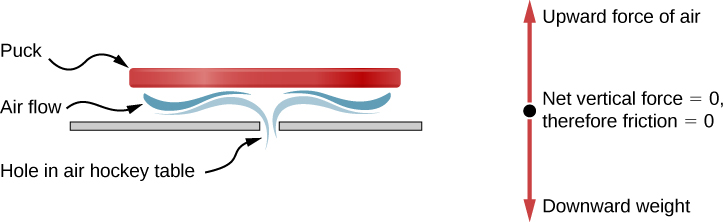
Consider an air hockey table (Figure 5.8). When the air is turned off, the puck slides only a short distance before friction slows it to a stop. However, when the air is turned on, it creates a nearly frictionless surface, and the puck glides long distances without slowing down. Additionally, if we know enough about the friction, we can accurately predict how quickly the object slows down.
英語のヒント
エアホッケー台を考えよう(図5.8)。空気を止めると、パックは短い距離だけ滑り、摩擦によって減速して止まる。空気を出すと、ほとんど摩擦のない面ができ、パックは減速せずに長い距離を滑る。さらに、摩擦について十分なことが分かっていれば、物体がどの程度の速さで減速するかを正確に予測できる。
OpenStax / Rice University, University Physics Volume 1, CC BY 4.0. Source-book artwork retained. · CC BY 4.0 · Source出典

Figure 5.8図 5.8
An air hockey table is useful in illustrating Newton’s laws. When the air is off, friction quickly slows the puck; but when the air is on, it minimizes contact between the puck and the hockey table, and the puck glides far down the table.
英語のヒント
エアホッケー台は、ニュートンの法則を示すのに役立つ。空気を止めると、摩擦によってパックはすぐに減速する。空気を出すと、パックと台の接触が最小限になり、パックは台の上を遠くまで滑る。
Newton’s first law is general and can be applied to anything from an object sliding on a table to a satellite in orbit to blood pumped from the heart. Experiments have verified that any change in velocity (speed or direction) must be caused by an external force. The idea of generally applicable or universal laws is important—it is a basic feature of all laws of physics. Identifying these laws is like recognizing patterns in nature from which further patterns can be discovered. The genius of Galileo, who first developed the idea for the first law of motion, and Newton, who clarified it, was to ask the fundamental question: “What is the cause?” Thinking in terms of cause and effect is fundamentally different from the typical ancient Greek approach, when questions such as “Why does a tiger have stripes?” would have been answered in Aristotelian fashion, such as “That is the nature of the beast.” The ability to think in terms of cause and effect is the ability to make a connection between an observed behavior and the surrounding world.
英語のヒント
ニュートンの第1法則は一般的な法則であり、机上を滑る物体から、軌道を回る衛星、心臓から送り出される血液まで、あらゆるものに適用できる。速度の変化、すなわち速さまたは向きの変化は必ず外力によって生じることが、実験で確かめられている。広く適用できる普遍的な法則という考え方は重要であり、あらゆる物理法則の基本的な特徴である。こうした法則を見いだすことは、自然の中に規則性を認め、そこからさらに別の規則性を発見することに似ている。運動の第1法則の考え方を最初に発展させたガリレオと、それを明確にしたニュートンの天才性は、「原因は何か」という根本的な問いを立てたことにあった。原因と結果によって考えることは、典型的な古代ギリシアの考え方とは根本的に異なる。当時なら、「なぜトラには縞模様があるのか」という問いに対し、「それがその獣の本性だからだ」というアリストテレス的な答えが返ってきただろう。原因と結果によって考える能力とは、観察された振る舞いと周囲の世界とのつながりを見いだす能力である。