第5章ニュートンの運動法則
In the preceding example, we dealt with net force only for simplicity. However, several forces act on the lawn mower. The weight (discussed in detail in Mass and Weight) pulls down on the mower, toward the center of Earth; this produces a contact force on the ground. The ground must exert an upward force on the lawn mower, known as the normal force , which we define in Common Forces. These forces are balanced and therefore do not produce vertical acceleration. In the next example, we show both of these forces. As you continue to solve problems using Newton’s second law, be sure to show multiple forces.
英語のヒント
Example 5.3例題 5.3
Which Force Is Bigger?どちらの力が大きいか
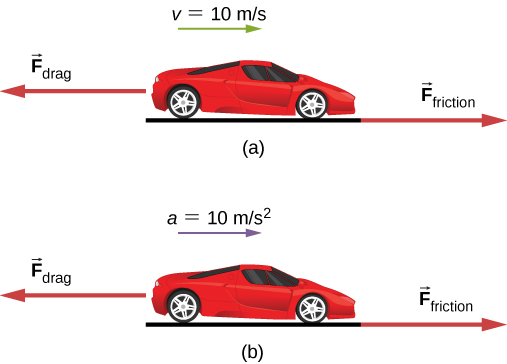
(a) The car shown in Figure 5.13 is moving at a constant speed. Which force is bigger, or ? Explain.
英語のヒント
(a) 図5.13の車は一定の速さで動いている。とのどちらの力が大きいか。説明せよ。
(b) The same car is now accelerating to the right. Which force is bigger, or Explain.
英語のヒント
(b) 同じ車が今度は右向きに加速している。とのどちらの力が大きいか。説明せよ。
OpenStax / Rice University, University Physics Volume 1, CC BY 4.0. Source-book artwork retained. · CC BY 4.0 · Source出典

Figure 5.13図 5.13
A car is shown (a) moving at constant speed and (b) accelerating. How do the forces acting on the car compare in each case? (a) What does the knowledge that the car is moving at constant velocity tell us about the net horizontal force on the car compared to the friction force? (b) What does the knowledge that the car is accelerating tell us about the horizontal force on the car compared to the friction force?
英語のヒント
(a) 一定の速さで動く車と、(b) 加速する車。それぞれの場合、車に働く力の大きさはどう比較できるか。(a) 車が一定の速度で動くという事実から、車に働く水平方向の合力を摩擦力と比べて何が分かるか。(b) 車が加速しているという事実から、車に働く水平方向の力を摩擦力と比べて何が分かるか。
Strategy方針
We must consider Newton’s first and second laws to analyze the situation. We need to decide which law applies; this, in turn, will tell us about the relationship between the forces.
英語のヒント
状況を分析するには、ニュートンの第1法則と第2法則を考える必要がある。どちらの法則が当てはまるかを判断すると、それによって力どうしの関係が分かる。
Solution解答
- The forces are equal. According to Newton’s first law, if the net force is zero, the velocity is constant.
英語のヒント
二つの力は等しい。ニュートンの第1法則によれば、合力が0ならば速度は一定である。 - In this case, must be larger than According to Newton’s second law, a net force is required to cause acceleration.
英語のヒント
この場合、はより大きいはずである。ニュートンの第2法則によれば、加速度を生じさせるには合力が必要である。
Significance考察
These questions may seem trivial, but they are commonly answered incorrectly. For a car or any other object to move, it must be accelerated from rest to the desired speed; this requires that the friction force be greater than the drag force. Once the car is moving at constant velocity, the net force must be zero; otherwise, the car will accelerate (gain speed). To solve problems involving Newton’s laws, we must understand whether to apply Newton’s first law (where ) or Newton’s second law (where is not zero). This will be apparent as you see more examples and attempt to solve problems on your own.
英語のヒント
これらの問いは取るに足らないように思えるかもしれないが、間違えて答えることが多い。車をはじめとする物体が動くには、静止状態から望む速さまで加速しなければならない。そのためには、摩擦力が抗力より大きい必要がある。いったん車が一定の速度で動くようになれば、合力は0でなければならない。そうでなければ、車は加速して速さを増す。ニュートンの法則に関する問題を解くには、第1法則(の場合)と第2法則(が0でない場合)のどちらを適用するかを理解する必要がある。さらに例を見て、自分で問題を解いていくにつれて、この点は明らかになる。
Example 5.4例題 5.4
What Rocket Thrust Accelerates This Sled?このそりを加速するロケットの推力はいくらか
Before space flights carrying astronauts, rocket sleds were used to test aircraft, missile equipment, and physiological effects on human subjects at high speeds. They consisted of a platform that was mounted on one or two rails and propelled by several rockets.
英語のヒント
宇宙飛行士を乗せた宇宙飛行が行われる前、高速時の航空機やミサイル装置、被験者の生理的反応を試験するために、ロケットそりが使われていた。一本または二本のレールに載せた台を、複数のロケットで推進する構造だった。
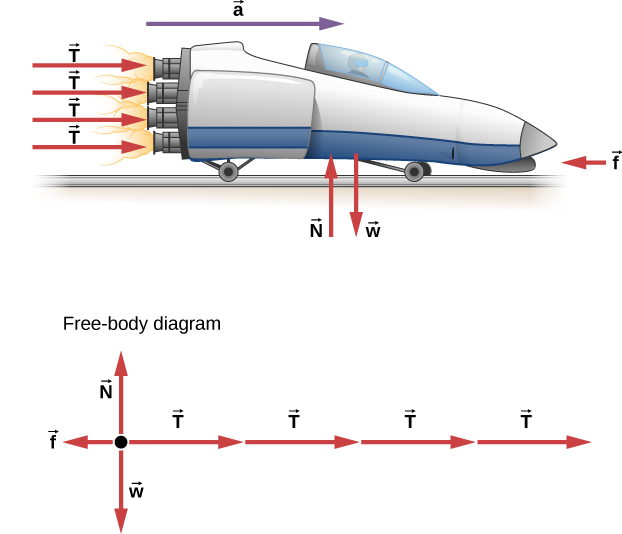
Calculate the magnitude of force exerted by each rocket, called its thrust T, for the four-rocket propulsion system shown in Figure 5.14. The sled’s initial acceleration is , the mass of the system is 2100 kg, and the force of friction opposing the motion is 650 N.
英語のヒント
図5.14に示す四基のロケットによる推進系で、各ロケットが及ぼす力の大きさ、すなわち推力Tを求めよ。そりの初期加速度は、系の質量は2100 kgで、運動に逆らう摩擦力は650 Nである。
OpenStax / Rice University, University Physics Volume 1, CC BY 4.0. Source-book artwork retained. · CC BY 4.0 · Source出典

Figure 5.14図 5.14
A sled experiences a rocket thrust that accelerates it to the right. Each rocket creates an identical thrust T. The system here is the sled, its rockets, and its rider, so none of the forces between these objects are considered. The arrow representing friction is drawn larger than scale.
英語のヒント
そりはロケットの推力を受け、右向きに加速する。各ロケットは同じ推力Tを生じる。ここでの系は、そり、ロケット、搭乗者なので、それらの物体間の力は考えない。摩擦力を表す矢印は、縮尺より大きく描いてある。
Strategy方針
Although forces are acting both vertically and horizontally, we assume the vertical forces cancel because there is no vertical acceleration. This leaves us with only horizontal forces and a simpler one-dimensional problem. Directions are indicated with plus or minus signs, with right taken as the positive direction. See the free-body diagram in Figure 5.14.
英語のヒント
力は鉛直方向にも水平方向にも働くが、鉛直方向には加速度がないので、鉛直方向の力は打ち消し合うと仮定する。すると、水平方向の力だけが残り、より単純な一次元の問題となる。向きは正負の符号で表し、右向きを正とする。図5.14の力の図を参照しよう。
Solution解答
Since acceleration, mass, and the force of friction are given, we start with Newton’s second law and look for ways to find the thrust of the engines. We have defined the direction of the force and acceleration as acting “to the right,” so we need to consider only the magnitudes of these quantities in the calculations. Hence we begin with
英語のヒント
加速度、質量、摩擦力が与えられているので、ニュートンの第2法則を出発点として、エンジンの推力を求める方法を考える。力と加速度の向きを「右向き」と定めたので、計算ではこれらの量の大きさだけを考えればよい。したがって、次の式から始める。
where is the net force along the horizontal direction. We can see from the figure that the engine thrusts add, whereas friction opposes the thrust. In equation form, the net external force is
英語のヒント
ここで、は水平方向の合力である。図から、エンジンの推力は加え合わされ、摩擦力は推力と反対向きに働くことが分かる。外力の合力を式で表すと、次のようになる。
Substituting this into Newton’s second law gives us
英語のヒント
これをニュートンの第2法則に代入すると、次の式が得られる。
Using a little algebra, we solve for the total thrust 4T:
英語のヒント
少し代数計算を行い、総推力4Tについて解く。
Substituting known values yields
英語のヒント
既知の値を代入すると、次のようになる。
Therefore, the total thrust is
英語のヒント
したがって、総推力は次のとおりである。
and the individual thrusts are
英語のヒント
各ロケットの推力は次のようになる。
Significance考察
The numbers are quite large, so the result might surprise you. Experiments such as this were performed in the early 1960s to test the limits of human endurance, and the setup was designed to protect human subjects in jet fighter emergency ejections. Speeds of 1000 km/h were obtained, with accelerations of 45 g’s. (Recall that g, acceleration due to gravity, is . When we say that acceleration is 45 g’s, it is which is approximately .) Although living subjects are not used anymore, land speeds of 10,000 km/h have been obtained with a rocket sled.
英語のヒント
数値がかなり大きいので、驚くかもしれない。このような実験は、人間の耐久限界を調べるため1960年代初めに行われ、ジェット戦闘機から緊急射出される搭乗者を保護するために装置が設計された。加速度45 gで、時速1000 kmに達した。g、すなわち重力加速度はである。加速度が45 gというのは、、およそという意味である。今では生きた被験者は使われていないが、ロケットそりによって地上速度は時速10,000 kmに達している。
In this example, as in the preceding one, the system of interest is obvious. We see in later examples that choosing the system of interest is crucial—and the choice is not always obvious.
英語のヒント
この例でも前の例と同様に、着目する系は明らかである。後の例で見るように、着目する系を選ぶことは決定的に重要であり、その選択はいつも明らかとは限らない。
Newton’s second law is more than a definition; it is a relationship among acceleration, force, and mass. It can help us make predictions. Each of those physical quantities can be defined independently, so the second law tells us something basic and universal about nature.
英語のヒント
ニュートンの第2法則は単なる定義ではなく、加速度、力、質量の間の関係である。予測にも役立つ。それぞれの物理量は独立に定義できるので、第2法則は自然についての基本的で普遍的な事柄を教えている。