第5章ニュートンの運動法則
5.3 Newton's Second Law5.3 ニュートンの第2法則
Learning Objectives学習目標
Learning Objectives学習目標
By the end of this section, you will be able to:
英語のヒント
この節を終えると、次のことができるようになる。
- Distinguish between external and internal forces
英語のヒント
外力と内力を区別する。 - Describe Newton's second law of motion
英語のヒント
ニュートンの運動の第2法則を説明する。 - Explain the dependence of acceleration on net force and mass
英語のヒント
加速度が合力と質量にどう依存するかを説明する。
Newton’s second law is closely related to his first law. It mathematically gives the cause-and-effect relationship between force and changes in motion. Newton’s second law is quantitative and is used extensively to calculate what happens in situations involving a force. Before we can write down Newton’s second law as a simple equation that gives the exact relationship of force, mass, and acceleration, we need to sharpen some ideas we mentioned earlier.
英語のヒント
ニュートンの第2法則は第1法則と密接に関係している。力と運動の変化の間の因果関係を、数学的に表したものである。第2法則は定量的で、力が関わる状況で何が起こるかを計算するために広く使われる。力、質量、加速度の正確な関係を示す簡単な式として第2法則を書き表す前に、すでに述べた考え方をいくつか明確にしておこう。
Force and Acceleration力と加速度
First, what do we mean by a change in motion? The answer is that a change in motion is equivalent to a change in velocity. A change in velocity means, by definition, that there is acceleration. Newton’s first law says that a net external force causes a change in motion; thus, we see that a net external force causes nonzero acceleration.
英語のヒント
まず、「運動の変化」とは何を意味するか。運動の変化とは速度の変化に等しい。速度が変化するとは、定義上、加速度があるということである。第1法則によれば、外力の合力が運動の変化を引き起こす。したがって、外力の合力は0でない加速度を生じさせると分かる。
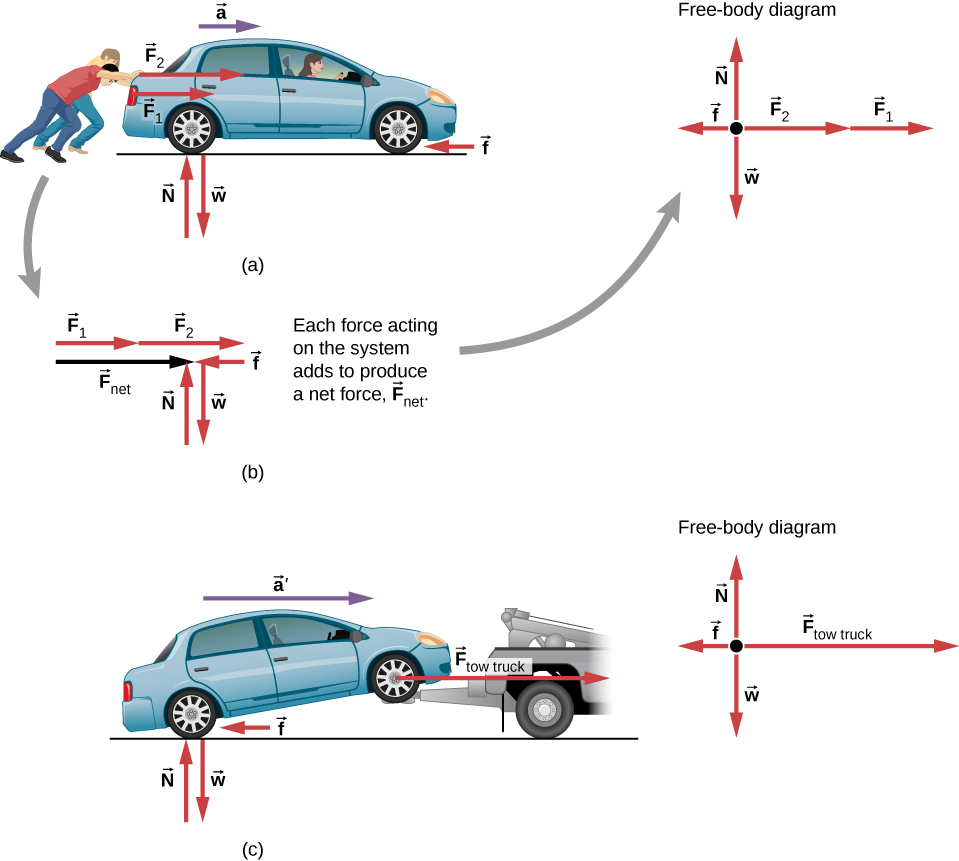
We defined external force in Forces as force acting on an object or system that originates outside of the object or system. Let’s consider this concept further. An intuitive notion of external is correct—it is outside the system of interest. For example, in Figure 5.10(a), the system of interest is the car plus the person within it. The two forces exerted by the two students are external forces. In contrast, an internal force acts between elements of the system. Thus, the force the person in the car exerts to hang on to the steering wheel is an internal force between elements of the system of interest. Only external forces affect the motion of a system, according to Newton’s first law. (The internal forces cancel each other out, as explained in the next section.) Therefore, we must define the boundaries of the system before we can determine which forces are external. Sometimes, the system is obvious, whereas at other times, identifying the boundaries of a system is more subtle. The concept of a system is fundamental to many areas of physics, as is the correct application of Newton’s laws. This concept is revisited many times in the study of physics.
英語のヒント
「力」では、外力を、物体や系の外部に由来し、その物体や系に作用する力と定義した。この概念をもう少し考えよう。「外部」という言葉を直観的に捉えてよい。対象とする系の外側という意味である。例えば図5.10(a)では、対象の系は車と中にいる人を合わせたものである。2人の学生が及ぼす二つの力は外力である。これに対し、内力は系を構成する要素どうしの間に働く。したがって、車内の人がハンドルにつかまるときに及ぼす力は、対象の系の要素間に働く内力である。第1法則によれば、系の運動に影響するのは外力だけである。内力どうしは打ち消し合う。これは次の節で説明する。したがって、どの力が外力かを判断する前に、系の境界を定めなければならない。系が明らかな場合もあれば、境界の見極めが微妙な場合もある。系という概念は、ニュートンの法則を正しく適用することと同様、物理学の多くの分野の基礎である。物理学を学ぶ中で、この概念は何度も取り上げられる。
OpenStax / Rice University, University Physics Volume 1, CC BY 4.0. Source-book artwork retained. · CC BY 4.0 · Source出典

Figure 5.10図 5.10
Different forces exerted on the same mass produce different accelerations. (a) Two students push a stalled car. All external forces acting on the car are shown. (b) The forces acting on the car are transferred to a coordinate plane (free-body diagram) for simpler analysis. (c) The tow truck can produce greater external force on the same mass, and thus greater acceleration.
英語のヒント
同じ質量に異なる力を及ぼすと、異なる加速度が生じる。(a) 2人の学生が動かなくなった車を押す。車に作用するすべての外力を示している。(b) 解析しやすいように、車に働く力を座標平面上の力の図へ移したもの。(c) レッカー車は、同じ質量にさらに大きな外力を及ぼせるので、より大きな加速度を生じさせる。
From this example, you can see that different forces exerted on the same mass produce different accelerations. In Figure 5.10(a), the two students push a car with a driver in it. Arrows representing all external forces are shown. The system of interest is the car and its driver. The weight of the system and the support of the ground are also shown for completeness and are assumed to cancel (because there was no vertical motion and no imbalance of forces in the vertical direction to create a change in motion). The vector represents the friction acting on the car, and it acts to the left, opposing the motion of the car. (We discuss friction in more detail in the next chapter.) In Figure 5.10(b), all external forces acting on the system add together to produce the net force The free-body diagram shows all of the forces acting on the system of interest. The dot represents the center of mass of the system. Each force vector extends from this dot. Because there are two forces acting to the right, the vectors are shown collinearly. Finally, in Figure 5.10(c), a larger net external force produces a larger acceleration when the tow truck pulls the car.
英語のヒント
この例から、同じ質量に異なる力を及ぼすと、異なる加速度が生じることが分かる。図5.10(a)では、2人の学生が運転手の乗った車を押す。すべての外力を矢印で示している。対象の系は車と運転手である。漏れがないように、系の重力と地面からの支持力も示してあり、両者は打ち消し合うと仮定する。鉛直方向の運動がなく、運動を変えるような鉛直方向の力の不つり合いもなかったからである。ベクトルは車に働く摩擦力で、車の運動に逆らって左向きに作用する。摩擦は次の章で詳しく扱う。図5.10(b)では、系に作用するすべての外力を足し合わせ、合力を得る。力の図は、対象の系に働くすべての力を示す。点は系の重心を表し、各力のベクトルはその点から伸びる。右向きに作用する力が二つあるため、ベクトルは同一直線上に描かれている。最後に図5.10(c)では、レッカー車が車を引くと、より大きな外力の合力によって、より大きな加速度が生じる。
It seems reasonable that acceleration would be directly proportional to and in the same direction as the net external force acting on a system. This assumption has been verified experimentally and is illustrated in Figure 5.10. To obtain an equation for Newton’s second law, we first write the relationship of acceleration and net external force as the proportionality
英語のヒント
加速度が、系に働く外力の合力に正比例し、その力と同じ向きをもつと考えるのは自然である。この仮定は実験で確かめられ、図5.10にも示されている。ニュートンの第2法則の式を得るために、まず加速度と外力の合力の関係を、次の比例関係として書く。
where the symbol means “proportional to.” (Recall from Forces that the net external force is the vector sum of all external forces and is sometimes indicated as ) This proportionality shows what we have said in words—acceleration is directly proportional to net external force. Once the system of interest is chosen, identify the external forces and ignore the internal ones. It is a tremendous simplification to disregard the numerous internal forces acting between objects within the system, such as muscular forces within the students’ bodies, let alone the myriad forces between the atoms in the objects. Still, this simplification helps us solve some complex problems.
英語のヒント
ここで、記号は「〜に比例する」を意味する。「力」で述べたように、外力の合力はすべての外力のベクトル和であり、と表すこともある。この比例関係は、加速度が外力の合力に正比例するという、言葉で述べた内容を示している。対象の系を選んだら、外力を見いだし、内力は無視する。学生の体内の筋力など、系の内部の物体間に働く多数の内力を考えずに済むことは、非常に大きな単純化である。まして、物体中の原子間に働く無数の力まで考える必要はない。この単純化によって、複雑な問題も解けるようになる。
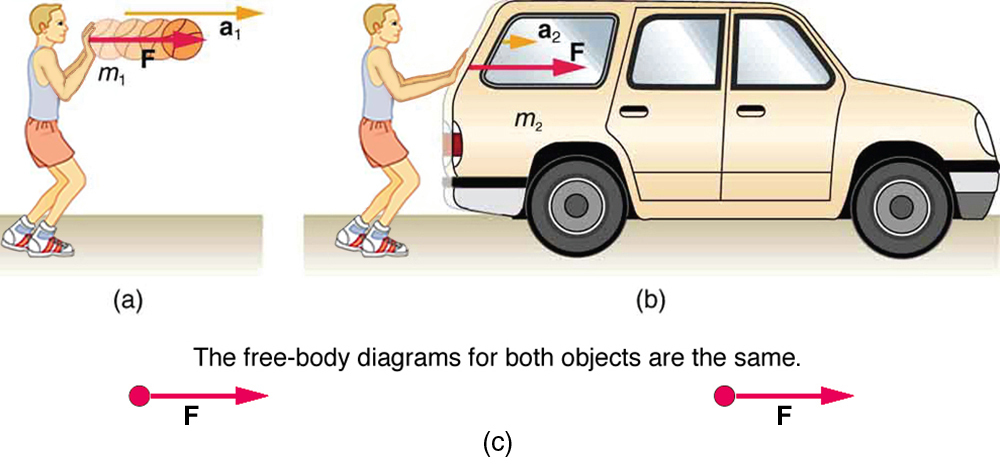
It also seems reasonable that acceleration should be inversely proportional to the mass of the system. In other words, the larger the mass (the inertia), the smaller the acceleration produced by a given force. As illustrated in Figure 5.11, the same net external force applied to a basketball produces a much smaller acceleration when it is applied to an SUV. The proportionality is written as
英語のヒント
加速度が系の質量に反比例すると考えることも自然である。言い換えれば、質量、すなわち慣性が大きいほど、同じ力によって生じる加速度は小さい。図5.11のように、バスケットボールに加えたものと同じ外力の合力をSUVに加えると、加速度ははるかに小さくなる。この比例関係は次のように書ける。
where m is the mass of the system and a is the magnitude of the acceleration. Experiments have shown that acceleration is exactly inversely proportional to mass, just as it is directly proportional to net external force.
英語のヒント
ここでmは系の質量、aは加速度の大きさである。実験によって、加速度は外力の合力に正比例するのと同様、質量には正確に反比例することが示されている。
OpenStax / Rice University, University Physics Volume 1, CC BY 4.0. Source-book artwork retained. · CC BY 4.0 · Source出典

Figure 5.11図 5.11
The same force exerted on systems of different masses produces different accelerations. (a) A basketball player pushes on a basketball to make a pass. (Ignore the effect of gravity on the ball.) (b) The same player exerts an identical force on a stalled SUV and produces far less acceleration. (c) The free-body diagrams are identical, permitting direct comparison of the two situations. A series of patterns for free-body diagrams will emerge as you do more problems and learn how to draw them in Drawing Free-Body Diagrams.
英語のヒント
質量の異なる系に同じ力を及ぼすと、異なる加速度が生じる。(a) バスケットボール選手がパスを出すためにボールを押す。ボールに働く重力の影響は無視する。(b) 同じ選手が、動かなくなったSUVに同じ力を及ぼすと、生じる加速度はずっと小さい。(c) 力の図は同一なので、二つの状況を直接比較できる。さらに問題を解き、「力の図の描き方」で描画法を学ぶと、力の図にさまざまなパターンが見えてくる。
It has been found that the acceleration of an object depends only on the net external force and the mass of the object. Combining the two proportionalities just given yields Newton’s second law.
英語のヒント
物体の加速度は、外力の合力と物体の質量だけに依存することが分かっている。先ほど示した二つの比例関係を組み合わせると、ニュートンの第2法則が得られる。
The law is a cause-and-effect relationship among three quantities that is not simply based on their definitions. The validity of the second law is based on experimental verification. The free-body diagram, which you will learn to draw in Drawing Free-Body Diagrams, is the basis for writing Newton’s second law.
英語のヒント
この法則は三つの量の間の因果関係であり、単にそれらの定義に基づくものではない。第2法則の妥当性は、実験による検証に基づいている。「力の図の描き方」で描き方を学ぶ力の図は、ニュートンの第2法則の式を立てるための基礎となる。
Example 5.2例題 5.2
What Acceleration Can a Person Produce When Pushing a Lawn Mower?人が芝刈り機を押すと、どれだけの加速度が生じるか
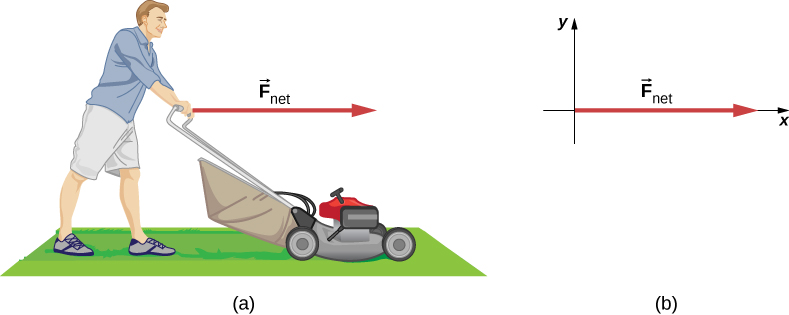
Suppose that the net external force (push minus friction) exerted on a lawn mower is 51 N (about 11 lb.) parallel to the ground (Figure 5.12). The mass of the mower is 24 kg. What is its acceleration?
英語のヒント
芝刈り機に働く外力の合力(押す力から摩擦力を引いたもの)が、地面に平行に51 N(約11 lb)であるとする(図5.12)。芝刈り機の質量は24 kgである。加速度はいくらか。
OpenStax / Rice University, University Physics Volume 1, CC BY 4.0. Source-book artwork retained. · CC BY 4.0 · Source出典

Figure 5.12図 5.12
(a) The net force on a lawn mower is 51 N to the right. At what rate does the lawn mower accelerate to the right? (b) The free-body diagram for this problem is shown.
英語のヒント
(a) 芝刈り機に働く合力は右向きに51 Nである。芝刈り機は右向きにどれだけの加速度で加速するか。(b) この問題の力の図。
Strategy方針
This problem involves only motion in the horizontal direction; we are also given the net force, indicated by the single vector, but we can suppress the vector nature and concentrate on applying Newton’s second law. Since and m are given, the acceleration can be calculated directly from Newton’s second law as
英語のヒント
この問題で扱うのは水平方向の運動だけである。合力も一本のベクトルで与えられているが、ベクトルとしての性質をいったん省き、ニュートンの第2法則を適用することに集中できる。とmが与えられているので、第2法則から加速度を直接計算できる。すなわち、である。
Solution解答
The magnitude of the acceleration a is . Entering known values gives
英語のヒント
加速度の大きさaはである。既知の値を代入すると、次のようになる。
Substituting the unit of kilograms times meters per square second for newtons yields
英語のヒント
ニュートンの単位を、キログラムとメートル毎秒毎秒の積で置き換えると、次のようになる。
Significance考察
The direction of the acceleration is the same direction as that of the net force, which is parallel to the ground. This is a result of the vector relationship expressed in Newton’s second law, that is, the vector representing net force is the scalar multiple of the acceleration vector. There is no information given in this example about the individual external forces acting on the system, but we can say something about their relative magnitudes. For example, the force exerted by the person pushing the mower must be greater than the friction opposing the motion (since we know the mower moved forward), and the vertical forces must cancel because no acceleration occurs in the vertical direction (the mower is moving only horizontally). The acceleration found is small enough to be reasonable for a person pushing a mower. Such an effort would not last too long, because the person’s top speed would soon be reached.
英語のヒント
加速度の向きは、地面に平行な合力の向きと同じである。これは、ニュートンの第2法則が表すベクトルの関係による。つまり、合力を表すベクトルは、加速度ベクトルのスカラー倍である。この例では、系に働く個々の外力についての情報は与えられていないが、相対的な大きさについてはいくらか分かる。たとえば、芝刈り機が前進したことから、それを押す人の力は、運動に逆らう摩擦力より大きいはずである。また、芝刈り機は水平方向にしか動かず、鉛直方向の加速度がないので、鉛直方向の力は打ち消し合うはずである。求めた加速度は、人が芝刈り機を押す場合として妥当な小さい値である。このように力を出し続けられる時間はあまり長くない。すぐにその人が出せる最高速度に達するためである。