第9章運動量と衝突
9.1 Linear Momentum9.1 運動量
Learning Objectives学習目標
Learning Objectives学習目標
By the end of this section, you will be able to:
英語のヒント
この節を終えると、次のことができるようになる。
- Explain what momentum is, physically
英語のヒント
運動量とは何かを、物理的な意味から説明する。 - Calculate the momentum of a moving object
英語のヒント
動いている物体の運動量を計算する。
Our study of kinetic energy showed that a complete understanding of an object’s motion must include both its mass and its velocity (). However, as powerful as this concept is, it does not include any information about the direction of the moving object’s velocity vector. We’ll now define a physical quantity that includes direction.
英語のヒント
運動エネルギーの学習から、物体の運動を完全に理解するには、質量と速度の両方を含めなければならないことがわかった()。しかし、この概念は強力ではあるものの、運動する物体の速度ベクトルの方向については何も情報を含んでいない。ここで、方向も含む物理量を定義する。
Like kinetic energy, this quantity includes both mass and velocity; like kinetic energy, it is a way of characterizing the “quantity of motion” of an object. It is given the name momentum (from the Latin word movimentum, meaning “movement”), and it is represented by the symbol p.
英語のヒント
運動エネルギーと同様に、この量は質量と速度の両方を含む。また、運動エネルギーと同様に、物体の「運動の量」を特徴付ける方法である。この量を運動量と呼び、「運動」を意味するラテン語movimentumに由来するmomentumという名を用いる。記号pで表す。
Image omitted because its reuse rights could not be verified.権利の確認ができないため画像を割愛。
Figure 9.2図 9.2
The velocity and momentum vectors for the ball are in the same direction. (credit: modification of work by Ben Sutherland)
英語のヒント
ボールの速度ベクトルと運動量ベクトルは同じ方向を向く。(出典:Ben Sutherlandの作品を改変)
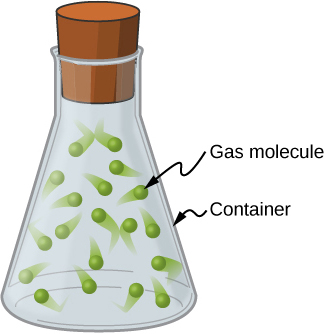
As shown in Figure 9.2, momentum is a vector quantity (since velocity is). This is one of the things that makes momentum useful and not a duplication of kinetic energy. It is perhaps most useful when determining whether an object’s motion is difficult to change (Figure 9.3) or easy to change (Figure 9.4) over a short time interval.
英語のヒント
Image omitted because its reuse rights could not be verified.権利の確認ができないため画像を割愛。
Figure 9.3図 9.3
This supertanker transports a huge mass of oil; as a consequence, it takes a long time for a force to change its (comparatively small) velocity. (credit: modification of work by “the_tahoe_guy”/Flickr)
英語のヒント
この大型タンカーは膨大な質量の石油を運んでいる。そのため、力を加えてその比較的小さい速度を変えるにも、長い時間がかかる。(出典:“the_tahoe_guy”/Flickrの作品を改変)
OpenStax / Rice University, University Physics Volume 1, CC BY 4.0. Source-book artwork retained. · CC BY 4.0 · Source出典
Figure 9.4図 9.4
Gas molecules can have very large velocities, but these velocities change nearly instantaneously when they collide with the container walls or with each other. This is primarily because their masses are so tiny.
英語のヒント
気体分子の速度は非常に大きくなりうるが、容器の壁や他の分子に衝突すると、その速度はほとんど瞬時に変わる。主な理由は、分子の質量が非常に小さいことにある。
Unlike kinetic energy, momentum depends equally on an object’s mass and velocity. For example, as you will learn when you study thermodynamics, the average speed of an air molecule at room temperature is approximately 500 m/s, with an average molecular mass of ; its momentum is thus
英語のヒント
運動エネルギーと異なり、運動量は物体の質量と速度に同じ程度に依存する。たとえば、熱力学で学ぶように、室温での空気分子の平均の速さは約500 m/s、平均の分子質量はである。したがって、その運動量は
For comparison, a typical automobile might have a speed of only 15 m/s, but a mass of 1400 kg, giving it a momentum of
英語のヒント
比較として、一般的な自動車の速さをわずか15 m/sとする。質量が1400 kgならば、その運動量は次のようになる。
These momenta are different by 27 orders of magnitude, or a factor of a billion billion billion!
英語のヒント
これらの運動量は27桁も異なる。倍率にすれば、10億の10億倍のさらに10億倍である。
Summaryまとめ
- The motion of an object depends on its mass as well as its velocity. Momentum is a concept that describes this. It is a useful and powerful concept, both computationally and theoretically. The SI unit for momentum is kg m/s.
英語のヒント
物体の運動は、速度だけでなく質量にも依存する。運動量はこのことを表す概念であり、計算の面でも理論の面でも有用かつ強力である。運動量のSI単位はkgm/sである。
Conceptual Questions概念に関する問題
Exercises 1–2練習問題 1–2
Exercise 1問題 1
An object that has a small mass and an object that has a large mass have the same momentum. Which object has the largest kinetic energy?
英語のヒント
質量の小さい物体と質量の大きい物体が、同じ運動量を持っている。運動エネルギーが大きいのはどちらか。
Solution解き方
Since , then if the momentum is fixed, the object with smaller mass has more kinetic energy.
英語のヒント
であるため、運動量が一定ならば、質量が小さい物体のほうが運動エネルギーは大きい。
Exercise 2問題 2
An object that has a small mass and an object that has a large mass have the same kinetic energy. Which mass has the largest momentum?
英語のヒント
質量の小さい物体と質量の大きい物体が、同じ運動エネルギーを持っている。運動量が大きいのはどちらか。
Problems問題
Exercises 3–9練習問題 3–9
Exercise 3問題 3
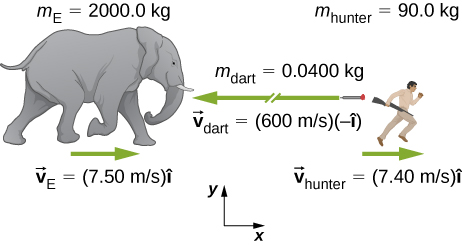
An elephant and a hunter are having a confrontation.
英語のヒント
ゾウと狩猟者が対峙している。
OpenStax / Rice University, University Physics Volume 1, CC BY 4.0. Source-book artwork retained. · CC BY 4.0 · Source出典
- Calculate the momentum of the 2000.0-kg elephant charging the hunter at a speed of 7.50 m/s.
英語のヒント
狩猟者に向かって7.50 m/sで突進する、質量2000.0 kgのゾウの運動量を求めよ。 - Calculate the ratio of the elephant’s momentum to the momentum of a 0.0400-kg tranquilizer dart fired at a speed of 600 m/s.
英語のヒント
速さ600 m/sで発射した質量0.0400 kgの麻酔矢の運動量に対する、ゾウの運動量の比を求めよ。 - What is the momentum of the 90.0-kg hunter running at 7.40 m/s after missing the elephant?
英語のヒント
ゾウを撃ち損じた後、7.40 m/sで走る、質量90.0 kgの狩猟者の運動量を求めよ。
Exercise 4問題 4
A skater of mass 40 kg is carrying a box of mass 5 kg. The skater has a speed of 5 m/s with respect to the floor and is gliding without any friction on a smooth surface.
英語のヒント
質量40 kgのスケーターが、質量5 kgの箱を運んでいる。スケーターは床に対して5 m/sの速さで、なめらかな面上を摩擦なしで滑っている。
- Find the momentum of the box with respect to the floor.
英語のヒント
床に対する箱の運動量を求めよ。 - Find the momentum of the box with respect to the floor after she puts the box down on the frictionless skating surface.
英語のヒント
スケーターが箱を摩擦のない滑走面に下ろした後の、床に対する箱の運動量を求めよ。
Solution解き方
a. magnitude: b. same as a.
英語のヒント
a. 大きさ: b. aと同じ。
Exercise 5問題 5
A car of mass 2000 kg is moving with a constant velocity of 10 m/s due east. What is the momentum of the car?
英語のヒント
質量2000 kgの自動車が、真東へ10 m/sの一定の速度で動いている。その運動量を求めよ。
Exercise 6問題 6
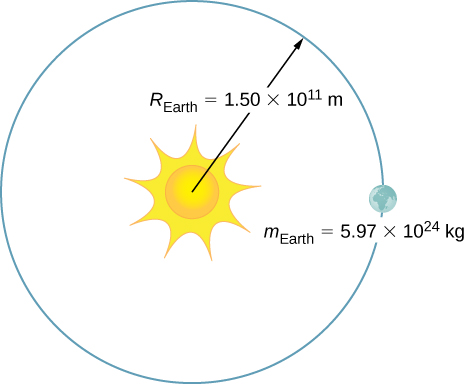
The mass of Earth is and its orbital radius is an average of . Calculate the magnitude of its linear momentum at the location in the diagram.
英語のヒント
地球の質量は、公転軌道の平均半径はである。図に示す位置での地球の運動量の大きさを求めよ。


Solution解き方
Exercise 7問題 7
If a rainstorm drops 1 cm of rain over an area of 10 km2 in the period of 1 hour, what is the momentum of the rain that falls in one second? Assume the terminal velocity of a raindrop is 10 m/s.
英語のヒント
激しい雨によって、1時間に面積10 km2の範囲に1 cmの雨が降った。1秒間に落ちる雨の運動量を求めよ。雨粒の終端速度を10 m/sとする。
Exercise 8問題 8
What is the average momentum of an avalanche that moves a 40-cm-thick layer of snow over an area of 100 m by 500 m over a distance of 1 km down a hill in 5.5 s? Assume a density of 350 kg/m3 for the snow.
英語のヒント
厚さ40 cm、100 m×500 mの範囲の雪の層が、雪崩によって5.5 sで斜面を1 km下った。この雪崩の平均運動量を求めよ。雪の密度は350 kg/m3とする。
Solution解き方
Exercise 9問題 9
What is the average momentum of a 70.0-kg sprinter who runs the 100-m dash in 9.65 s?
英語のヒント
100 m走を9.65 sで走る、質量70.0 kgの短距離走者の平均運動量を求めよ。
momentum
運動量
measure of the quantity of motion that an object has; it takes into account both how fast the object is moving, and its mass; specifically, it is the product of mass and velocity; it is a vector quantity
英語のヒント
物体が持つ運動の量を測る尺度。物体がどれくらい速く動くかと、その質量の両方を考慮する。具体的には質量と速度の積であり、ベクトル量である。