第9章運動量と衝突
Momentum and Force運動量と力
In words, the average force applied to an object is equal to the change of the momentum that the force causes, divided by the time interval over which this change of momentum occurs. This relationship is very useful in situations where the collision time is small, but measureable; typical values would be 1/10th of a second, or even one thousandth of a second. Car crashes, punting a football, or collisions of subatomic particles would meet this criterion.
英語のヒント
言葉でいえば、物体に加える平均の力は、その力によって生じた運動量の変化を、その変化が起こった時間間隔で割ったものに等しい。この関係は、衝突時間が短いが測定できる場合に非常に役立つ。典型的には0.1秒、あるいは0.001秒という値である。自動車の衝突、アメリカンフットボールのパントキック、原子より小さい粒子どうしの衝突などがこの条件を満たす。
For a continuously changing momentum—due to a continuously changing force—this becomes a powerful conceptual tool. In the limit , Equation 9.2 becomes
英語のヒント
力が連続的に変化するために運動量も連続的に変化する場合、これは強力な概念上の道具となる。の極限では、式9.2は次のようになる。
This says that the rate of change of the system’s momentum (implying that momentum is a function of time) is exactly equal to the net applied force (also, in general, a function of time). This is, in fact, Newton’s second law, written in terms of momentum rather than acceleration. This is the relationship Newton himself presented in his Principia Mathematica (although he called it “quantity of motion” rather than “momentum”).
英語のヒント
この式は、系の運動量の変化率が、加えた力の合力に正確に等しいことを述べている。ここでは運動量は時間の関数であり、力も一般には時間の関数である。これは実際には、加速度の代わりに運動量で書いたニュートンの第二法則である。ニュートン自身が『プリンキピア・マテマティカ』で示したのもこの関係だった。ただし、彼はmomentumではなく「運動の量」と呼んでいた。
If the mass of the system remains constant, Equation 9.3 reduces to the more familiar form of Newton’s second law. We can see this by substituting the definition of momentum:
英語のヒント
系の質量が一定のままならば、この式は、よりなじみ深いニュートンの第二法則の形になる。運動量の定義を代入すれば、それを確かめられる。
The assumption of constant mass allowed us to pull m out of the derivative. If the mass is not constant, we cannot use this form of the second law, but instead must start from Equation 9.3. Thus, one advantage to expressing force in terms of changing momentum is that it allows for the mass of the system to change, as well as the velocity; this is a concept we’ll explore when we study the motion of rockets.
英語のヒント
質量を一定と仮定したため、mを微分の外に出せた。質量が一定でなければ、この形の第二法則は使えず、代わりに元の式から始めなければならない。このように、運動量の変化を用いて力を表す利点の一つは、系の速度だけでなく質量も変化する場合を扱えることである。この概念は、ロケットの運動を学ぶ際に詳しく調べる。
Although Equation 9.3 allows for changing mass, as we will see in Rocket Propulsion, the relationship between momentum and force remains useful when the mass of the system is constant, as in the following example.
英語のヒント
Example 9.5例題 9.5
Calculating Force: Venus Williams’ Tennis Serve力の計算:ビーナス・ウィリアムズのテニスのサーブ
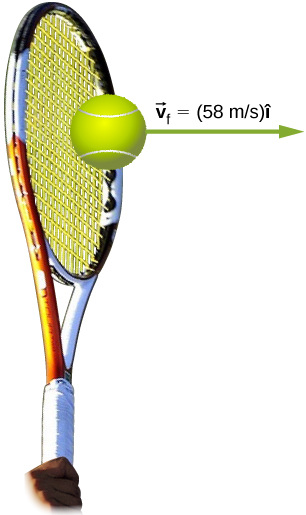
During the 2007 French Open, Venus Williams hit the fastest recorded serve in a premier women’s match, reaching a speed of 58 m/s (209 km/h). What is the average force exerted on the 0.057-kg tennis ball by Venus Williams’ racquet? Assume that the ball’s speed just after impact is 58 m/s, as shown in Figure 9.13, that the initial horizontal component of the velocity before impact is negligible, and that the ball remained in contact with the racquet for 5.0 ms.
英語のヒント
2007年の全仏オープンで、ビーナス・ウィリアムズは女子の主要大会の試合で記録上最速のサーブを放ち、その速さは58 m/s、すなわち209 km/hに達した。ラケットが質量0.057 kgのテニスボールに加えた平均の力はいくらか。図9.13のように、衝突直後のボールの速さを58 m/sとする。衝突前の初速度の水平成分は無視でき、ボールは5.0 msにわたってラケットに接触していたと仮定する。
OpenStax / Rice University, University Physics Volume 1, CC BY 4.0. Source-book artwork retained. · CC BY 4.0 · Source出典

Figure 9.13図 9.13
The final velocity of the tennis ball is .
英語のヒント
テニスボールの最終速度はである。
Strategy方針
This problem involves only one dimension because the ball starts from having no horizontal velocity component before impact. Newton’s second law stated in terms of momentum is then written as
英語のヒント
衝突前のボールの速度には水平成分がないため、この問題は一次元だけを扱う。運動量で表したニュートンの第二法則は、次のように書ける。
As noted above, when mass is constant, the change in momentum is given by
英語のヒント
先に述べたように、質量が一定のとき、運動量の変化は次式で与えられる。
where we have used scalars because this problem involves only one dimension. In this example, the velocity just after impact and the time interval are given; thus, once is calculated, we can use to find the force.
英語のヒント
ここでは一次元の問題なので、スカラーを用いた。この例では衝突直後の速度と時間間隔が与えられているため、を計算できれば、から力を求められる。
Solution解答
To determine the change in momentum, insert the values for the initial and final velocities into the equation above:
英語のヒント
運動量の変化を求めるため、上の式に初速度と最終速度の値を代入する。
Now the magnitude of the net external force can be determined by using
英語のヒント
これで、外力の合力の大きさは、次式を用いて求められる。
where we have retained only two significant figures in the final step.
英語のヒント
最後の段階では、有効数字を2桁だけ残している。
Significance考察
This quantity was the average force exerted by Venus Williams’ racquet on the tennis ball during its brief impact (note that the ball also experienced the 0.57-N force of gravity, but that force was not due to the racquet). This problem could also be solved by first finding the acceleration and then using , but one additional step would be required compared with the strategy used in this example.
英語のヒント
この量は、短い衝突の間に、ビーナス・ウィリアムズのラケットがテニスボールに加えた平均の力である。ボールには0.57 Nの重力も働いていたが、それはラケットによる力ではないことに注意しよう。この問題は、最初に加速度を求めてからを用いても解けるが、この例の方法より手順が一つ多くなる。