第9章運動量と衝突
Summaryまとめ
- The approach to two-dimensional collisions is to choose a convenient coordinate system and break the motion into components along perpendicular axes.
英語のヒント
二次元の衝突では、都合のよい座標系を選び、互いに垂直な軸に沿って運動を成分に分ける。 - Momentum is conserved in both directions simultaneously and independently.
英語のヒント
運動量は、両方向で同時に、かつ独立に保存される。 - The Pythagorean theorem gives the magnitude of the momentum vector using the x- and y-components, calculated using conservation of momentum in each direction.
英語のヒント
各方向の運動量保存から求めたx成分とy成分を使い、ピタゴラスの定理で運動量ベクトルの大きさを求められる。
Conceptual Questions概念に関する問題
Exercises 50練習問題 50
Exercise 50問題 50
Momentum for a system can be conserved in one direction while not being conserved in another. What is the angle between the directions? Give an example.
英語のヒント
系の運動量が、ある方向では保存され、別の方向では保存されないことがある。この二つの方向のなす角はいくらか。例を挙げよ。
Solution解き方
The angle between the directions must be 90°. Any system that has zero net external force in one direction and nonzero net external force in a perpendicular direction will satisfy these conditions.
英語のヒント
方向のなす角は90°でなければならない。一つの方向では外力の合力がゼロで、それに垂直な方向ではゼロでない系なら、この条件を満たす。
Problems問題
Exercises 51–60練習問題 51–60
Exercise 51問題 51
A 0.90-kg falcon is diving at 28.0 m/s at a downward angle of . It catches a 0.325-kg pigeon from behind in midair. What is their combined velocity after impact if the pigeon’s initial velocity was 7.00 m/s directed horizontally? Note that is a unit vector pointing in the direction in which the falcon is initially flying.
英語のヒント
質量0.90 kgのハヤブサが、水平方向から下向きの角度で28.0 m/sで急降下している。空中で、質量0.325 kgのハトを後方から捕まえる。ハトの初速度が水平に7.00 m/sなら、接触後に一体となった両者の速度はいくらか。はハヤブサの初めの飛行方向を向く単位ベクトルである。
Image omitted because its reuse rights could not be verified.権利の確認ができないため画像を割愛。
Figure 9.26図 9.26
(credit “falcon”: modification of work by “USFWS Mountain-Prairie”/Flickr; credit “pigeon”: modification of work by Jacob Spinks)
(「ハヤブサ」画像:USFWS Mountain-Prairie/Flickrの作品を改変。「ハト」画像:Jacob Spinksの作品を改変。)
Solution解き方
22.1 m/s at below the horizontal
英語のヒント
水平から下向きの方向に22.1 m/s。
Exercise 52問題 52
A billiard ball, labeled 1, moving horizontally strikes another billiard ball, labeled 2, at rest. Before impact, ball 1 was moving at a speed of 3.00 m/s, and after impact it is moving at 0.50 m/s at 50° from the original direction. If the two balls have equal masses of 300 g, what is the velocity of the ball 2 after the impact?
英語のヒント
水平に動くビリヤード球1が、静止したビリヤード球2に当たる。衝突前の球1の速さは3.00 m/sで、衝突後は元の進行方向に対して50°の角度へ0.50 m/sで動く。2個の球の質量がともに300 gなら、衝突後の球2の速度はいくらか。
Exercise 53問題 53
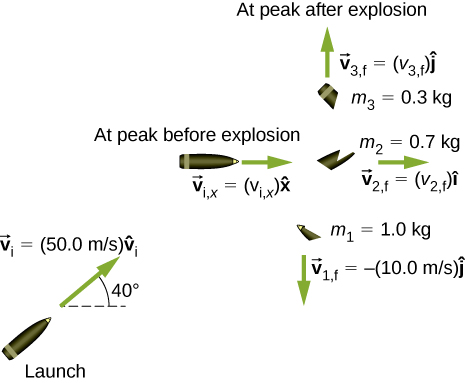
A projectile of mass 2.0 kg is fired in the air at an angle of 40.0 to the horizon at a speed of 50.0 m/s. At the highest point in its flight, the projectile breaks into three parts of mass 1.0 kg, 0.7 kg, and 0.3 kg. The 1.0-kg part falls straight down after breakup with an initial speed of 10.0 m/s, the 0.7-kg part moves in the original forward direction, and the 0.3-kg part goes straight up.
英語のヒント
質量2.0 kgの物体を、水平に対して40.0の角度で、速さ50.0 m/sで空中へ打ち出す。軌道の最高点で、物体は1.0 kg、0.7 kg、0.3 kgの三つに分かれる。1.0 kgの破片は分裂後、初めの速さ10.0 m/sで真下へ落ち、0.7 kgの破片は元の前向きの方向へ進み、0.3 kgの破片は真上へ進む。
OpenStax / Rice University, University Physics Volume 1, CC BY 4.0. Source-book artwork retained. · CC BY 4.0 · Source出典

- Find the speeds of the 0.3-kg and 0.7-kg pieces immediately after the break-up.
英語のヒント
分裂直後の0.3 kgと0.7 kgの破片の速さを求めよ。 - How high from the break-up point does the 0.3-kg piece go before coming to rest?
英語のヒント
0.3 kgの破片は、いったん静止するまでに分裂点からどれほど高く上がるか。 - Where does the 0.7-kg piece land relative to where it was fired from?
英語のヒント
0.7 kgの破片は、発射地点を基準としてどこに着地するか。
Solution解き方
a. 33 m/s and 110 m/s; b. 57 m; c. 480 m
a. 33 m/sと110 m/s。b. 57 m。c. 480 m。
Exercise 54問題 54
Two asteroids collide and stick together. The first asteroid has mass of and is initially moving at 770 m/s. The second asteroid has mass of and is moving at 1020 m/s. Their initial velocities made an angle of 20° with respect to each other. What is the final speed and direction with respect to the velocity of the first asteroid?
英語のヒント
二つの小惑星が衝突してくっつく。第1の小惑星の質量はで、初め770 m/sで動いている。第2の質量はで、1020 m/sで動いている。両者の初速度のなす角は20°である。合体後の速さと、第1の小惑星の速度に対する方向を求めよ。
Exercise 55問題 55
A 200-kg rocket in deep space moves with a velocity of . Suddenly, it explodes into three pieces, with the first (78 kg) moving at and the second (56 kg) moving at . Find the velocity of the third piece.
英語のヒント
深宇宙を、質量200 kgのロケットが速度で動いている。突然、三つに爆発し、第1の破片(78 kg)は、第2の破片(56 kg)はで動く。第3の破片の速度を求めよ。
Solution解き方
Exercise 56問題 56
A proton traveling at scatters elastically from an initially stationary alpha particle and is deflected at an angle of 85° with respect to its initial velocity. Given that the alpha particle has four times the mass of the proton, what percent of its initial kinetic energy does the proton retain after the collision?
英語のヒント
で進む陽子が、初め静止したアルファ粒子によって弾性的に散乱され、初速度に対して85°の方向へ曲がる。アルファ粒子の質量が陽子の4倍なら、衝突後、陽子は初めの運動エネルギーの何%を保持するか。
Exercise 57問題 57
Three 70-kg deer are standing on a flat 200-kg rock that is on an ice-covered pond. A gunshot goes off and the deer scatter, with deer A running at , deer B running at , and deer C running at . What is the velocity of the rock on which they were standing?
英語のヒント
氷で覆われた池の上にある、質量200 kgの平らな岩に、70 kgのシカが3頭立っている。銃声が鳴るとシカは散り散りに走り、シカAは、シカBは、シカCはで進む。3頭が立っていた岩の速度はいくらか。
Solution解き方
Exercise 58問題 58
A family is skating. The father (75 kg) skates at 8.2 m/s and collides and sticks to the mother (50 kg), who was initially moving at 3.3 m/s and at 45° with respect to the father’s velocity. The pair then collides with their daughter (30 kg), who was stationary, and the three slide off together. What is their final velocity?
英語のヒント
家族がスケートをしている。父親(75 kg)が8.2 m/sで滑り、母親(50 kg)に衝突して一体となる。母親は初め、父親の速度に対して45°の方向へ3.3 m/sで動いていた。次に2人が静止していた娘(30 kg)に衝突し、3人が一体となって滑る。最終的な速度はいくらか。
Exercise 59問題 59
An oxygen atom (mass 16 u) moving at 733 m/s at 15.0° with respect to the direction collides and sticks to an oxygen molecule (mass 32 u) moving at 528 m/s at 128° with respect to the direction. The two stick together to form ozone. What is the final velocity of the ozone molecule?
英語のヒント
質量16 uの酸素原子が方向に対して15.0°の方向へ733 m/sで動き、質量32 uの酸素分子に衝突してくっつく。酸素分子は方向に対して128°の方向へ528 m/sで動いていた。両者が結合してオゾンとなるとき、オゾン分子の最終速度はいくらか。
Solution解き方
341 m/s at 86.8° with respect to the axis.
英語のヒント
軸に対して86.8°の方向に341 m/s。
Exercise 60問題 60
Two cars of the same mass approach an extremely icy four-way perpendicular intersection. Car A travels northward at 30 m/s and car B is travelling eastward. They collide and stick together, traveling at 28° north of east. What was the initial velocity of car B?
英語のヒント
質量が同じ2台の車が、ひどく凍結した、道路が直角に交わる交差点へ近づく。車Aは北へ30 m/s、車Bは東へ進む。衝突してくっついた後、東から北へ28°の方向に進む。車Bの初速度はいくらだったか。