第9章運動量と衝突
9.4 Types of Collisions9.4 衝突の種類
Learning Objectives学習目標
Learning Objectives学習目標
By the end of this section, you will be able to:
英語のヒント
この節を終えると、次のことができるようになる。
- Identify the type of collision
英語のヒント
衝突の種類を見分ける。 - Correctly label a collision as elastic or inelastic
英語のヒント
衝突が弾性か非弾性かを正しく分類する。 - Use kinetic energy along with momentum and impulse to analyze a collision
英語のヒント
運動エネルギーを、運動量と力積と組み合わせて衝突の解析に用いる。
Although momentum is conserved in all interactions, not all interactions (collisions or explosions) are the same. The possibilities include:
英語のヒント
運動量はあらゆる相互作用で保存されるが、相互作用(衝突や爆発)がすべて同じというわけではない。次のような場合がある。
- A single object can explode into multiple objects (explosions).
英語のヒント
1個の物体が爆発して複数の物体に分かれることがある(爆発)。 - Multiple objects can collide and bounce off each other, called an elastic collision, resulting in the same kinetic energy of the system before and after the collision.
英語のヒント
複数の物体が衝突して互いに跳ね返り、衝突前後で系の運動エネルギーが同じになることがある。これを弾性衝突という。 - Multiple objects can collide and the system loses kinetic energy, called an inelastic collision. One such case is where the two objects stick together, forming a single object.
英語のヒント
複数の物体が衝突し、系の運動エネルギーが失われることがある。これを非弾性衝突という。その一例は、2個の物体がくっついて1個の物体になる場合である。
It’s useful, therefore, to categorize different types of interactions, according to how the interacting objects move before and after the interaction.
英語のヒント
したがって、相互作用する物体がその前後でどう動くかに応じて、相互作用を種類別に分類すると便利である。
Explosions爆発
The first possibility is that a single object may break apart into two or more pieces. An example of this is a firecracker, or a bow and arrow, or a rocket rising through the air toward space. These can be difficult to analyze if the number of fragments after the collision is more than about three or four; but nevertheless, the total momentum of the system before and after the explosion is identical.
英語のヒント
第1の可能性は、1個の物体が2個以上の破片に分かれることである。爆竹、弓と矢、空中を上昇して宇宙へ向かうロケットがその例である。衝突後の破片の数が3個か4個ほどを超えると解析は難しくなることがある。それでも、爆発前後で系の全運動量は同じである。
Note that if the object is initially motionless, then the system (which is just the object) has no momentum and no kinetic energy. After the explosion, the net momentum of all the pieces of the object must sum to zero (since the momentum of this closed system cannot change). However, the system will have a great deal of kinetic energy after the explosion, although it had none before. Thus, we see that, although the momentum of the system is conserved in an explosion, the kinetic energy of the system most definitely is not; it increases. This interaction—one object becoming many, with an increase of kinetic energy of the system—is called an explosion.
英語のヒント
物体が初め静止しているなら、系(この物体そのもの)には運動量も運動エネルギーもないことに注意しよう。爆発後には、物体のすべての破片の運動量を足し合わせるとゼロにならなければならない(この閉じた系の運動量は変化できないからである)。しかし、系には爆発前にはなかった大きな運動エネルギーが爆発後には生じる。つまり、爆発では系の運動量は保存されるが、運動エネルギーは明らかに保存されず、増加する。1個の物体が多数に分かれ、系の運動エネルギーが増えるこの相互作用を、爆発という。
Where does the energy come from? Does conservation of energy still hold? Yes; some form of potential energy is converted to kinetic energy. In the case of gunpowder burning and pushing out a bullet, chemical potential energy is converted to kinetic energy of the bullet, and of the recoiling gun. For a bow and arrow, it is elastic potential energy in the bowstring.
英語のヒント
そのエネルギーはどこから来るのか。エネルギー保存則はやはり成り立つのか。答えは、成り立つ。何らかの形の位置エネルギーが運動エネルギーに変換されるのである。火薬が燃えて弾丸を押し出す場合は、化学的な位置エネルギーが、弾丸と反動で後退する銃の運動エネルギーに変わる。弓と矢の場合は、弦に蓄えられた弾性の位置エネルギーである。
Inelastic非弾性衝突
The second possibility is the reverse: that two or more objects collide with each other and stick together, thus (after the collision) forming one single composite object. The total mass of this composite object is the sum of the masses of the original objects, and the new single object moves with a velocity dictated by the conservation of momentum. However, it turns out again that, although the total momentum of the system of objects remains constant, the kinetic energy doesn’t; but this time, the kinetic energy decreases. This type of collision is called inelastic.
英語のヒント
第2の可能性はその逆である。2個以上の物体が互いに衝突してくっつき、衝突後には1個の複合した物体になる。この物体の全質量は元の物体の質量の和であり、新たな1個の物体は運動量保存則で決まる速度で動く。しかし、ここでも系の全運動量は一定のままだが、運動エネルギーは一定ではない。今回は運動エネルギーが減少する。この種類の衝突を非弾性衝突という。
Any collision where the objects stick together will result in the maximum loss of kinetic energy (i.e., will be a minimum).
英語のヒント
物体がくっつく衝突では、運動エネルギーの損失が最大になる(すなわち、が最小になる)。
Such a collision is called perfectly inelastic. In the extreme case, multiple objects collide, stick together, and remain motionless after the collision. Since the objects are all motionless after the collision, the final kinetic energy is also zero; therefore, the loss of kinetic energy is a maximum.
英語のヒント
このような衝突を完全非弾性衝突という。極端な場合には、複数の物体が衝突してくっつき、その後は静止したままになる。衝突後にすべての物体が静止しているので、最終的な運動エネルギーもゼロとなり、運動エネルギーの損失が最大になる。
- If , the collision is inelastic.
英語のヒント
なら、衝突は非弾性衝突である。 - If is the lowest energy, or the energy lost by both objects is the most, the collision is perfectly inelastic (objects stick together).
英語のヒント
が最小のエネルギーとなる場合、すなわち両物体が失うエネルギーが最大になる場合、衝突は完全非弾性衝突である(物体同士がくっつく)。 - If , the collision is elastic.
英語のヒント
なら、衝突は弾性衝突である。
Elastic弾性衝突
The extreme case on the other end is if two or more objects approach each other, collide, and bounce off each other, moving away from each other at the same relative speed at which they approached each other. In this case, the total kinetic energy of the system is conserved. Such an interaction is called elastic.
英語のヒント
反対側の極端な場合は、2個以上の物体が互いに近づいて衝突し、跳ね返った後、近づいたときと同じ相対的な速さで互いに遠ざかる場合である。この場合、系の全運動エネルギーは保存される。このような相互作用を弾性衝突という。
Example 9.10例題 9.10
Formation of a Deuteron重陽子の生成
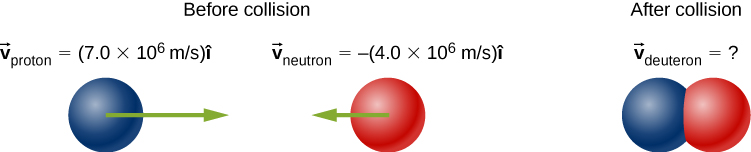
A proton (mass ) collides with a neutron (with essentially the same mass as the proton) to form a particle called a deuteron. What is the velocity of the deuteron if it is formed from a proton moving with velocity to the right and a neutron moving with velocity to the left?
英語のヒント
陽子(質量)が中性子(質量は陽子とほぼ同じ)に衝突し、重陽子という粒子を形成する。右向きに速度で動く陽子と、左向きに速度で動く中性子から生じた重陽子の速度はいくらか。
OpenStax / Rice University, University Physics Volume 1, CC BY 4.0. Source-book artwork retained. · CC BY 4.0 · Source出典

Strategy方針
Define the system to be the two particles. This is a collision, so we should first identify what kind. Since we are told the two particles form a single particle after the collision, this means that the collision is perfectly inelastic. Thus, kinetic energy is not conserved, but momentum is. Thus, we use conservation of momentum to determine the final velocity of the system.
英語のヒント
2個の粒子を系として定義する。衝突の問題なので、まず衝突の種類を見分ける。衝突後には2個の粒子から1個の粒子ができると与えられているので、完全非弾性衝突である。したがって、運動エネルギーは保存されないが、運動量は保存される。運動量保存則を用いて系の最終的な速度を求める。
Solution解答
Treat the two particles as having identical masses M. Use the subscripts p, n, and d for proton, neutron, and deuteron, respectively. This is a one-dimensional problem, so we have
英語のヒント
2個の粒子の質量がともにMで等しいものとして扱う。陽子、中性子、重陽子を、それぞれ添字p、n、dで表す。一次元の問題なので、次式を得る。
The masses divide out:
英語のヒント
質量を約分すると、
The velocity is thus .
英語のヒント
したがって、速度はである。
Significance考察
This is essentially how particle colliders like the Large Hadron Collider work: They accelerate particles up to very high speeds (large momenta), but in opposite directions. This maximizes the creation of so-called “daughter particles.”
英語のヒント
これが、大型ハドロン衝突型加速器などの粒子衝突型加速器の基本的な仕組みである。粒子を互いに反対方向に非常に大きな速さ(大きな運動量)まで加速する。これにより、いわゆる「娘粒子」の生成を最大限にする。
Example 9.11例題 9.11
Ice Hockey 2アイスホッケー2
(This is a variation of an earlier example.)
英語のヒント
(これは前の例題を変えたものである。)
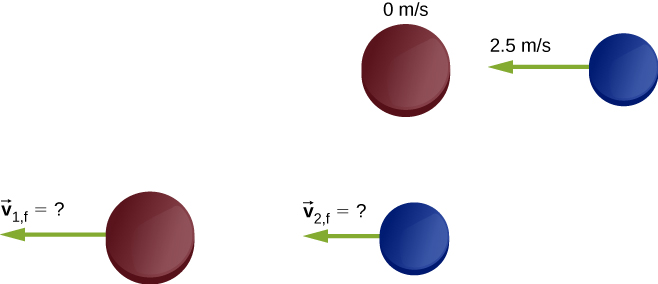
Two ice hockey pucks of different masses are on a flat, horizontal hockey rink. The red puck has a mass of 15 grams, and is motionless; the blue puck has a mass of 12 grams, and is moving at 2.5 m/s to the left. It collides with the motionless red puck (Figure 9.20). If the collision is perfectly elastic, what are the final velocities of the two pucks?
英語のヒント
質量が異なる2枚のアイスホッケーのパックが、平らな水平のリンク上にある。赤いパックの質量は15 gで、静止している。青いパックの質量は12 gで、左向きに2.5 m/sで動いている。青いパックが静止した赤いパックに衝突する(図9.20)。衝突が完全に弾性的なら、2枚のパックの最終的な速度はいくらか。
OpenStax / Rice University, University Physics Volume 1, CC BY 4.0. Source-book artwork retained. · CC BY 4.0 · Source出典

Figure 9.20図 9.20
Two different hockey pucks colliding. The top diagram shows the pucks the instant before the collision, and the bottom diagram show the pucks the instant after the collision. The net external force is zero.
英語のヒント
異なる2枚のホッケーのパックの衝突。上の図は衝突直前、下の図は衝突直後のパックを示す。外力の合力はゼロである。
Strategy方針
We’re told that we have two colliding objects, and we’re told their masses and initial velocities; we’re asked for both final velocities. Conservation of momentum seems like a good strategy; define the system to be the two pucks. There is no friction, so we have a closed system. We have two unknowns (the two final velocities), but only one equation. The comment about the collision being perfectly elastic is the clue; it suggests that kinetic energy is also conserved in this collision. That gives us our second equation.
英語のヒント
衝突する2個の物体について、質量と初速度が与えられ、両方の最終速度を求める。運動量保存を利用するのがよさそうである。2枚のパックを系と定義する。摩擦はないので、閉じた系となる。未知数は2個(2枚の最終速度)あるが、式は1本しかない。完全に弾性的な衝突という記述が手掛かりである。それは、この衝突で運動エネルギーも保存されることを示す。これで2本目の式が得られる。
The initial momentum and initial kinetic energy of the system resides entirely and only in the second puck (the blue one); the collision transfers some of this momentum and energy to the first puck.
英語のヒント
系の初めの運動量と運動エネルギーは、すべて2枚目のパック(青い方)だけが持っている。衝突によって、その運動量とエネルギーの一部が1枚目のパックへ移る。
Solution解答
Conservation of momentum, in this case, reads
英語のヒント
この場合、運動量保存の式は次のようになる。
Conservation of kinetic energy reads
英語のヒント
運動エネルギー保存の式は次のようになる。
There are our two equations in two unknowns. The algebra is tedious but not terribly difficult; you definitely should work it through. The solution is
英語のヒント
これが未知数2個に対する2本の式である。代数的な計算は手間がかかるが、それほど難しくないので、必ず自分で最後まで計算してみよう。解は次のようになる。
Substituting with the given numbers where a positive direction is to the left, we obtain
英語のヒント
左向きを正として、与えられた数値を代入すると、次の結果を得る。
Significance考察
Notice that after the collision, the blue puck is moving to the right; its direction of motion was reversed. The red puck is now moving to the left.
英語のヒント
衝突後、青いパックは右向きに動いていることに注意しよう。運動の向きが逆転したのである。赤いパックは今度は左向きに動いている。
Example 9.12例題 9.12
Thor vs. Iron Manソー対アイアンマン
The 2012 movie “The Avengers” has a scene where Iron Man and Thor fight. At the beginning of the fight, Thor throws his hammer at Iron Man, hitting him and throwing him slightly up into the air and against a small tree, which breaks. From the video, Iron Man is standing still when the hammer hits him. The distance between Thor and Iron Man is approximately 10 m, and the hammer takes about 1 s to reach Iron Man after Thor releases it. The tree is about 2 m behind Iron Man, which he hits in about 0.75 s. Also from the video, Iron Man’s trajectory to the tree is very close to horizontal. Assuming Iron Man’s total mass is 200 kg:
英語のヒント
2012年の映画『アベンジャーズ』には、アイアンマンとソーが戦う場面がある。戦いの初めに、ソーがアイアンマンめがけてハンマーを投げる。ハンマーが当たるとアイアンマンは少し宙へ浮き、小さな木にぶつかって、その木が折れる。映像では、ハンマーが当たるときアイアンマンは静止している。ソーとアイアンマンの距離は約10 mで、ソーがハンマーを放してからアイアンマンに届くまで約1 sかかる。木はアイアンマンの約2 m後方にあり、アイアンマンは約0.75 sでそこにぶつかる。また、映像によれば、木までのアイアンマンの軌道はほぼ水平である。アイアンマンの全質量を200 kgと仮定して、次を求めよ。
- Estimate the mass of Thor’s hammer
英語のヒント
ソーのハンマーの質量を見積もれ。 - Estimate how much kinetic energy was lost in this collision
英語のヒント
この衝突で失われた運動エネルギーを見積もれ。
Strategy方針
After the collision, Thor’s hammer is in contact with Iron Man for the entire time, so this is a perfectly inelastic collision. Thus, with the correct choice of a closed system, we expect momentum is conserved, but not kinetic energy. We use the given numbers to estimate the initial momentum, the initial kinetic energy, and the final kinetic energy. Because this is a one-dimensional problem, we can go directly to the scalar form of the equations.
英語のヒント
衝突後、ソーのハンマーはずっとアイアンマンに接触しているので、これは完全非弾性衝突である。したがって、閉じた系を正しく選べば、運動量は保存されるが、運動エネルギーは保存されないと予想できる。与えられた数値から、初めの運動量、初めの運動エネルギー、最後の運動エネルギーを見積もる。一次元の問題なので、そのままスカラー形式の式を使える。
Solution解答
- First, we posit conservation of momentum. For that, we need a closed system. The choice here is the system (hammer + Iron Man), from the time of collision to the moment just before Iron Man and the hammer hit the tree. Let:
英語のヒント
まず、運動量保存を仮定する。そのためには閉じた系が必要である。ここでは、衝突時からアイアンマンとハンマーが木にぶつかる直前までの、(ハンマー+アイアンマン)を系に選ぶ。各量を次のように置く。- mass of the hammer
英語のヒント
ハンマーの質量 - mass of Iron Man
英語のヒント
アイアンマンの質量 - velocity of the hammer before hitting Iron Man
英語のヒント
アイアンマンに当たる前のハンマーの速度 - v combined velocity of Iron Man + hammer after the collision
英語のヒント
v 衝突後に一体となったアイアンマン+ハンマーの速度
Again, Iron Man’s initial velocity was zero. Conservation of momentum here reads:英語のヒント
繰り返すと、アイアンマンの初速度はゼロである。この場合、運動量保存は次式で表される。We are asked to find the mass of the hammer, so we have英語のヒント
求めるのはハンマーの質量なので、次式を得る。Considering the uncertainties in our estimates, this should be expressed with just one significant figure; thus, .英語のヒント
見積もりの不確かさを考えると、有効数字は1桁だけで表すべきである。したがって、となる。 - The initial kinetic energy of the system, like the initial momentum, is all in the hammer:
英語のヒント
系の初めの運動エネルギーは、初めの運動量と同じく、すべてハンマーが持っている。After the collision,英語のヒント
衝突後には、Thus, there was a loss of .英語のヒント
したがって、が失われた。
Significance考察
From other scenes in the movie, Thor apparently can control the hammer’s velocity with his mind. It is possible, therefore, that he mentally causes the hammer to maintain its initial velocity of 10 m/s while Iron Man is being driven backward toward the tree. If so, this would represent an external force on our system, so it would not be closed. Thor’s mental control of his hammer is beyond the scope of this book, however.
英語のヒント
映画のほかの場面からすると、ソーは念じることでハンマーの速度を操れるようである。したがって、アイアンマンが後方の木に向かって押し飛ばされている間、ソーが念力でハンマーの初速度10 m/sを保っていた可能性もある。その場合、系に外力が働くことになり、閉じた系ではなくなる。しかし、ソーによるハンマーの念力操作は本書の範囲外である。
Example 9.13例題 9.13
Analyzing a Car Crash自動車事故の解析
At a stoplight, a small car (1200 kg) collides with a motionless large truck (3000 kg). The car comes to an instantaneous stop; the truck slides straight ahead, coming to a stop after sliding 10 meters. The measured coefficient of friction between the truck’s tires and the road was 0.62. How fast was the car moving at the moment of impact?
英語のヒント
信号のある場所で、小型乗用車(1200 kg)が静止した大型トラック(3000 kg)に衝突する。乗用車は瞬時に停止する。トラックはまっすぐ前方へ滑り、10 m滑って停止する。トラックのタイヤと道路の間の摩擦係数を測ると0.62だった。衝突の瞬間、乗用車はどれほどの速さで動いていたか。
Strategy方針
At first it may seem we don’t have enough information to solve this problem. Although we know the initial speed of the truck, we don’t know the speed of the car (indeed, that’s what we’re asked to find), so we don’t know the initial momentum of the system. Similarly, we know the final speed of the car, but not the speed of the truck immediately after impact. The fact that the truck eventually slid to a speed of zero doesn’t help with the final momentum, since an external friction force caused that. Nor can we calculate an impulse, since we don’t know the collision time, or the amount of time the truck slid before stopping. A useful strategy is to impose a restriction on the analysis.
英語のヒント
初めは、この問題を解く情報が足りないように思えるかもしれない。トラックの初めの速さは分かるが、乗用車の速さは分からない(まさにそれが求める量である)。したがって、系の初めの運動量は分からない。同様に、乗用車の最後の速さは分かるが、衝突直後のトラックの速さは分からない。トラックが最終的に速さゼロまで減速したという事実は、衝突後の運動量を求める助けにならない。その減速は外力である摩擦力によって起きたからである。衝突時間も、トラックが停止まで滑った時間も分からないので、力積も計算できない。解析に制限を設けると、うまく進められる。
Suppose we define a system consisting of just the car and the truck. The momentum of this system isn’t conserved, because of the friction between the truck and the road. But if we could find the speed of the truck the instant after impact—before friction had any measurable effect on the truck—then we could consider the momentum of the system to be conserved, with that restriction.
英語のヒント
乗用車とトラックだけからなる系を定義しよう。この系の運動量は、トラックと道路の間の摩擦によって保存されない。しかし、摩擦がトラックに測定できるほどの影響を及ぼす前、つまり衝突した直後の瞬間のトラックの速さを求められれば、そのように時間を制限したうえで、系の運動量が保存されると考えられる。
Can we find the final speed of the truck? Yes; we invoke the work-energy theorem.
英語のヒント
トラックの衝突後の速さを求められるだろうか。求められる。仕事とエネルギーの定理を用いるのである。
Solution解答
First, define some variables. Let:
英語のヒント
まず、変数を定義する。次のように置こう。
- be the masses of the car and truck, respectively
英語のヒント
:それぞれ乗用車とトラックの質量 - be the velocities of the truck before and after the collision, respectively
英語のヒント
:それぞれ衝突前と衝突後のトラックの速度 - Z be the velocities of the car before and after the collision, respectively
英語のヒント
Z:それぞれ衝突前と衝突後の乗用車の速度 - be the kinetic energies of the truck immediately after the collision, and after the truck has stopped sliding (so ).
英語のヒント
:それぞれ衝突直後と、トラックが滑り終わって停止した後のトラックの運動エネルギー(したがって) - d be the distance the truck slides after the collision before eventually coming to a stop.
英語のヒント
d:衝突後、トラックが最終的に停止するまでに滑る距離
Since we actually want the initial speed of the car, and since the car is not part of the work-energy calculation, let’s start with conservation of momentum. For the car + truck system, conservation of momentum reads
英語のヒント
実際に求めたいのは乗用車の初めの速さであり、乗用車は仕事とエネルギーの計算には含まれないので、まず運動量保存から始めよう。乗用車+トラックの系について、運動量保存は次式で表される。
Since the car’s initial velocity was zero, as was the truck’s final velocity, this simplifies to
英語のヒント
乗用車の初速度はゼロで、トラックの最終速度もゼロだったので、次のように簡単になる。
So now we need the truck’s speed immediately after impact. Recall that
英語のヒント
次に必要なのは、衝突直後のトラックの速さである。次の関係を思い出そう。
where
英語のヒント
ここで、
Also,
英語のヒント
また、
The work is done over the distance the truck slides, which we’ve called d. Equating:
英語のヒント
仕事は、トラックが滑る距離、すなわちdとした距離にわたってなされる。等しいと置くと、
Friction is the force on the truck that does the work to stop the sliding. With a level road, the friction force is
英語のヒント
トラックに作用して滑りを止める仕事をする力は、摩擦である。道路が水平なら、摩擦力は次式で与えられる。
Since the angle between the directions of the friction force vector and the displacement d is , and we have
英語のヒント
摩擦力のベクトルと変位dの方向のなす角はであり、なので、次式を得る。
(Notice that the truck’s mass divides out; evidently the mass of the truck doesn’t matter.)
英語のヒント
(トラックの質量は約分されて消えることに注意しよう。どうやら、トラックの質量は結果に関係しない。)
Solving for the truck’s speed immediately after the collision gives
英語のヒント
衝突直後のトラックの速さについて解くと、
Substituting the given numbers:
英語のヒント
与えられた数値を代入すると、
Now we can calculate the initial speed of the car:
英語のヒント
これで乗用車の初めの速さを計算できる。
Significance考察
This is an example of the type of analysis done by investigators of major car accidents. A great deal of legal and financial consequences depend on an accurate analysis and calculation of momentum and energy.
英語のヒント
これは、大きな自動車事故の調査員が行う解析の一例である。法的・金銭的な面で多くの結果が、運動量とエネルギーの正確な解析と計算に左右される。
This collision converted some of the initial kinetic energy to other forms (presumably the deformation of the car and truck and some heat and sound):
英語のヒント
この衝突では、初めの運動エネルギーの一部がほかの形に変わった(おそらく、乗用車とトラックの変形、および熱と音である)。
Change in kinetic energy =
英語のヒント
運動エネルギーの変化=