第9章運動量と衝突
Effect of Impulse力積の効果
Since an impulse is a force acting for some amount of time, it causes an object’s motion to change. Recall Equation 9.6:
英語のヒント
力積は、ある時間にわたって作用する力によるものなので、物体の運動を変化させる。式9.6を思い出そう。
Because is the momentum of a system, is the change of momentum . This gives us the following relation, called the impulse-momentum theorem (or relation).
英語のヒント
は系の運動量であるため、は運動量の変化となる。ここから、力積と運動量の定理、または関係式と呼ばれる次の関係を得る。
OpenStax / Rice University, University Physics Volume 1, CC BY 4.0. Source-book artwork retained. · CC BY 4.0 · Source出典

Figure 9.10図 9.10
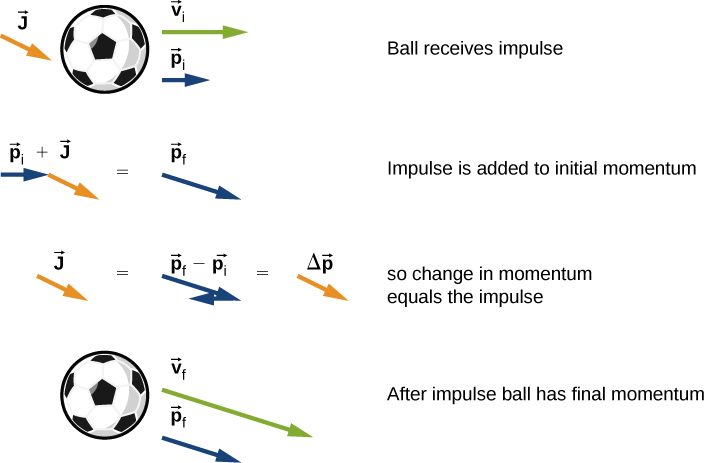
Illustration of impulse-momentum theorem. (a) A ball with initial velocity and momentum receives an impulse . (b) This impulse is added vectorially to the initial momentum. (c) Thus, the impulse equals the change in momentum, . (d) After the impulse, the ball moves off with its new momentum
英語のヒント
力積と運動量の定理の図解。(a)初速度、初めの運動量を持つボールが、力積を受ける。(b)この力積を、初めの運動量にベクトルとして加える。(c)したがって、力積は運動量の変化に等しく、となる。(d)力積を受けた後、ボールは新たな運動量を持って動き出す。
There are two crucial concepts in the impulse-momentum theorem:
英語のヒント
力積と運動量の定理には、二つの決定的に重要な概念がある。
- Impulse is a vector quantity; an impulse of, say, is very different from an impulse of ; they cause completely opposite changes of momentum.
英語のヒント
力積はベクトル量である。たとえば、力積は力積と大きく異なり、両者はまったく逆向きの運動量変化を生じさせる。 - An impulse does not cause momentum; rather, it causes a change in the momentum of an object. Thus, you must subtract the initial momentum from the final momentum, and—since momentum is also a vector quantity—you must take careful account of the signs of the momentum vectors.
英語のヒント
力積が生じさせるのは、運動量そのものではなく、物体の運動量の変化である。したがって、最終的な運動量から初めの運動量を引かなければならない。また、運動量もベクトル量なので、運動量ベクトルの符号を注意深く扱う必要がある。
The most common questions asked in relation to impulse are to calculate the applied force, or the change of velocity that occurs as a result of applying an impulse. The general approach is the same.
英語のヒント
力積に関する問題で最もよく求められるのは、加えた力、または力積を加えた結果として生じた速度の変化である。一般的な取り組み方は同じである。
Example 9.3例題 9.3
Moving the Enterpriseエンタープライズ号を動かす
OpenStax / Rice University, University Physics Volume 1, CC BY 4.0. Source-book artwork retained. · CC BY 4.0 · Source出典

Figure 9.11図 9.11
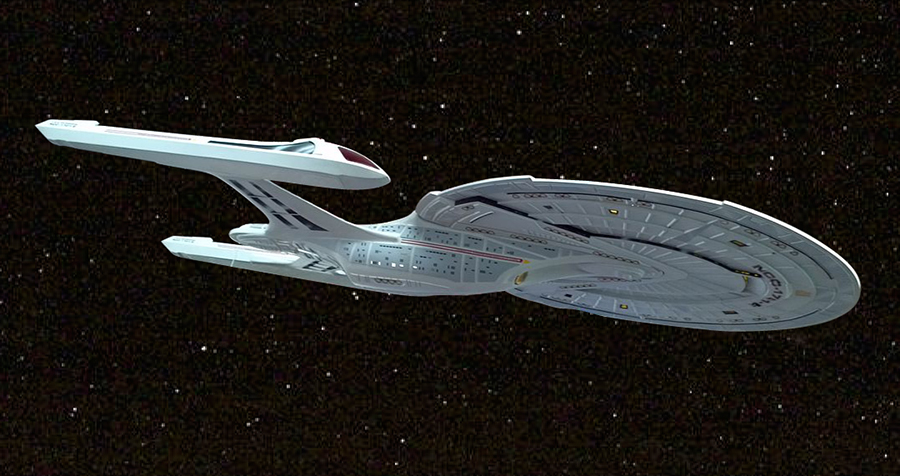
The fictional starship Enterprise from the Star Trek adventures operated on so-called “impulse engines” that combined matter with antimatter to produce energy.
英語のヒント
『スター・トレック』の冒険に登場する架空の宇宙船エンタープライズ号は、物質と反物質を組み合わせてエネルギーを生み出す、いわゆる「インパルス・エンジン」で動いていた。
When Captain Picard commands, “Take us out,” the starship Enterprise (Figure 9.11) starts from rest to a final speed of . Assuming this maneuver is completed in 60 s, what average force did the impulse engines apply to the ship?
英語のヒント
ピカード艦長が「発進せよ」と命じると、宇宙船エンタープライズ号(図9.11)は静止状態から加速して、最終的に速さになる。この操作を60 sで完了すると仮定すると、インパルス・エンジンが船に加えた平均の力はいくらか。
Strategy方針
We are asked for a force; we know the initial and final speeds (and hence the change in speed), and we know the time interval over which this all happened. In particular, we know the amount of time that the force acted. This suggests using the impulse-momentum relation. To use that, though, we need the mass of the Enterprise. An internet search gives a best estimate of the mass of the Enterprise (in the 2009 movie) as .
英語のヒント
求めるのは力であり、初めと終わりの速さ、したがって速さの変化と、それが起こった時間間隔がわかっている。特に、力が作用した時間がわかっているので、力積と運動量の関係を使えそうである。ただし、それを使うにはエンタープライズ号の質量が必要になる。インターネットで調べると、2009年の映画に登場するエンタープライズ号の質量について、最も妥当な推定値はとわかる。
Solution解答
Because this problem involves only one direction (i.e., the direction of the force applied by the engines), we only need the scalar form of the impulse-momentum theorem Equation 9.7, which is
英語のヒント
この問題では、エンジンが加える力の方向という一つの方向だけを扱う。そのため、力積と運動量の定理である式9.7のスカラー表示だけを使えばよい。すなわち、
with
英語のヒント
ここで、
and
英語のヒント
および、
Equating these expressions gives
英語のヒント
これらの式を等しいと置くと、
Solving for the magnitude of the force and inserting the given values leads to
英語のヒント
力の大きさについて解き、与えられた値を代入すると、
Significance考察
Using Newton's Second Law, this force causes an acceleration of . This is 130,000 times gravity, which is unimaginably huge. It goes almost without saying that such a force would kill everyone on board instantly, as well as destroying every piece of equipment. Fortunately, the Enterprise has “inertial dampeners.” It is left as an exercise for the reader’s imagination to determine how these work.
英語のヒント
ニュートンの第二法則を用いると、この力によって生じる加速度はとなる。これは重力加速度の13万倍という、想像を絶する大きさである。そのような力を受ければ、搭乗者は全員即死し、機器もすべて破壊されるのは、ほとんど言うまでもない。幸い、エンタープライズ号には「慣性緩衝装置」がある。それがどう動作するかを考えることは、読者の想像力を働かせる演習として残しておく。
Example 9.4例題 9.4
The iPhone DropiPhoneの落下
Apple released its iPhone 6 Plus in November 2014. According to many reports, it was originally supposed to have a screen made from sapphire, but that was changed at the last minute for a hardened glass screen. Reportedly, this was because the sapphire screen cracked when the phone was dropped. What force did the iPhone 6 Plus experience as a result of being dropped?
英語のヒント
Appleは2014年11月にiPhone 6 Plusを発売した。多くの報道によると、当初はサファイア製の画面を採用する予定だったが、直前に強化ガラス製へ変更された。伝えられるところでは、端末を落とすとサファイアの画面が割れたことが理由だった。iPhone 6 Plusは落下によってどれほどの力を受けたのだろうか。
Strategy方針
The force the phone experiences is due to the impulse applied to it by the floor when the phone collides with the floor. Our strategy then is to use the impulse-momentum relationship. We calculate the impulse, estimate the impact time, and use this to calculate the force.
英語のヒント
端末が受ける力は、床との衝突時に、床から端末へ加えられる力積によるものである。したがって、力積と運動量の関係を用いる。力積を計算し、衝突時間を見積もって、それらから力を求める。
We need to make a couple of reasonable estimates, as well as find technical data on the phone itself. First, let’s suppose that the phone is most often dropped from about chest height on an average-height person. Second, assume that it is dropped from rest, that is, with an initial vertical velocity of zero. Finally, we assume that the phone bounces very little—the height of its bounce is assumed to be negligible.
英語のヒント
端末自体の技術データを調べるとともに、いくつか妥当な見積もりを置く必要がある。第一に、端末は平均的な身長の人の胸の高さ付近から落とされることが最も多いとしよう。第二に、静止状態から落とす、すなわち初めの鉛直方向の速度はゼロとする。最後に、端末はほとんど跳ね返らず、跳ね返りの高さを無視できるとする。
Solution解答
Define upward to be the +y-direction. A typical height is approximately and, as stated, . The average force on the phone is related to the impulse the floor applies on it during the collision:
英語のヒント
上向きを+y方向とする。典型的な高さは約であり、先ほど述べた通りである。端末に加わる平均の力と、衝突中に床が端末に与える力積の関係は、
The impulse equals the change in momentum,
英語のヒント
力積は運動量の変化に等しい。
so
英語のヒント
したがって、
Next, the change of momentum is
英語のヒント
次に、運動量の変化は、
We need to be careful with the velocities here; this is the change of velocity due to the collision with the floor. But the phone also has an initial drop velocity [], so we label our velocities. Let:
英語のヒント
ここでは速度の扱いに注意が必要である。今考えているのは、床との衝突による速度の変化である。しかし、端末には落とし始めたときの初速度[]もあるので、それぞれの速度を区別して記号を付ける。次のように定める。
- the initial velocity with which the phone was dropped (zero, in this example)
英語のヒント
端末を落とし始めたときの初速度。この例ではゼロである。 - the velocity the phone had the instant just before it hit the floor
英語のヒント
端末が床に衝突する直前の瞬間の速度。 - the final velocity of the phone as a result of hitting the floor
英語のヒント
床に衝突した結果としての端末の最終速度。
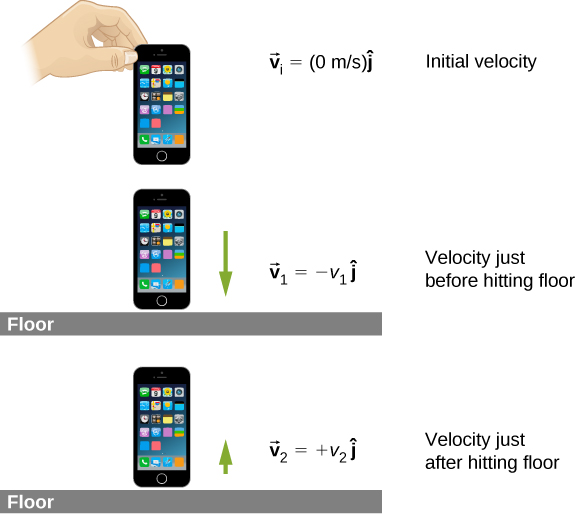
Figure 9.12 shows the velocities at each of these points in the phone’s trajectory.
英語のヒント
図9.12は、端末の軌道上の各位置における速度を示している。
OpenStax / Rice University, University Physics Volume 1, CC BY 4.0. Source-book artwork retained. · CC BY 4.0 · Source出典

Figure 9.12図 9.12
(a) The initial velocity of the phone is zero, just after the person drops it. (b) Just before the phone hits the floor, its velocity is which is unknown at the moment, except for its direction, which is downward (c) After bouncing off the floor, the phone has a velocity , which is also unknown, except for its direction, which is upward
英語のヒント
(a)人が端末を手放した直後の初速度はゼロである。(b)床に当たる直前の速度はであり、現時点では未知だが、下向きであることだけはわかっている。(c)床で跳ね返った後の速度はであり、これも未知だが、上向きであることだけはわかっている。
With these definitions, the change of momentum of the phone during the collision with the floor is
英語のヒント
この定義を用いると、床との衝突中の端末の運動量の変化は、
Since we assume the phone doesn’t bounce at all when it hits the floor (or at least, the bounce height is negligible), then is zero, so
英語のヒント
床に当たった端末はまったく跳ね返らない、少なくとも跳ね返りの高さは無視できると仮定しているため、はゼロとなる。したがって、
We can get the speed of the phone just before it hits the floor using either kinematics or conservation of energy. We’ll use conservation of energy here; you should re-do this part of the problem using kinematics and prove that you get the same answer.
英語のヒント
床に当たる直前の端末の速さは、運動学とエネルギー保存のどちらからでも求められる。ここではエネルギー保存を使う。運動学を使ってこの部分を自分でも解き直し、同じ答えになることを示してほしい。
First, define the zero of potential energy to be located at the floor. Conservation of energy then gives us:
英語のヒント
まず、床の位置を位置エネルギーのゼロと定める。すると、エネルギー保存より、
Defining and using gives
英語のヒント
と定め、を用いると、
Because is a vector magnitude, it must be positive. Thus, . Inserting this result into the expression for force gives
英語のヒント
はベクトルの大きさなので、正でなければならない。したがってとなる。この結果を力の式に代入すると、
Finally, we need to estimate the collision time. One common way to estimate a collision time is to calculate how long the object would take to travel its own length. The phone is moving at 5.4 m/s just before it hits the floor, and it is 0.14 m long, giving an estimated collision time of 0.026 s. Inserting the given numbers, we obtain
英語のヒント
最後に、衝突時間を見積もる必要がある。一般的な見積もり方の一つは、物体が自分自身の長さに等しい距離を進むのにかかる時間を計算することである。端末は床に当たる直前に5.4 m/sで動いており、長さは0.14 mなので、衝突時間は0.026 sと見積もられる。与えられた数値を代入すると、
Significance考察
The iPhone itself weighs just ; the force the floor applies to it is therefore over 20 times its weight.
英語のヒント
iPhone自体の重さはわずかである。したがって、床が端末に加える力は、端末の重さの20倍を超える。