第9章運動量と衝突
The Meaning of ‘System’「系」の意味
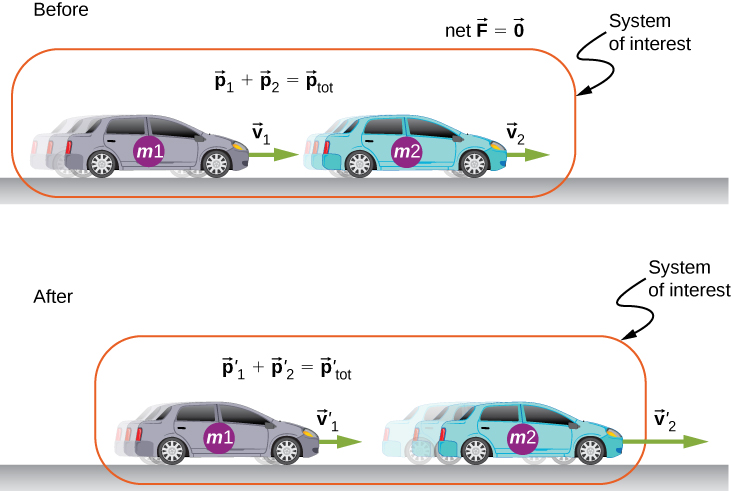
A system (mechanical) is the collection of objects in whose motion (kinematics and dynamics) you are interested. If you are analyzing the bounce of a ball on the ground, you are probably only interested in the motion of the ball, and not of Earth; thus, the ball is your system. If you are analyzing a car crash, the two cars together compose your system (Figure 9.15).
英語のヒント
力学的な系とは、その運動を運動学や動力学の観点から調べたい物体の集まりである。地面で跳ねるボールを解析するなら、通常は地球の運動ではなくボールの運動だけに関心があるので、ボールが系となる。自動車の衝突を解析するなら、2台の車を合わせたものが系となる(図9.15)。
OpenStax / Rice University, University Physics Volume 1, CC BY 4.0. Source-book artwork retained. · CC BY 4.0 · Source出典

Figure 9.15図 9.15
The two cars together form the system that is to be analyzed. It is important to remember that the contents (the mass) of the system do not change before, during, or after the objects in the system interact.
英語のヒント
2台の自動車を合わせたものが、解析する系となる。系を構成する物体が相互作用する前・最中・後を通じて、系の中身、すなわち質量が変わらないことを忘れてはならない。
Example 9.6例題 9.6
Colliding Carts衝突する台車
Two carts in a physics lab roll on a level track, with negligible friction. These carts have small magnets at their ends, so that when they collide, they stick together (Figure 9.16). The first cart has a mass of 675 grams and is rolling at 0.75 m/s to the right; the second has a mass of 500 grams and is rolling at 1.33 m/s, also to the right. After the collision, what is the velocity of the two joined carts?
英語のヒント
物理実験室で、2台の台車が摩擦を無視できる水平な軌道上を走っている。台車の端には小さな磁石が付いていて、衝突するとくっつく(図9.16)。1台目の質量は675 gで、右向きに0.75 m/sで走っている。2台目の質量は500 gで、やはり右向きに1.33 m/sで走っている。衝突後、つながった2台の速度はいくらになるか。

OpenStax / Rice University, University Physics Volume 1, CC BY 4.0. Source-book artwork retained. · CC BY 4.0 · Source出典

Figure 9.16図 9.16
Two lab carts collide and stick together after the collision.
英語のヒント
2台の実験用台車が衝突し、その後くっついている。
Strategy方針
We have a collision. We’re given masses and initial velocities; we’re asked for the final velocity. This all suggests using conservation of momentum as a method of solution. However, we can only use it if we have a closed system. So we need to be sure that the system we choose has no net external force on it, and that its mass is not changed by the collision.
英語のヒント
衝突の問題であり、質量と初速度が与えられ、最終速度を求める。したがって、運動量保存を使うのがよさそうである。ただし、それが使えるのは閉じた系の場合だけである。選んだ系に働く外力の合力がゼロであり、衝突によってその質量が変わらないことを確かめなければならない。
Defining the system to be the two carts meets the requirements for a closed system: The combined mass of the two carts certainly doesn’t change, and while the carts definitely exert forces on each other, those forces are internal to the system, so they do not change the momentum of the system as a whole. In the vertical direction, the weights of the carts are canceled by the normal forces on the carts from the track.
英語のヒント
2台の台車を系と定めれば、閉じた系の条件を満たす。2台を合わせた質量は確かに変わらない。台車どうしは力を及ぼすが、それらは系の内力なので、系全体の運動量を変えない。鉛直方向では、各台車に働く重力が、軌道から受ける垂直抗力によって打ち消される。
Solution解答
Conservation of momentum is
英語のヒント
運動量保存を式で表すと、
Define the direction of their initial velocity vectors to be the +x-direction. The initial momentum is then
英語のヒント
初速度ベクトルの方向を+x方向とする。初めの運動量は、
The final momentum of the now-linked carts is
英語のヒント
つながった台車の最終的な運動量は、
Equating:
英語のヒント
両者を等しいと置くと、
Substituting the given numbers:
英語のヒント
与えられた数値を代入すると、
Significance考察
The principles that apply here to two laboratory carts apply identically to all objects of whatever type or size. Even for photons, the concepts of momentum and conservation of momentum are still crucially important even at that scale. (Since they are massless, the momentum of a photon is defined very differently from the momentum of ordinary objects. You will learn about this when you study quantum physics.)
英語のヒント
ここで2台の実験用台車に適用した原理は、どの種類、どの大きさの物体にも同じように当てはまる。光子でさえ、その尺度でも運動量と運動量保存の概念は決定的に重要である。光子には質量がないため、その運動量は通常の物体とは大きく異なる仕方で定義される。これについては量子物理学で学ぶ。
Example 9.7例題 9.7
A Bouncing Superball跳ね返るスーパーボール
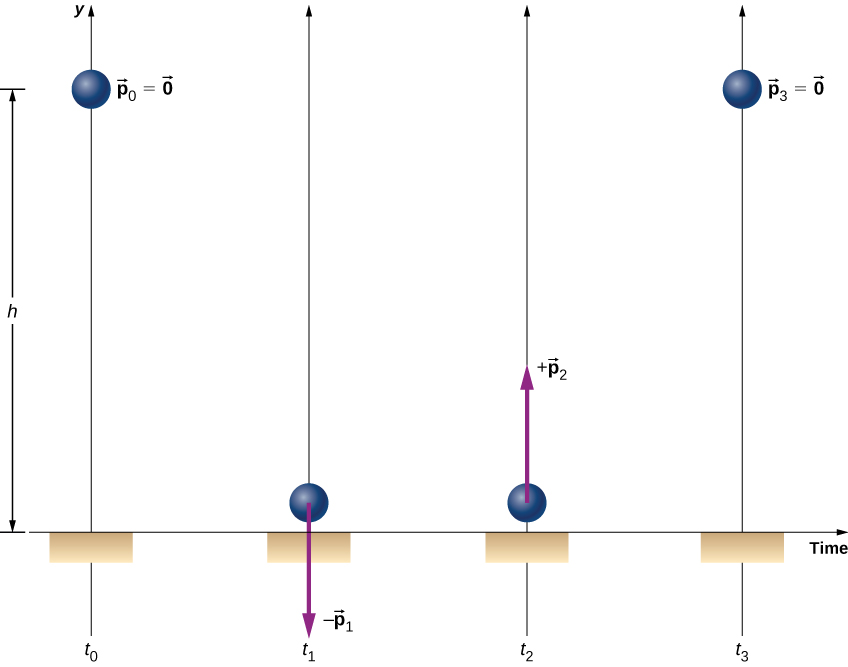
A superball of mass 0.25 kg is dropped from rest from a height of above the floor. It bounces with no loss of energy and returns to its initial height (Figure 9.17).
英語のヒント
質量0.25 kgのスーパーボールを、床からの高さの位置で静かに放す。ボールはエネルギーを失わずに跳ね返り、初めの高さまで戻る(図9.17)。
- What is the superball’s change of momentum during its bounce on the floor?
英語のヒント
床で跳ね返る間の、スーパーボールの運動量の変化はいくらか。 - What was Earth’s change of momentum due to the ball colliding with the floor?
英語のヒント
ボールが床に衝突したことで、地球の運動量はどれだけ変わったか。 - What was Earth’s change of velocity as a result of this collision?
英語のヒント
この衝突の結果、地球の速度はどれだけ変わったか。
(This example shows that you have to be careful about defining your system.)
英語のヒント
この例は、系の定義には注意が必要であることを示している。
OpenStax / Rice University, University Physics Volume 1, CC BY 4.0. Source-book artwork retained. · CC BY 4.0 · Source出典

Figure 9.17図 9.17
A superball is dropped to the floor (), hits the floor (), bounces (), and returns to its initial height ().
英語のヒント
スーパーボールを床に向けて落とす()。床に当たり()、跳ね返って()、初めの高さへ戻る()。
Strategy方針
Since we are asked only about the ball’s change of momentum, we define our system to be the ball. But this is clearly not a closed system; gravity applies a downward force on the ball while it is falling, and the normal force from the floor applies a force during the bounce. Thus, we cannot use conservation of momentum as a strategy. Instead, we simply determine the ball’s momentum just before it collides with the floor and just after, and calculate the difference. We have the ball’s mass, so we need its velocities.
英語のヒント
求めるのはボールの運動量の変化だけなので、系をボールと定める。しかし、これは明らかに閉じた系ではない。落下中は重力が下向きに働き、跳ね返る間には床から垂直抗力が加わる。したがって、運動量保存は使えない。代わりに、床に当たる直前と直後のボールの運動量を求め、その差を計算する。質量はわかっているので、速度が必要になる。
Solution解答
- Since this is a one-dimensional problem, we use the scalar form of the equations. Let:
英語のヒント
一次元の問題なので、式のスカラー表示を用いる。次のように定める。- the magnitude of the ball’s momentum at time , the moment it was released; since it was dropped from rest, this is zero.
英語のヒント
手を放した瞬間の時刻における、ボールの運動量の大きさ。静止状態から落としたので、これはゼロである。 - the magnitude of the ball’s momentum at time , the instant just before it hits the floor.
英語のヒント
床に当たる直前の時刻における、ボールの運動量の大きさ。 - the magnitude of the ball’s momentum at time , just after it loses contact with the floor after the bounce.
英語のヒント
跳ね返った後、床から離れた直後の時刻における、ボールの運動量の大きさ。
The ball’s change of momentum is英語のヒント
ボールの運動量の変化は、Its velocity just before it hits the floor can be determined from either conservation of energy or kinematics. We use kinematics here; you should re-solve it using conservation of energy and confirm you get the same result.
We want the velocity just before it hits the ground (at time ). We know its initial velocity (at time ), the height it falls, and its acceleration; we don’t know the fall time. We could calculate that, but instead we use英語のヒント
床に当たる直前の速度は、エネルギー保存と運動学のどちらからでも求められる。ここでは運動学を用いる。エネルギー保存を使って自分でも解き直し、同じ結果になることを確かめてほしい。求めたいのは、床に当たる直前、時刻での速度である。時刻での初速度、落下する高さ、加速度はわかっているが、落下時間はわからない。落下時間を計算してもよいが、ここでは代わりに次式を使う。Thus the ball has a momentum of英語のヒント
したがって、ボールの運動量は、We don’t have an easy way to calculate the momentum after the bounce. Instead, we reason from the symmetry of the situation.
Before the bounce, the ball starts with zero velocity and falls 1.50 m under the influence of gravity, achieving some amount of momentum just before it hits the ground. On the return trip (after the bounce), it starts with some amount of momentum, rises the same 1.50 m it fell, and ends with zero velocity. Thus, the motion after the bounce was the mirror image of the motion before the bounce. From this symmetry, it must be true that the ball’s momentum after the bounce must be equal and opposite to its momentum before the bounce. (This is a subtle but crucial argument; make sure you understand it before you go on.)
Therefore,英語のヒント
跳ね返った後の運動量を、直接簡単に計算する方法はない。代わりに、この状況の対称性から考える。跳ね返る前、ボールは速度ゼロから重力を受けて1.50 m落下し、床に当たる直前にある運動量を得る。跳ね返った後の戻りの運動では、ある運動量から始まり、落下したのと同じ1.50 mだけ上昇して、最後に速度ゼロとなる。つまり、跳ね返った後の運動は、その前の運動を鏡に映したような関係にある。この対称性から、跳ね返った後の運動量は、その直前の運動量と大きさが等しく、向きが逆でなければならない。これは微妙だが決定的に重要な議論なので、先へ進む前に理解できたか確かめよう。したがって、Thus, the ball’s change of momentum during the bounce is英語のヒント
したがって、跳ね返る間のボールの運動量の変化は、 - What was Earth’s change of momentum due to the ball colliding with the floor?
Your instinctive response may well have been either “zero; the Earth is just too massive for that tiny ball to have affected it” or possibly, “more than zero, but utterly negligible.” But no—if we re-define our system to be the Superball + Earth, then this system is closed (neglecting the gravitational pulls of the Sun, the Moon, and the other planets in the solar system), and therefore the total change of momentum of this new system must be zero. Therefore, Earth’s change of momentum is exactly the same magnitude:英語のヒント
ボールが床に衝突したことによる、地球の運動量の変化はいくらか。直観的には、「ゼロだ。地球は重すぎて、あの小さなボールには影響を与えられない」と思ったかもしれないし、「ゼロよりは大きいが、まったく無視できる」と考えたかもしれない。しかし、そうではない。系を「スーパーボール+地球」と定義し直すと、太陽・月・太陽系の他の惑星からの重力を無視すれば、この系は閉じている。したがって、新しい系の運動量の変化の合計はゼロでなければならない。地球の運動量の変化は、次のようにまったく同じ大きさとなる。 - What was Earth’s change of velocity as a result of this collision?
This is where your instinctive feeling is probably correct:英語のヒント
この衝突の結果、地球の速度はいくら変わったか。こちらでは、おそらく直観が正しい。This change of Earth’s velocity is utterly negligible.英語のヒント
この地球の速度の変化は、まったく無視できるほど小さい。
Significance考察
It is important to realize that the answer to part (c) is not a velocity; it is a change of velocity, which is a very different thing. Nevertheless, to give you a feel for just how small that change of velocity is, suppose you were moving with a velocity of . At this speed, it would take you about 7 million years to travel a distance equal to the diameter of a hydrogen atom.
英語のヒント
(c)の答えは速度ではなく速度の変化であり、両者は大きく異なることを理解しておく必要がある。それでも、この速度変化がどれほど小さいかを実感するために、自分が速度で動いていると考えてみよう。この速さでは、水素原子の直径に等しい距離を進むのに、約700万年もかかる。
Example 9.8例題 9.8
Ice Hockey 1アイスホッケー1
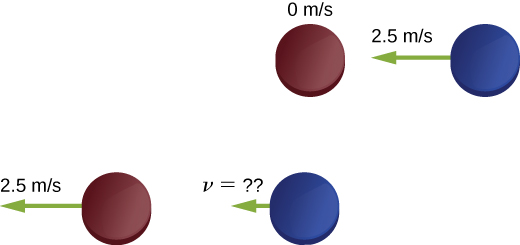
Two hockey pucks of identical mass are on a flat, horizontal ice hockey rink. The red puck is motionless; the blue puck is moving at 2.5 m/s to the left (Figure 9.18). It collides with the motionless red puck. The pucks have a mass of 15 g. After the collision, the red puck is moving at 2.5 m/s, to the left. What is the final velocity of the blue puck?
英語のヒント
同じ質量のホッケーパックが2枚、平らで水平なアイスホッケーリンクの上にある。赤いパックは静止し、青いパックは左向きに2.5 m/sで動いている(図9.18)。青いパックが静止した赤いパックに衝突する。どちらのパックも質量は15 gである。衝突後、赤いパックは左向きに2.5 m/sで動く。青いパックの最終速度はいくらか。
OpenStax / Rice University, University Physics Volume 1, CC BY 4.0. Source-book artwork retained. · CC BY 4.0 · Source出典

Figure 9.18図 9.18
Two identical hockey pucks colliding. The top diagram shows the pucks the instant before the collision, and the bottom diagram show the pucks the instant after the collision. The net external force is zero.
英語のヒント
同じ2枚のホッケーパックが衝突する。上の図は衝突直前、下の図は衝突直後の状態を示す。外力の合力はゼロである。
Strategy方針
We’re told that we have two colliding objects, we’re told the masses and initial velocities, and one final velocity; we’re asked for both final velocities. Conservation of momentum seems like a good strategy. Define the system to be the two pucks; there’s no friction, so we have a closed system.
英語のヒント
2つの物体が衝突し、その質量と初速度、および一方の最終速度が与えられている。両方の最終速度を求めるので、運動量保存がよさそうである。2枚のパックを系と定めれば、摩擦がないため閉じた系になる。
Before you look at the solution, what do you think the answer will be?
英語のヒント
解答を見る前に、答えはどうなると思うか。
The blue puck final velocity will be:
英語のヒント
青いパックの最終速度は、
- zeroゼロ
- 2.5 m/s to the left左向きに2.5 m/s
- 2.5 m/s to the right右向きに2.5 m/s
- 1.25 m/s to the left左向きに1.25 m/s
- 1.25 m/s to the right右向きに1.25 m/s
- something else
英語のヒント
それ以外
Solution解答
Define the +x-direction to point to the right. Conservation of momentum then reads
英語のヒント
右向きを+x方向と定める。すると、運動量保存は次のように書ける。
Before the collision, the momentum of the system is entirely and only in the blue puck. Thus,
英語のヒント
衝突前には、系の運動量はすべて青いパックだけが持っている。したがって、
(Remember that the masses of the pucks are equal.) Substituting numbers:
英語のヒント
パックの質量が等しいことを思い出そう。数値を代入すると、
Significance考察
Evidently, the two pucks simply exchanged momentum. The blue puck transferred all of its momentum to the red puck. In fact, this is what happens in similar collision where
英語のヒント
明らかに、2枚のパックは運動量を単に交換しただけである。青いパックが、自分の持つ運動量をすべて赤いパックへ渡した。実際、である同様の衝突では、このことが起こる。
Example 9.9例題 9.9
Landing of Philaeフィラエの着陸
On November 12, 2014, the European Space Agency successfully landed a probe named Philae on Comet 67P/Churyumov/Gerasimenko (Figure 9.19). During the landing, however, the probe actually landed three times, because it bounced twice. Let’s calculate how much the comet’s speed changed as a result of the first bounce.
英語のヒント
2014年11月12日、欧州宇宙機関はフィラエという探査機を、67P/チュリュモフ・ゲラシメンコ彗星に着陸させることに成功した(図9.19)。しかし、この着陸では探査機が2回跳ね返り、実際には3回着地した。最初の跳ね返りによって、彗星の速さがどれだけ変わったか計算してみよう。
Image omitted because its reuse rights could not be verified.権利の確認ができないため画像を割愛。
Figure 9.19図 9.19
An artist’s rendering of Philae landing on a comet. (credit: modification of work by “DLR German Aerospace Center”/Flickr)
英語のヒント
フィラエが彗星に着陸する様子を描いた想像図。(出典:“DLR German Aerospace Center”/Flickrの作品を改変)
Let’s define upward to be the +y-direction, perpendicular to the surface of the comet, and to be at the surface of the comet. Here’s what we know:
英語のヒント
彗星の表面に垂直な上向きを+y方向とし、彗星表面をと定める。わかっている量は次の通りである。
- The mass of Comet 67P:67P彗星の質量:
- The acceleration due to the comet’s gravity:彗星の重力による加速度:
- Philae’s mass:フィラエの質量:
- Initial touchdown speed:
英語のヒント
最初の着地時の速さ: - Initial upward speed due to first bounce:最初の跳ね返りによる初めの上向きの速さ:
- Landing impact time:着陸時の衝突時間:
Strategy方針
We’re asked for how much the comet’s speed changed, but we don’t know much about the comet, beyond its mass and the acceleration its gravity causes. However, we are told that the Philae lander collides with (lands on) the comet, and bounces off of it. A collision suggests momentum as a strategy for solving this problem.
英語のヒント
求めるのは彗星の速さがどれだけ変わったかだが、彗星についてわかっているのは、その質量と重力による加速度くらいである。しかし、フィラエ着陸機が彗星に衝突、すなわち着陸し、その後跳ね返ったことはわかっている。衝突なので、運動量を使って解くことを考える。
If we define a system that consists of both Philae and Comet 67/P, then there is no net external force on this system, and thus the momentum of this system is conserved. (We’ll neglect the gravitational force of the sun.) Thus, if we calculate the change of momentum of the lander, we automatically have the change of momentum of the comet. Also, the comet’s change of velocity is directly related to its change of momentum as a result of the lander “colliding” with it.
英語のヒント
フィラエと67/P彗星の両方を含む系を定めると、この系に働く外力の合力はゼロとなり、系の運動量は保存される。ここでは太陽の重力を無視する。したがって、着陸機の運動量の変化を計算すれば、彗星の運動量の変化も自動的にわかる。また、着陸機との「衝突」による彗星の速度の変化は、運動量の変化と直接結び付いている。
Solution解答
Let be Philae’s momentum at the moment just before touchdown, and be its momentum just after the first bounce. Then its momentum just before landing was
英語のヒント
着地の直前のフィラエの運動量を、最初の跳ね返りの直後の運動量をとする。すると、着陸直前の運動量は、
and just after was
英語のヒント
その直後の運動量は、
Therefore, the lander’s change of momentum during the first bounce is
英語のヒント
したがって、最初の跳ね返りの間の着陸機の運動量の変化は、
Notice how important it is to include the negative sign of the initial momentum.
英語のヒント
初めの運動量の負の符号を含めることが、どれほど重要かに注意しよう。
Now for the comet. Since momentum of the system must be conserved, the comet’s momentum changed by exactly the negative of this:
英語のヒント
次に彗星を考える。系の運動量は保存されなければならないので、彗星の運動量の変化は、この値の符号を正確に反転したものとなる。
Therefore, its change of velocity is
英語のヒント
したがって、彗星の速度の変化は、
Significance考察
This is a very small change in velocity, about a thousandth of a billionth of a meter per second. Crucially, however, it is not zero.
英語のヒント
これは非常に小さい速度変化であり、およそ毎秒1 mの10億分の1の、さらに1000分の1である。しかし、決定的に重要なのは、ゼロではないことである。