第9章運動量と衝突
9.3 Conservation of Linear Momentum9.3 運動量保存
Learning Objectives学習目標
Learning Objectives学習目標
By the end of this section, you will be able to:
英語のヒント
この節を終えると、次のことができるようになる。
- Explain the meaning of “conservation of momentum”
英語のヒント
「運動量保存」の意味を説明する。 - Correctly identify if a system is, or is not, closed
英語のヒント
系が閉じているかどうかを正しく見分ける。 - Define a system whose momentum is conserved
英語のヒント
運動量が保存される系を定義する。 - Mathematically express conservation of momentum for a given system
英語のヒント
与えられた系の運動量保存を数式で表す。 - Calculate an unknown quantity using conservation of momentum
英語のヒント
運動量保存を用いて未知の量を計算する。
Recall Newton’s third law: When two objects of masses and interact (meaning that they apply forces on each other), the force that object 2 applies to object 1 is equal in magnitude and opposite in direction to the force that object 1 applies on object 2. Let:
英語のヒント
ニュートンの第三法則を思い出そう。質量との二つの物体が相互作用する、すなわち互いに力を及ぼすとき、物体2が物体1に加える力は、物体1が物体2に加える力と大きさが等しく、方向が反対になる。次のように記号を定める。
- the force on from
英語のヒント
からに加わる力 - the force on from
英語のヒント
からに加わる力
Then, in symbols, Newton’s third law says
英語のヒント
すると、ニュートンの第三法則は記号で次のように表される。
(9.10)
(Recall that these two forces do not cancel because they are applied to different objects. causes to accelerate, and causes to accelerate.)
英語のヒント
これらの力は異なる物体に働くため、互いに打ち消し合わないことを思い出そう。はを加速させ、はを加速させる。
Although the magnitudes of the forces on the objects are the same, the accelerations are not, simply because the masses (in general) are different. Therefore, the changes in velocity of each object are different:
英語のヒント
物体に働く力の大きさは等しいが、加速度は等しくない。理由は単純で、一般に質量が異なるからである。したがって、各物体の速度の変化も異なる。
However, the products of the mass and the change of velocity are equal (in magnitude):
英語のヒント
しかし、質量と速度の変化の積は、大きさが等しい。
It’s a good idea, at this point, to make sure you’re clear on the physical meaning of the derivatives in Equation 9.3. Because of the interaction, each object ends up getting its velocity changed, by an amount dv. Furthermore, the interaction occurs over a time interval dt, which means that the change of velocities also occurs over dt. This time interval is the same for each object.
英語のヒント
ここで、参照式に含まれる微分の物理的な意味を、はっきり理解しているか確認しておこう。相互作用の結果、それぞれの物体の速度がdvだけ変化する。さらに、相互作用は時間間隔dtにわたって起こるので、速度の変化もdtの間に起こる。この時間間隔は両方の物体で同じである。
Let‘s assume, for the moment, that the masses of the objects do not change during the interaction. (We’ll relax this restriction later.) In that case, we can pull the masses inside the derivatives:
英語のヒント
ひとまず、相互作用の間に物体の質量は変わらないと仮定しよう。この制限は後で緩める。この場合、質量を微分の内側に入れられる。
(9.12)
and thus
英語のヒント
したがって、
This says that the rate at which momentum changes is the same for both objects. The masses are different, and the changes of velocity are different, but the rate of change of the product of m and are the same.
英語のヒント
これは、運動量が変化する割合が両物体で同じであることを示す。質量も速度の変化も異なるが、mとの積の変化率は同じである。
Physically, this means that during the interaction of the two objects (), both objects have their momentum changed; but those changes are identical in magnitude, though opposite in sign. For example, the momentum of object 1 might increase, which means that the momentum of object 2 decreases by exactly the same amount.
英語のヒント
物理的には、二つの物体()の相互作用中に、両方の物体の運動量が変わるということである。その変化は大きさが等しく、符号が反対になる。たとえば物体1の運動量が増えるならば、物体2の運動量はまったく同じ量だけ減る。
In light of this, let’s re-write Equation 9.12 in a more suggestive form:
英語のヒント
このことを踏まえ、式9.12を、意味がより見えやすい形に書き直そう。
This says that during the interaction, although object 1’s momentum changes, and object 2’s momentum also changes, these two changes cancel each other out, so that the total change of momentum of the two objects together is zero.
英語のヒント
この式によると、相互作用中には物体1の運動量も物体2の運動量も変わるが、それらの変化が互いに打ち消し合う。そのため、二つの物体を合わせた運動量の変化はゼロになる。
Since the total combined momentum of the two objects together never changes, then we could write
英語のヒント
二つの物体を合わせた全運動量は決して変わらないので、次のように書ける。
(9.15)
from which it follows that
英語のヒント
ここから、次が導かれる。
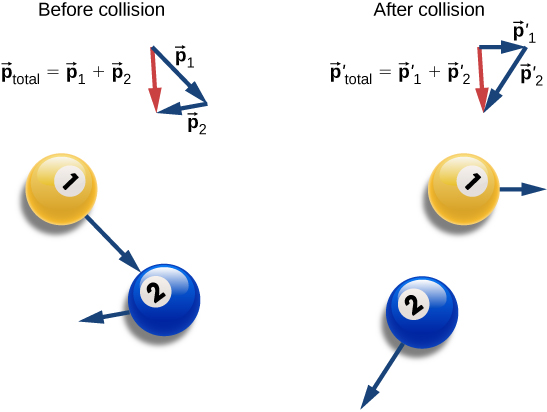
As shown in Figure 9.14, the total momentum of the system before and after the collision remains the same.
英語のヒント
図9.14に示すように、系の全運動量は衝突の前後で同じままである。
OpenStax / Rice University, University Physics Volume 1, CC BY 4.0. Source-book artwork retained. · CC BY 4.0 · Source出典

Figure 9.14図 9.14
Before the collision, the two billiard balls travel with momenta and . The total momentum of the system is the sum of these, as shown by the red vector labeled on the left. After the collision, the two billiard balls travel with different momenta and . The total momentum, however, has not changed, as shown by the red vector arrow on the right.
英語のヒント
衝突前、二つのビリヤード球の運動量はとである。系の全運動量はこれらの和で、左側のと記された赤いベクトルで示す。衝突後、両球の運動量はとへと変わる。しかし全運動量は、右側の赤いベクトル矢印が示すように、変わっていない。
Generalizing this result to N objects, we obtain
英語のヒント
この結果をN個の物体へ一般化すると、次を得る。
Equation 9.17 is the definition of the total (or net) momentum of a system of N interacting objects, along with the statement that the total momentum of a system of objects is constant in time—or better, is conserved.
英語のヒント
この式は、相互作用するN個の物体からなる系の全運動量、すなわち正味の運動量の定義であるとともに、系の全運動量が時間によらず一定である、より適切にいえば保存されるという主張を表す。
Requirements for Momentum Conservation運動量が保存されるための条件
There is a complication, however. A system must meet two requirements for its momentum to be conserved:
英語のヒント
ただし、少し複雑な点がある。系の運動量が保存されるには、二つの条件を満たす必要がある。
- The mass of the system must remain constant during the interaction.
As the objects interact (apply forces on each other), they may transfer mass from one to another; but any mass one object gains is balanced by the loss of that mass from another. The total mass of the system of objects, therefore, remains unchanged as time passes:英語のヒント
相互作用中、系の質量は一定でなければならない。物体が互いに力を加えて相互作用するとき、一方から他方へ質量が移ることはありうる。しかし、一方の物体が得た質量は、その分だけ他方の物体が失う質量と釣り合う。したがって、物体系の全質量は時間がたっても変わらない。 - The net external force on the system must be zero.
As the objects collide, or explode, and move around, they exert forces on each other. However, all of these forces are internal to the system, and thus each of these internal forces is balanced by another internal force that is equal in magnitude and opposite in sign. As a result, the change in momentum caused by each internal force is cancelled by another momentum change that is equal in magnitude and opposite in direction. Therefore, internal forces cannot change the total momentum of a system because the changes sum to zero. However, if there is some external force that acts on all of the objects (gravity, for example, or friction), then this force changes the momentum of the system as a whole; that is to say, the momentum of the system is changed by the external force. Thus, for the momentum of the system to be conserved, we must have英語のヒント
系に働く外力の合力はゼロでなければならない。物体が衝突したり、爆発したり、動き回ったりするとき、互いに力を及ぼす。しかし、それらはすべて系の内力である。そのため、それぞれの内力には、大きさが等しく符号が逆の別の内力が対応する。結果として、一つの内力が生む運動量変化は、大きさが等しく方向が逆の別の運動量変化によって打ち消される。変化を足し合わせるとゼロになるため、内力は系の全運動量を変えることができない。しかし、たとえば重力や摩擦のような外力が物体全体に作用すれば、その力が系全体の運動量を変える。つまり、系の運動量は外力によって変わる。したがって、系の運動量が保存されるには、次が成り立たなければならない。
A system of objects that meets these two requirements is said to be a closed system (also called an isolated system). Thus, the more compact way to express this is shown below.
英語のヒント
これら二つの条件を満たす物体系を、閉じた系、または孤立系という。したがって、以下のように簡潔に表せる。
This statement is called the Law of Conservation of Momentum. Along with the conservation of energy, it is one of the foundations upon which all of physics stands. All our experimental evidence supports this statement: from the motions of galactic clusters to the quarks that make up the proton and the neutron, and at every scale in between. In a closed system, the total momentum never changes.
英語のヒント
この主張を運動量保存則という。エネルギー保存則とともに、物理学全体を支える基礎の一つである。銀河団の運動から、陽子や中性子を構成するクォークまで、その間のあらゆる尺度において、実験上の証拠はすべてこの主張を支持している。閉じた系では、全運動量は決して変化しない。
Note that there absolutely can be external forces acting on the system; but for the system’s momentum to remain constant, these external forces have to cancel, so that the net external force is zero. Billiard balls on a table all have a weight force acting on them, but the weights are balanced (canceled) by the normal forces, so there is no net force.
英語のヒント
系に外力が作用していても、まったく構わないことに注意しよう。ただし、系の運動量が一定のままであるには、外力どうしが打ち消し合い、外力の合力がゼロになる必要がある。テーブル上のビリヤード球にはすべて重力が働くが、それぞれの重力は垂直抗力と釣り合って打ち消されるため、合力はゼロとなる。