第9章運動量と衝突
Two crucial concepts come out of these examples:
英語のヒント
これらの例題から、二つの重要な考え方が得られる。
- As with all problems, you must define your coordinate system and origin. For center-of-mass calculations, it often makes sense to choose your origin to be located at one of the masses of your system. That choice automatically defines its distance in Equation 9.29 to be zero. However, you must still include the mass of the object at your origin in your calculation of M, the total mass Equation 9.19. In the Earth-moon system example, this means including the mass of Earth. If you hadn’t, you’d have ended up with the center of mass of the system being at the center of the moon, which is clearly wrong.
英語のヒント
- In the second example (the salt crystal), notice that there is no mass at all at the location of the center of mass. This is an example of what we stated above, that there does not have to be any actual mass at the center of mass of an object.
英語のヒント
2番目の例題(食塩の結晶)では、質量中心の位置に質量が全くないことに注意しよう。これは、物体の質量中心に実際の質量が存在する必要はないという、先に述べたことの一例である。
Center of Mass of Continuous Objects連続的な物体の質量中心
If the object in question has its mass distributed uniformly in space, rather than as a collection of discrete particles, then , and the summation becomes an integral:
英語のヒント
考えている物体の質量が、離散的な粒子の集まりとしてではなく、空間内に一様に分布しているなら、となり、総和は積分になる。
In this context, r is a characteristic dimension of the object (the radius of a sphere, the length of a long rod). To generate an integrand that can actually be calculated, you need to express the differential mass element dm as a function of the mass density of the continuous object, and the dimension r. An example will clarify this.
英語のヒント
ここでrは、球の半径や長い棒の長さのような、物体を特徴づける寸法である。実際に計算できる被積分関数を作るには、微小質量要素dmを、連続体の質量密度と寸法rの関数として表す必要がある。例題で明らかにしよう。
Example 9.18例題 9.18
CM of a Uniform Thin Hoop一様で細い輪の質量中心
Find the center of mass of a uniform thin hoop (or ring) of mass M and radius r.
英語のヒント
質量M、半径rの、一様で細い輪の質量中心を求めよ。
Strategy方針
First, the hoop’s symmetry suggests the center of mass should be at its geometric center. If we define our coordinate system such that the origin is located at the center of the hoop, the integral should evaluate to zero.
英語のヒント
まず、輪の対称性から、質量中心は幾何学的な中心にあるはずだと予想できる。輪の中心に原点を置くように座標系を定義すれば、積分の値はゼロになるはずである。
We replace dm with an expression involving the density of the hoop and the radius of the hoop. We then have an expression we can actually integrate. Since the hoop is described as “thin,” we treat it as a one-dimensional object, neglecting the thickness of the hoop. Therefore, its density is expressed as the number of kilograms of material per meter. Such a density is called a linear mass density, and is given the symbol ; this is the Greek letter “lambda,” which is the equivalent of the English letter “l” (for “linear”).
英語のヒント
dmを、輪の密度と半径を含む式で置き換える。そうすれば、実際に積分できる式になる。輪は「細い」とされているので、厚さを無視して一次元の物体として扱う。したがって、その密度は1 m当たりの物質の質量をkgで表した値になる。このような密度を線密度といい、記号で表す。これはギリシャ文字の「ラムダ」で、英語のlinearの頭文字「l」に対応する。
Since the hoop is described as uniform, this means that the linear mass density is constant. Thus, to get our expression for the differential mass element dm, we multiply by a differential length of the hoop, substitute, and integrate (with appropriate limits for the definite integral).
英語のヒント
輪は一様なので、線密度は一定である。微小質量要素dmの式を得るため、に輪の微小な長さを掛け、代入して積分する。定積分の積分区間には適切な値を用いる。
Solution解答
First, define our coordinate system and the relevant variables (Figure 9.31).
英語のヒント
まず、座標系と必要な変数を定義する(図9.31)。
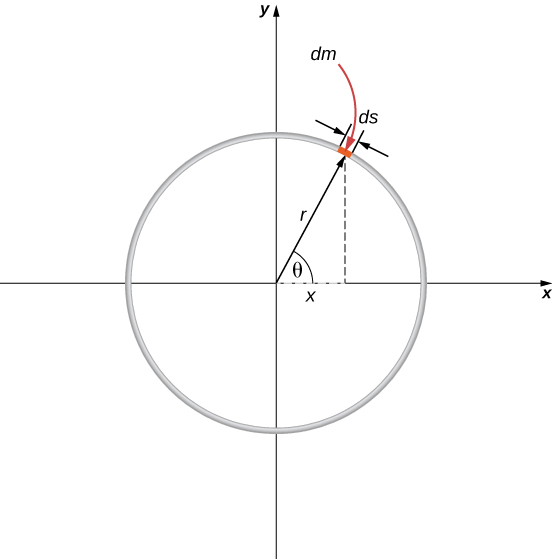
OpenStax / Rice University, University Physics Volume 1, CC BY 4.0. Source-book artwork retained. · CC BY 4.0 · Source出典

Figure 9.31図 9.31
Finding the center of mass of a uniform hoop. We express the coordinates of a differential piece of the hoop, and then integrate around the hoop.
英語のヒント
一様な輪の質量中心を求める。輪の微小な部分の座標を表し、輪の全周について積分する。
We have to determine the limits of integration a and b. Expressing in component form gives us
英語のヒント
積分の下端aと上端bを定めなければならない。を成分で表すと、
In the diagram, we highlighted a piece of the hoop that is of differential length ds; it therefore has a differential mass . Substituting:
英語のヒント
図では、輪のうち微小な長さdsの部分を強調してある。その微小質量はなので、代入すると、
However, the arc length ds subtends a differential angle , so we have
英語のヒント
ところで、弧の長さdsに対する中心角は微小角なので、次の関係がある。
and thus
英語のヒント
したがって、
One more step: Since is the linear mass density, it is computed by dividing the total mass by the length of the hoop:
英語のヒント
さらにもう一段階進める。は線密度なので、全質量を輪の長さで割ると求められる。
giving us
英語のヒント
これを用いると、
Notice that the variable of integration is now the angle . This tells us that the limits of integration (around the circular hoop) are , so and . Also, for convenience, we separate the integral into the x- and y-components of . The final integral expression is
英語のヒント
いまや積分変数は角度である。したがって、輪を一周する積分区間はであり、、となる。また、計算の都合上、積分をのx成分とy成分に分ける。最終的な積分の式は次のとおりである。
as expected.
英語のヒント
予想どおりである。