第9章運動量と衝突
Subatomic Collisions and Momentum原子より小さな粒子の衝突と運動量
Conservation of momentum is crucial to our understanding of atomic and subatomic particles because much of what we know about these particles comes from collision experiments.
英語のヒント
運動量保存は、原子や原子より小さな粒子を理解するうえで極めて重要である。これらの粒子についての知識の多くは、衝突実験から得られているからである。
At the beginning of the twentieth century, there was considerable interest in, and debate about, the structure of the atom. It was known that atoms contain two types of electrically charged particles: negatively charged electrons and positively charged protons. (The existence of an electrically neutral particle was suspected, but would not be confirmed until 1932.) The question was, how were these particles arranged in the atom? Were they distributed uniformly throughout the volume of the atom (as J.J. Thomson proposed), or arranged at the corners of regular polygons (which was Gilbert Lewis’ model), or rings of negative charge that surround the positively charged nucleus—rather like the planetary rings surrounding Saturn (as suggested by Hantaro Nagaoka), or something else?
英語のヒント
20世紀の初め、原子の構造には大きな関心が寄せられ、盛んに議論されていた。原子が2種類の帯電した粒子、つまり負に帯電した電子と正に帯電した陽子を含むことは知られていた。(電気的に中性の粒子の存在も予想されていたが、確認されたのは1932年である。)問題は、これらの粒子が原子の中でどう配置されているかだった。J・J・トムソンが提案したように原子の体積全体に一様に分布しているのか。ギルバート・ルイスの模型のように正多角形の頂点に配置されているのか。長岡半太郎が示唆したように、土星を囲む環に似た負電荷の輪が、正に帯電した原子核を取り囲んでいるのか。それとも別の形なのか。
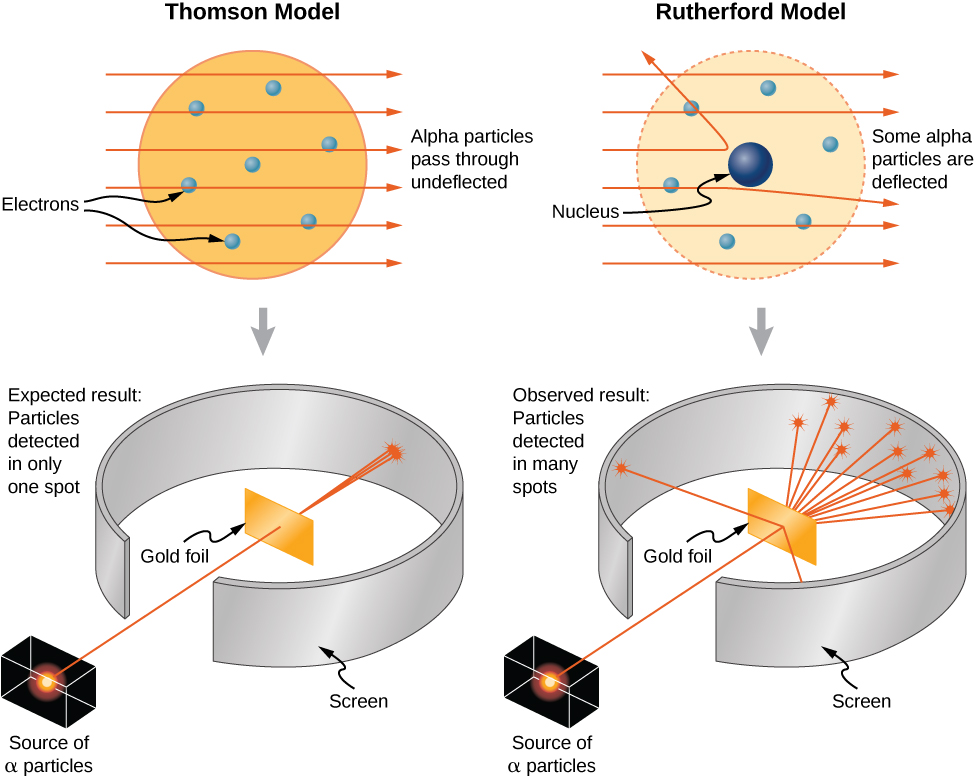
The New Zealand physicist Ernest Rutherford (along with the German physicist Hans Geiger and the British physicist Ernest Marsden) performed the crucial experiment in 1909. They bombarded a thin sheet of gold foil with a beam of high-energy (that is, high-speed) alpha-particles (the nucleus of a helium atom). The alpha-particles collided with the gold atoms, and their subsequent velocities were detected and analyzed, using conservation of momentum and conservation of energy.
英語のヒント
ニュージーランドの物理学者アーネスト・ラザフォードは、ドイツの物理学者ハンス・ガイガー、イギリスの物理学者アーネスト・マースデンとともに、1909年に決定的な実験を行った。薄い金箔に、高エネルギー(すなわち高速)のアルファ粒子(ヘリウム原子の原子核)のビームを照射したのである。アルファ粒子は金原子に衝突し、その後の速度が検出された。そして、運動量保存則とエネルギー保存則を用いて解析された。
If the charges of the gold atoms were distributed uniformly (per Thomson), then the alpha-particles should collide with them and nearly all would be deflected through many angles, all small; the Nagaoka model would produce a similar result. If the atoms were arranged as regular polygons (Lewis), the alpha-particles would deflect at a relatively small number of angles.
英語のヒント
金原子の電荷が一様に分布していれば(トムソンの考え)、アルファ粒子は電荷に衝突し、ほぼすべてがさまざまな小さな角度に曲げられるはずである。長岡の模型も同様の結果を予測する。原子が正多角形として配置されているなら(ルイスの考え)、アルファ粒子が曲がる角度の種類は比較的少なくなるはずである。
What actually happened is that nearly none of the alpha-particles were deflected. Those that were, were deflected at large angles, some close to —those alpha-particles reversed direction completely (Figure 9.21). None of the existing atomic models could explain this. Eventually, Rutherford developed a model of the atom that was much closer to what we now have—again, using conservation of momentum and energy as his starting point.
英語のヒント
実際には、ほとんどのアルファ粒子は進行方向を変えなかった。曲がったものは大きな角度で曲がり、中には近く、すなわち進行方向を完全に逆転したものもあった(図9.21)。既存の原子模型では、どれもこれを説明できなかった。最終的にラザフォードは、再び運動量とエネルギーの保存を出発点として、現在の理解にはるかに近い原子模型を作り上げた。
OpenStax / Rice University, University Physics Volume 1, CC BY 4.0. Source-book artwork retained. · CC BY 4.0 · Source出典

Figure 9.21図 9.21
The Thomson and Rutherford models of the atom. The Thomson model predicted that nearly all of the incident alpha-particles would be scattered and at small angles. Rutherford and Geiger found that nearly none of the alpha particles were scattered, but those few that were deflected did so through very large angles. The results of Rutherford’s experiments were inconsistent with the Thomson model. Rutherford used conservation of momentum and energy to develop a new, and better model of the atom—the nuclear model.
英語のヒント
トムソンとラザフォードの原子模型。トムソン模型では、入射するアルファ粒子のほぼすべてが小さな角度で散乱すると予測された。ラザフォードとガイガーが見いだしたのは、ほとんどのアルファ粒子は散乱せず、わずかに曲がったものは非常に大きな角度で曲がるという結果だった。ラザフォードの実験結果はトムソン模型と整合しなかった。ラザフォードは運動量とエネルギーの保存を用いて、新たな、より優れた原子模型、すなわち原子核模型を作り上げた。
Summaryまとめ
- An elastic collision is one that conserves kinetic energy.
英語のヒント
弾性衝突とは、運動エネルギーを保存する衝突である。 - An inelastic collision does not conserve kinetic energy.
英語のヒント
非弾性衝突では、運動エネルギーは保存されない。 - Momentum is conserved regardless of whether or not kinetic energy is conserved.
英語のヒント
運動エネルギーが保存されるかどうかにかかわらず、運動量は保存される。 - Analysis of kinetic energy changes and conservation of momentum together allow the final velocities to be calculated in terms of initial velocities and masses in one-dimensional, two-body collisions.
英語のヒント
一次元の二物体の衝突では、運動エネルギーの変化と運動量保存を合わせて解析することで、初速度と質量から最終速度を計算できる。
Conceptual Questions概念に関する問題
Exercises 38–39練習問題 38–39
Exercise 38問題 38
Two objects of equal mass are moving with equal and opposite velocities when they collide. Can all the kinetic energy be lost in the collision?
英語のヒント
質量が等しい2個の物体が、大きさが等しく向きが反対の速度で動いていて衝突する。衝突で運動エネルギーがすべて失われることはありうるか。
Solution解き方
Yes, all the kinetic energy can be lost if the two masses come to rest due to the collision (i.e., they stick together).
英語のヒント
ありうる。衝突によって2個の物体が静止するなら(すなわち、くっつくなら)、運動エネルギーはすべて失われうる。
Exercise 39問題 39
Describe a system for which momentum is conserved but mechanical energy is not. Now the reverse: Describe a system for which kinetic energy is conserved but momentum is not.
英語のヒント
運動量は保存されるが力学的エネルギーは保存されない系を述べよ。次は逆に、運動エネルギーは保存されるが運動量は保存されない系を述べよ。
Problems問題
Exercises 40–49練習問題 40–49
Exercise 40問題 40
A 5.50-kg bowling ball moving at 9.00 m/s collides with a 0.850-kg bowling pin, which is scattered at an angle of 15.8° to the initial direction of the bowling ball and with a speed of 15.0 m/s.
英語のヒント
質量5.50 kgのボウリングの球が9.00 m/sで動き、質量0.850 kgのピンに衝突する。ピンは球の初めの進行方向に対して15.8°の角度に、速さ15.0 m/sで飛ぶ。
- Calculate the final velocity (magnitude and direction) of the bowling ball.
英語のヒント
球の最終速度(大きさと方向)を計算せよ。 - Is the collision elastic?
英語のヒント
この衝突は弾性衝突か。
Solution解き方
a. 6.80 m/s, 5.33°; b. yes (calculate the ratio of the initial and final kinetic energies)
英語のヒント
a. 6.80 m/s、5.33°。b. 弾性衝突である(初めと最後の運動エネルギーの比を計算する)。
Exercise 41問題 41
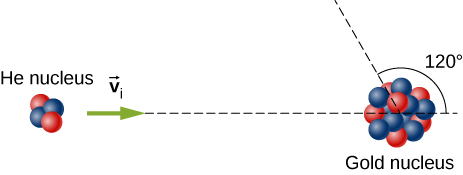
Ernest Rutherford (the first New Zealander to be awarded the Nobel Prize in Chemistry) demonstrated that nuclei were very small and dense by scattering helium-4 nuclei from gold-197 nuclei. The energy of the incoming helium nucleus was , and the masses of the helium and gold nuclei were and , respectively (note that their mass ratio is 4 to 197).
英語のヒント
ニュージーランド人として初めてノーベル化学賞を受賞したアーネスト・ラザフォードは、ヘリウム4の原子核を金197の原子核で散乱させ、原子核が非常に小さく高密度であることを示した。入射するヘリウム原子核のエネルギーはで、ヘリウムと金の原子核の質量はそれぞれ、だった(質量比は4対197であることに注意)。
a. If a helium nucleus scatters to an angle of during an elastic collision with a gold nucleus, calculate the helium nucleus’s final speed and the final velocity (magnitude and direction) of the gold nucleus.
英語のヒント
a. ヘリウム原子核が金原子核と弾性衝突し、の角度に散乱するとき、ヘリウム原子核の最終的な速さと、金原子核の最終速度(大きさと方向)を求めよ。
OpenStax / Rice University, University Physics Volume 1, CC BY 4.0. Source-book artwork retained. · CC BY 4.0 · Source出典

b. What is the final kinetic energy of the helium nucleus?
英語のヒント
b. ヘリウム原子核の最終的な運動エネルギーはいくらか。
Exercise 42問題 42
A 90.0-kg ice hockey player hits a 0.150-kg puck, giving the puck a velocity of 45.0 m/s. If both are initially at rest and if the ice is frictionless, how far does the player recoil in the time it takes the puck to reach the goal 15.0 m away?
英語のヒント
質量90.0 kgのアイスホッケー選手が質量0.150 kgのパックを打ち、パックに45.0 m/sの速度を与える。初めに両者が静止し、氷に摩擦がないとすると、パックが15.0 m先のゴールへ届くまでに、選手は反動でどれだけ後退するか。
Solution解き方
2.5 cm
Exercise 43問題 43
A 100-g firecracker is launched vertically into the air and explodes into two pieces at the peak of its trajectory. If a 72-g piece is projected horizontally to the left at 20 m/s, what is the speed and direction of the other piece?
英語のヒント
100 gの爆竹を鉛直に打ち上げると、軌道の最高点で爆発して二つに分かれた。72 gの破片が水平左向きに20 m/sで飛び出したなら、もう一方の破片の速さと方向はいくらか。
Exercise 44問題 44
In an elastic collision, a 400-kg bumper car collides directly from behind with a second, identical bumper car that is traveling in the same direction. The initial speed of the leading bumper car is 5.60 m/s and that of the trailing car is 6.00 m/s. Assuming that the mass of the drivers is much, much less than that of the bumper cars, what are their final speeds?
英語のヒント
質量400 kgのバンパーカーが、同じ方向へ進む同じ質量の別のバンパーカーに真後ろから弾性衝突する。前の車の初めの速さは5.60 m/s、後ろの車は6.00 m/sである。運転者の質量が車に比べてはるかに小さいと仮定すると、2台の最終的な速さはいくらか。
Solution解き方
the speed of the leading bumper car is 6.00 m/s and that of the trailing bumper car is 5.60 m/s
英語のヒント
前のバンパーカーの速さは6.00 m/s、後ろのバンパーカーの速さは5.60 m/sである。
Exercise 45問題 45
Repeat the preceding problem if the mass of the leading bumper car is 30.0% greater than that of the trailing bumper car.
英語のヒント
前のバンパーカーの質量が後ろの車より30.0%大きい場合について、前問を解き直せ。
Exercise 46問題 46
An alpha particle (4He) undergoes an elastic collision with a stationary uranium nucleus (235U). What percent of the kinetic energy of the alpha particle is transferred to the uranium nucleus? Assume the collision is one-dimensional.
英語のヒント
アルファ粒子(4He)が、静止したウラン原子核(235U)と弾性衝突する。アルファ粒子の運動エネルギーの何%がウラン原子核に移るか。衝突は一次元とする。
Solution解き方
6.6%
Exercise 47問題 47
You are standing on a very slippery icy surface and throw a 1-kg football horizontally at a speed of 6.7 m/s. What is your velocity when you release the football? Assume your mass is 65 kg.
英語のヒント
非常に滑りやすい氷の上に立ち、質量1 kgのフットボールを水平に6.7 m/sの速さで投げる。ボールを手放したときの自分の速度はいくらか。自分の質量を65 kgとする。
Exercise 48問題 48
A 35-kg child rides a relatively massless sled down a hill and then coasts along the flat section at the bottom, where a second 35-kg child jumps on the sled as it passes by her. If the speed of the sled is 3.5 m/s before the second child jumps on, what is its speed after she jumps on?
英語のヒント
質量35 kgの子どもが、質量を無視できるそりに乗って丘を滑り下り、麓の平らな部分を惰性で進む。そこでは、もう1人の35 kgの子どもが、通り過ぎるそりに飛び乗る。2人目が乗る前のそりの速さが3.5 m/sなら、乗った後の速さはいくらか。
Solution解き方
1.8 m/s
Exercise 49問題 49
A boy sleds down a hill and onto a frictionless ice-covered lake at 10.0 m/s. In the middle of the lake is a 1000-kg boulder. When the sled crashes into the boulder, he is propelled backwards from the boulder. The collision is an elastic collision. If the boy’s mass is 40.0 kg and the sled’s mass is 2.50 kg, what is the speed of the sled and the boulder after the collision?
英語のヒント
少年がそりで丘を滑り下り、摩擦のない、氷で覆われた湖へ10.0 m/sで入る。湖の中央には1000 kgの大岩がある。そりが大岩に衝突すると、少年は大岩から後方へ押し戻される。衝突は弾性衝突である。少年の質量が40.0 kg、そりの質量が2.50 kgなら、衝突後のそりと大岩の速さはいくらか。
elastic
弾性
collision that conserves kinetic energy
英語のヒント
運動エネルギーを保存する衝突。
explosion
爆発
single object breaks up into multiple objects; kinetic energy is not conserved in explosions
英語のヒント
1個の物体が複数の物体に分かれること。爆発では運動エネルギーは保存されない。
inelastic
非弾性
collision that does not conserve kinetic energy
英語のヒント
運動エネルギーを保存しない衝突。
perfectly inelastic
完全非弾性
collision after which all objects are motionless, the final kinetic energy is zero, and the loss of kinetic energy is a maximum
英語のヒント
衝突後にすべての物体が静止し、最終的な運動エネルギーがゼロになり、運動エネルギーの損失が最大になる衝突。