第9章運動量と衝突
9.2 Impulse and Collisions9.2 力積と衝突
Learning Objectives学習目標
Learning Objectives学習目標
By the end of this section, you will be able to:
英語のヒント
この節を終えると、次のことができるようになる。
- Explain what an impulse is, physically
英語のヒント
力積とは何かを、物理的な意味から説明する。 - Describe what an impulse does
英語のヒント
力積が何をするかを述べる。 - Relate impulses to collisions
英語のヒント
力積と衝突を関連付ける。 - Apply the impulse-momentum theorem to solve problems
英語のヒント
力積と運動量の定理を使って問題を解く。
We have defined momentum to be the product of mass and velocity. Therefore, if an object’s velocity should change (due to the application of a force on the object), then necessarily, its momentum changes as well. This indicates a connection between momentum and force. The purpose of this section is to explore and describe that connection.
英語のヒント
運動量を質量と速度の積として定義した。したがって、物体に力が加わることでその速度が変われば、運動量も必ず変わる。これは運動量と力の間につながりがあることを示している。この節の目的は、そのつながりを調べて記述することである。
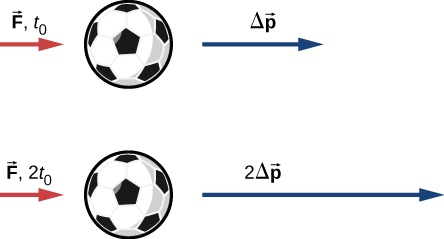
Suppose you apply a force on a free object for some amount of time. Clearly, the larger the force, the larger the object’s change of momentum will be. Alternatively, the more time you spend applying this force, again the larger the change of momentum will be, as depicted in Figure 9.5. The amount by which the object’s motion changes is therefore proportional to the magnitude of the force, and also to the time interval over which the force is applied.
英語のヒント
自由に動ける物体に、ある時間にわたって力を加えるとする。力が大きいほど、物体の運動量の変化も大きくなるのは明らかである。また、同じ力を加え続ける時間が長いほど、運動量の変化はやはり大きくなる(図9.5)。したがって、物体の運動の変化量は、力の大きさと、その力を加える時間の両方に比例する。
OpenStax / Rice University, University Physics Volume 1, CC BY 4.0. Source-book artwork retained. · CC BY 4.0 · Source出典

Figure 9.5図 9.5
The change in momentum of an object is proportional to the length of time during which the force is applied. If a force is exerted on the lower ball for twice as long as on the upper ball, then the change in the momentum of the lower ball is twice that of the upper ball.
英語のヒント
物体の運動量の変化は、力を加える時間の長さに比例する。下のボールに上のボールの2倍の時間にわたって力を加えると、下のボールの運動量の変化は上のボールの2倍になる。
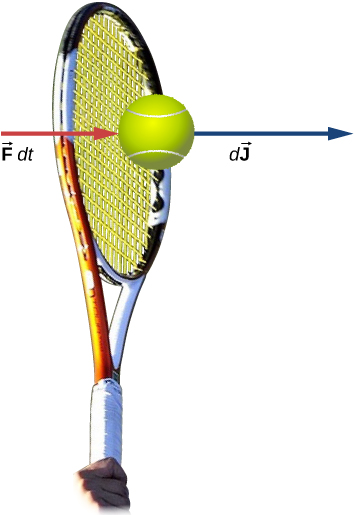
Mathematically, if a quantity is proportional to two (or more) things, then it is proportional to the product of those things. The product of a force and a time interval (over which that force acts) is called impulse, and is given the symbol
英語のヒント
数学的には、ある量が2つ以上のものに比例するならば、それらの積に比例する。力と、その力が作用する時間間隔との積を力積と呼び、記号で表す。
OpenStax / Rice University, University Physics Volume 1, CC BY 4.0. Source-book artwork retained. · CC BY 4.0 · Source出典

Figure 9.6図 9.6
A force applied by a tennis racquet to a tennis ball over a time interval generates an impulse acting on the ball.
英語のヒント
テニスラケットがある時間間隔にわたってボールに加える力は、ボールに作用する力積を生じる。
The total impulse over the interval is
英語のヒント
時間間隔にわたる力積の合計は
Equation 9.2 and Equation 9.3 together say that when a force is applied for an infinitesimal time interval dt, it causes an infinitesimal impulse , and the total impulse given to the object is defined to be the sum (integral) of all these infinitesimal impulses.
英語のヒント
To calculate the impulse using Equation 9.3, we need to know the force function F(t), which we often don’t. However, a result from calculus is useful here: Recall that the average value of a function over some interval is calculated by
英語のヒント
力積の積分表示を用いて力積を計算するには、力を表す関数F(t)を知る必要があるが、わからない場合も多い。そこで微積分の結果が役立つ。ある区間での関数の平均値は、次の式で計算できることを思い出そう。
where . Applying this to the time-dependent force function, we obtain
英語のヒント
ここでである。これを時間に依存する力の関数に適用すると、次が得られる。
(9.4)
The idea here is that you can calculate the impulse on the object even if you don’t know the details of the force as a function of time; you only need the average force. In fact, though, the process is usually reversed: You determine the impulse (by measurement or calculation) and then calculate the average force that caused that impulse.
英語のヒント
要点は、時間の関数としての力の詳しい形がわからなくても、平均の力さえわかれば、物体が受ける力積を計算できることである。実際には、通常は逆の手順を取る。測定や計算によって力積を求め、それを生じさせた平均の力を計算するのである。
To calculate the impulse, a useful result follows from writing the force in Equation 9.3 as :
英語のヒント
力積の積分表示に含まれる力をと書けば、力積の計算に有用な結果が得られる。
For a constant force , this simplifies to
英語のヒント
一定の力の場合、これは次のように簡単になる。
That is,
英語のヒント
すなわち、
(9.6)
Note that the integral form, Equation 9.3, applies to constant forces as well; in that case, since the force is independent of time, it comes out of the integral, which can then be trivially evaluated.
英語のヒント
積分形の式は、一定の力にも適用できる。この場合、力は時間に依存しないので積分の外に出せて、積分を容易に計算できる。
Example 9.1例題 9.1
The Arizona Meteor Craterアリゾナの隕石孔
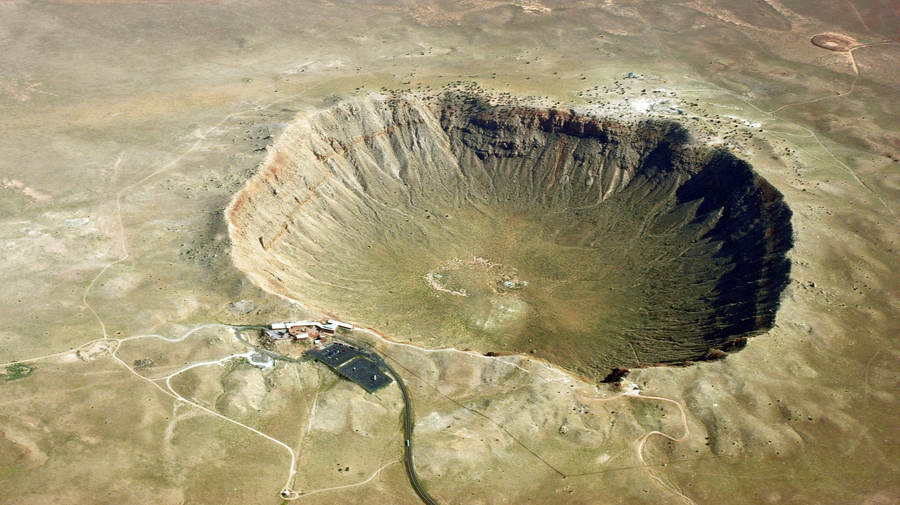
Approximately 50,000 years ago, a large (radius of 25 m) iron-nickel meteorite collided with Earth at an estimated speed of in what is now the northern Arizona desert, in the United States. The impact produced a crater that is still visible today (Figure 9.7); it is approximately 1200 m (three-quarters of a mile) in diameter, 170 m deep, and has a rim that rises 45 m above the surrounding desert plain. Iron-nickel meteorites typically have a density of . Use impulse considerations to estimate the average force and the maximum force that the meteor applied to Earth during the impact.
英語のヒント
約5万年前、半径25 mの大きな鉄ニッケル隕石が、推定速度で地球に衝突した。場所は、現在の米国アリゾナ州北部の砂漠である。衝突でできたクレーターは今も残っている(図9.7)。直径は約1200 m、すなわち約4分の3マイル、深さは170 mで、縁は周囲の砂漠の平地より45 m高い。鉄ニッケル隕石の典型的な密度はである。力積を用いて、衝突中に隕石が地球に加えた平均の力と最大の力を見積もれ。
Shane Torgerson, Meteorcrater. Modified in OpenStax University Physics Volume 1. CC BY 3.0. · CC BY 3.0 · Source出典

Figure 9.7図 9.7
The Arizona Meteor Crater in Flagstaff, Arizona (often referred to as the Barringer Crater after the person who first suggested its origin and whose family owns the land). (credit: modification of work by “Shane.torgerson”/Wikimedia Commons)
英語のヒント
アリゾナ州フラッグスタッフのアリゾナ隕石孔。その起源を初めて提唱した人物の名にちなみ、バリンジャー・クレーターと呼ばれることも多い。土地はその一族が所有している。(出典:“Shane.torgerson”/Wikimedia Commonsの作品を改変)
Strategy方針
It is conceptually easier to reverse the question and calculate the force that Earth applied on the meteor in order to stop it. Therefore, we’ll calculate the force on the meteor and then use Newton’s third law to argue that the force from the meteor on Earth was equal in magnitude and opposite in direction.
英語のヒント
問いを逆にし、隕石を止めるために地球が隕石に加えた力を計算するほうが、概念的には考えやすい。そこでまず隕石が受けた力を計算する。その後、ニュートンの第三法則を用い、隕石が地球に加えた力は大きさが等しく方向が逆であったと論じる。
Using the given data about the meteor, and making reasonable guesses about the shape of the meteor and impact time, we first calculate the impulse using Equation 9.6. We then use the relationship between force and impulse Equation 9.5 to estimate the average force during impact. Next, we choose a reasonable force function for the impact event, calculate the average value of that function Equation 9.4, and set the resulting expression equal to the calculated average force. This enables us to solve for the maximum force.
英語のヒント
Solution解答
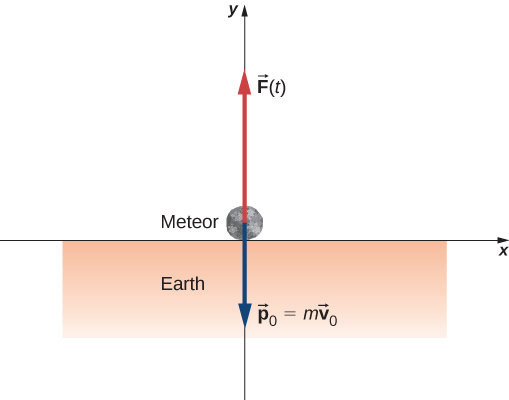
Define upward to be the +y-direction. For simplicity, assume the meteor is traveling vertically downward prior to impact. In that case, its initial velocity is , and the force Earth exerts on the meteor points upward, . The situation at is depicted below.
英語のヒント
上向きを+y方向と定める。簡単のため、隕石は衝突直前に鉛直下向きに動いていたと仮定する。この場合、初速度はで、地球が隕石に及ぼす力は上向きのである。の状況を以下に示す。
OpenStax / Rice University, University Physics Volume 1, CC BY 4.0. Source-book artwork retained. · CC BY 4.0 · Source出典

The average force during the impact is related to the impulse by
英語のヒント
衝突中の平均の力と力積の関係は、
The mass is equal to the product of the meteor’s density and its volume:
英語のヒント
質量は隕石の密度と体積の積に等しい。
If we assume (guess) that the meteor was roughly spherical, we have
英語のヒント
隕石がおおむね球形だったと仮定、すなわち推測すれば、
Thus we obtain
英語のヒント
したがって、次を得る。
The problem says the velocity at impact was (the final velocity is zero); also, we guess that the primary impact lasted about . Substituting these values gives
英語のヒント
問題文によれば、衝突時の速度はである。最終速度はゼロとなる。また、主な衝突が約続いたと推測する。これらの値を代入すると、
This is the average force applied during the collision. Notice that this force vector points in the same direction as the change of velocity vector .
英語のヒント
これが衝突中に加わった平均の力である。この力のベクトルが、速度の変化を表すベクトルと同じ方向を向くことに注意しよう。
Next, we calculate the maximum force. The impulse is related to the force function by
英語のヒント
次に最大の力を計算する。力積と力の関数の関係は、
We need to make a reasonable choice for the force as a function of time. We define to be the moment the meteor first touches the ground. Then we assume the force is a maximum at impact, and rapidly drops to zero. A function that does this is
英語のヒント
時間の関数としての力について、妥当な形を選ぶ必要がある。隕石が初めて地面に触れた瞬間をと定める。そして、力は衝突時に最大となり、その後急速にゼロへ減少すると仮定する。このようになる関数の一つは、
(The parameter represents how rapidly the force decreases to zero.) The average force is
英語のヒント
パラメータは、力がどれくらい急速にゼロへ減少するかを表す。平均の力は、
where . Since we already have a numeric value for , we can use the result of the integral to obtain .
英語のヒント
ここでである。の数値はすでに得ているので、積分の結果を用いてを求められる。
Choosing (this is a common choice, as you will see in later chapters), and guessing that , this integral evaluates to
英語のヒント
と選び、と推測すると、この積分は次の値になる。このパラメータの選び方は、後の章で見るように、よく用いられるものである。
Thus, the maximum force has a magnitude of
英語のヒント
したがって、最大の力の大きさは、
The complete force function, including the direction, is
英語のヒント
方向も含めた力の関数全体は、
This is the force Earth applied to the meteor; by Newton’s third law, the force the meteor applied to Earth is
英語のヒント
これは地球が隕石に加えた力である。ニュートンの第三法則より、隕石が地球に加えた力は、
which is the answer to the original question.
英語のヒント
これが元の問いに対する答えである。
Significance考察
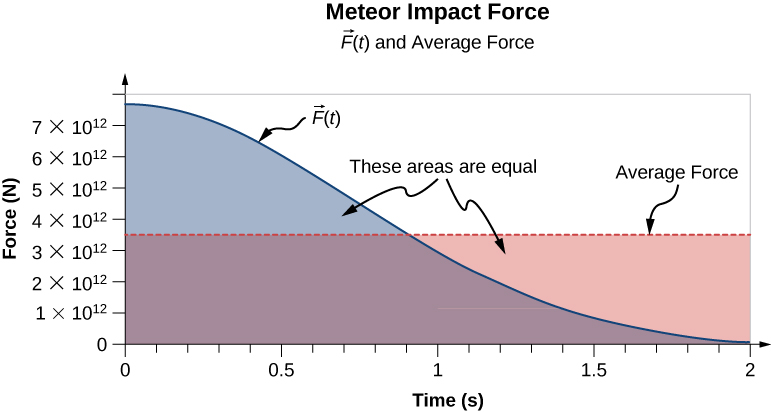
The graph of this function contains important information. Let’s graph (the magnitude of) both this function and the average force together (Figure 9.8).
英語のヒント
この関数のグラフには重要な情報が含まれる。この関数の大きさと平均の力を、同じグラフに描いてみよう(図9.8)。
OpenStax / Rice University, University Physics Volume 1, CC BY 4.0. Source-book artwork retained. · CC BY 4.0 · Source出典

Figure 9.8図 9.8
A graph of the average force (in red) and the force as a function of time (blue) of the meteor impact. The areas under the curves are equal to each other, and are numerically equal to the applied impulse.
英語のヒント
隕石衝突の平均の力を赤で、時間の関数としての力を青で示したグラフ。各曲線の下の面積は互いに等しく、数値としては加えられた力積に等しい。
Notice that the area under each plot has been filled in. For the plot of the (constant) force , the area is a rectangle, corresponding to . As for the plot of F(t), recall from calculus that the area under the plot of a function is numerically equal to the integral of that function, over the specified interval; so here, that is . Thus, the areas are equal, and both represent the impulse that the meteor applied to Earth during the two-second impact. The average force on Earth sounds like a huge force, and it is. Nevertheless, Earth barely noticed it. The acceleration Earth obtained was just
英語のヒント
各グラフの下の領域が塗られていることに注目しよう。一定の力のグラフでは、この領域は長方形で、その面積はに対応する。F(t)のグラフについては、関数のグラフの下の面積が、指定された区間での関数の積分と数値的に等しいことを、微積分から思い出そう。ここではである。したがって、二つの面積は等しく、どちらも2秒間の衝突中に隕石が地球に加えた力積を表す。地球に加わる平均の力は途方もなく大きく聞こえるし、実際その通りである。それでも、地球にはほとんど変化が生じなかった。地球が得た加速度は、わずかに
which is completely immeasurable. That said, the impact created seismic waves that nowadays could be detected by modern monitoring equipment.
英語のヒント
となり、まったく測定できないほど小さい。とはいえ、この衝突は地震波を生じさせた。現在なら、現代の観測装置によって検出できる波である。
Example 9.2例題 9.2
The Benefits of Impulse力積を考える利点
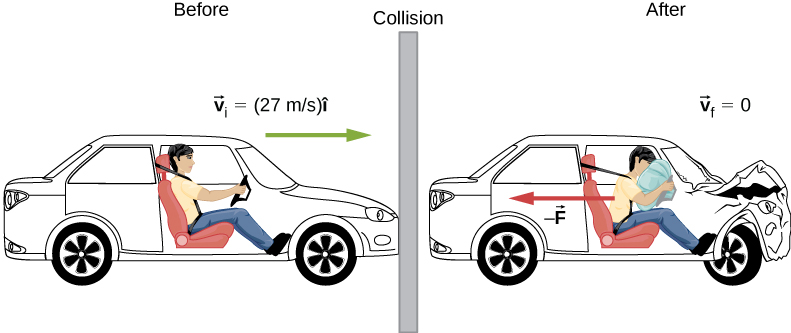
A car traveling at 27 m/s collides with a building. The collision with the building causes the car to come to a stop in approximately 1 second. The driver, who weighs 860 N, is protected by a combination of a variable-tension seatbelt and an airbag (Figure 9.9). (In effect, the driver collides with the seatbelt and airbag and not with the building.) The airbag and seatbelt slow his velocity, such that he comes to a stop in approximately 2.5 s.
英語のヒント
27 m/sで走っていた自動車が建物に衝突し、約1秒で停止する。重さ860 Nの運転者は、張力が変化するシートベルトとエアバッグの組合せで保護されている(図9.9)。実質的には、運転者は建物ではなくシートベルトとエアバッグに衝突する。エアバッグとシートベルトが運転者を減速させ、約2.5 sで停止させる。
- What average force does the driver experience during the collision?
英語のヒント
衝突中に運転者が受ける平均の力はいくらか。 - Without the seatbelt and airbag, his collision time (with the steering wheel) would have been approximately 0.20 s. What force would he experience in this case?
英語のヒント
シートベルトとエアバッグがなければ、運転者がハンドルに衝突する時間は約0.20 sだったはずである。この場合、どれほどの力を受けるか。
OpenStax / Rice University, University Physics Volume 1, CC BY 4.0. Source-book artwork retained. · CC BY 4.0 · Source出典

Figure 9.9図 9.9
The motion of a car and its driver at the instant before and the instant after colliding with the wall. The restrained driver experiences a large backward force from the seatbelt and airbag, which causes his velocity to decrease to zero. (The forward force from the seatbelt is much smaller than the backward force, so we neglect it in the solution.)
英語のヒント
壁との衝突の直前と直後の、自動車と運転者の運動。身体を拘束された運転者は、シートベルトとエアバッグから大きな後ろ向きの力を受け、その速度がゼロまで減少する。シートベルトから受ける前向きの力は後ろ向きの力よりはるかに小さいので、解答では無視する。
Strategy方針
We are given the driver’s weight, his initial and final velocities, and the time of collision; we are asked to calculate a force. Impulse seems the right way to tackle this; we can combine Equation 9.5 and Equation 9.6.
英語のヒント
運転者の重さ、初速度と最終速度、衝突時間が与えられており、力を求める問題である。力積を使って取り組むのがよさそうで、平均の力と力積の関係式を式9.6と組み合わせればよい。
Solution解答
- Define the +x-direction to be the direction the car is initially moving. We know
英語のヒント
自動車が初めに進んでいた方向を+x方向と定める。既知の関係は、and英語のヒント
および、Since J is equal to both those things, they must be equal to each other:英語のヒント
Jはこれら二つの量のどちらにも等しいので、両者は互いに等しくなければならない。We need to convert this weight to the equivalent mass, expressed in SI units:英語のヒント
この重さを、SI単位で表した対応する質量に換算する必要がある。Remembering that , and noting that the final velocity is zero, we solve for the force:英語のヒント
であることを思い出し、最終速度がゼロであることを用いて、力について解く。The negative sign implies that the force slows him down. For perspective, this is about 1.1 times his own weight.英語のヒント
負の符号は、力が運転者を減速させることを示す。この力の大きさを比べると、運転者自身の重さの約1.1倍である。 - Same calculation, just the different time interval:
英語のヒント
同じ計算で、時間間隔だけを変えると、which is about 14 times his own weight. Big difference!英語のヒント
となり、運転者自身の重さの約14倍である。大きな違いである。
Significance考察
You see that the value of an airbag is how greatly it reduces the force on the vehicle occupants. For this reason, they have been required on all passenger vehicles in the United States since 1991, and have been commonplace throughout Europe and Asia since the mid-1990s. The change of momentum in a crash is the same, with or without an airbag; the force, however, is vastly different.
英語のヒント
エアバッグの価値は、車の乗員に加わる力を大幅に減らす点にある。このため米国では1991年以降、すべての乗用車に装備が義務付けられ、ヨーロッパとアジアでも1990年代半ばから広く普及している。事故時の運動量の変化はエアバッグの有無によらず同じだが、力は大きく異なる。