第9章運動量と衝突
9.5 Collisions in Multiple Dimensions9.5 多次元での衝突
Learning Objectives学習目標
Learning Objectives学習目標
By the end of this section, you will be able to:
英語のヒント
この節を終えると、次のことができるようになる。
- Express momentum as a two-dimensional vector
英語のヒント
運動量を二次元のベクトルとして表す。 - Write equations for momentum conservation in component form
英語のヒント
運動量保存の式を成分で書く。 - Calculate momentum in two dimensions, as a vector quantity
英語のヒント
二次元の運動量をベクトル量として計算する。
It is far more common for collisions to occur in two dimensions; that is, the angle between the initial velocity vectors is neither zero nor . Let’s see what complications arise from this.
英語のヒント
衝突は二次元で起こる方がはるかに一般的である。つまり、初速度のベクトル同士の角度がゼロでもでもない場合である。これによって、どのような複雑さが生じるか見ていこう。
The first idea we need is that momentum is a vector; like all vectors, it can be expressed as a sum of perpendicular components (usually, though not always, an x-component and a y-component, and a z-component if necessary). Thus, when we write down the statement of conservation of momentum for a problem, our momentum vectors can be, and usually will be, expressed in component form.
英語のヒント
最初に必要な考えは、運動量がベクトルであるということである。ほかのすべてのベクトルと同じく、互いに垂直な成分の和で表せる。通常はx成分とy成分、必要ならz成分を用いるが、常にそうとは限らない。したがって、問題について運動量保存の関係を書くとき、運動量ベクトルを成分で表すことができ、通常はそうする。
The second idea we need comes from the fact that momentum is related to force:
英語のヒント
2番目に必要な考えは、運動量が力と次のように関係していることから得られる。
Expressing both the force and the momentum in component form,
英語のヒント
力と運動量の両方を成分で表すと、
Remember, these equations are simply Newton’s second law, in vector form and in component form. We know that Newton’s second law is true in each direction, independently of the others. It follows therefore (via Newton’s third law) that conservation of momentum is also true in each direction independently.
英語のヒント
これらの式は、ニュートンの第二法則をベクトルと成分で表したものにすぎないことを思い出そう。ニュートンの第二法則は、ほかの方向とは独立に、各方向で成り立つ。したがって、ニュートンの第三法則を通じて、運動量保存も各方向で独立に成り立つと分かる。
These two ideas motivate the solution to two-dimensional problems: We write down the expression for conservation of momentum twice: once in the x-direction and once in the y-direction.
英語のヒント
この二つの考えから、二次元の問題の解き方が導かれる。運動量保存の式を、x方向について1回、y方向について1回、計2回書くのである。
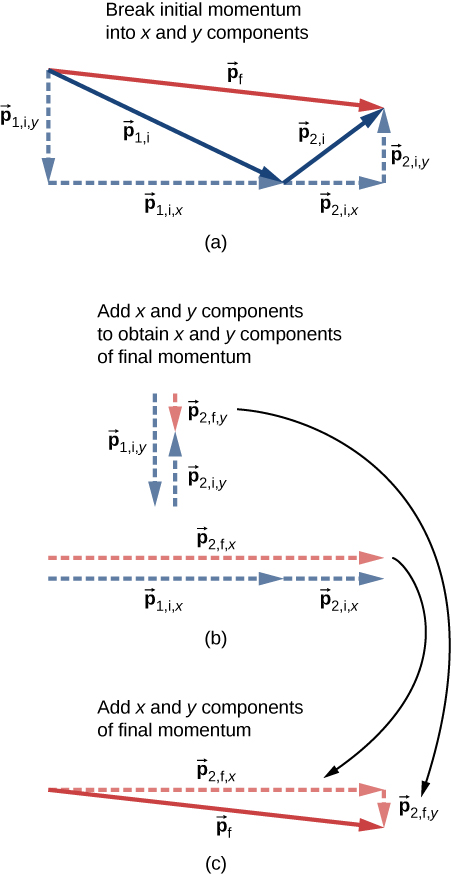
OpenStax / Rice University, University Physics Volume 1, CC BY 4.0. Source-book artwork retained. · CC BY 4.0 · Source出典

Figure 9.22図 9.22
(a) For two-dimensional momentum problems, break the initial momentum vectors into their x- and y-components. (b) Add the x- and y-components together separately. This gives you the x- and y-components of the final momentum, which are shown as red dashed vectors. (c) Adding these components together gives the final momentum.
英語のヒント
(a) 二次元の運動量の問題では、初めの運動量ベクトルをx成分とy成分に分ける。(b) x成分同士、y成分同士を別々に加える。これにより、最後の運動量のx成分とy成分が得られる。図では赤い破線のベクトルで示す。(c) この二つの成分を加えると、最後の運動量が得られる。
We solve each of these two component equations independently to obtain the x- and y-components of the desired velocity vector:
英語のヒント
二つの成分の式をそれぞれ独立に解き、求める速度ベクトルのx成分とy成分を得る。
(Here, m represents the total mass of the system.) Finally, combine these components using the Pythagorean theorem,
英語のヒント
(ここで、mは系の全質量を表す。)最後に、ピタゴラスの定理を用いて成分を組み合わせる。
Example 9.14例題 9.14
Traffic Collision交通事故での衝突
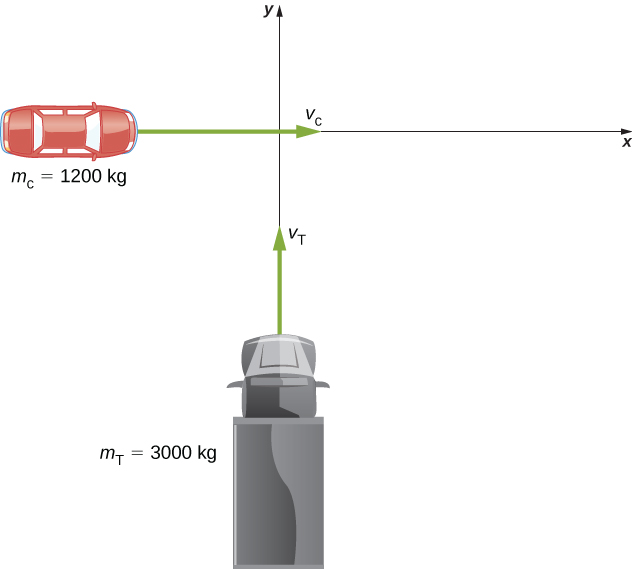
A small car of mass 1200 kg traveling east at 60 km/hr collides at an intersection with a truck of mass 3000 kg that is traveling due north at 40 km/hr (Figure 9.23). The two vehicles are locked together. What is the velocity of the combined wreckage?
英語のヒント
質量1200 kgの小型乗用車が東へ60 km/hrで進み、交差点で、真北へ40 km/hrで進む質量3000 kgのトラックに衝突する(図9.23)。2台はくっつく。一体となった車体の速度はいくらか。
OpenStax / Rice University, University Physics Volume 1, CC BY 4.0. Source-book artwork retained. · CC BY 4.0 · Source出典

Figure 9.23図 9.23
A large truck moving north is about to collide with a small car moving east. The final momentum vector has both x- and y-components.
英語のヒント
北へ進む大型トラックが、東へ進む小型乗用車に衝突しようとしている。最終的な運動量ベクトルには、x成分とy成分の両方がある。
Strategy方針
First off, we need a closed system. The natural system to choose is the (car + truck), but this system is not closed; friction from the road acts on both vehicles. We avoid this problem by restricting the question to finding the velocity at the instant just after the collision, so that friction has not yet had any effect on the system. With that restriction, momentum is conserved for this system.
英語のヒント
まず、閉じた系が必要である。自然な選択は(乗用車+トラック)だが、この系は閉じていない。道路からの摩擦力が両方の車に作用するからである。そこで、摩擦がまだ系に影響を及ぼしていない、衝突直後の瞬間の速度を求める問題に限定して、この問題を避ける。そのように限定すれば、この系の運動量は保存される。
Since there are two directions involved, we do conservation of momentum twice: once in the x-direction and once in the y-direction.
英語のヒント
二つの方向が関わるので、運動量保存を2回用いる。x方向で1回、y方向で1回である。
Solution解答
Before the collision the total momentum is
英語のヒント
衝突前の全運動量は、
After the collision, the wreckage has momentum
英語のヒント
衝突後、車体の運動量は、
Since the system is closed, momentum must be conserved, so we have
英語のヒント
系は閉じているので、運動量は保存されなければならない。したがって、次式を得る。
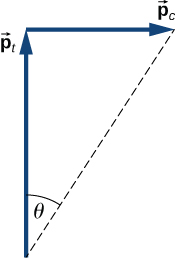
We have to be careful; the two initial momenta are not parallel. We must add vectorially (Figure 9.24).
英語のヒント
ここでは注意が必要である。二つの初めの運動量は平行ではないので、ベクトルとして加えなければならない(図9.24)。
OpenStax / Rice University, University Physics Volume 1, CC BY 4.0. Source-book artwork retained. · CC BY 4.0 · Source出典

Figure 9.24図 9.24
Graphical addition of momentum vectors. Notice that, although the car’s velocity is larger than the truck’s, its momentum is smaller.
英語のヒント
運動量ベクトルを図で加える。乗用車の速度はトラックより大きいが、運動量は小さいことに注意しよう。
If we define the +x-direction to point east and the +y-direction to point north, as in the figure, then (conveniently),
英語のヒント
図のように+x方向を東、+y方向を北と定めると、都合よく次のように表せる。
Therefore, in the x-direction:
英語のヒント
したがって、x方向では、
and in the y-direction:
英語のヒント
また、y方向では、
Applying the Pythagorean theorem gives
英語のヒント
ピタゴラスの定理を適用すると、
As for its direction, using the angle shown in the figure,
英語のヒント
方向については、図に示す角度を用いると、
This angle is east of north, or counterclockwise from the +x-direction.
英語のヒント
この角度は北から東へ測ったもので、+x方向から反時計回りにである。
Significance考察
As a practical matter, accident investigators usually work in the “opposite direction”; they measure the distance of skid marks on the road (which gives the stopping distance) and use the work-energy theorem along with conservation of momentum to determine the speeds and directions of the cars prior to the collision. We saw that analysis in an earlier section.
英語のヒント
実際の事故調査では、通常は「逆向き」に計算を進める。道路に残ったタイヤの滑走痕の長さ(停止距離が分かる)を測り、仕事とエネルギーの定理と運動量保存則を組み合わせて、衝突前の車の速さと方向を求めるのである。この解析は前の節で見た。
Example 9.15例題 9.15
Exploding Scuba Tankスキューバタンクの爆発
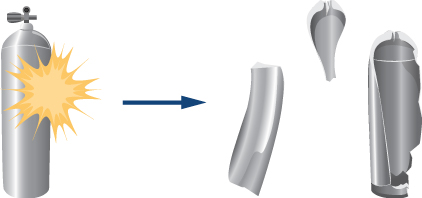
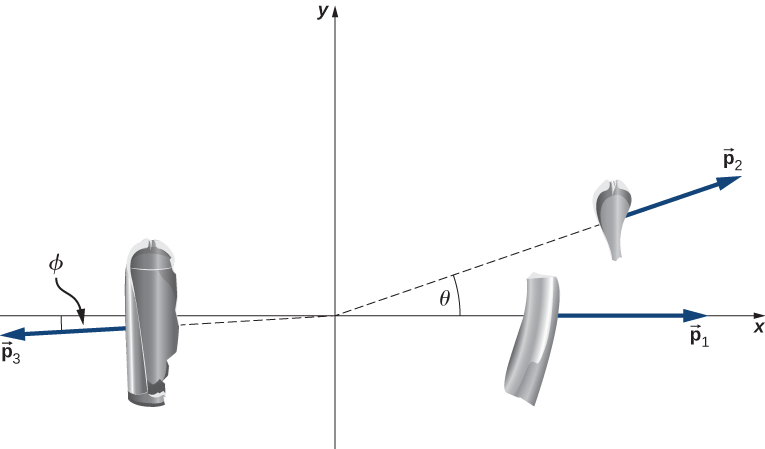
A common scuba tank is an aluminum cylinder that weighs 31.7 pounds empty (Figure 9.25). When full of compressed air, the internal pressure is between 2500 and 3000 psi (pounds per square inch). Suppose such a tank, which had been sitting motionless, suddenly explodes into three pieces. The first piece, weighing 10 pounds, shoots off horizontally at 235 miles per hour; the second piece (7 pounds) shoots off at 172 miles per hour, also in the horizontal plane, but at a angle to the first piece. What is the mass and initial velocity of the third piece? (Do all work, and express your final answer, in SI units.)
英語のヒント
一般的なスキューバタンクは、空のときに31.7ポンドの重さがあるアルミニウム製の円筒である(図9.25)。圧縮空気を満たすと、内部の圧力は2500〜3000 psi(平方インチ当たりのポンド)になる。静止していたこのタンクが突然爆発し、三つに分かれたとする。第1の破片は10ポンドで、水平に時速235マイルで飛び出す。第2の破片は7ポンドで、同じ水平面内を時速172マイルで、第1の破片に対しての角度で飛び出す。第3の破片の質量と初速度はいくらか。(計算全体と最終的な答えにはSI単位を用いること。)
OpenStax / Rice University, University Physics Volume 1, CC BY 4.0. Source-book artwork retained. · CC BY 4.0 · Source出典

Figure 9.25図 9.25
A scuba tank explodes into three pieces.
英語のヒント
スキューバタンクが爆発し、三つに分かれる。
Strategy方針
To use conservation of momentum, we need a closed system. If we define the system to be the scuba tank, this is not a closed system, since gravity is an external force. However, the problem asks for just the initial velocity of the third piece, so we can neglect the effect of gravity and consider the tank by itself as a closed system. Notice that, for this system, the initial momentum vector is zero.
英語のヒント
運動量保存を使うには、閉じた系が必要である。スキューバタンクを系にすると、重力が外力として働くため、閉じた系にはならない。しかし、問題で求めるのは第3の破片の初速度だけなので、重力の影響を無視し、タンクだけを閉じた系とみなせる。この系では、初めの運動量ベクトルはゼロであることに注意しよう。
We choose a coordinate system where all the motion happens in the xy-plane. We then write down the equations for conservation of momentum in each direction, thus obtaining the x- and y-components of the momentum of the third piece, from which we obtain its magnitude (via the Pythagorean theorem) and its direction. Finally, dividing this momentum by the mass of the third piece gives us the velocity.
英語のヒント
すべての運動がxy平面内で起こる座標系を選ぶ。各方向の運動量保存の式を書けば、第3の破片の運動量のx成分とy成分が得られる。そこから、ピタゴラスの定理で大きさを求め、方向も求める。最後に、この運動量を第3の破片の質量で割れば、速度が得られる。
Solution解答
First, let’s get all the conversions to SI units out of the way:
英語のヒント
まず、SI単位への換算をすべて済ませよう。
Now apply conservation of momentum in each direction.
英語のヒント
次に、各方向で運動量保存を適用する。
OpenStax / Rice University, University Physics Volume 1, CC BY 4.0. Source-book artwork retained. · CC BY 4.0 · Source出典

x-direction:
x方向:
y-direction:
y方向:
From our chosen coordinate system, we write the x-components as
英語のヒント
選んだ座標系に基づき、x成分を次のように書く。
For the y-direction, we have
英語のヒント
y方向については、次式を得る。
This gives the magnitude of :
英語のヒント
これにより、の大きさが得られる。
The velocity of the third piece is therefore
英語のヒント
したがって、第3の破片の速度は、
The direction of its velocity vector is the same as the direction of its momentum vector:
英語のヒント
速度ベクトルの方向は、運動量ベクトルの方向と同じである。
Because is below the -axis, the actual angle is from the +x-direction.
英語のヒント
は軸より下にあるので、実際の角度は+x方向からである。
Significance考察
The enormous velocities here are typical; an exploding tank of any compressed gas can easily punch through the wall of a house and cause significant injury, or death. Fortunately, such explosions are extremely rare, on a percentage basis.
英語のヒント
ここで得られた非常に大きな速度は、典型的なものである。どのような圧縮気体のタンクでも、爆発すれば家の壁を容易に突き抜け、重傷や死をもたらしうる。幸い、割合で見ると、このような爆発は極めてまれである。