第9章運動量と衝突
Force and Momentum力と運動量
Remember that our actual goal is to determine the equation of motion for the entire object (the entire system of particles). To that end, let’s define:
英語のヒント
実際の目標は、物体全体(粒子の系全体)の運動方程式を求めることだった。この目的のために、次のように定義しよう。
the total momentum of the system of N particles (the reason for the subscript will become clear shortly)
英語のヒント
N個の粒子からなる系の全運動量(この添字を用いる理由は、まもなく明らかになる)。
Then we have
英語のヒント
すると、次のようになる。
Since this change of momentum is caused by only the net external force, we have dropped the “ext” subscript.
英語のヒント
この運動量変化は外力の合力だけによって生じるので、添字「ext」を省いた。
This is Newton’s second law, but now for the entire extended object. If this feels a bit anticlimactic, remember what is hiding inside it: is the vector sum of the momentum of (in principle) hundreds of thousands of billions of billions of particles , all caused by one simple net external force—a force that you can calculate.
英語のヒント
これはニュートンの第二法則だが、今度は広がりを持つ物体全体についての法則である。少し拍子抜けに感じるなら、この式の中に何が含まれているかを思い出そう。は、原理的には何千億の何千億倍もの数の粒子の運動量のベクトル和である。その変化を引き起こすのは、計算できる一つの単純な外力の合力なのだ。
Center of Mass質量中心
Our next task is to determine what part of the extended object, if any, is obeying Equation 9.26.
英語のヒント
次の課題は、広がりを持つ物体のどの部分が、もしそのような部分があるなら、この運動方程式に従うのかを明らかにすることである。
It’s tempting to take the next step; does the following equation mean anything?
英語のヒント
次の一歩へ進みたくなる。次式には、何か意味があるだろうか。
(9.27)
If it does mean something (acceleration of what, exactly?), then we could write
英語のヒント
もし意味があるなら(正確には、何の加速度なのか)、次のように書ける。
and thus
英語のヒント
したがって、
which follows because the derivative of a sum is equal to the sum of the derivatives.
英語のヒント
これは、和の微分が各項の微分の和に等しいことから得られる。
Now, is the momentum of the jth particle. Defining the positions of the constituent particles (relative to some coordinate system) as , we thus have
英語のヒント
ここで、は第j粒子の運動量である。ある座標系に対する構成粒子の位置をと定義すると、次のようになる。
Substituting back, we obtain
英語のヒント
元の式に代入すると、
Dividing both sides by M (the total mass of the extended object) gives us
英語のヒント
両辺をM(広がりを持つ物体の全質量)で割ると、
Thus, the point in the object that traces out the trajectory dictated by the applied force in Equation 9.27 is inside the parentheses in Equation 9.28.
英語のヒント
Looking at this calculation, notice that (inside the parentheses) we are calculating the product of each particle’s mass with its position, adding all N of these up, and dividing this sum by the total mass of particles we summed. This is reminiscent of an average; inspired by this, we’ll (loosely) interpret it to be the weighted average position of the mass of the extended object. It’s actually called the center of mass of the object. Notice that the position of the center of mass has units of meters; that suggests a definition:
英語のヒント
この計算の括弧内では、各粒子の質量と位置の積を求め、それらN個をすべて足し合わせ、足した粒子の全質量で割っている。これは平均に似ている。そこから、広がりを持つ物体の質量の位置を、質量で重み付けした平均として解釈できる。実際、これを物体の質量中心という。質量中心の位置の単位はメートルであることに注意しよう。次のように定義できる。
So, the point that obeys Equation 9.26 (and therefore Equation 9.27 as well) is the center of mass of the object, which is located at the position vector .
英語のヒント
つまり、外力と全運動量の関係(したがって式9.27にも)に従う点は、物体の質量中心であり、その位置ベクトルはである。
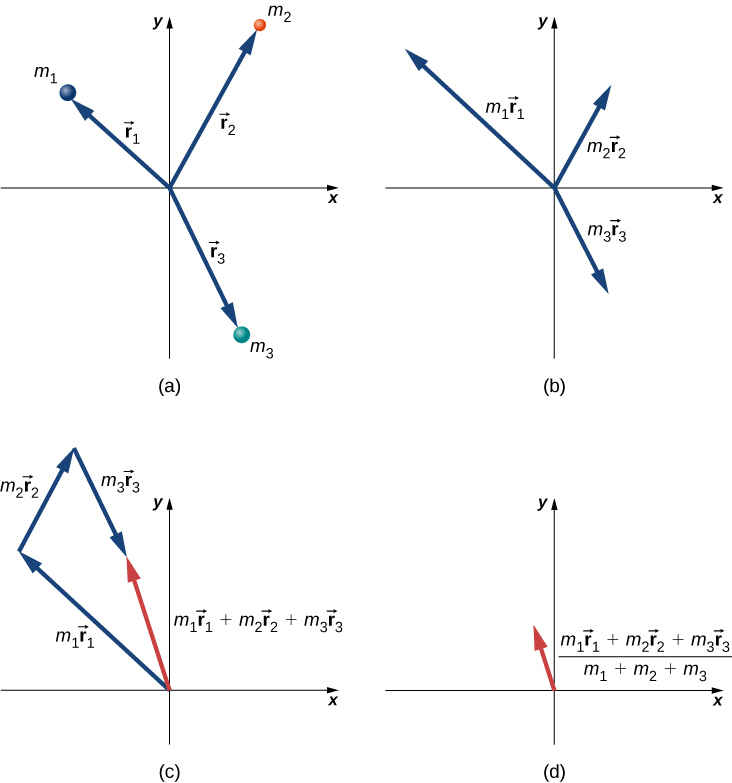
It may surprise you to learn that there does not have to be any actual mass at the center of mass of an object. For example, a hollow steel sphere with a vacuum inside it is spherically symmetrical (meaning its mass is uniformly distributed about the center of the sphere); all of the sphere’s mass is out on its surface, with no mass inside. But it can be shown that the center of mass of the sphere is at its geometric center, which seems reasonable. Thus, there is no mass at the position of the center of mass of the sphere. (Another example is a doughnut.) The procedure to find the center of mass is illustrated in Figure 9.28.
英語のヒント
物体の質量中心に実際の質量が存在する必要はないと知ると、驚くかもしれない。例えば、内部が真空の中空の鋼球は球対称である。つまり、球の中心の周りに質量が一様に分布している。質量はすべて表面にあり、内部にはない。しかし、この球の質量中心は幾何学的な中心にあると示せる。これはもっともらしい結果である。したがって、球の質量中心の位置には質量がない。(ドーナツも別の例である。)質量中心を求める手順を図9.28に示す。
OpenStax / Rice University, University Physics Volume 1, CC BY 4.0. Source-book artwork retained. · CC BY 4.0 · Source出典
Figure 9.28図 9.28
Finding the center of mass of a system of three different particles. (a) Position vectors are created for each object. (b) The position vectors are multiplied by the mass of the corresponding object. (c) The scaled vectors from part (b) are added together. (d) The final vector is divided by the total mass. This vector points to the center of mass of the system. Note that no mass is actually present at the center of mass of this system.
英語のヒント
異なる三つの粒子からなる系の質量中心を求める。(a) 各物体の位置ベクトルを作る。(b) 各位置ベクトルに、対応する物体の質量を掛ける。(c) (b)で大きさを変えたベクトルを足し合わせる。(d) 得られたベクトルを全質量で割る。このベクトルが系の質量中心を指す。この系の質量中心には、実際の質量は存在しないことに注意しよう。
Since , it follows that:
英語のヒント
なので、次のようになる。
(9.30)
(9.31)
(9.32)
and thus
英語のヒント
したがって、
Therefore, you can calculate the components of the center of mass vector individually.
英語のヒント
したがって、質量中心の位置ベクトルの成分は、それぞれ別々に計算できる。
Finally, to complete the kinematics, the instantaneous velocity of the center of mass is calculated exactly as you might suspect:
英語のヒント
最後に運動学の記述を完成させよう。質量中心の瞬間速度は、予想どおり次のように計算される。
and this, like the position, has x-, y-, and z-components.
英語のヒント
これにも位置と同じく、x成分、y成分、z成分がある。
To calculate the center of mass in actual situations, we recommend the following procedure:
英語のヒント
実際の場合に質量中心を計算するには、次の手順を勧める。
Here are two examples that will give you a feel for what the center of mass is.
英語のヒント
質量中心とは何かをつかむため、二つの例題を見てみよう。
Example 9.16例題 9.16
Center of Mass of the Earth-Moon System地球と月の系の質量中心
Using data from text appendix, determine how far the center of mass of the Earth-moon system is from the center of Earth. Compare this distance to the radius of Earth, and comment on the result. Ignore the other objects in the solar system.
英語のヒント
本書の付録のデータを用いて、地球と月の系の質量中心が地球の中心からどれだけ離れているかを求めよ。この距離を地球の半径と比べ、結果について述べよ。太陽系のほかの天体は無視する。
Strategy方針
We get the masses and separation distance of the Earth and moon, impose a coordinate system, and use Equation 9.29 with just objects. We use a subscript “e” to refer to Earth, and subscript “m” to refer to the moon.
英語のヒント
地球と月の質量と両者の間の距離を調べ、座標系を設定する。物体が個の場合について、質量中心の定義式を使う。地球を添字「e」、月を添字「m」で表す。
Solution解答
Define the origin of the coordinate system as the center of Earth. Then, with just two objects, Equation 9.29 becomes
英語のヒント
座標系の原点を地球の中心に定める。物体は二つだけなので、質量中心の定義式は次のようになる。
We defined the center of Earth as the origin, so . Inserting these into the equation for R gives
英語のヒント
地球の中心を原点としたので、である。これらをRの式に代入すると、
Significance考察
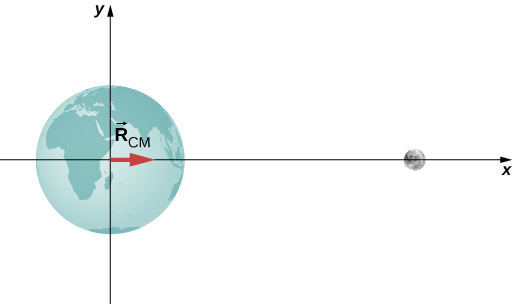
The radius of Earth is , so the center of mass of the Earth-moon system is (6.37 − 4.64) (roughly 1080 miles) below the surface of Earth. The location of the center of mass is shown (not to scale).
英語のヒント
地球の半径はなので、地球と月の系の質量中心は、地表から(6.37 − 4.64) (約1080マイル)下にある。質量中心の位置を図に示す(縮尺は実際と異なる)。


Example 9.17例題 9.17
Center of Mass of a Salt Crystal食塩結晶の質量中心
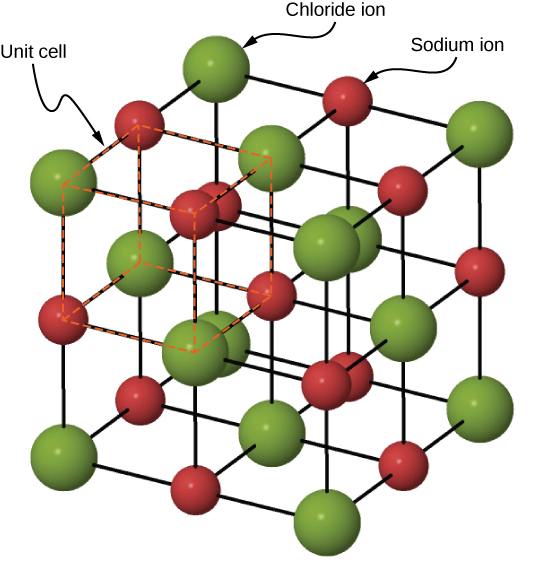
Figure 9.29 shows a single crystal of sodium chloride—ordinary table salt. The sodium and chloride ions form a single unit, NaCl. When multiple NaCl units group together, they form a cubic lattice. The smallest possible cube (called the unit cell) consists of four sodium ions and four chloride ions, alternating. The length of one edge of this cube (i.e., the bond length) is . Find the location of the center of mass of the unit cell. Specify it either by its coordinates , or by and two angles.
英語のヒント
図9.29は、塩化ナトリウム、すなわち普通の食塩の単結晶を示す。ナトリウムイオンと塩化物イオンは、NaClという一つの単位を作る。複数のNaClが集まると、立方格子を形成する。最小の立方体(単位格子)は、ナトリウムイオン4個と塩化物イオン4個が交互に並んだものからなる。この立方体の1辺の長さ(すなわち結合長)はである。単位格子の質量中心の位置を求め、座標、またはと二つの角度で指定せよ。
OpenStax / Rice University, University Physics Volume 1, CC BY 4.0. Source-book artwork retained. · CC BY 4.0 · Source出典

Figure 9.29図 9.29
A drawing of a sodium chloride (NaCl) crystal.
英語のヒント
塩化ナトリウム(NaCl)結晶の図。
Strategy方針
We can look up all the ion masses. If we impose a coordinate system on the unit cell, this will give us the positions of the ions. We can then apply Equation 9.30, Equation 9.31, and Equation 9.32 (along with the Pythagorean theorem).
英語のヒント
Solution解答
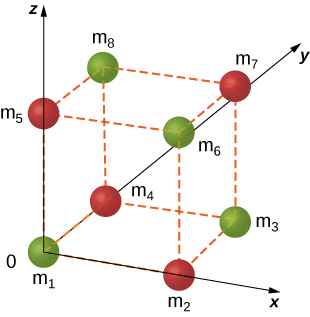
Define the origin to be at the location of the chloride ion at the bottom left of the unit cell. Figure 9.30 shows the coordinate system.
英語のヒント
原点を単位格子の左下の塩化物イオンの位置に定める。図9.30に座標系を示す。
OpenStax / Rice University, University Physics Volume 1, CC BY 4.0. Source-book artwork retained. · CC BY 4.0 · Source出典

Figure 9.30図 9.30
A single unit cell of a NaCl crystal.
英語のヒント
NaCl結晶の一つの単位格子。
There are eight ions in this crystal, so N = 8:
英語のヒント
この結晶には8個のイオンがあるので、N=8である。
The mass of each of the chloride ions is
英語のヒント
各塩化物イオンの質量は、
so we have
英語のヒント
したがって、
For the sodium ions,
英語のヒント
ナトリウムイオンについては、
The total mass of the unit cell is therefore
英語のヒント
したがって、単位格子の全質量は、
From the geometry, the locations are
英語のヒント
幾何学的な配置から、位置は次のようになる。
Substituting:
英語のヒント
代入すると、
Similar calculations give (you could argue that this must be true, by symmetry, but it’s a good idea to check).
英語のヒント
同様の計算からを得る(対称性からそうなるはずだと考えられるが、確かめておくとよい)。
Significance考察
Although this is a great exercise to determine the center of mass given a Chloride ion at the origin, in fact the origin could be chosen at any location. Therefore, there is no meaningful application of the center of mass of a unit cell beyond as an exercise.
英語のヒント
原点に塩化物イオンがあるとして質量中心を求めるのはよい練習になるが、実際には原点はどこに選んでもよい。したがって、単位格子の質量中心を求めることには、練習問題としての意味を超えた有用な応用はない。