第9章運動量と衝突
Summaryまとめ
- The law of conservation of momentum says that the momentum of a closed system is constant in time (conserved).
英語のヒント
運動量保存則は、閉じた系の運動量が時間によらず一定、すなわち保存されると述べている。 - A closed (or isolated) system is defined to be one for which the mass remains constant, and the net external force is zero.
英語のヒント
閉じた系、または孤立系とは、質量が一定に保たれ、外力の合力がゼロである系と定義される。 - The total momentum of a system is conserved only when the system is closed.
英語のヒント
系の全運動量が保存されるのは、系が閉じている場合だけである。
Conceptual Questions概念に関する問題
Exercises 24–29練習問題 24–29
Exercise 24問題 24
Under what circumstances is momentum conserved?
英語のヒント
どのような状況で運動量は保存されるか。
Solution解き方
Momentum is conserved when the mass of the system of interest remains constant during the interaction in question and when no net external force acts on the system during the interaction.
英語のヒント
着目する系の質量が、問題としている相互作用の間ずっと一定であり、かつその間に系に働く外力の合力がゼロであるとき、運動量は保存される。
Exercise 25問題 25
Can momentum be conserved for a system if there are external forces acting on the system? If so, under what conditions? If not, why not?
英語のヒント
系に外力が働いていても、運動量は保存されうるか。保存されるなら、どのような条件でか。保存されないなら、なぜか。
Exercise 26問題 26
Explain in terms of momentum and Newton’s laws how a car’s air resistance is due in part to the fact that it pushes air in its direction of motion.
英語のヒント
自動車の空気抵抗の一因は、自動車が進行方向へ空気を押すことにある。これを運動量とニュートンの法則を用いて説明せよ。
Solution解き方
To accelerate air molecules in the direction of motion of the car, the car must exert a force on these molecules by Newton’s second law . By Newton’s third law, the air molecules exert a force of equal magnitude but in the opposite direction on the car. This force acts in the direction opposite the motion of the car and constitutes the force due to air resistance.
英語のヒント
空気分子を自動車の進行方向へ加速するには、ニュートンの第二法則により、自動車は分子に力を加えなければならない。ニュートンの第三法則によると、空気分子は自動車に、大きさが等しく方向が反対の力を及ぼす。この力は自動車の運動と逆向きに働き、空気抵抗による力を構成する。
Exercise 27問題 27
Can objects in a system have momentum while the momentum of the system is zero? Explain your answer.
英語のヒント
系全体の運動量がゼロでも、系内の物体が運動量を持つことはありうるか。説明せよ。
Exercise 28問題 28
A sprinter accelerates out of the starting blocks. Can you consider him as a closed system? Explain.
英語のヒント
短距離走者がスターティングブロックを蹴って加速する。この走者を閉じた系とみなせるか。説明せよ。
Solution解き方
No, he is not a closed system because a net nonzero external force acts on him in the form of the starting blocks pushing on his feet.
英語のヒント
閉じた系ではない。スターティングブロックが足を押す力として、ゼロではない外力の合力が働くからである。
Exercise 29問題 29
A rocket in deep space (zero gravity) accelerates by firing hot gas out of its thrusters. Does the rocket constitute a closed system? Explain.
英語のヒント
深宇宙の重力がゼロの場所で、ロケットが推進器から高温の気体を噴射して加速する。このロケットは閉じた系を構成するか。説明せよ。
Problems問題
Exercises 30–37練習問題 30–37
Exercise 30問題 30
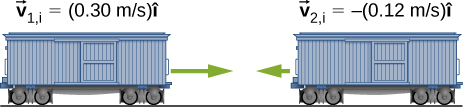
Train cars are coupled together by being bumped into one another. Suppose two loaded train cars are moving toward one another, the first having a mass of and a velocity of , and the second having a mass of and a velocity of . What is their final velocity?
英語のヒント
列車の車両は、互いにぶつけることで連結できる。荷物を積んだ2両が互いに向かって動いている。1両目の質量は、速度は、2両目の質量は、速度はである。連結後の速度を求めよ。
Solution解き方
Exercise 31問題 31
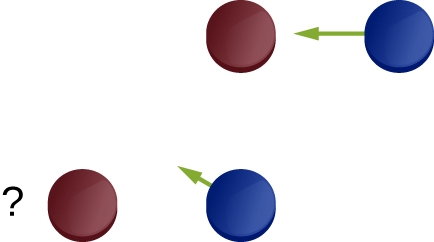
Two identical pucks collide elastically on an air hockey table. Puck 1 was originally at rest; puck 2 has an incoming speed of 6.00 m/s and scatters at an angle of with respect to its incoming direction. What is the velocity (magnitude and direction) of puck 1 after the collision?
英語のヒント
同じ2枚のパックが、エアホッケー台上で弾性衝突する。パック1は初め静止している。パック2は速さ6.00 m/sで入射し、元の進行方向に対しての角度に散乱する。衝突後のパック1の速度の大きさと方向を求めよ。


Exercise 32問題 32
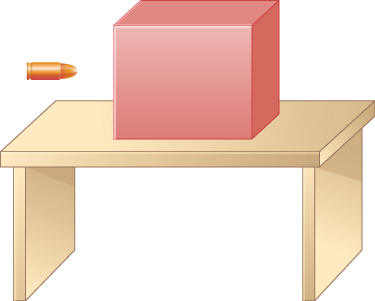
The figure below shows a bullet of mass 200 g traveling horizontally towards the east with speed 400 m/s, which strikes a block of mass 1.5 kg that is initially at rest on a frictionless table.
英語のヒント
下の図では、質量200 gの弾丸が東向きに水平に400 m/sで進み、摩擦のない台上に初め静止していた質量1.5 kgの物体に当たる。
OpenStax / Rice University, University Physics Volume 1, CC BY 4.0. Source-book artwork retained. · CC BY 4.0 · Source出典

After striking the block, the bullet is embedded in the block and the block and the bullet move together as one unit.
英語のヒント
弾丸は当たった後に物体の中へ埋まり、物体と弾丸は一体となって動く。
- What is the magnitude and direction of the velocity of the block/bullet combination immediately after the impact?
英語のヒント
衝突直後、物体と弾丸を合わせたものの速度の大きさと方向はいくらか。 - What is the magnitude and direction of the impulse by the block on the bullet?
英語のヒント
物体が弾丸に加える力積の大きさと方向はいくらか。 - What is the magnitude and direction of the impulse from the bullet on the block?
英語のヒント
弾丸が物体に加える力積の大きさと方向はいくらか。 - If it took 3 ms for the bullet to change the speed from 400 m/s to the final speed after impact, what is the average force between the block and the bullet during this time?
英語のヒント
弾丸の速さが400 m/sから衝突後の最終的な速さへ変わるのに3 msかかったなら、その間に物体と弾丸の間で働く平均の力はいくらか。
Solution解き方
a. 47 m/s in the bullet to block direction; b., toward the bullet; c. , toward the block; d. magnitude is
英語のヒント
a. 弾丸から物体へ向かう方向に47 m/s。b. 弾丸に向かって。c. 物体に向かって。d. 大きさは。
Exercise 33問題 33
A 20-kg child is coasting at 3.3 m/s over flat ground in a 4.0-kg wagon.
英語のヒント
質量20 kgの子どもが、質量4.0 kgのワゴンに乗り、平らな地面を惰性で3.3 m/sで進んでいる。
- If the child drops a 1-kg ball out the back of the wagon, what is the final speed of the child and wagon?
英語のヒント
子どもが質量1 kgのボールをワゴンの後ろから落とすと、子どもとワゴンの最終的な速さはいくらになるか。 - If the child drops a 1-kg ball out the back of the wagon so that the ball is at rest relative to the ground, what is the final speed of the child and wagon?
英語のヒント
子どもが質量1 kgのボールを、地面に対して静止するようにワゴンの後ろから落とすと、子どもとワゴンの最終的な速さはいくらになるか。
Exercise 34問題 34
A 4.5 kg puffer fish expands to 40% of its mass by taking in water. When the puffer fish is threatened, it releases the water toward the threat to move quickly forward. What is the ratio of the speed of the puffer fish forward to the speed of the expelled water backwards?
英語のヒント
質量4.5 kgのフグが水を取り込み、質量の40%に相当する分だけふくらむ。脅威にさらされると、その脅威の方向へ水を吐き出し、自分は素早く前進する。フグの前向きの速さと、後ろ向きに排出された水の速さの比はいくらか。
Solution解き方
2:5
Exercise 35問題 35
Explain why a cannon recoils when it fires a shell.
英語のヒント
大砲が砲弾を発射すると後退する理由を説明せよ。
Exercise 36問題 36
Two figure skaters are coasting in the same direction, with the leading skater moving at 5.5 m/s and the trailing skating moving at 6.2 m/s. When the trailing skater catches up with the leading skater, he picks her up without applying any horizontal forces on his skates. If the trailing skater is 50% heavier than the 50-kg leading skater, what is their speed after he picks her up?
英語のヒント
2人のフィギュアスケーターが同じ方向へ惰性で滑っている。前のスケーターの速さは5.5 m/s、後ろのスケーターの速さは6.2 m/sである。後ろの男性が前の女性に追い付き、自分のスケート靴に水平方向の力を加えずに女性を抱き上げる。前の女性は質量50 kgで、後ろの男性はそれより50%重いとすると、抱き上げた後の2人の速さはいくらになるか。
Solution解き方
5.9 m/s
Exercise 37問題 37
A 2000-kg railway freight car coasts at 4.4 m/s underneath a grain terminal, which dumps grain directly down into the freight car. If the speed of the loaded freight car must not go below 3.0 m/s, what is the maximum mass of grain that it can accept?
英語のヒント
質量2000 kgの鉄道の貨車が、惰性で4.4 m/sで進み、穀物ターミナルの下を通る。ターミナルは穀物を貨車の中へ真下に落とす。積み込んだ貨車の速さを3.0 m/s未満にしてはならないとすると、積み込める穀物の最大質量はいくらか。
closed system
閉じた系
system for which the mass is constant and the net external force on the system is zero
英語のヒント
質量が一定であり、系に働く外力の合力がゼロである系。
Law of Conservation of Momentum
運動量保存則
total momentum of a closed system cannot change
英語のヒント
閉じた系の全運動量は変化できないという法則。
system
系
object or collection of objects whose motion is currently under investigation; however, your system is defined at the start of the problem, you must keep that definition for the entire problem
英語のヒント
現在その運動を調べている物体、または物体の集まり。ただし、系を問題の最初にどのように定義したにせよ、その定義を問題全体を通して保たなければならない。