第9章運動量と衝突
9.6 Center of Mass9.6 質量中心
Learning Objectives学習目標
Learning Objectives学習目標
By the end of this section, you will be able to:
英語のヒント
この節を終えると、次のことができるようになる。
- Explain the meaning and usefulness of the concept of center of mass
英語のヒント
質量中心の概念の意味と有用性を説明する。 - Calculate the center of mass of a given system
英語のヒント
与えられた系の質量中心を計算する。 - Apply the center of mass concept in two and three dimensions
英語のヒント
質量中心の概念を二次元と三次元に適用する。 - Calculate the velocity and acceleration of the center of mass
英語のヒント
質量中心の速度と加速度を計算する。
We have been avoiding an important issue up to now: When we say that an object moves (more correctly, accelerates) in a way that obeys Newton’s second law, we have been ignoring the fact that all objects are actually made of many constituent particles. A car has an engine, steering wheel, seats, passengers; a football is leather and rubber surrounding air; a brick is made of atoms. There are many different types of particles, and they are generally not distributed uniformly in the object. How do we include these facts into our calculations?
英語のヒント
これまでは、重要な問題を避けてきた。物体がニュートンの第二法則に従って動く(正確には加速する)というとき、実際にはすべての物体が多くの構成粒子からできていることを無視していたのである。自動車にはエンジン、ハンドル、座席、乗客があり、フットボールは空気を囲む革とゴムからなり、れんがは原子からできている。粒子にはさまざまな種類があり、一般に物体内に一様に分布しているわけではない。これらの事実を、どう計算に取り入れればよいだろうか。
Then too, an extended object might change shape as it moves, such as a water balloon or a cat falling (Figure 9.27). This implies that the constituent particles are applying internal forces on each other, in addition to the external force that is acting on the object as a whole. We want to be able to handle this, as well.
英語のヒント
さらに、水風船や落下する猫のように、広がりを持つ物体は運動中に形を変えることもある(図9.27)。これは、物体全体に働く外力に加え、構成粒子が互いに内力を及ぼし合っていることを意味する。このような場合も扱えるようにしたい。
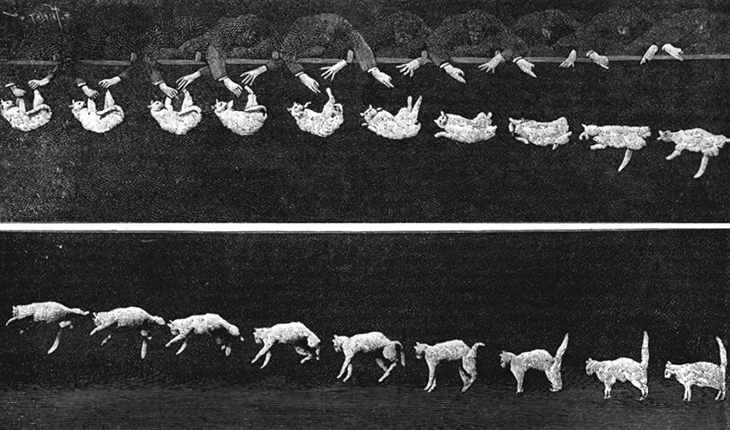
OpenStax / Rice University, University Physics Volume 1, CC BY 4.0. Source-book artwork retained. · CC BY 4.0 · Source出典

Figure 9.27図 9.27
As the cat falls, its body performs complicated motions so it can land on its feet, but one point in the system moves with the simple uniform acceleration of gravity.
英語のヒント
猫は落ちながら複雑に体を動かして足から着地するが、系内のある1点は、一定の重力加速度による単純な運動をする。
The problem before us, then, is to determine what part of an extended object is obeying Newton’s second law when an external force is applied and to determine how the motion of the object as a whole is affected by both the internal and external forces.
英語のヒント
ここでの課題は、広がりを持つ物体に外力が加わるとき、どの部分がニュートンの第二法則に従うのかを突き止めること、そして、内力と外力が物体全体の運動にどう影響するかを明らかにすることである。
Be warned: To treat this new situation correctly, we must be rigorous and completely general. We won’t make any assumptions about the nature of the object, or of its constituent particles, or either the internal or external forces. Thus, the arguments will be complex.
英語のヒント
注意しておこう。この新たな状況を正しく扱うには、厳密かつ完全に一般的な議論が必要である。物体の性質、その構成粒子、内力、外力のいずれについても、特別な仮定は置かない。そのため、議論は複雑になる。
Internal and External Forces内力と外力
Suppose we have an extended object of mass M, made of N interacting particles. Let’s label their masses as , where . Note that
英語のヒント
相互作用するN個の粒子からなる、質量Mの広がりを持つ物体を考える。各粒子の質量をと表し、とする。次の関係に注意しよう。
(9.19)
If we apply some net external force on the object, every particle experiences some “share” or some fraction of that external force. Let:
英語のヒント
物体に外力の合力を加えると、各粒子はその外力の「分け前」、すなわち一部分を受ける。次のように置く。
Notice that these fractions of the total force are not necessarily equal; indeed, they virtually never are. (They can be, but they usually aren’t.) In general, therefore,
英語のヒント
全体の力を分担するこれらの部分は、必ずしも等しくないことに注意しよう。実際、等しくなることはほとんどない。(等しい場合もありうるが、通常はそうではない。)したがって、一般には、
Next, we assume that each of the particles making up our object can interact with (apply forces on) every other particle of the object. We won’t try to guess what kind of forces they are; but since these forces are the result of particles of the object acting on other particles of the same object, we refer to them as internal forces ; thus:
英語のヒント
次に、物体を構成する各粒子は、物体内のほかのすべての粒子と相互作用できる(力を及ぼせる)と仮定する。それがどのような種類の力かは推測しない。ただし、これらの力は物体内の粒子が同じ物体内の別の粒子に及ぼすものなので、内力と呼ぶ。すなわち、
the net internal force that the jth particle experiences from all the other particles that make up the object.
英語のヒント
第j粒子が、物体を構成するほかのすべての粒子から受ける内力の合力。
Now, the net force, internal plus external, on the jth particle is the vector sum of these:
英語のヒント
ここで、第j粒子に働く内力と外力を合わせた合力は、それらのベクトル和である。
(9.20)
where again, this is for all N particles; .
英語のヒント
これはN個のすべての粒子についての式であり、である。
As a result of this fractional force, the momentum of each particle gets changed:
英語のヒント
このように分担された力によって、各粒子の運動量が変化する。
(9.21)
The net force on the object is the vector sum of these forces:
英語のヒント
物体に働く合力は、これらの力のベクトル和である。
(9.22)
This net force changes the momentum of the object as a whole, and the net change of momentum of the object must be the vector sum of all the individual changes of momentum of all of the particles:
英語のヒント
この合力は物体全体の運動量を変える。物体全体の運動量の変化は、すべての粒子の個々の運動量変化をベクトルとして足し合わせたものでなければならない。
(9.23)
(9.24)
Let’s now think about these summations. First consider the internal forces term; remember that each is the force on the jth particle from the other particles in the object. But by Newton’s third law, for every one of these forces, there must be another force that has the same magnitude, but the opposite sign (points in the opposite direction). These forces do not cancel; however, that’s not what we’re doing in the summation. Rather, we’re simply mathematically adding up all the internal force vectors. That is, in general, the internal forces for any individual part of the object won’t cancel, but when all the internal forces are added up, the internal forces must cancel in pairs. It follows, therefore, that the sum of all the internal forces must be zero:
英語のヒント
これらの総和を考えよう。まず内力の項を考える。はそれぞれ、物体内のほかの粒子から第j粒子に及ぼされる力である。ニュートンの第三法則により、その一つ一つに対し、大きさが等しく符号が反対(向きが反対)の力が必ず存在する。これらの力は打ち消し合わない。しかし、ここで行っているのは、個々の粒子上で力を打ち消す操作ではない。単にすべての内力ベクトルを数学的に足し合わせているのである。つまり、物体の個々の部分に働く内力は一般には打ち消し合わないが、すべての内力を足し合わせると、内力は対になって打ち消し合う。したがって、すべての内力の和はゼロでなければならない。
(This argument is subtle, but crucial; take plenty of time to completely understand it.)
英語のヒント
(この議論は細かな注意を要するが、極めて重要である。十分に時間をかけて理解しよう。)
For the external forces, this summation is simply the total external force that was applied to the whole object:
英語のヒント
外力については、この総和は単に、物体全体に加えた外力の合計となる。
As a result,
英語のヒント
その結果、
This is an important result. Equation 9.25 tells us that the total change of momentum of the entire object (all N particles) is due only to the external forces; the internal forces do not change the momentum of the object as a whole. This is why you can’t lift yourself in the air by standing in a basket and pulling up on the handles: For the system of you + basket, your upward pulling force is an internal force.
英語のヒント
これは重要な結果である。この式は、物体全体(N個すべての粒子)の運動量の変化が、外力だけによって生じることを示している。内力は物体全体の運動量を変えない。かごの中に立って取っ手を引き上げても、自分自身を空中へ持ち上げられないのはこのためである。「自分+かご」の系では、自分が上向きに引く力は内力だからである。