第9章運動量と衝突
9.7 Rocket Propulsion9.7 ロケット推進
Learning Objectives学習目標
Learning Objectives学習目標
By the end of this section, you will be able to:
英語のヒント
この節を終えると、次のことができるようになる。
- Describe the application of conservation of momentum when the mass changes with time, as well as the velocity
英語のヒント
速度に加えて質量も時間とともに変わる場合に、運動量保存をどう適用するか説明する。 - Calculate the speed of a rocket in empty space, at some time, given initial conditions
英語のヒント
初期条件が与えられたとき、何もない空間での、ある時刻のロケットの速さを計算する。 - Calculate the speed of a rocket in Earth’s gravity field, at some time, given initial conditions
英語のヒント
初期条件が与えられたとき、地球の重力場内での、ある時刻のロケットの速さを計算する。
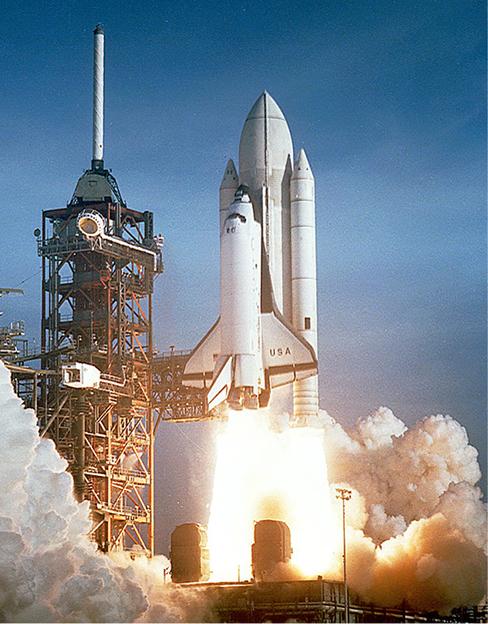
Now we deal with the case where the mass of an object is changing. We analyze the motion of a rocket, which changes its velocity (and hence its momentum) by ejecting burned fuel gases, thus causing it to accelerate in the opposite direction of the velocity of the ejected fuel (see Figure 9.33). Specifically: A fully fueled rocket ship in deep space has a total mass (this mass includes the initial mass of the fuel). At some moment in time, the rocket has a velocity and mass m; this mass is a combination of the mass of the empty rocket and the mass of the remaining unburned fuel it contains. (We refer to m as the “instantaneous mass” and as the “instantaneous velocity.”) The rocket accelerates by burning the fuel it carries and ejecting the burned exhaust gases. If the burn rate of the fuel is constant, and the velocity at which the exhaust is ejected is also constant, what is the change of velocity of the rocket as a result of burning all of its fuel?
英語のヒント
今度は、物体の質量が変わる場合を扱う。燃焼した燃料の気体を噴出して速度(したがって運動量)を変えるロケットの運動を解析する。ロケットは噴出した燃料の速度と反対向きに加速する(図9.33)。具体的に考えよう。燃料を満載した宇宙船が深宇宙にあり、その全質量をとする。これには初めの燃料の質量も含む。ある時刻に、ロケットの速度が、質量がmであるとする。mは空のロケット本体と、残っている未燃焼の燃料の質量の和である。mを「瞬間の質量」、を「瞬間速度」と呼ぶ。ロケットは、搭載した燃料を燃やして排気を噴出することで加速する。燃料の燃焼率と排気の噴出速度がともに一定なら、すべての燃料を燃やした結果、ロケットの速度はどれだけ変わるだろうか。
(credit: modification of work by NASA) NASA imagery used for educational publication; no NASA endorsement is implied. · NASA media use permission; OpenStax additions CC BY 4.0 · Source出典

Figure 9.33図 9.33
The space shuttle had a number of reusable parts. Solid fuel boosters on either side were recovered and refueled after each flight, and the entire orbiter returned to Earth for use in subsequent flights. The large liquid fuel tank was expended. The space shuttle was a complex assemblage of technologies, employing both solid and liquid fuel, and pioneering ceramic tiles as reentry heat shields. As a result, it permitted multiple launches as opposed to single-use rockets. (credit: modification of work by NASA)
英語のヒント
スペースシャトルには、再使用できる部品がいくつもあった。両側の固体燃料ブースターは飛行ごとに回収され、燃料を入れ直した。軌道船全体も地球へ戻り、次の飛行に用いた。大きな液体燃料タンクは使い捨てだった。スペースシャトルは、固体・液体の両燃料を使い、大気圏再突入の熱遮蔽にセラミックタイルを先駆的に採用するなど、複雑な技術の集合体だった。その結果、使い捨てロケットとは異なり、複数回の打ち上げが可能になった。(NASAの作品を改変。)
Physical Analysis物理的な分析
Here’s a description of what happens, so that you get a feel for the physics involved.
英語のヒント
関係する物理をつかめるよう、起こることを説明しよう。
- As the rocket engines operate, they are continuously ejecting burned fuel gases, which have both mass and velocity, and therefore some momentum. By conservation of momentum, the rocket’s momentum changes by this same amount (with the opposite sign). We will assume the burned fuel is being ejected at a constant rate, which means the rate of change of the rocket’s momentum is also constant. By Equation 9.9, this represents a constant force on the rocket.
英語のヒント
ロケットエンジンが作動すると、燃焼した燃料の気体が絶えず噴出される。気体には質量と速度があるため、運動量がある。運動量保存により、ロケットの運動量は同じ量だけ、逆の符号で変わる。燃焼した燃料は一定の率で噴出すると仮定するので、ロケットの運動量の変化率も一定である。力と運動量変化の関係より、これはロケットに一定の力が働くことを意味する。 - However, as time goes on, the mass of the rocket (which includes the mass of the remaining fuel) continuously decreases. Thus, even though the force on the rocket is constant, the resulting acceleration is not; it is continuously increasing.
英語のヒント
しかし、時間とともにロケットの質量(残った燃料の質量を含む)は連続的に減る。したがって、ロケットに働く力は一定でも、その結果としての加速度は一定ではなく、増え続ける。 - So, the total change of the rocket’s velocity will depend on the amount of mass of fuel that is burned, and that dependence is not linear.
英語のヒント
そのため、ロケットの速度の全変化量は、燃焼する燃料の質量に依存し、その関係は線形ではない。
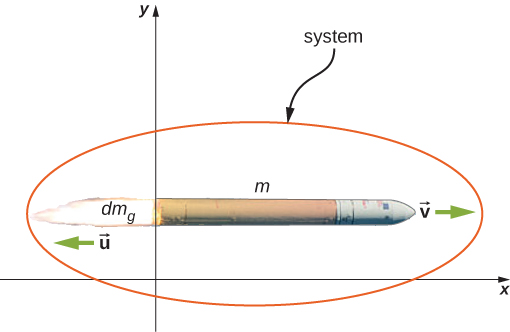
The problem has the mass and velocity of the rocket changing; also, the total mass of ejected gases is changing. If we define our system to be the rocket + fuel, then this is a closed system (since the rocket is in deep space, there are no external forces acting on this system); as a result, momentum is conserved for this system. Thus, we can apply conservation of momentum to answer the question (Figure 9.34).
英語のヒント
この問題では、ロケットの質量も速度も変化し、噴出した気体の全質量も変化する。系を「ロケット+燃料」と定めると、閉じた系になる。深宇宙にあるので、系には外力が働かないからである。その結果、この系の運動量は保存され、運動量保存を使って問いに答えられる(図9.34)。
(credit: modification of work by NASA/Bill Ingalls) NASA imagery used for educational publication; no NASA endorsement is implied. · NASA media use permission; OpenStax additions CC BY 4.0 · Source出典

Figure 9.34図 9.34
The rocket accelerates to the right due to the expulsion of some of its fuel mass to the left. Conservation of momentum enables us to determine the resulting change of velocity. The mass m is the instantaneous total mass of the rocket (i.e., mass of rocket body plus mass of fuel at that point in time). (credit: modification of work by NASA/Bill Ingalls)
英語のヒント
ロケットは、燃料の質量の一部を左へ噴出することで右へ加速する。運動量保存から、それによる速度の変化を求められる。mはその瞬間のロケットの全質量、すなわち本体とその時点の燃料の質量の和である。(NASA/Bill Ingallsの作品を改変。)
At the same moment that the total instantaneous rocket mass is m (i.e., m is the mass of the rocket body plus the mass of the fuel at that point in time), we define the rocket’s instantaneous velocity to be (in the +x-direction); this velocity is measured relative to an inertial reference system (the Earth, for example). Thus, the initial momentum of the system is
英語のヒント
瞬間の全質量がm、すなわち本体とその時点の燃料の質量の和であるとき、ロケットの瞬間速度を(+x方向)とする。この速度は、地球などの慣性基準系に対して測ったものである。したがって、系の初めの運動量は、
The rocket’s engines are burning fuel at a constant rate and ejecting the exhaust gases in the −x-direction. During an infinitesimal time interval dt, the engines eject a (positive) infinitesimal mass of gas at velocity ; note that although the rocket velocity is measured with respect to Earth, the exhaust gas velocity is measured with respect to the (moving) rocket. Measured with respect to the Earth, therefore, the exhaust gas has velocity .
英語のヒント
ロケットのエンジンは一定の率で燃料を燃やし、−x方向へ排気を噴出している。微小時間dtの間に、微小な気体質量(正の量)が速度で噴出する。ロケットの速度は地球に対して測るが、排気の速度は動いているロケットに対して測ることに注意しよう。したがって、地球に対して測った排気の速度はとなる。
As a consequence of the ejection of the fuel gas, the rocket’s mass decreases by , and its velocity increases by . Therefore, including both the change for the rocket and the change for the exhaust gas, the final momentum of the system is
英語のヒント
燃焼ガスの噴出により、ロケットの質量はだけ減り、速度はだけ増える。ロケットと排気の両方の変化を含めると、系の最後の運動量は次のようになる。
Since all vectors are in the x-direction, we drop the vector notation. Applying conservation of momentum, we obtain
英語のヒント
すべてのベクトルがx方向なので、ベクトル記号を省く。運動量保存を適用すると、次式を得る。
Now, and dv are each very small; thus, their product is very, very small, much smaller than the other two terms in this expression. We neglect this term, therefore, and obtain:
英語のヒント
とdvはそれぞれ非常に小さいので、その積はさらに非常に小さく、この式のほかの二つの項よりはるかに小さい。したがって、この項を無視すると、次式を得る。
Our next step is to remember that, since represents an increase in the mass of ejected gases, it must also represent a decrease of mass of the rocket:
英語のヒント
次に、は噴出した気体の質量の増加なので、同時にロケットの質量の減少を表すことを思い出そう。
Replacing this, we have
英語のヒント
これで置き換えると、
or
英語のヒント
すなわち、
Integrating from the initial mass m0 to the final mass m of the rocket gives us the result we are after:
英語のヒント
ロケットの初めの質量m0から最後の質量mまで積分すると、求めていた結果が得られる。
and thus our final answer is
英語のヒント
したがって、最終的な答えは、
This result is called the rocket equation. It was originally derived by the Russian rocket scientist Konstantin Tsiolkovsky in 1897. It gives us the change of velocity that the rocket obtains from burning a mass of fuel that decreases the total rocket mass from down to m. As expected, the relationship between and the change of mass of the rocket is nonlinear.
英語のヒント
この結果をロケット方程式という。1897年に、ロシアのロケット科学者コンスタンチン・ツィオルコフスキーが初めて導いた。燃料を燃焼させ、ロケットの全質量がからmに減ったときに得られる速度変化を示す式である。予想したとおり、とロケットの質量変化の関係は非線形である。
Example 9.20例題 9.20
Thrust on a Spacecraft宇宙船に働く推力
A spacecraft is moving in gravity-free space along a straight path when its pilot decides to accelerate forward. He turns on the thrusters, and burned fuel is ejected at a constant rate of , at a speed (relative to the rocket) of . The initial mass of the spacecraft and its unburned fuel is , and the thrusters are on for 30 s.
英語のヒント
宇宙船が無重力の空間を直線に沿って進んでいるとき、操縦士が前方へ加速することにした。推進器を作動させると、燃焼した燃料が一定の率で、ロケットに対して速さで噴出する。宇宙船と未燃焼の燃料の初めの質量はで、推進器は30 s作動する。
- What is the thrust (the force applied to the rocket by the ejected fuel) on the spacecraft?
英語のヒント
宇宙船に働く推力(噴出した燃料がロケットに及ぼす力)はいくらか。 - What is the spacecraft’s acceleration as a function of time?
英語のヒント
宇宙船の加速度を、時間の関数として表せ。 - What are the spacecraft’s accelerations at t = 0, 15, 30, and 35 s?
英語のヒント
t=0、15、30、35 sにおける宇宙船の加速度はいくらか。
Strategy方針
- The force on the spacecraft is equal to the rate of change of the momentum of the fuel.
英語のヒント
宇宙船に働く力は、燃料の運動量の変化率に等しい。 - Knowing the force from part (a), we can use Newton’s second law to calculate the consequent acceleration. The key here is that, although the force applied to the spacecraft is constant (the fuel is being ejected at a constant rate), the mass of the spacecraft isn’t; thus, the acceleration caused by the force won’t be constant. We expect to get a function a(t), therefore.
英語のヒント
(a)で力が分かるので、ニュートンの第二法則から生じる加速度を計算できる。要点は、宇宙船に働く力は一定でも、宇宙船の質量は一定ではないということである。燃料は一定の率で噴出している。そのため、この力が生じさせる加速度は一定ではない。したがって、時間の関数a(t)が得られるはずである。 - We’ll use the function we obtain in part (b), and just substitute the numbers given. Important: We expect that the acceleration will get larger as time goes on, since the mass being accelerated is continuously decreasing (fuel is being ejected from the rocket).
英語のヒント
(b)で得た関数に、与えられた数値を代入する。重要なのは、加速される質量が燃料の噴出によって減り続けるので、時間が経つほど加速度は大きくなるはずだという点である。
Solution解答
- The momentum of the ejected fuel gas is
英語のヒント
噴出した燃焼ガスの運動量は、The ejection velocity is constant, and therefore the force is英語のヒント
噴出速度は一定なので、力は、Now, is the rate of change of the mass of the fuel; the problem states that this is . Substituting, we get英語のヒント
は燃料の質量の変化率であり、問題文ではと与えられている。代入すると、 - Above, we defined m to be the combined mass of the empty rocket plus however much unburned fuel it contained: . From Newton’s second law,
英語のヒント
先に、mを空のロケット本体と、その中に残っている未燃焼の燃料を合わせた質量として定義した。すなわち、である。ニュートンの第二法則より、The force is constant and the empty rocket mass is constant, but the fuel mass is decreasing at a uniform rate; specifically:英語のヒント
力と空のロケット本体の質量は一定だが、燃料の質量は一定の率で減少している。具体的には、This gives us英語のヒント
これにより、Notice that, as expected, the acceleration is a function of time. Substituting the given numbers:英語のヒント
予想したとおり、加速度は時間の関数である。与えられた数値を代入すると、 - At :では、At .
At .
Acceleration is increasing, as we expected.
At (and at any time after ), the acceleration is since the thrusters stopped working and thus no external forces are acting on the spacecraft.英語のヒント
であり、である。予想どおり、加速度は増加している。では(そしてより後はいつでも)、推進器が停止して宇宙船に外力が働かないので、加速度はとなる。
Significance考察
Notice that the acceleration is not constant; as a result, any dynamical quantities must be calculated either using integrals, or (more easily) conservation of total energy.
英語のヒント
加速度は一定ではないことに注意しよう。そのため、力学的な量は、積分を使うか、より簡単には全エネルギー保存を使って計算しなければならない。