第6章多項式
6.3 Multiply Polynomials6.3 多項式の乗法
Learning Objectives学習目標
Learning Objectives学習目標
By the end of this section, you will be able to:
英語のヒント
この節を終えると、次のことができるようになる。
- Multiply a polynomial by a monomial
英語のヒント
多項式に単項式を掛ける - Multiply a binomial by a binomial
英語のヒント
二項式どうしを掛ける - Multiply a trinomial by a binomial
英語のヒント
三項式に二項式を掛ける
Before You Begin (2)準備問題(2題)
Multiply a Polynomial by a Monomial多項式に単項式を掛ける
We have used the Distributive Property to simplify expressions like . You multiplied both terms in the parentheses, , by 2, to get . With this chapter’s new vocabulary, you can say you were multiplying a binomial, , by a monomial, 2.
英語のヒント
のような式を簡単にするために、分配法則を使ってきた。括弧内の両方の項に2を掛け、を得た。この章で学んだ用語を使えば、二項式に単項式2を掛けたことになる。
Multiplying a binomial by a monomial is nothing new for you! Here’s an example:
英語のヒント
二項式に単項式を掛けることは、初めてのことではない。例を見てみよう。
Example 6.28例題 6.28
Multiply:
英語のヒント
次の乗法を計算する:
Solution解答
 |
|
Distribute. 分配法則を使う。 |
 |
Simplify. 簡単にする。 |
 |
Try It (2)確認問題(2題)
Example 6.29例題 6.29
Multiply:
英語のヒント
次の乗法を計算する:
Solution解答
 |
|
Distribute. 分配法則を使う。 |
 |
Simplify. 簡単にする。 |
 |
Try It (2)確認問題(2題)
Example 6.30例題 6.30
Multiply:
英語のヒント
次の乗法を計算する:
Solution解答
 |
|
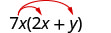
Distribute. 分配法則を使う。 |
 |
Simplify. 簡単にする。 |
 |
Try It (2)確認問題(2題)
Example 6.31例題 6.31
Multiply:
英語のヒント
次の乗法を計算する:
Solution解答
 |
|
Distribute. 分配法則を使う。 |
 |
Simplify. 簡単にする。 |
 |
Try It (2)確認問題(2題)
Example 6.32例題 6.32
Multiply:
英語のヒント
次の乗法を計算する:
Solution解答
Solution解答
 |
|
Distribute. 分配法則を使う。 |
 |
Simplify. 簡単にする。 |
 |
Try It (2)確認問題(2題)
Example 6.33例題 6.33
Multiply:
英語のヒント
次の乗法を計算する:
Solution解答
The monomial is the second factor. 単項式が2番目の因数になっている。 |
 |
Distribute. 分配法則を使う。 |
 |
Simplify. 簡単にする。 |
 |
Try It (2)確認問題(2題)
Multiply a Binomial by a Binomial二項式どうしを掛ける
Just like there are different ways to represent multiplication of numbers, there are several methods that can be used to multiply a binomial times a binomial. We will start by using the Distributive Property.
英語のヒント
数の掛け算にいろいろな表し方があるのと同じように、二項式どうしの掛け算にも、いくつかの方法がある。まず分配法則を使う方法から始めよう。
Multiply a Binomial by a Binomial Using the Distributive Property分配法則を使って二項式どうしを掛ける
 |
|
We distributed the p to get: pを分配して、次を得た。 |
 |
What if we have (x + 7) instead of p? pの代わりに(x+7)だったらどうなるか。 |
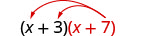 |
Distribute (x + 7). (x+7)を分配する。 |
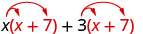 |
Distribute again. もう一度、分配法則を使う。 |
 |
Combine like terms. 同類項をまとめる。 |
 |
Notice that before combining like terms, you had four terms. You multiplied the two terms of the first binomial by the two terms of the second binomial—four multiplications.
英語のヒント
同類項をまとめる前には、項が四つあったことに注目しよう。最初の二項式の二つの項を、2番目の二項式の二つの項に掛けたので、掛け算は4回である。
Example 6.34例題 6.34
Multiply:
英語のヒント
次の乗法を計算する:
Solution解答
 |
|
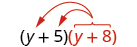
Distribute (y + 8). (y+8)を分配する。 |
 |
Distribute again もう一度分配する。 |
 |
Combine like terms. 同類項をまとめる。 |
 |
Try It (2)確認問題(2題)
Example 6.35例題 6.35
Multiply:
英語のヒント
次の乗法を計算する:
Solution解答
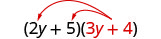 |
|
Distribute (3y + 4). (3y+4)を分配する。 |
 |
Distribute again もう一度分配する。 |
 |
Combine like terms. 同類項をまとめる。 |
 |
Try It (2)確認問題(2題)
Example 6.36例題 6.36
Multiply:
英語のヒント
次の乗法を計算する:
Solution解答
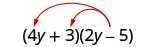 |
|
Distribute. 分配法則を使う。 |
 |
Distribute again. もう一度、分配法則を使う。 |
 |
Combine like terms. 同類項をまとめる。 |
 |
Try It (2)確認問題(2題)
Example 6.37例題 6.37
Multiply:
英語のヒント
次の乗法を計算する:
Solution解答
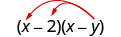 |
|
Distribute. 分配法則を使う。 |
 |
Distribute again. もう一度、分配法則を使う。 |
 |
There are no like terms to combine. まとめられる同類項はない。 |
Try It (2)確認問題(2題)
Multiply a Binomial by a Binomial Using the FOIL MethodFOIL法を使って二項式どうしを掛ける
Remember that when you multiply a binomial by a binomial you get four terms. Sometimes you can combine like terms to get a trinomial, but sometimes, like in Example 6.37, there are no like terms to combine.
英語のヒント
二項式どうしを掛けると、四つの項が得られる。同類項をまとめて三項式にできる場合もあれば、例題6.37のように、まとめられる同類項がない場合もある。
Let’s look at the last example again and pay particular attention to how we got the four terms.
英語のヒント
最後の例をもう一度見て、四つの項をどのように得たのかに注目しよう。
Where did the first term, , come from?
英語のヒント
最初の項は、どこから来たのだろうか。
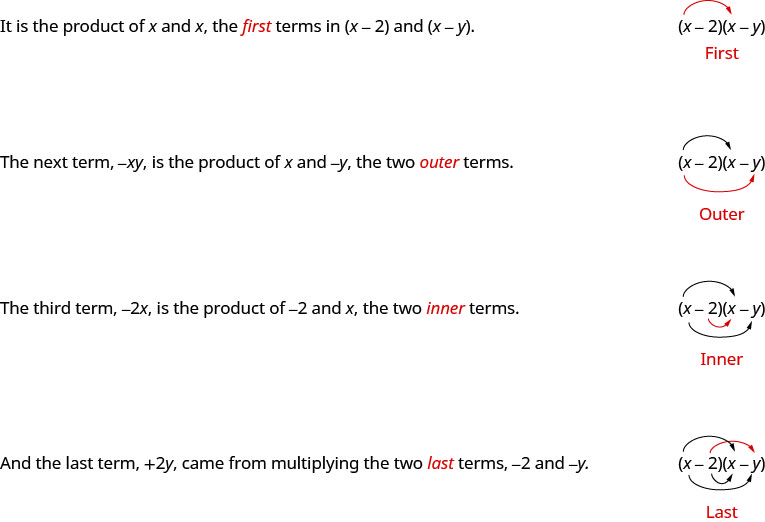
We abbreviate “First, Outer, Inner, Last” as FOIL. The letters stand for ‘First, Outer, Inner, Last’. The word FOIL is easy to remember and ensures we find all four products.
英語のヒント
「First、Outer、Inner、Last」を略してFOILという。各文字は「最初、外側、内側、最後」を表す。FOILは覚えやすく、四つの積を漏らさず求められる。
Let’s look at .
英語のヒント
を見てみよう。
Distibutive Property 分配法則 |
FOIL FOIL法 |
 |
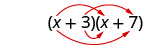 |
 |
|
 |
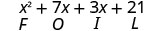 |
 |
 |
Notice how the terms in third line fit the FOIL pattern.
英語のヒント
3行目の各項が、どのようにFOILの順序に対応しているか注目しよう。
Now we will do an example where we use the FOIL pattern to multiply two binomials.
英語のヒント
次に、FOILの順序を使って二項式どうしを掛ける例を見よう。
Example 6.38例題 6.38
How to Multiply a Binomial by a Binomial using the FOIL MethodFOIL法で二項式どうしを掛ける手順
Multiply using the FOIL method:
英語のヒント
FOIL法を使って掛ける:
Solution解答





Try It (2)確認問題(2題)
We summarize the steps of the FOIL method below. The FOIL method only applies to multiplying binomials, not other polynomials!
英語のヒント
FOIL法の手順を以下にまとめる。FOIL法が使えるのは二項式どうしの掛け算だけで、ほかの多項式には使えない。
When you multiply by the FOIL method, drawing the lines will help your brain focus on the pattern and make it easier to apply.
英語のヒント
FOIL法で掛け算をするときには、線を描くと順序に集中でき、適用しやすくなる。
Example 6.39例題 6.39
Multiply:
英語のヒント
次の乗法を計算する:
Solution解答
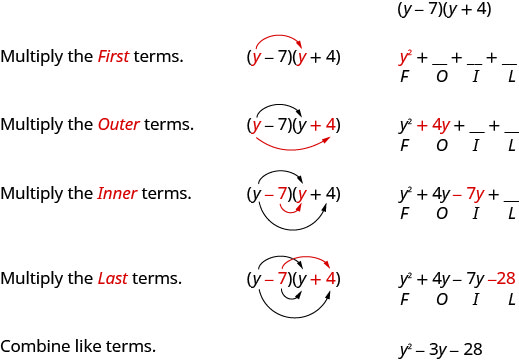
Try It (2)確認問題(2題)
Example 6.40例題 6.40
Multiply:
英語のヒント
次の乗法を計算する:
Solution解答
Solution解答
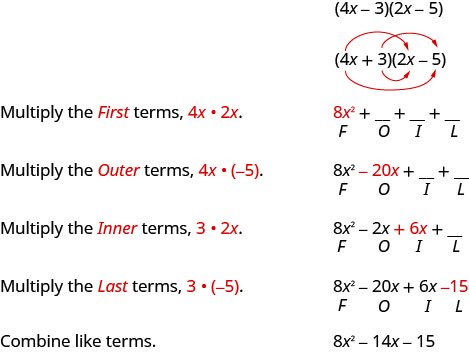
Try It (2)確認問題(2題)
The final products in the last four examples were trinomials because we could combine the two middle terms. This is not always the case.
英語のヒント
直前の四つの例では、中央の二つの項をまとめられたため、最終的な積が三項式になった。しかし、いつもそうなるとは限らない。
Example 6.41例題 6.41
Multiply:
英語のヒント
次の乗法を計算する:
Solution解答
 |
|
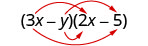 |
|
Multiply the First. 最初の項どうしを掛ける。 |
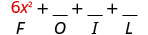 |
Multiply the Outer. 外側の項どうしを掛ける。 |
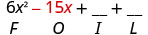 |
Multiply the Inner. 内側の項どうしを掛ける。 |
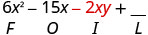 |
Multiply the Last. 最後の項どうしを掛ける。 |
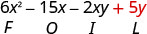 |
Combine like terms—there are none. 同類項をまとめる――今回は同類項がない。 |
 |
Try It (2)確認問題(2題)
Be careful of the exponents in the next example.
英語のヒント
次の例では、指数に注意しよう。
Example 6.42例題 6.42
Multiply:
英語のヒント
次の乗法を計算する:
Solution解答
 |
|
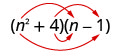 |
|
Multiply the First. 最初の項どうしを掛ける。 |
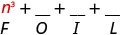 |
Multiply the Outer. 外側の項どうしを掛ける。 |
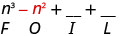 |
Multiply the Inner. 内側の項どうしを掛ける。 |
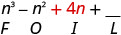 |
Multiply the Last. 最後の項どうしを掛ける。 |
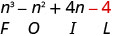 |
Combine like terms—there are none. 同類項をまとめる――今回は同類項がない。 |
 |
Try It (2)確認問題(2題)
Example 6.43例題 6.43
Multiply:
英語のヒント
次の乗法を計算する:
Solution解答
Solution解答
 |
||
Multiply the First. 最初の項どうしを掛ける。 |
 |
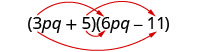 |
Multiply the Outer. 外側の項どうしを掛ける。 |
 |
|
Multiply the Inner. 内側の項どうしを掛ける。 |
 |
|
Multiply the Last. 最後の項どうしを掛ける。 |
 |
|
Combine like terms—there are none. 同類項をまとめる――今回は同類項がない。 |
 |