第17章音
17.1 Sound Waves17.1 音波
Learning Objectives学習目標
Learning Objectives学習目標
By the end of this section, you will be able to:
英語のヒント
この節を終えると、次のことができるようになる。
- Explain the difference between sound and hearing
英語のヒント
音と聴覚の違いを説明する。 - Describe sound as a wave
英語のヒント
音を波として説明する。 - List the equations used to model sound waves
英語のヒント
音波を表す式を挙げる。 - Describe compression and rarefactions as they relate to sound
英語のヒント
音における密部と疎部を説明する。
The physical phenomenon of sound is a disturbance of matter that is transmitted from its source outward. Hearing is the perception of sound, just as seeing is the perception of visible light. On the atomic scale, sound is a disturbance of atoms that is far more ordered than their thermal motions. In many instances, sound is a periodic wave, and the atoms undergo simple harmonic motion. Thus, sound waves can induce oscillations and resonance effects (Figure 17.2).
英語のヒント
物理現象としての音は、発生源から外へ伝わる、物質の乱れである。聴覚は音の知覚であり、視覚が可視光の知覚であるのと同様である。原子の尺度で見ると、音は原子の乱れだが、熱運動よりはるかに秩序立っている。多くの場合、音は周期的な波であり、原子は単振動する。したがって、音波は振動や共振を引き起こすことがある(図17.2)。
Image omitted because its reuse rights could not be verified.権利の確認ができないため画像を割愛。
Figure 17.2図 17.2
This glass has been shattered by a high-intensity sound wave of the same frequency as the resonant frequency of the glass. (credit: “||read||”/Flickr)
英語のヒント
このグラスは、固有振動数と同じ周波数の、強い音波によって砕けた。(「||read||」/Flickr)
Additional Resources追加教材
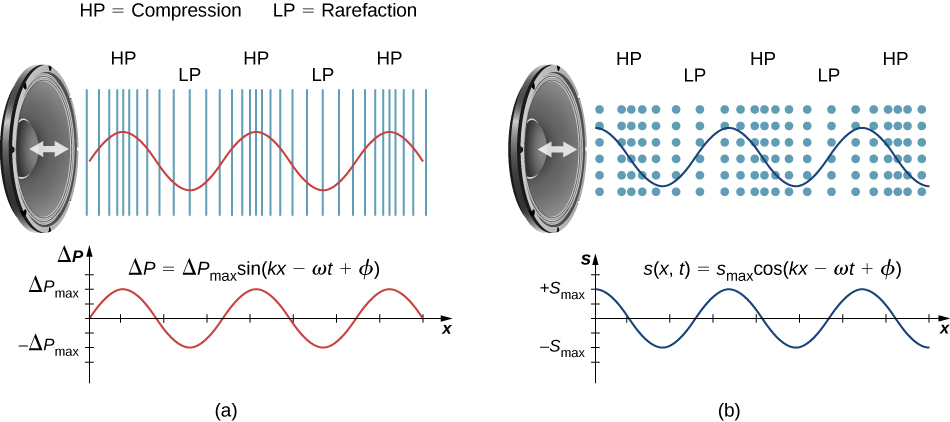
A speaker produces a sound wave by oscillating a cone, causing vibrations of air molecules. In Figure 17.3, a speaker vibrates at a constant frequency and amplitude, producing vibrations in the surrounding air molecules. As the speaker oscillates back and forth, it transfers energy to the air, mostly as thermal energy. But a small part of the speaker’s energy goes into compressing and expanding the surrounding air, creating slightly higher and lower local pressures. These compressions (high-pressure regions) and rarefactions (low-pressure regions) move out as longitudinal pressure waves having the same frequency as the speaker—they are the disturbance that is a sound wave. (Sound waves in air and most fluids are longitudinal, because fluids have almost no shear strength. In solids, sound waves can be both transverse and longitudinal.)
英語のヒント
スピーカーはコーンを振動させ、空気分子を振動させることで音波を作る。図17.3では、スピーカーが一定の周波数と振幅で振動し、周囲の空気分子を振動させている。スピーカーが前後に振動すると、エネルギーが空気へ伝わる。その大部分は熱エネルギーとなる。しかし一部は周囲の空気を圧縮・膨張させ、局所的に少し高い圧力と低い圧力を作る。この密部(高圧の領域)と疎部(低圧の領域)が、スピーカーと同じ周波数の縦の圧力波として外へ進む。これが音波という乱れである。空気や大部分の流体の中では、せん断に対する強度がほとんどないため、音波は縦波となる。固体では、音波は横波にも縦波にもなり得る。
Figure 17.3(a) shows the compressions and rarefactions, and also shows a graph of gauge pressure versus distance from a speaker. As the speaker moves in the positive x-direction, it pushes air molecules, displacing them from their equilibrium positions. As the speaker moves in the negative x-direction, the air molecules move back toward their equilibrium positions due to a restoring force. The air molecules oscillate in simple harmonic motion about their equilibrium positions, as shown in part (b). Note that sound waves in air are longitudinal, and in the figure, the wave propagates in the positive x-direction and the molecules oscillate parallel to the direction in which the wave propagates.
英語のヒント
図17.3(a)は、密部と疎部、およびスピーカーからの距離に対するゲージ圧のグラフを示す。スピーカーがx軸の正方向へ動くと、空気分子を押し、つり合いの位置から変位させる。x軸の負方向へ動くと、空気分子は復元力によって、つり合いの位置へ戻る。(b)のように、空気分子はつり合いの位置のまわりで単振動する。空気中の音波は縦波である。図では、波がx軸の正方向へ伝わり、分子はその伝わる方向と平行に振動している。
OpenStax / Rice University, University Physics Volume 1, CC BY 4.0. Source-book artwork retained. · CC BY 4.0 · Source出典

Figure 17.3図 17.3
(a) A vibrating cone of a speaker, moving in the positive x-direction, compresses the air in front of it and expands the air behind it. As the speaker oscillates, it creates another compression and rarefaction as those on the right move away from the speaker. After many vibrations, a series of compressions and rarefactions moves out from the speaker as a sound wave. The red graph shows the gauge pressure of the air versus the distance from the speaker. Pressures vary only slightly from atmospheric pressure for ordinary sounds. Note that gauge pressure is modeled with a sine function, where the crests of the function line up with the compressions and the troughs line up with the rarefactions. (b) Sound waves can also be modeled using the displacement of the air molecules. The blue graph shows the displacement of the air molecules versus the position from the speaker and is modeled with a cosine function. Notice that the displacement is zero for the molecules in their equilibrium position and are centered at the compressions and rarefactions. Compressions are formed when molecules on either side of the equilibrium molecules are displaced toward the equilibrium position. Rarefactions are formed when the molecules are displaced away from the equilibrium position.
英語のヒント
(a) スピーカーの振動するコーンがx軸の正方向へ動くと、前の空気を圧縮し、後ろの空気を膨張させる。右側の密部と疎部がスピーカーから離れていく間に、スピーカーは振動によって新たな密部と疎部を作る。振動が繰り返されると、それらの列が音波として外へ進む。赤いグラフは、スピーカーからの距離に対する空気のゲージ圧を示す。通常の音では、大気圧からのずれはわずかである。ゲージ圧は正弦関数で表され、その山が密部、谷が疎部に対応する。(b) 音波は、空気分子の変位でも表せる。青いグラフは、スピーカーからの位置に対する空気分子の変位であり、余弦関数で表す。つり合いの位置にある分子の変位はゼロで、密部と疎部の中心に当たる。つり合いの位置にある分子の両側から、周囲の分子がその位置へ近づくと密部が生じ、離れると疎部が生じる。
Not shown in the figure is the amplitude of a sound wave as it decreases with distance from its source, because the energy of the wave is spread over a larger and larger area. The intensity decreases as it moves away from the speaker, as discussed in Waves. The energy is also absorbed by objects and converted into thermal energy by the viscosity of the air. In addition, during each compression, a little heat transfers to the air; during each rarefaction, even less heat transfers from the air, and these heat transfers reduce the organized disturbance into random thermal motions. Whether the heat transfer from compression to rarefaction is significant depends on how far apart they are—that is, it depends on wavelength. Wavelength, frequency, amplitude, and speed of propagation are important characteristics for sound, as they are for all waves.
英語のヒント
図には、音源から離れるにつれて音波の振幅が小さくなる様子は示していない。波のエネルギーが、より広い面積へ分散するためである。「波」で扱ったように、スピーカーから離れると強度が下がる。エネルギーは物体にも吸収され、空気の粘性によって熱エネルギーにも変わる。さらに、圧縮のたびに少量の熱が空気へ伝わり、膨張のたびに、それより少ない熱が空気から出ていく。この熱移動によって、秩序ある乱れが、不規則な熱運動へ変わる。密部から疎部への熱移動が大きいかどうかは、両者の間隔、つまり波長に依存する。波長・周波数・振幅・伝播速度は、すべての波と同様、音にも重要な特性である。