第17章音
Noise Reduction through Destructive Interference弱め合う干渉による騒音の低減
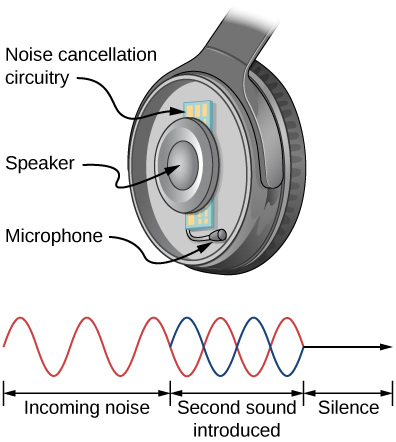
Figure 17.18 shows a clever use of sound interference to cancel noise. Larger-scale applications of active noise reduction by destructive interference have been proposed for entire passenger compartments in commercial aircraft. To obtain destructive interference, a fast electronic analysis is performed, and a second sound is introduced out of phase with the original sound, with its maxima and minima exactly reversed from the incoming noise. Sound waves in fluids are pressure waves and are consistent with Pascal’s principle; that is, pressures from two different sources add and subtract like simple numbers. Therefore, positive and negative gauge pressures add to a much smaller pressure, producing a lower-intensity sound. Although completely destructive interference is possible only under the simplest conditions, it is possible to reduce noise levels by 30 dB or more using this technique.
英語のヒント
図17.18は、音の干渉を巧みに使って騒音を打ち消す方法を示している。弱め合う干渉による能動的な騒音低減を、旅客機の客室全体へ大規模に応用する案も提案されている。弱め合う干渉を得るには、高速な電子的解析を行い、元の音と位相がずれた第二の音を加える。その極大と極小は、入ってくる騒音と正確に逆になる。流体中の音波は圧力波であり、パスカルの原理に従う。つまり、異なる二つの音源からの圧力は、普通の数と同じように加減できる。このため、正と負のゲージ圧を加えると、はるかに小さな圧力になり、音の強さが弱まる。完全な打消しが可能なのは最も単純な条件の場合だけだが、この技術を使えば騒音レベルを30 dB以上低減できる。
OpenStax / Rice University, University Physics Volume 1, CC BY 4.0. Source-book artwork retained. · CC BY 4.0 · Source出典

Figure 17.18図 17.18
Headphones designed to cancel noise with destructive interference create a sound wave exactly opposite to the incoming sound. These headphones can be more effective than the simple passive attenuation used in most ear protection. Such headphones were used on the record-setting, around-the-world nonstop flight of the Voyager aircraft in 1986 to protect the pilots’ hearing from engine noise.
英語のヒント
弱め合う干渉によって騒音を打ち消すよう設計されたヘッドホンは、入ってくる音と正確に逆の音波を作る。こうしたヘッドホンは、多くの防音具が利用する単純な受動的減衰よりも効果が高い場合がある。1986年、ボイジャー機が無着陸世界一周飛行の記録を樹立した際にも、エンジン騒音から操縦士の聴覚を守るために使われた。
Where else can we observe sound interference? All sound resonances, such as in musical instruments, are due to constructive and destructive interference. Only the resonant frequencies interfere constructively to form standing waves, whereas others interfere destructively and are absent.
英語のヒント
ほかにはどこで音の干渉を観察できるだろうか。楽器などで生じる音の共鳴は、すべて強め合う干渉と弱め合う干渉による。共鳴振動数の音だけが強め合って定常波を作り、それ以外の振動数の音は弱め合って消える。
Resonance in a Tube Closed at one End一端を閉じた管の共鳴
As we discussed in Waves, standing waves are formed by two waves moving in opposite directions. When two identical sinusoidal waves move in opposite directions, the waves may be modeled as
英語のヒント
波で述べたように、定常波は反対方向に進む二つの波によって生じる。同じ正弦波が互いに反対方向へ進むとき、それらは次のようにモデル化できる。
When these two waves interfere, the resultant wave is a standing wave:
英語のヒント
この二つの波が干渉すると、合成波は定常波になる。
Resonance can be produced due to the boundary conditions imposed on a wave. In Waves, we showed that resonance could be produced in a string under tension that had symmetrical boundary conditions, specifically, a node at each end. We defined a node as a fixed point where the string did not move. We found that the symmetrical boundary conditions resulted in some frequencies resonating and producing standing waves, also called normal modes, while other frequencies interfere destructively. Sound waves can resonate in a hollow tube, and the frequencies of the sound waves that resonate depend on the boundary conditions.
英語のヒント
共鳴は、波に課される境界条件によって生じる。波では、張力のかかった弦の境界条件が対称、具体的には両端が節であるときに共鳴が生じることを示した。節とは、弦が動かない固定点として定義した。対称な境界条件のもとでは、一部の振動数が共鳴して固有モードとも呼ばれる定常波を作り、ほかの振動数は弱め合う。音波も中空の管の中で共鳴でき、その共鳴振動数は境界条件に依存する。
Suppose we have a tube that is closed at one end and open at the other. If we hold a vibrating tuning fork near the open end of the tube, an incident sound wave travels through the tube and reflects off the closed end. The reflected sound has the same frequency and wavelength as the incident sound wave, but is traveling in the opposite direction. At the closed end of the tube, the molecules of air have very little freedom to oscillate, and a node arises. At the open end, the molecules are free to move, and at the right frequency, an antinode occurs. Unlike the symmetrical boundary conditions for the standing waves on the string, the boundary conditions for a tube open at one end and closed at the other end are anti-symmetrical: a node at the closed end and an antinode at the open end.
英語のヒント
一端が閉じ、他端が開いた管を考えよう。開口端の近くに振動する音叉を置くと、入射した音波は管内を進み、閉じた端で反射する。反射した音は、入射音波と同じ振動数と波長を持つが、反対方向へ進む。閉じた端では、空気分子が振動する自由度はごく小さく、節ができる。開いた端では分子が自由に動けるので、適切な振動数では腹ができる。弦の定常波の対称な境界条件とは異なり、一端が開き他端が閉じた管の境界条件は反対称である。閉じた端が節、開いた端が腹となる。
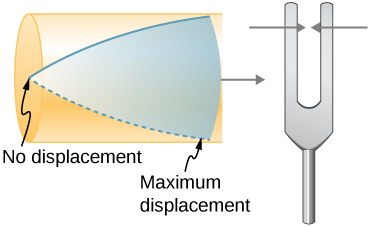
If the tuning fork has just the right frequency, the air column in the tube resonates loudly, but at most frequencies it vibrates very little. This observation just means that the air column has only certain natural frequencies. Consider the lowest frequency that will cause the tube to resonate, producing a loud sound. There will be a node at the closed end and an antinode at the open end, as shown in Figure 17.19.
英語のヒント
音叉がちょうど適切な振動数を持つ場合、管内の気柱は大きな音を出して共鳴するが、大半の振動数ではほとんど振動しない。この観察は、気柱には特定の固有振動数しかないことを意味する。管を共鳴させ、大きな音を生む最も低い振動数を考えよう。図17.19のように、閉じた端には節、開いた端には腹ができる。
OpenStax / Rice University, University Physics Volume 1, CC BY 4.0. Source-book artwork retained. · CC BY 4.0 · Source出典

Figure 17.19図 17.19
Resonance of air in a tube closed at one end, caused by a tuning fork that vibrates at the lowest frequency that can produce resonance (the fundamental frequency). A node exists at the closed end and an antinode at the open end.
英語のヒント
共鳴を起こす最も低い振動数(基本振動数)で振動する音叉によって生じた、一端を閉じた管内の空気の共鳴。閉じた端に節、開いた端に腹がある。
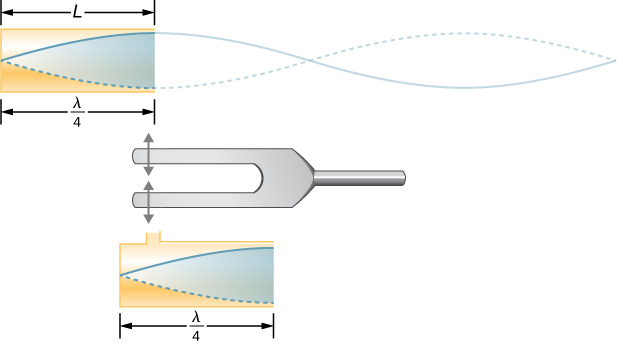
The standing wave formed in the tube has an antinode at the open end and a node at the closed end. The distance from a node to an antinode is one-fourth of a wavelength, and this equals the length of the tube; thus, This same resonance can be produced by a vibration introduced at or near the closed end of the tube (Figure 17.20). It is best to consider this a natural vibration of the air column, independently of how it is induced.
英語のヒント
管内にできる定常波は、開いた端に腹、閉じた端に節を持つ。節から腹までの距離は波長の4分の1で、それが管の長さに等しい。したがってとなる。同じ共鳴は、管の閉じた端、またはその近くで振動を与えても生じる(図17.20)。振動をどう誘起したかに関係なく、気柱の固有振動と考えるのが適切である。
OpenStax / Rice University, University Physics Volume 1, CC BY 4.0. Source-book artwork retained. · CC BY 4.0 · Source出典

Figure 17.20図 17.20
The same standing wave is created in the tube by a vibration introduced near its closed end.
英語のヒント
閉じた端の近くで振動を与えても、管内に同じ定常波ができる。
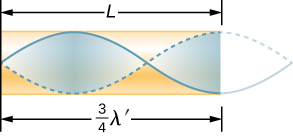
Given that maximum air displacements are possible at the open end and none at the closed end, other shorter wavelengths can resonate in the tube, such as the one shown in Figure 17.21. Here the standing wave has three-fourths of its wavelength in the tube, or so that Continuing this process reveals a whole series of shorter-wavelength and higher-frequency sounds that resonate in the tube. We use specific terms for the resonances in any system. The lowest resonant frequency is called the fundamental, while all higher resonant frequencies are called overtones. The resonant frequencies that are integral multiples of the fundamental are collectively called harmonics. The fundamental is the first harmonic, the second harmonic is twice the frequency of the first harmonic, and so on. Some of these harmonics may not exist for a given scenario. Figure 17.22 shows the fundamental and the first three overtones (or the first, third, fifth, and seventh harmonics) in a tube closed at one end.
英語のヒント
開いた端では空気の変位が最大となり、閉じた端では変位がないという条件のもとでは、図17.21のように、より短い波長の波も管内で共鳴できる。ここでは定常波の波長の4分の3が管内に収まり、なので、となる。この操作を続けると、管内で共鳴する、さらに波長が短く振動数が高い音の系列が見つかる。どの系の共鳴にも特定の名称を使う。最も低い共鳴振動数を基本振動数と呼び、それより高い共鳴振動数をすべて上音と呼ぶ。基本振動数の整数倍に当たる共鳴振動数を、まとめて倍音と呼ぶ。基本振動数は第1倍音、第2倍音は第1倍音の2倍の振動数であり、以下同様である。条件によっては、これらの倍音の一部が存在しないこともある。図17.22は、一端を閉じた管の基本振動と最初の三つの上音、すなわち第1、第3、第5、第7倍音を示している。
OpenStax / Rice University, University Physics Volume 1, CC BY 4.0. Source-book artwork retained. · CC BY 4.0 · Source出典

Figure 17.21図 17.21
Another resonance for a tube closed at one end. This standing wave has maximum air displacement at the open end and none at the closed end. The wavelength is shorter, with three-fourths equaling the length of the tube, so that . This higher-frequency vibration is the first overtone.
英語のヒント
一端を閉じた管で起こる別の共鳴。この定常波は、開いた端で空気の変位が最大となり、閉じた端では変位がない。波長は短く、その4分の3が管の長さに等しいので、となる。この高い振動数の振動が第1上音である。
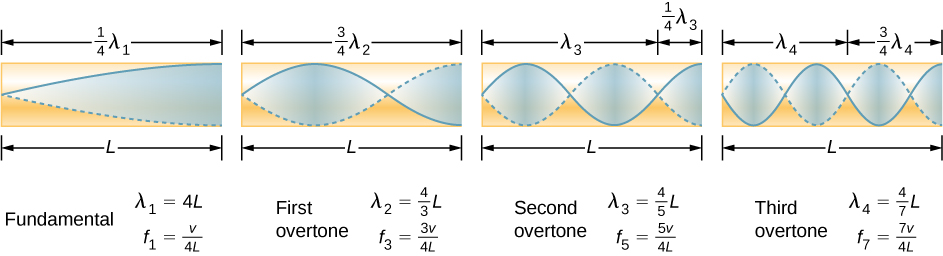
OpenStax / Rice University, University Physics Volume 1, CC BY 4.0. Source-book artwork retained. · CC BY 4.0 · Source出典

Figure 17.22図 17.22
The fundamental and three lowest overtones for a tube closed at one end. All have maximum air displacements at the open end and none at the closed end.
英語のヒント
一端を閉じた管の基本振動と、低い順に三つの上音。いずれも開いた端で空気の変位が最大となり、閉じた端では変位がない。
The relationship for the resonant wavelengths of a tube closed at one end is
英語のヒント
一端を閉じた管の共鳴波長の関係は、次式で表される。
Now let us look for a pattern in the resonant frequencies for a simple tube that is closed at one end. The fundamental has and frequency is related to wavelength and the speed of sound as given by
英語のヒント
次に、一端を閉じた単純な管の共鳴振動数の規則性を調べよう。基本振動ではであり、振動数、波長、音速は次の関係にある。
Solving for f in this equation gives
英語のヒント
この式をfについて解くと、
where v is the speed of sound in air. Similarly, the first overtone has (see Figure 17.22), so that
英語のヒント
ここでvは空気中の音速である。同様に、第1上音はを満たすので(図17.22)、
Because we call the first overtone the third harmonic. Continuing this process, we see a pattern that can be generalized in a single expression. The resonant frequencies of a tube closed at one end are
英語のヒント
なので、第1上音を第3倍音と呼ぶ。この操作を続けると、一つの式に一般化できる規則性が見いだせる。一端を閉じた管の共鳴振動数は、次のとおりである。
where is the fundamental, is the first overtone, and so on. It is interesting that the resonant frequencies depend on the speed of sound and, hence, on temperature. This dependence poses a noticeable problem for organs in old unheated cathedrals, and it is also the reason why musicians commonly bring their wind instruments to room temperature before playing them.
英語のヒント
ここでは基本振動数、は第1上音の振動数であり、以下同様である。興味深いことに、共鳴振動数は音速に依存するため、温度にも依存する。この依存性は、暖房のない古い大聖堂のオルガンに目立った問題を生じさせる。また、演奏前に管楽器を室温になじませることが多いのも、このためである。