第17章音
17.6 Beats17.6 うなり
Learning Objectives学習目標
Learning Objectives学習目標
By the end of this section, you will be able to:
英語のヒント
この節を終えると、次のことができるようになる。
- Determine the beat frequency produced by two sound waves that differ in frequency
英語のヒント
周波数が異なる二つの音波から、うなりの周波数を求める - Describe how beats are produced by musical instruments
英語のヒント
楽器によってうなりが生じる仕組みを説明する
The study of music provides many examples of the superposition of waves and the constructive and destructive interference that occurs. Very few examples of music being performed consist of a single source playing a single frequency for an extended period of time. You will probably agree that a single frequency of sound for an extended period might be boring to the point of irritation, similar to the unwanted drone of an aircraft engine or a loud fan. Music is pleasant and interesting due to mixing the changing frequencies of various instruments and voices.
英語のヒント
音楽を調べると、波の重ね合わせと、それによって生じる強め合いや弱め合いの干渉の例が数多く見つかる。実際の演奏で、一つの音源が一つの周波数だけを長時間出し続ける例はほとんどない。同じ周波数の音を長時間聞くと、退屈を通り越していら立つこともあるだろう。航空機のエンジンや大きな音を出す扇風機が出す、わずらわしい単調な音に似ている。音楽が心地よく興味深いのは、さまざまな楽器や声の、変化する周波数が混ざり合うためである。
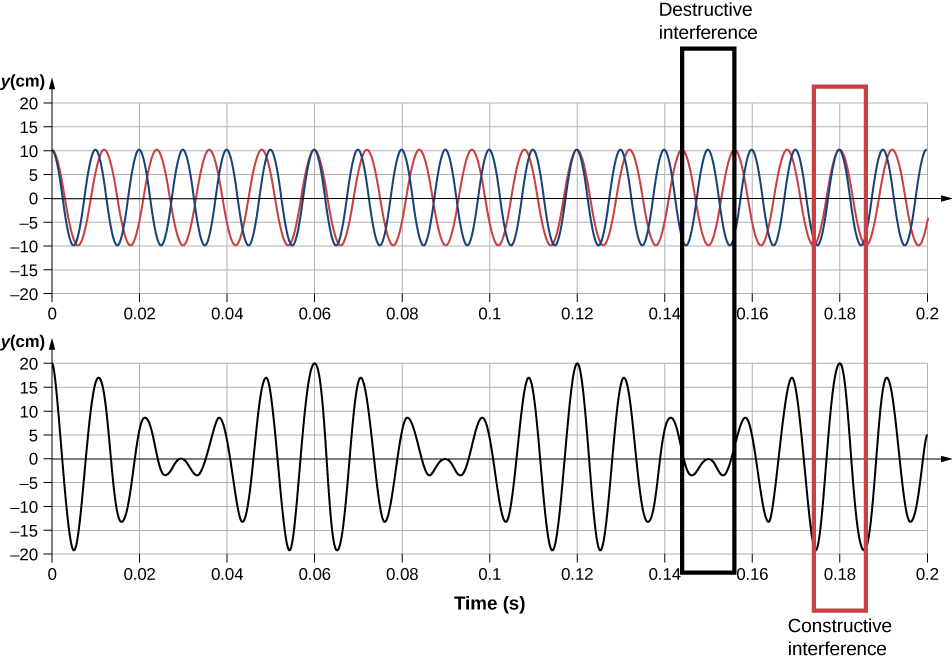
An interesting phenomenon that occurs due to the constructive and destructive interference of two or more frequencies of sound is the phenomenon of beats. If two sounds differ in frequencies, the sound waves can be modeled as
英語のヒント
周波数が異なる二つ以上の音の、強め合いと弱め合いの干渉によって起きる興味深い現象に、うなりがある。二つの音の周波数が異なるとき、それらの音波は次のように表せる。
Using the trigonometric identity and considering the point in space as we find the resulting sound at a point in space, from the superposition of the two sound waves, is equal to Figure 17.29:
英語のヒント
三角関数の恒等式を用い、空間内の点をとすると、二つの音波の重ね合わせによってその点に生じる音は次式になる(図17.29)。
where the beat frequency is
英語のヒント
ここで、うなりの周波数は次のようになる。
OpenStax / Rice University, University Physics Volume 1, CC BY 4.0. Source-book artwork retained. · CC BY 4.0 · Source出典

Figure 17.29図 17.29
Beats produced by the constructive and destructive interference of two sound waves that differ in frequency.
英語のヒント
周波数が異なる二つの音波の、強め合いと弱め合いの干渉によって生じるうなり。
These beats can be used by piano tuners to tune a piano. A tuning fork is struck and a note is played on the piano. As the piano tuner tunes the string, the beats have a lower frequency as the frequency of the note played approaches the frequency of the tuning fork.
英語のヒント
ピアノの調律師は、このうなりを調律に使える。音叉を鳴らし、ピアノでも一つの音を出す。調律師が弦を調整してピアノの音の周波数を音叉の周波数へ近づけるにつれ、うなりの周波数は低くなる。
Example 17.7例題 17.7
Find the Beat Frequency Between Two Tuning Forks二つの音叉によるうなりの周波数
What is the beat frequency produced when a tuning fork of a frequency of 256 Hz and a tuning fork of a frequency of 512 Hz are struck simultaneously?
英語のヒント
周波数256 Hzの音叉と周波数512 Hzの音叉を同時に鳴らすと、うなりの周波数はいくらになるか。
Strategy方針
The beat frequency is the difference of the two frequencies.
英語のヒント
うなりの周波数は、二つの周波数の差である。
Solution解答
We use
英語のヒント
を使う。
Significance考察
The beat frequency is the absolute value of the difference between the two frequencies. A negative frequency would not make sense.
英語のヒント
うなりの周波数は、二つの周波数の差の絶対値である。負の周波数では意味をなさない。
The study of the superposition of various waves has many interesting applications beyond the study of sound. In later chapters, we will discuss the wave properties of particles. The particles can be modeled as a “wave packet” that results from the superposition of various waves, where the particle moves at the “group velocity” of the wave packet.
英語のヒント
さまざまな波の重ね合わせには、音の研究にとどまらない多くの興味深い応用がある。後の章では、粒子の波としての性質を扱う。粒子は、さまざまな波の重ね合わせから生じる「波束」として表せる。このとき粒子は、波束の「群速度」で動く。
Summaryまとめ
- When two sound waves that differ in frequency interfere, beats are created with a beat frequency that is equal to the absolute value of the difference in the frequencies.
英語のヒント
周波数が異なる二つの音波が干渉すると、うなりが生じる。その周波数は、二つの周波数の差の絶対値に等しい。
Conceptual Questions概念に関する問題
Exercises 89–92練習問題 89–92
Exercise 89問題 89
Two speakers are attached to variable-frequency signal generator. Speaker A produces a constant-frequency sound wave of 1.00 kHz, and speaker B produces a tone of 1.10 kHz. The beat frequency is 0.10 kHz. If the frequency of each speaker is doubled, what is the beat frequency produced?
英語のヒント
二つのスピーカーを、周波数を変えられる信号発生器につなぐ。スピーカーAは1.00 kHzの一定の周波数の音波を出し、スピーカーBは1.10 kHzの音を出す。うなりの周波数は0.10 kHzである。各スピーカーの周波数を2倍にすると、うなりの周波数はいくらになるか。
Exercise 90問題 90
The label has been scratched off a tuning fork and you need to know its frequency. From its size, you suspect that it is somewhere around 250 Hz. You find a 250-Hz tuning fork and a 270-Hz tuning fork. When you strike the 250-Hz fork and the fork of unknown frequency, a beat frequency of 5 Hz is produced. When you strike the unknown with the 270-Hz fork, the beat frequency is 15 Hz. What is the unknown frequency? Could you have deduced the frequency using just the 250-Hz fork?
英語のヒント
音叉の表示がこすれて消えており、その周波数を知る必要がある。大きさから、250 Hz前後ではないかと考える。250 Hzと270 Hzの音叉を見つけた。250 Hzの音叉と周波数不明の音叉を同時に鳴らすと、5 Hzのうなりが生じる。周波数不明の音叉と270 Hzの音叉では、うなりの周波数が15 Hzになる。不明だった周波数はいくらか。250 Hzの音叉だけで、その周波数を推定できただろうか。
Solution解き方
The frequency of the unknown fork is 255 Hz. No, if only the 250 Hz fork is used, listening to the beat frequency could only limit the possible frequencies to 245 Hz or 255 Hz.
英語のヒント
不明だった音叉の周波数は255 Hzである。250 Hzの音叉だけでは特定できない。うなりを聞いても、可能な周波数を245 Hzまたは255 Hzに絞れるだけである。
Exercise 91問題 91
Referring to the preceding question, if you had only the 250-Hz fork, could you come up with a solution to the problem of finding the unknown frequency?
英語のヒント
前問について、250 Hzの音叉しかない場合でも、不明な周波数を求める方法を考えられるか。
Exercise 92問題 92
A “showy” custom-built car has two brass horns that are supposed to produce the same frequency but actually emit 263.8 and 264.5 Hz. What beat frequency is produced?
英語のヒント
「派手な」特注車には、同じ周波数を出すはずの黄銅製ホーンが二つ付いているが、実際には263.8 Hzと264.5 Hzを出す。生じるうなりの周波数はいくらか。
Solution解き方
The beat frequency is 0.7 Hz.
英語のヒント
うなりの周波数は0.7 Hzである。