第17章音
17.8 Shock Waves17.8 衝撃波
Learning Objectives学習目標
Learning Objectives学習目標
By the end of this section, you will be able to:
英語のヒント
この節を終えると、次のことができるようになる。
- Explain the mechanism behind sonic booms
英語のヒント
ソニックブームが起こる仕組みを説明する。 - Describe the difference between sonic booms and shock waves
英語のヒント
ソニックブームと衝撃波の違いを説明する。 - Describe a bow wake
英語のヒント
船首波を説明する。
When discussing the Doppler effect of a moving source and a stationary observer, the only cases we considered were cases where the source was moving at speeds that were less than the speed of sound. Recall that the observed frequency for a moving source approaching a stationary observer is As the source approaches the speed of sound, the observed frequency increases. According to the equation, if the source moves at the speed of sound, the denominator is equal to zero, implying the observed frequency is infinite. If the source moves at speeds greater than the speed of sound, the observed frequency is negative.
英語のヒント
動く音源と静止した観測者のドップラー効果では、音源の速さが音速より小さい場合だけを考えた。動く音源が静止した観測者へ近づくときの観測振動数はである。音源が音速に近づくと、観測振動数は増す。この式では、音源が音速で動くと分母がゼロになり、観測振動数は無限大になることを示す。音速を超えて動けば、観測振動数は負になる。
What could this mean? What happens when a source approaches the speed of sound? It was once argued by some scientists that such a large pressure wave would result from the constructive interference of the sound waves, that it would be impossible for a plane to exceed the speed of sound because the pressures would be great enough to destroy the airplane. But now planes routinely fly faster than the speed of sound. On July 28, 1976, Captain Eldon W. Joersz and Major George T. Morgan flew a Lockheed SR-71 Blackbird #61-7958 at 3529.60 km/h (2193.20 mi/h), which is Mach 2.85. The Mach number is the speed of the source divided by the speed of sound:
英語のヒント
これは何を意味するのだろうか。音源が音速に近づくと何が起こるのだろうか。かつて一部の科学者は、音波が強め合って非常に大きな圧力波ができ、その圧力で機体が壊れるため、飛行機が音速を超えるのは不可能だと主張した。しかし現在、飛行機は日常的に音速を超えて飛ぶ。1976年7月28日、エルドン・W・ジョアーズ大尉とジョージ・T・モーガン少佐は、ロッキードSR-71ブラックバード61-7958号機を3529.60 km/h(2193.20 mi/h)、すなわちマッハ2.85で飛ばした。マッハ数は音源の速さを音速で割った値である。
You will see that interesting phenomena occur when a source approaches and exceeds the speed of sound.
英語のヒント
音源が音速に近づき、それを超えると、興味深い現象が起こることを見ていこう。
Doppler Effect and High Velocityドップラー効果と高速運動
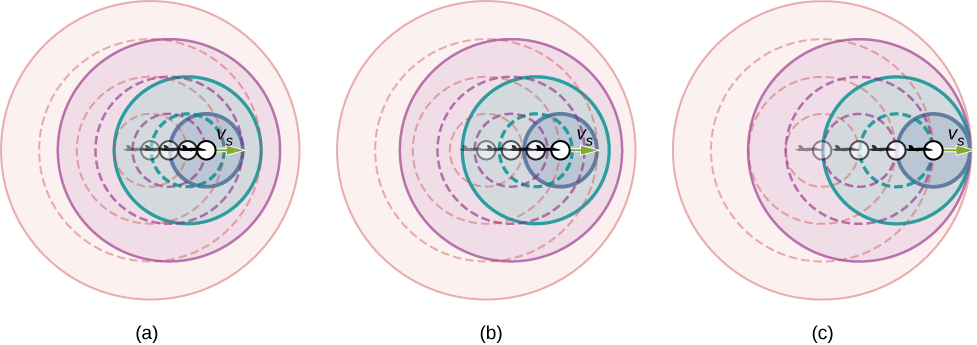
What happens to the sound produced by a moving source, such as a jet airplane, that approaches or even exceeds the speed of sound? The answer to this question applies not only to sound but to all other waves as well. Suppose a jet plane is coming nearly straight at you, emitting a sound of frequency The greater the plane’s speed the greater the Doppler shift and the greater the value observed for (Figure 17.35).
英語のヒント
ジェット機のような動く音源が音速に近づき、さらには超えると、その音はどうなるだろうか。答えは音だけでなく、あらゆる波に当てはまる。振動数の音を出しながら、ジェット機がほぼまっすぐこちらへ来るとする。飛行機の速さが大きいほど、ドップラーシフトも、観測されるの値も大きくなる(図17.35)。
OpenStax / Rice University, University Physics Volume 1, CC BY 4.0. Source-book artwork retained. · CC BY 4.0 · Source出典

Figure 17.35図 17.35
Because of the Doppler shift, as a moving source approaches a stationary observer, the observed frequency is higher than the source frequency. The faster the source is moving, the higher the observed frequency. In this figure, the source in (b) is moving faster than the source in (a). Shown are four time steps, the first three shown as dotted lines. (c) If a source moves at the speed of sound, each successive wave interfere with the previous one and the observer observes them all at the same instant.
英語のヒント
動く音源が静止した観測者へ近づくと、ドップラーシフトによって観測振動数は音源より高くなる。速く動くほど観測振動数も高い。図では(b)の音源が(a)より速い。4段階の時刻を示し、最初の3段階は点線とする。(c) 音源が音速で動くと、後続の波が直前の波と干渉し、観測者はすべてを同じ瞬間に観測する。
Now, as approaches the speed of sound, approaches infinity, because the denominator in approaches zero. At the speed of sound, this result means that in front of the source, each successive wave interferes with the previous one because the source moves forward at the speed of sound. The observer gets them all at the same instant, so the frequency is infinite [part (c) of the figure].
英語のヒント
が音速に近づくと、の分母がゼロへ近づくため、は無限大へ近づく。音速では、音源自体が音速で前進するので、音源の前方で後続の波が直前の波と干渉することを意味する。観測者にはすべての波が同じ瞬間に届くので、振動数は無限大になる[図(c)]。
Shock Waves and Sonic Booms衝撃波とソニックブーム
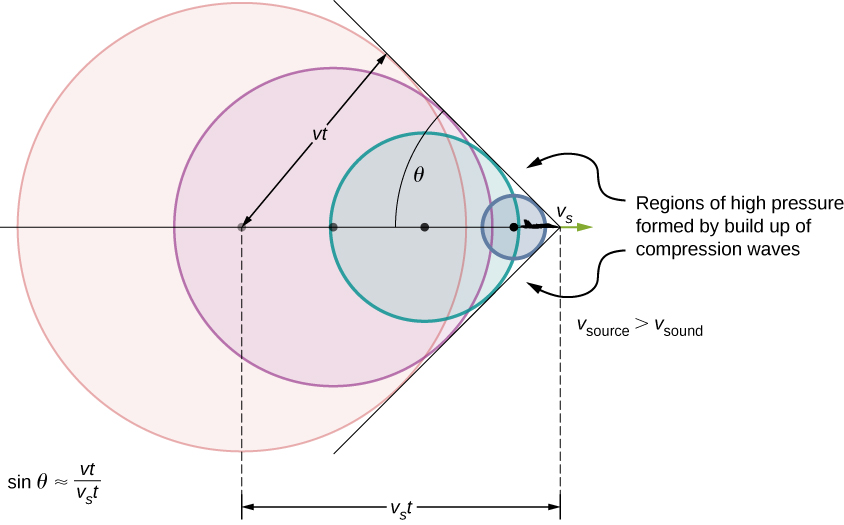
If the source exceeds the speed of sound, no sound is received by the observer until the source has passed, so that the sounds from the approaching source are mixed with those from it when receding. This mixing appears messy, but something interesting happens—a shock wave is created (Figure 17.36).
英語のヒント
音源が音速を超えると、観測者には音源が通り過ぎるまで音が届かない。そのため、近づいているときの音と、遠ざかっているときの音が混ざる。一見複雑そうだが、興味深いことが起こる。衝撃波ができるのである(図17.36)。
OpenStax / Rice University, University Physics Volume 1, CC BY 4.0. Source-book artwork retained. · CC BY 4.0 · Source出典

Figure 17.36図 17.36
Sound waves from a source that moves faster than the speed of sound spread spherically from the point where they are emitted, but the source moves ahead of each wave. Constructive interference along the lines shown (actually a cone in three dimensions) creates a shock wave called a sonic boom. The faster the speed of the source, the smaller the angle .
英語のヒント
音速を超える音源の音波は、放出点から球状に広がるが、音源は各波の先を進む。図の線に沿う強め合う干渉、実際の3次元では円錐上の干渉によって、ソニックブームという衝撃波ができる。音源が速いほど角度は小さい。
Constructive interference along the lines shown (a cone in three dimensions) from similar sound waves arriving there simultaneously. This superposition forms a disturbance called a shock wave, a constructive interference of sound created by an object moving faster than sound. Inside the cone, the interference is mostly destructive, so the sound intensity there is much less than on the shock wave. The angle of the shock wave can be found from the geometry. In time t the source has moved and the sound wave has moved a distance vt and the angle can be found using Note that the Mach number is defined as so the sine of the angle equals the inverse of the Mach number,
英語のヒント
似た音波が図の線、3次元では円錐へ同時に到着し、強め合う干渉を起こす。この重ね合わせが、音速より速い物体の音が強め合ってできる、衝撃波という乱れを作る。円錐内の干渉は主に弱め合うため、内部の音の強度は衝撃波上よりはるかに小さい。衝撃波の角度は幾何学から求められる。時間tで音源は、音波はvtの距離を進むので、を使って角度を求められる。マッハ数の定義はだから、角度の正弦はマッハ数の逆数に等しい。
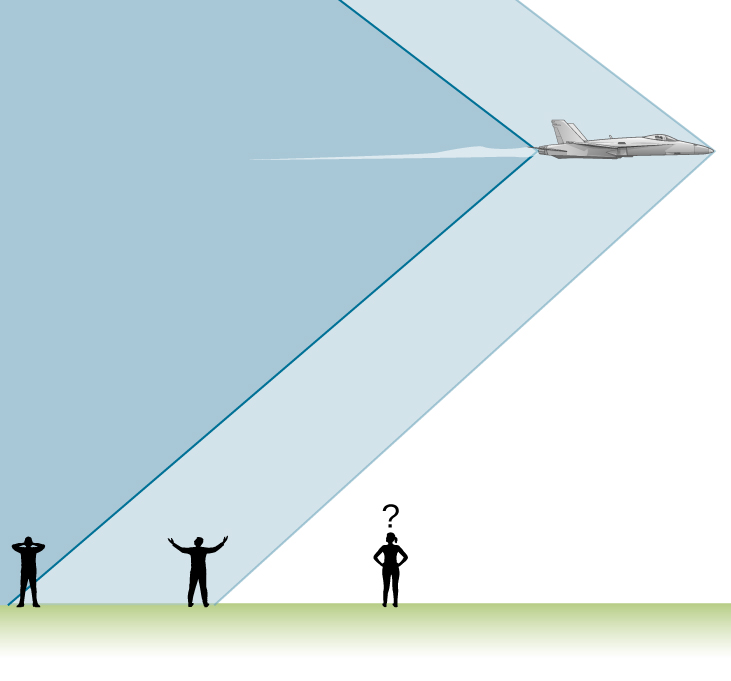
You may have heard of the common term ‘sonic boom.’ A common misconception is that the sonic boom occurs as the plane breaks the sound barrier; that is, accelerates to a speed higher than the speed of sound. Actually, the sonic boom occurs as the shock wave sweeps along the ground.
英語のヒント
「ソニックブーム」という言葉を聞いたことがあるだろう。飛行機が音の壁を破り、音速以上へ加速するときに起こる、というのはよくある誤解である。実際には、衝撃波が地上を通過するときにソニックブームが起こる。
An aircraft creates two shock waves, one from its nose and one from its tail (Figure 17.37). During television coverage of space shuttle landings, two distinct booms could often be heard. These were separated by exactly the time it would take the shuttle to pass by a point. Observers on the ground often do not see the aircraft creating the sonic boom, because it has passed by before the shock wave reaches them, as seen in the figure. If the aircraft flies close by at low altitude, pressures in the sonic boom can be destructive and break windows as well as rattle nerves. Because of how destructive sonic booms can be, researchers have developed experimental aircraft and components to reduce their impact. Many of these efforts were led by Christine Darden, a "human computer" who advanced to become the head of a NASA program dedicated to predicting and reducing sonic booms. From the 1960's until the late 1990's, Darden employed new materials, innovative designs, and advanced computer simulations. She led experiments involving panels placed on the aircraft that dispersed the shock waves. In recent years, these principles have been revisited and advanced, including in an experimental plane, the X-59, designed for quieter and more efficient flight.
英語のヒント
航空機は、機首と尾部から一つずつ、二つの衝撃波を作る(図17.37)。スペースシャトルの着陸のテレビ中継では、はっきり分かれた二つの爆音が聞こえることが多かった。間隔は、シャトルがある点を通過するのにかかる時間と正確に一致する。図のように、衝撃波が届く前に機体は通過しているので、地上の観測者にはソニックブームを作った航空機が見えないことが多い。低空を近くで飛ぶと、ソニックブームの圧力が窓を壊し、人を動揺させることもある。その破壊力のため、研究者は影響を減らす実験機や部品を開発してきた。この多くを率いたのが、人間計算手からNASAのソニックブーム予測・低減計画の責任者へ進んだクリスティーン・ダーデンである。1960年代から1990年代後半にかけて、新素材、革新的な設計、高度なコンピューターシミュレーションを用いた。機体に取り付けたパネルで衝撃波を分散させる実験も率いた。近年、これらの原理は再び取り上げられて発展し、より静かで効率的な飛行を目指す実験機X-59などに使われている。
OpenStax / Rice University, University Physics Volume 1, CC BY 4.0. Source-book artwork retained. · CC BY 4.0 · Source出典

Figure 17.37図 17.37
Two sonic booms experienced by observers, created by the nose and tail of an aircraft as the shock wave sweeps along the ground, are observed on the ground after the plane has passed by.
英語のヒント
航空機の機首と尾部が作った衝撃波が地上を通過し、二つのソニックブームが聞こえる。地上で観測されるのは、機体が通り過ぎた後である。
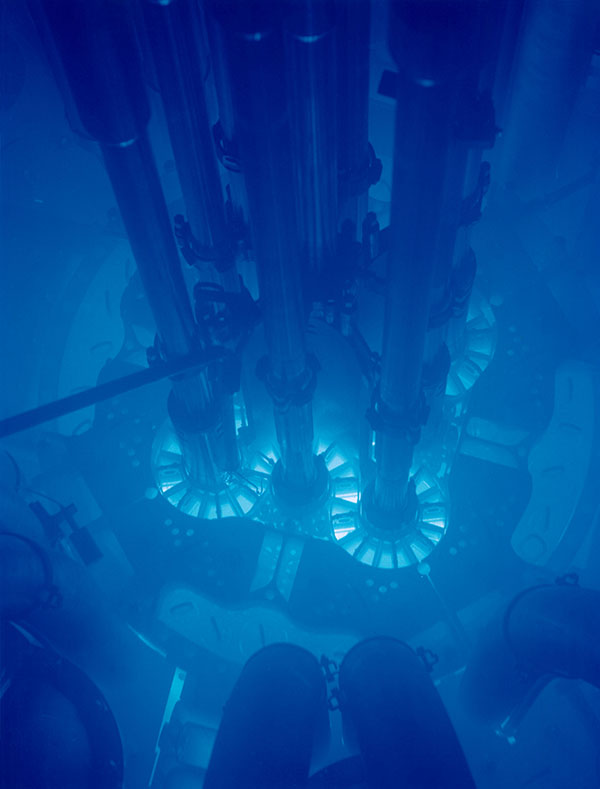
Shock waves are one example of a broader phenomenon called bow wakes. A bow wake, such as the one in Figure 17.38, is created when the wave source moves faster than the wave propagation speed. Water waves spread out in circles from the point where created, and the bow wake is the familiar V-shaped wake, trailing the source. A more exotic bow wake is created when a subatomic particle travels through a medium faster than the speed of light travels in that medium. (In a vacuum, the maximum speed of light is in the medium of water, the speed of light is closer to 0.75c.) If the particle creates light in its passage, that light spreads on a cone with an angle indicative of the speed of the particle, as illustrated in Figure 17.39. Such a bow wake is called Cerenkov radiation and is commonly observed in particle physics.
英語のヒント
Image omitted because its reuse rights could not be verified.権利の確認ができないため画像を割愛。
Figure 17.38図 17.38
Bow wake created by a duck. Constructive interference produces the rather structured wake, whereas relatively little wave action occurs inside the wake, where interference is mostly destructive. (credit: Horia Varlan)
英語のヒント
アヒルが作る船首波。強め合う干渉が整った航跡を作る一方、内部では主に弱め合う干渉が起こり、波の動きは比較的小さい。(提供:Horia Varlan)
Argonne National Laboratory / Idaho National Laboratory, Advanced Test Reactor core. CC BY-SA 2.0. Source-book resized version retained; this individual image remains under CC BY-SA 2.0. · CC BY-SA 2.0 · Source出典

Figure 17.39図 17.39
The blue glow in this research reactor pool is Cerenkov radiation caused by subatomic particles traveling faster than the speed of light in water. (credit: Idaho National Laboratory)
英語のヒント
研究用原子炉のプールの青い光は、水中の光速より速く進む亜原子粒子によるチェレンコフ放射である。(提供:Idaho National Laboratory)