第17章音
Human Hearing and Sound Intensity Levels人間の聴覚と音の強さレベル
As stated earlier in this chapter, hearing is the perception of sound. The hearing mechanism involves some interesting physics. The sound wave that impinges upon our ear is a pressure wave. The ear is a transducer that converts sound waves into electrical nerve impulses in a manner much more sophisticated than, but analogous to, a microphone. Figure 17.14 shows the anatomy of the ear.
英語のヒント
この章の前の部分で述べたように、聴覚とは音を知覚することである。聴覚の仕組みには、興味深い物理が関わる。耳に到達する音波は圧力波である。耳は音波を電気的な神経の信号へ変える変換器であり、マイクロフォンよりはるかに精巧だが、それと似た仕組みで働く。図17.14に耳の構造を示す。
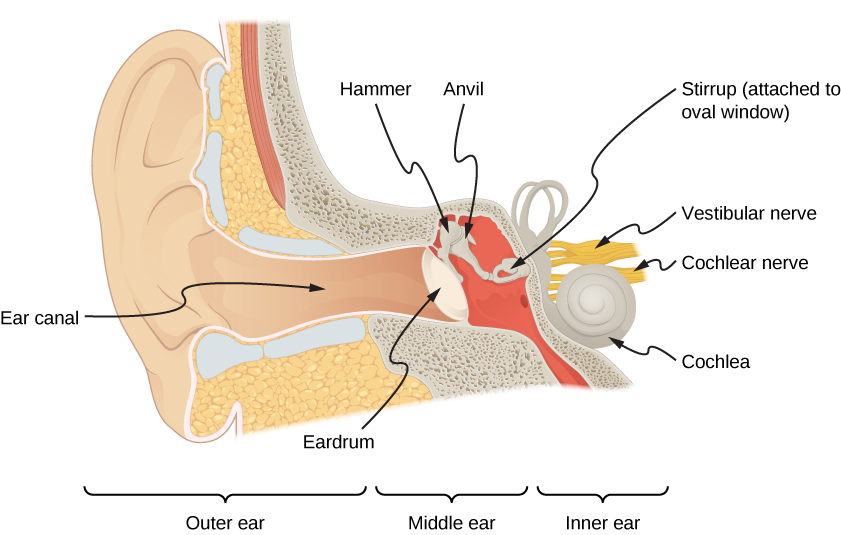
OpenStax / Rice University, University Physics Volume 1, CC BY 4.0. Source-book artwork retained. · CC BY 4.0 · Source出典

Figure 17.14図 17.14
The anatomy of the human ear.
英語のヒント
人間の耳の構造。
The outer ear, or ear canal, carries sound to the recessed, protected eardrum. The air column in the ear canal resonates and is partially responsible for the sensitivity of the ear to sounds in the 2000–5000-Hz range. The middle ear converts sound into mechanical vibrations and applies these vibrations to the cochlea.
英語のヒント
外耳、すなわち外耳道は、奥まった場所で保護されている鼓膜へ音を運ぶ。外耳道内の気柱は共鳴し、耳が2000〜5000 Hzの音に敏感である理由の一つになっている。中耳は音を機械的振動に変え、その振動を蝸牛に伝える。
Additional Resources追加教材
The range of intensities that the human ear can hear depends on the frequency of the sound, but, in general, the range is quite large. The minimum threshold intensity that can be heard is Pain is experienced at intensities of Measurements of sound intensity (in units of ) are very cumbersome due to this large range in values. For this reason, as well as for other reasons, the concept of sound intensity level was proposed.
英語のヒント
人間の耳が聞き取れる音の強さの範囲は周波数に依存するが、一般に非常に広い。聞き取れる最小の強さ、すなわち可聴閾値はであり、の強さでは痛みを感じる。値の範囲がこれほど広いため、音の強さをで測って扱うのは非常に煩雑である。この理由やほかの理由から、「音の強さレベル」という概念が提案された。
The sound intensity level of a sound, measured in decibels, having an intensity I in watts per meter squared, is defined as
英語のヒント
1平方メートルあたりのワット数で表した強さがIの音について、デシベルで測る音の強さレベルを次のように定義する。
where is a reference intensity, corresponding to the threshold intensity of sound that a person with normal hearing can perceive at a frequency of 1.00 kHz. It is more common to consider sound intensity levels in dB than in How human ears perceive sound can be more accurately described by the logarithm of the intensity rather than directly by the intensity. Because is defined in terms of a ratio, it is a unitless quantity, telling you the level of the sound relative to a fixed standard (). The units of decibels (dB) are used to indicate this ratio is multiplied by 10 in its definition. The bel, upon which the decibel is based, is named for Alexander Graham Bell, the inventor of the telephone.
英語のヒント
ここでは基準の強さであり、聴覚が正常な人が周波数1.00 kHzで聞き取れる音の強さの閾値に対応する。音はで強さを扱うよりも、dBで音の強さレベルを扱うほうが一般的である。人間の耳が音をどう知覚するかは、強さそのものより、強さの対数によってより正確に表せる。は比を使って定義されるため、一定の基準()に対する音のレベルを表す無次元量である。デシベル(dB)という単位は、定義においてこの比に10を掛けていることを示すために用いられる。デシベルのもとになったベルという名称は、電話の発明者アレクサンダー・グラハム・ベルに由来する。
The decibel level of a sound having the threshold intensity of is because Table 17.2 gives levels in decibels and intensities in watts per meter squared for some familiar sounds. The ear is sensitive to as little as a trillionth of a watt per meter squared—even more impressive when you realize that the area of the eardrum is only about so that only falls on it at the threshold of hearing. Air molecules in a sound wave of this intensity vibrate over a distance of less than one molecular diameter, and the gauge pressures involved are less than
英語のヒント
可聴閾値の音のデシベル値はである。だからである。表17.2に、身近な音について、デシベルで表したレベルと、1平方メートルあたりのワット数で表した強さを示す。耳は1平方メートルあたり1兆分の1ワットもの微弱な音に反応する。鼓膜の面積がわずか約で、可聴閾値ではそこへしか入射しないことを考えると、さらに驚くべき感度である。この強さの音波では、空気分子の振動する距離は分子1個の直径より小さく、ゲージ圧は未満である。
Sound intensity level (dB) 音の強さレベル(dB) |
Intensity I 強さI |
Example/effect 例・影響 |
|---|---|---|
0 |
Threshold of hearing at 1000 Hz 1000 Hzでの可聴閾値 |
|
10 |
Rustle of leaves 英語のヒント葉のそよぐ音 |
|
20 |
Whisper at 1-m distance 英語のヒント距離1 mでのささやき声 |
|
30 |
Quiet home 静かな家庭 |
|
40 |
Average home 一般的な家庭 |
|
50 |
Average office, soft music 一般的な事務所、小さな音量の音楽 |
|
60 |
Normal conversation 普通の会話 |
|
70 |
Noisy office, busy traffic 騒がしい事務所、交通量の多い道路 |
|
80 |
Loud radio, classroom lecture 大音量のラジオ、教室での講義 |
|
90 |
Inside a heavy truck; damage from prolonged exposure Several government agencies and health-related professional associations recommend that 85 dB not be exceeded for 8-hour daily exposures in the absence of hearing protection. 英語のヒント大型トラックの車内。長時間さらされると聴覚が損傷する。複数の政府機関と保健分野の専門団体は、聴覚保護具を使わず毎日8時間音にさらされる場合、85 dBを超えないことを推奨している。 |
|
100 |
Noisy factory, siren at 30 m; damage from 8 h per day exposure 騒がしい工場、距離30 mでのサイレン。毎日8時間さらされると聴覚が損傷する。 |
|
110 |
Damage from 30 min per day exposure 毎日30分さらされると聴覚が損傷する。 |
|
120 |
1 |
Loud rock concert; pneumatic chipper at 2 m; threshold of pain 英語のヒント大音量のロックコンサート、距離2 mでの空気圧式はつり機。痛みを感じる閾値。 |
140 |
Jet airplane at 30 m; severe pain, damage in seconds 距離30 mでのジェット機。激しい痛みがあり、数秒で聴覚が損傷する。 |
|
160 |
Bursting of eardrums 英語のヒント鼓膜が破れる。 |
An observation readily verified by examining Table 17.2 or by using Equation 17.12 is that each factor of 10 in intensity corresponds to 10 dB. For example, a 90-dB sound compared with a 60-dB sound is 30 dB greater, or three factors of 10 (that is, times) as intense. Another example is that if one sound is as intense as another, it is 70 dB higher (Table 17.3).
英語のヒント
表17.2を調べるか、音の強さレベルの定義式を使うと、音の強さが10倍になるごとに10 dB増えることを容易に確かめられる。たとえば90 dBの音は60 dBの音より30 dB高く、強さは10を3回掛けた倍率、すなわち倍である。別の例として、ある音の強さが別の音の倍なら、音の強さレベルは70 dB高い(表17.3)。
2.0 |
3.0 dB |
5.0 |
7.0 dB |
10.0 |
10.0 dB |
100.0 |
20.0 dB |
1000.0 |
30.0 dB |
Example 17.2例題 17.2
Calculating Sound Intensity Levels音の強さレベルを計算する
Calculate the sound intensity level in decibels for a sound wave traveling in air at and having a pressure amplitude of 0.656 Pa.
英語のヒント
の空気中を伝わり、圧力振幅が0.656 Paの音波について、音の強さレベルをデシベルで求めよ。
Strategy方針
We are given , so we can calculate I using the equation Using I, we can calculate straight from its definition in
英語のヒント
が与えられているため、式を使ってIを計算できる。Iがわかれば、を定義式から直接計算できる。
Solution解答
- Identify knowns:
Sound travels at 331 m/s in air at
Air has a density of at atmospheric pressure and英語のヒント
既知量を確認する。音はの空気中を331 m/sで伝わる。大気圧下、での空気の密度はである。 - Enter these values and the pressure amplitude into
英語のヒント
これらの値と圧力振幅をに代入する。 - Enter the value for I and the known value for into Calculate to find the sound intensity level in decibels:
英語のヒント
Iの値との既知の値をに代入し、音の強さレベルをデシベルで求める。
Significance考察
This 87-dB sound has an intensity five times as great as an 80-dB sound. So a factor of five in intensity corresponds to a difference of 7 dB in sound intensity level. This value is true for any intensities differing by a factor of five.
英語のヒント
この87 dBの音の強さは、80 dBの音の5倍である。つまり、強さが5倍になることは、音の強さレベルが7 dB異なることに対応する。この値は、強さの比が5であるどの二つの音についても成り立つ。
Example 17.3例題 17.3
Changing Intensity Levels of a Sound音の強さレベルの変化
Show that if one sound is twice as intense as another, it has a sound level about 3 dB higher.
英語のヒント
ある音の強さが別の音の2倍なら、その音の強さレベルは約3 dB高いことを示せ。
Strategy方針
We are given that the ratio of two intensities is 2 to 1, and are then asked to find the difference in their sound levels in decibels. We can solve this problem by using of the properties of logarithms.
英語のヒント
二つの音の強さの比が2対1と与えられ、音の強さレベルの差をデシベルで求めるよう問われている。対数の性質を使って解ける。
Solution解答
- Identify knowns:
The ratio of the two intensities is 2 to 1, or英語のヒント
既知量を確認する。二つの音の強さの比は2対1、すなわち次のとおりである。We wish to show that the difference in sound levels is about 3 dB. That is, we want to show:英語のヒント
音の強さレベルの差が約3 dBであることを示したい。すなわち、次の関係を示す。Note that英語のヒント
次の関係に注意する。 - Use the definition of to obtain
英語のヒント
の定義を使うと、次式を得る。Thus,英語のヒント
したがって、
Significance考察
This means that the two sound intensity levels differ by 3.01 dB, or about 3 dB, as advertised. Note that because only the ratio is given (and not the actual intensities), this result is true for any intensities that differ by a factor of two. For example, a 56.0-dB sound is twice as intense as a 53.0-dB sound, a 97.0-dB sound is half as intense as a 100-dB sound, and so on.
英語のヒント
これは、二つの音の強さレベルが3.01 dB、すなわち先に述べたとおり約3 dB異なることを意味する。実際の強さではなく比だけが与えられているため、この結果は強さの比が2であるどの二つの音にも当てはまる。たとえば56.0 dBの音は53.0 dBの音の2倍の強さであり、97.0 dBの音は100 dBの音の半分の強さである。ほかの場合も同様である。
Another decibel scale is also in use, called the sound pressure level, based on the ratio of the pressure amplitude to a reference pressure. This scale is used particularly in applications where sound travels in water. It is beyond the scope of this text to treat this scale because it is not commonly used for sounds in air, but it is important to note that very different decibel levels may be encountered when sound pressure levels are quoted.
英語のヒント
圧力振幅と基準圧力の比に基づく「音圧レベル」という、別のデシベル尺度も使われている。この尺度は、特に水中を伝わる音を扱う用途で用いられる。空気中の音では一般的に使われないため、この尺度の扱いは本書の範囲外である。ただし、音圧レベルとして示された値では、デシベル値が大きく異なることがある点に注意が必要である。