第17章音
17.7 The Doppler Effect17.7 ドップラー効果
Learning Objectives学習目標
Learning Objectives学習目標
By the end of this section, you will be able to:
英語のヒント
この節を終えると、次のことができるようになる。
- Explain the change in observed frequency as a moving source of sound approaches or departs from a stationary observer
英語のヒント
動く音源が静止した観測者へ近づく、または遠ざかるときの、観測振動数の変化を説明する。 - Explain the change in observed frequency as an observer moves toward or away from a stationary source of sound
英語のヒント
観測者が静止した音源へ近づく、または遠ざかるときの、観測振動数の変化を説明する。
The characteristic sound of a motorcycle buzzing by is an example of the Doppler effect. Specifically, if you are standing on a street corner and observe an ambulance with a siren sounding passing at a constant speed, you notice two characteristic changes in the sound of the siren. First, the sound increases in loudness as the ambulance approaches and decreases in loudness as it moves away, which is expected. But in addition, the high-pitched siren shifts dramatically to a lower-pitched sound. As the ambulance passes, the frequency of the sound heard by a stationary observer changes from a constant high frequency to a constant lower frequency, even though the siren is producing a constant source frequency. The closer the ambulance brushes by, the more abrupt the shift. Also, the faster the ambulance moves, the greater the shift. We also hear this characteristic shift in frequency for passing cars, airplanes, and trains.
英語のヒント
オートバイがうなりを上げて通り過ぎるときの特徴的な音は、ドップラー効果の一例である。街角に立ち、サイレンを鳴らした救急車が一定の速さで通り過ぎるのを見ていると、サイレンの音に二つの特徴的な変化がある。まず、予想どおり、近づくにつれて音が大きくなり、遠ざかるにつれて小さくなる。それに加えて、甲高い音が急にはっきりと低い音へ変わる。サイレン自体は一定の振動数で音を出しているのに、静止した観測者が聞く振動数は、救急車が通り過ぎると、一定の高い振動数から一定の低い振動数へ変わる。近くをかすめて通るほど変化は急であり、救急車が速いほど変化は大きい。通過する自動車、飛行機、列車でも、この特徴的な振動数の変化が聞こえる。
The Doppler effect is an alteration in the observed frequency of a sound due to motion of either the source or the observer. Although less familiar, this effect is easily noticed for a stationary source and moving observer. For example, if you ride a train past a stationary warning horn, you will hear the horn’s frequency shift from high to low as you pass by. The actual change in frequency due to relative motion of source and observer is called a Doppler shift. The Doppler effect and Doppler shift are named for the Austrian physicist and mathematician Christian Johann Doppler (1803–1853), who did experiments with both moving sources and moving observers. Doppler, for example, had musicians play on a moving open train car and also play standing next to the train tracks as a train passed by. Their music was observed both on and off the train, and changes in frequency were measured.
英語のヒント
ドップラー効果とは、音源または観測者が動くことによって、観測される音の振動数が変わることである。あまりなじみはないが、静止した音源に対して観測者が動く場合も容易に気づける。例えば列車に乗って静止した警笛の前を通ると、通過時に警笛の振動数が高いほうから低いほうへ変わる。音源と観測者の相対運動による実際の振動数の変化を、ドップラーシフトという。ドップラー効果とドップラーシフトは、動く音源と動く観測者の両方で実験した、オーストリアの物理学者・数学者クリスチャン・ヨハン・ドップラー(1803〜1853)にちなんで名づけられた。例えばドップラーは、走る屋根のない鉄道車両で音楽家に演奏させたり、列車が通過するときに線路の脇に立って演奏させたりした。列車の内外で音楽を観測し、振動数の変化を測った。
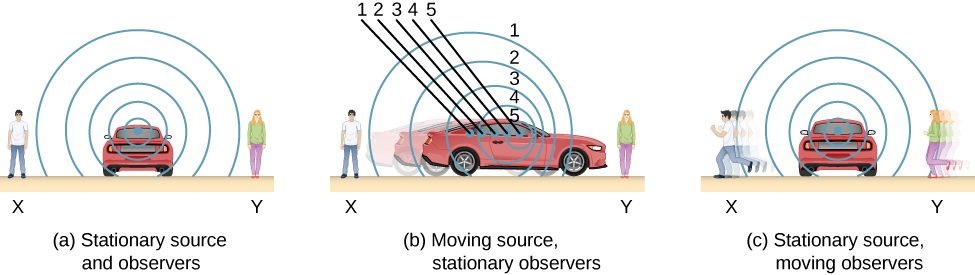
What causes the Doppler shift? Figure 17.30 illustrates sound waves emitted by stationary and moving sources in a stationary air mass. Each disturbance spreads out spherically from the point at which the sound is emitted. If the source is stationary, then all of the spheres representing the air compressions in the sound wave are centered on the same point, and the stationary observers on either side hear the same wavelength and frequency as emitted by the source (case a). If the source is moving, the situation is different. Each compression of the air moves out in a sphere from the point at which it was emitted, but the point of emission moves. This moving emission point causes the air compressions to be closer together on one side and farther apart on the other. Thus, the wavelength is shorter in the direction the source is moving (on the right in case b), and longer in the opposite direction (on the left in case b). Finally, if the observers move, as in case (c), the frequency at which they receive the compressions changes. The observer moving toward the source receives them at a higher frequency, and the person moving away from the source receives them at a lower frequency.
英語のヒント
ドップラーシフトはなぜ起こるのだろうか。図17.30は、静止した空気の中で、静止した音源と動く音源が出す音波を示す。各々の乱れは、音が出た点を中心に球状に広がる。音源が静止していれば、音波の圧縮を表すすべての球は同じ点を中心とし、両側の静止した観測者は音源と同じ波長・振動数の音を聞く(a)。音源が動く場合は異なる。各圧縮は放出された点から球状に広がるが、放出点自体が移動する。そのため、圧縮どうしの間隔は片側で狭く、反対側で広くなる。したがって波長は音源の進む向き(bの右)で短く、反対向き(bの左)で長くなる。最後に(c)のように観測者が動くと、圧縮を受け取る頻度が変わる。音源へ向かう観測者は高い振動数で圧縮を受け取り、遠ざかる人は低い振動数で受け取る。
OpenStax / Rice University, University Physics Volume 1, CC BY 4.0. Source-book artwork retained. · CC BY 4.0 · Source出典

Figure 17.30図 17.30
Sounds emitted by a source spread out in spherical waves. (a) When the source, observers, and air are stationary, the wavelength and frequency are the same in all directions and to all observers. (b) Sounds emitted by a source moving to the right spread out from the points at which they were emitted. The wavelength is reduced, and consequently, the frequency is increased in the direction of motion, so that the observer on the right hears a higher-pitched sound. The opposite is true for the observer on the left, where the wavelength is increased and the frequency is reduced. (c) The same effect is produced when the observers move relative to the source. Motion toward the source increases frequency as the observer on the right passes through more wave crests than she would if stationary. Motion away from the source decreases frequency as the observer on the left passes through fewer wave crests than he would if stationary.
英語のヒント
音源が出した音は球面波として広がる。(a) 音源、観測者、空気が静止していると、どの向きでも、どの観測者に対しても波長と振動数は同じである。(b) 右へ動く音源が出した音は、各放出点から広がる。進行方向では波長が短くなって振動数が増すので、右の観測者には高い音が聞こえる。左の観測者では反対に、波長が長く振動数が低くなる。(c) 観測者が音源に対して動いても同じ効果が生じる。右の観測者が音源へ向かうと、静止時より多くの波の山を通過するので、振動数が増す。左の観測者が音源から遠ざかると、静止時より通過する山が少なくなるので、振動数が下がる。
We know that wavelength and frequency are related by where v is the fixed speed of sound. The sound moves in a medium and has the same speed v in that medium whether the source is moving or not. Thus, f multiplied by is a constant. Because the observer on the right in case (b) receives a shorter wavelength, the frequency she receives must be higher. Similarly, the observer on the left receives a longer wavelength, and hence he hears a lower frequency. The same thing happens in case (c). A higher frequency is received by the observer moving toward the source, and a lower frequency is received by an observer moving away from the source. In general, then, relative motion of source and observer toward one another increases the received frequency. Relative motion apart decreases frequency. The greater the relative speed, the greater the effect.
英語のヒント
波長と振動数の関係はであり、vは一定の音速である。音は媒質の中を進み、音源が動いていてもいなくても、その媒質内での速さvは同じである。したがってfとの積は一定になる。(b)の右の観測者が受け取る波長は短いので、振動数は高くなければならない。同様に、左の観測者は長い波長を受け取るので、低い振動数を聞く。(c)でも同じで、音源へ近づく観測者は高い振動数を、遠ざかる観測者は低い振動数を受け取る。一般に、音源と観測者が相対的に近づけば受信振動数は増し、遠ざかれば減る。相対速度が大きいほど効果も大きい。
The Doppler effect occurs not only for sound, but for any wave when there is relative motion between the observer and the source. Doppler shifts occur in the frequency of sound, light, and water waves, for example. Doppler shifts can be used to determine velocity, such as when ultrasound is reflected from blood in a medical diagnostic. The relative velocities of stars and galaxies is determined by the shift in the frequencies of light received from them and has implied much about the origins of the universe. Modern physics has been profoundly affected by observations of Doppler shifts.
英語のヒント
ドップラー効果は音だけでなく、観測者と波源に相対運動があれば、あらゆる波で起こる。例えば音波、光波、水面波の振動数にドップラーシフトが生じる。医療診断で血液から反射した超音波を使う場合のように、ドップラーシフトから速度を求められる。恒星や銀河の相対速度は、そこから届く光の振動数のずれによって決まり、宇宙の起源について多くを示唆してきた。現代物理学は、ドップラーシフトの観測によって深い影響を受けている。