第17章音
Problems問題
Exercises 77–88練習問題 77–88
Exercise 77問題 77
If a wind instrument, such as a tuba, has a fundamental frequency of 32.0 Hz, what are its first three overtones? It is closed at one end. (The overtones of a real tuba are more complex than this example, because it is a tapered tube.)
英語のヒント
チューバのような管楽器の基本振動数が32.0 Hzであるとき、低い方から三つの倍音の振動数を求めよ。一端は閉じている。(実際のチューバは先細りの管なので、倍音はこの例より複雑である。)
Exercise 78問題 78
What are the first three overtones of a bassoon that has a fundamental frequency of 90.0 Hz? It is open at both ends. (The overtones of a real bassoon are more complex than this example, because its double reed makes it act more like a tube closed at one end.)
英語のヒント
基本振動数90.0 Hzのファゴットについて、低い方から三つの倍音の振動数を求めよ。両端は開いている。(実際のファゴットはダブルリードによって一端を閉じた管に近い働きをするため、倍音はこの例より複雑である。)
Solution解き方
Exercise 79問題 79
How long must a flute be in order to have a fundamental frequency of 262 Hz (this frequency corresponds to middle C on the evenly tempered chromatic scale) on a day when air temperature is ? It is open at both ends.
英語のヒント
気温の日に、フルートの基本振動数を262 Hz(平均律の半音階で中央のCに対応する振動数)にするには、どれだけの長さが必要か。両端は開いている。
Exercise 80問題 80
What length should an oboe have to produce a fundamental frequency of 110 Hz on a day when the speed of sound is 343 m/s? It is open at both ends.
英語のヒント
音速が343 m/sの日に、オーボエの基本振動数を110 Hzにするには、どれだけの長さが必要か。両端は開いている。
Solution解き方
1.56 m
Exercise 81問題 81
(a) Find the length of an organ pipe closed at one end that produces a fundamental frequency of 256 Hz when air temperature is . (b) What is its fundamental frequency at ?
英語のヒント
(a) 気温で基本振動数256 Hzの音を出す、一端を閉じたオルガン管の長さを求めよ。(b) での基本振動数はいくらか。
Exercise 82問題 82
An organ pipe is closed at both ends. Compute the wavelengths and frequencies of the first three modes of resonance. Assume the speed of sound is
英語のヒント
オルガン管の両端が閉じている。低い方から三つの共鳴モードの波長と振動数を計算せよ。音速をとする。
Solution解き方
The pipe has symmetrical boundary conditions;
英語のヒント
管の境界条件は対称である。
Exercise 83問題 83
An organ pipe is closed at one end. Compute the wavelengths and frequencies of the first three modes of resonance. Assume the speed of sound is
英語のヒント
オルガン管の一端が閉じている。低い方から三つの共鳴モードの波長と振動数を計算せよ。音速をとする。
Exercise 84問題 84
A sound wave of a frequency of 2.00 kHz is produced by a string oscillating in the mode. The linear mass density of the string is and the length of the string is 1.50 m. What is the tension in the string?
英語のヒント
のモードで振動する弦が、周波数2.00 kHzの音波を生じる。弦の線密度は、長さは1.50 mである。弦の張力を求めよ。
Solution解き方
Exercise 85問題 85
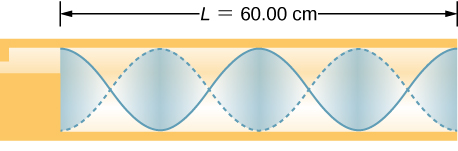
Consider the sound created by resonating the tube shown below. The air temperature is . What are the wavelength, wave speed, and frequency of the sound produced?
英語のヒント
次の図の管を共鳴させて生じる音を考える。気温はである。生じる音の波長、波の速さ、振動数を求めよ。

Exercise 86問題 86
A student holds an 80.00-cm lab pole one quarter of the length from the end of the pole. The lab pole is made of aluminum. The student strikes the lab pole with a hammer. The pole resonates at the lowest possible frequency. What is that frequency?
英語のヒント
学生が長さ80.00 cmの実験用の棒を、端から全長の4分の1の位置で支えている。棒はアルミニウム製である。学生がハンマーで棒をたたくと、可能な最低の振動数で共鳴する。その振動数を求めよ。
Solution解き方
Exercise 87問題 87
A string on the violin has a length of 24.00 cm and a mass of 0.860 g. The fundamental frequency of the string is 1.00 kHz. (a) What is the speed of the wave on the string? (b) What is the tension in the string?
英語のヒント
バイオリンの弦の長さが24.00 cm、質量が0.860 gであり、基本振動数は1.00 kHzである。(a) 弦を伝わる波の速さを求めよ。(b) 弦の張力を求めよ。
Exercise 88問題 88
By what fraction will the frequencies produced by a wind instrument change when air temperature goes from to ? That is, find the ratio of the frequencies at those temperatures.
英語のヒント
気温がからになると、管楽器が出す音の振動数はどの割合で変わるか。すなわち、それぞれの気温での振動数の比を求めよ。
Solution解き方
1.03 or
比は1.03、すなわちの増加。