第17章音
17.4 Normal Modes of a Standing Sound Wave17.4 音の定常波の固有モード
Learning Objectives学習目標
Learning Objectives学習目標
By the end of this section, you will be able to:
英語のヒント
この節を終えると、次のことができるようになる。
- Explain the mechanism behind sound-reducing headphones
英語のヒント
騒音を減らすヘッドホンの仕組みを説明する。 - Describe resonance in a tube closed at one end and open at the other end
英語のヒント
一端が閉じ、他端が開いた管の共鳴を説明する。 - Describe resonance in a tube open at both ends
英語のヒント
両端が開いた管の共鳴を説明する。
Interference is the hallmark of waves, all of which exhibit constructive and destructive interference exactly analogous to that seen for water waves. In fact, one way to prove something “is a wave” is to observe interference effects. Since sound is a wave, we expect it to exhibit interference.
英語のヒント
干渉は波を特徴付ける現象であり、すべての波は、水の波で見られるものとまったく同様に、強め合う干渉と弱め合う干渉を示す。実際、何かが「波である」と確かめる方法の一つは、干渉の効果を観察することである。音は波なので、干渉を示すと予想できる。
Interference of Sound Waves音波の干渉
In Waves, we discussed the interference of wave functions that differ only in a phase shift. We found that the wave function resulting from the superposition of and is
英語のヒント
波では、位相のずれだけが異なる波動関数の干渉を論じた。とを重ね合わせて生じる波動関数は、次のようになる。
One way for two identical waves that are initially in phase to become out of phase with one another is to have the waves travel different distances; that is, they have different path lengths. Sound waves provide an excellent example of a phase shift due to a path difference. As we have discussed, sound waves can basically be modeled as longitudinal waves, where the molecules of the medium oscillate around an equilibrium position, or as pressure waves.
英語のヒント
初め同位相にある二つの同じ波の位相を互いにずらす方法の一つは、異なる距離を進ませることである。つまり、経路長を異ならせる。音波は、経路差による位相のずれのよい例となる。すでに述べたように、音波は基本的に、媒質の分子が平衡位置の周りを振動する縦波、または圧力の波としてモデル化できる。
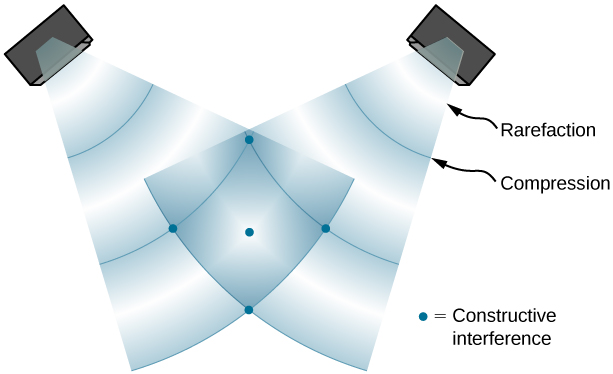
When the waves leave the speakers, they move out as spherical waves (Figure 17.16). The waves interfere; constructive inference is produced by the combination of two crests or two troughs, as shown. Destructive interference is produced by the combination of a trough and a crest.
英語のヒント
波がスピーカーを離れると、球面波として外へ広がる(図17.16)。波は互いに干渉する。図のように、山と山、または谷と谷が重なると、強め合う干渉が起こる。谷と山が重なると、弱め合う干渉が起こる。
OpenStax / Rice University, University Physics Volume 1, CC BY 4.0. Source-book artwork retained. · CC BY 4.0 · Source出典

Figure 17.16図 17.16
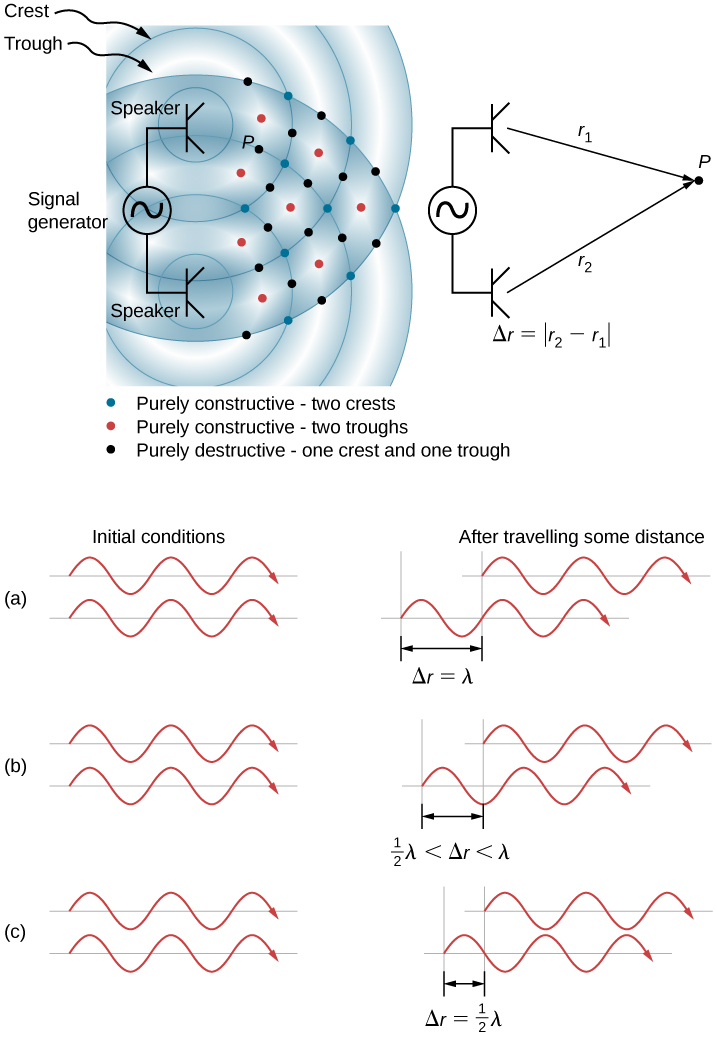
When sound waves are produced by a speaker, they travel at the speed of sound and move out as spherical waves. Here, two speakers produce the same steady tone (frequency). The result is points of high-intensity sound (highlighted), which result from two crests (compression) or two troughs (rarefaction) overlapping. Destructive interference results from a crest and trough overlapping. The points where there is constructive interference in the figure occur because the two waves are in phase at those points. Points of destructive interference (Figure 17.17) are the result of the two waves being out of phase.
英語のヒント
スピーカーで生じた音波は、音速で球面状に広がる。ここでは、二つのスピーカーが同じ一定の音(同じ振動数)を出している。その結果、二つの山(圧縮)または二つの谷(希薄)が重なる点では、音が強くなる(強調した点)。山と谷が重なると、弱め合う干渉が起こる。図で強め合う干渉が起こるのは、その点で二つの波が同位相だからである。弱め合う干渉の点(図17.17)は、二つの波の位相がずれることで生じる。
OpenStax / Rice University, University Physics Volume 1, CC BY 4.0. Source-book artwork retained. · CC BY 4.0 · Source出典

Figure 17.17図 17.17
Two speakers being driven by a single signal generator. The sound waves produced by the speakers are in phase and are of a single frequency. The sound waves interfere with each other. When two crests or two troughs coincide, there is constructive interference, marked by the red and blue dots. When a trough and a crest coincide, destructive interference occurs, marked by black dots. The phase difference is due to the path lengths traveled by the individual waves. Two identical waves travel two different path lengths to a point P. (a) The difference in the path lengths is one wavelength, resulting in total constructive interference and a resulting amplitude equal to twice the original amplitude. (b) The difference in the path lengths is less than one wavelength but greater than one half a wavelength, resulting in an amplitude greater than zero and less than twice the original amplitude. (c) The difference in the path lengths is one half of a wavelength, resulting in total destructive interference and a resulting amplitude of zero.
英語のヒント
一つの信号発生器で駆動する二つのスピーカー。スピーカーが出す音波は同位相で、単一の振動数を持つ。音波は互いに干渉する。二つの山または二つの谷が一致すると、赤と青の点で示す強め合う干渉が起こる。谷と山が一致すると、黒い点で示す弱め合う干渉が起こる。位相差は、各波が進む経路長によって生じる。二つの同じ波が、異なる長さの経路を通って点Pへ進む。(a)経路差が1波長なら完全に強め合い、合成振幅は元の振幅の2倍となる。(b)経路差が1波長より短く半波長より長い場合、合成振幅は0より大きく、元の振幅の2倍より小さくなる。(c)経路差が半波長なら完全に弱め合い、合成振幅は0となる。
The phase difference at each point is due to the different path lengths traveled by each wave. When the difference in the path lengths is an integer multiple of a wavelength,
英語のヒント
各点での位相差は、それぞれの波が進む経路長の違いによる。経路差が波長の整数倍、すなわち、
the waves are in phase and there is constructive interference. When the difference in path lengths is an odd multiple of a half wavelength,
英語のヒント
であるとき、波は同位相となり、強め合う干渉が起こる。経路差が半波長の奇数倍、すなわち、
the waves are out of phase and the result is destructive interference. These points can be located with a sound-level intensity meter.
英語のヒント
であるとき、波の位相はずれ、弱め合う干渉が起こる。これらの点は、音の強さのレベルを測る計器で探せる。
Example 17.5例題 17.5
Interference of Sound Waves音波の干渉
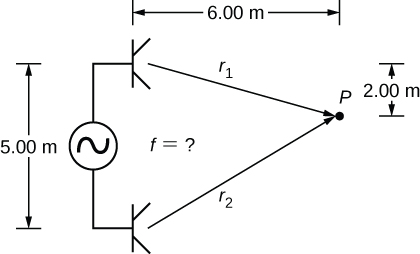
Two speakers are separated by 5.00 m and are being driven by a signal generator at an unknown frequency. A student with a sound-level meter walks out 6.00 m and down 2.00 m, and finds the first minimum intensity, as shown below. What is the frequency supplied by the signal generator? Assume the wave speed of sound is
英語のヒント
二つのスピーカーが5.00 m離れており、信号発生器によって未知の振動数で駆動されている。騒音計を持った学生が、下図のように前方へ6.00 m、下方へ2.00 m進むと、音の強さが最初に極小となる点を見つけた。信号発生器が供給する振動数はいくらか。音速はとする。
OpenStax / Rice University, University Physics Volume 1, CC BY 4.0. Source-book artwork retained. · CC BY 4.0 · Source出典

Strategy方針
The wave velocity is equal to The frequency is then A minimum intensity indicates destructive interference and the first such point occurs where there is path difference of which can be found from the geometry.
英語のヒント
波の速さはである。したがって、振動数はとなる。強さの極小は弱め合う干渉を示し、最初の極小点では経路差がとなる。この経路差は幾何学的に求められる。
Solution解答
- Find the path length to the minimum point from each speaker.
英語のヒント
各スピーカーから極小点までの経路長を求める。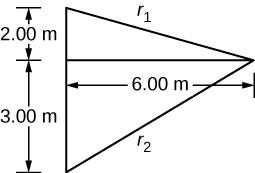
OpenStax / Rice University, University Physics Volume 1, CC BY 4.0. Source-book artwork retained. · CC BY 4.0 · Source出典
- Use the difference in the path length to find the wavelength.
英語のヒント
経路差から波長を求める。 - Find the frequency.
英語のヒント
振動数を求める。

Significance考察
If point P were a point of maximum intensity, then the path length would be an integer multiple of the wavelength.
英語のヒント
点Pが強さの極大点なら、経路長は波長の整数倍となる。
The concept of a phase shift due to a difference in path length is very important. You will use this concept again in Interference and Photons and Matter Waves, where we discuss how Thomas Young used this method in his famous double-slit experiment to provide evidence that light has wavelike properties.