第17章音
17.2 Speed of Sound17.2 音の速さ
Learning Objectives学習目標
Learning Objectives学習目標
By the end of this section, you will be able to:
英語のヒント
この節を終えると、次のことができるようになる。
- Explain the relationship between wavelength and frequency of sound
英語のヒント
音の波長と周波数の関係を説明する。 - Determine the speed of sound in different media
英語のヒント
さまざまな媒質中の音速を求める。 - Derive the equation for the speed of sound in air
英語のヒント
空気中の音速の式を導く。 - Determine the speed of sound in air for a given temperature
英語のヒント
与えられた気温での空気中の音速を求める。
Sound, like all waves, travels at a certain speed and has the properties of frequency and wavelength. You can observe direct evidence of the speed of sound while watching a fireworks display (Figure 17.4). You see the flash of an explosion well before you hear its sound and possibly feel the pressure wave, implying both that sound travels at a finite speed and that it is much slower than light.
英語のヒント
音は、すべての波と同様、ある速さで伝わり、周波数と波長を持つ。花火を見ると、音の速さを直接示す証拠を観察できる(図17.4)。爆発の光が見えてから、かなり遅れて音を聞き、ときには圧力波を感じる。これは、音が有限の速さで伝わることと、光よりずっと遅いことの両方を示す。

OpenStax / Rice University, University Physics Volume 1, CC BY 4.0. Source-book artwork retained. · CC BY 4.0 · Source出典

Figure 17.4図 17.4
When a firework shell explodes, we perceive the light energy before the sound energy because sound travels more slowly than light does.
英語のヒント
花火の玉が破裂すると、光のエネルギーを音のエネルギーより先に感じ取る。音は光より遅く伝わるためである。
The difference between the speed of light and the speed of sound can also be experienced during an electrical storm. The flash of lighting is often seen before the clap of thunder. You may have heard that if you count the number of seconds between the flash and the sound, you can estimate the distance to the source. Every five seconds converts to about one mile. The velocity of any wave is related to its frequency and wavelength by
英語のヒント
光と音の速さの違いは、雷雨でも体験できる。雷鳴を聞くより先に稲妻が見えることが多い。光ってから音が聞こえるまでの秒数を数えると、発生源までの距離を見積もれる、と聞いたことがあるかもしれない。約5秒ごとに約1マイルに相当する。どんな波でも、速さは周波数と波長に次のように関係する。
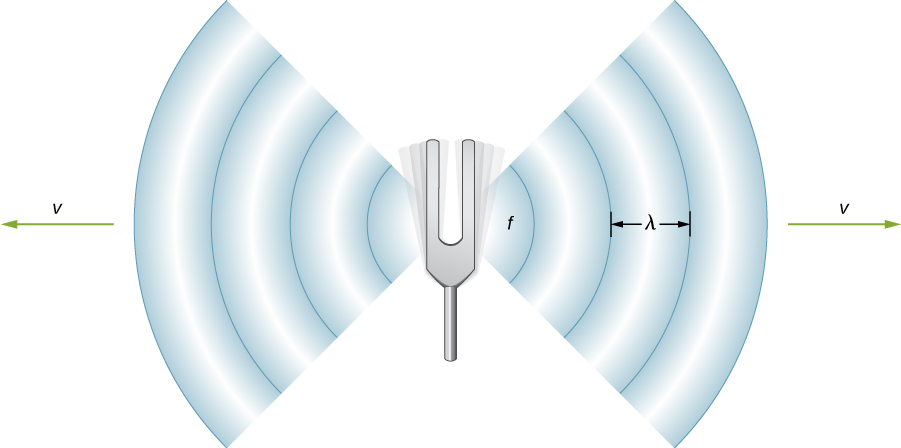
where v is the speed of the wave, f is its frequency, and is its wavelength. Recall from Waves that the wavelength is the length of the wave as measured between sequential identical points. For example, for a surface water wave or sinusoidal wave on a string, the wavelength can be measured between any two convenient sequential points with the same height and slope, such as between two sequential crests or two sequential troughs. Similarly, the wavelength of a sound wave is the distance between sequential identical parts of a wave—for example, between sequential compressions (Figure 17.5). The frequency is the same as that of the source and is the number of waves that pass a point per unit time.
英語のヒント
OpenStax / Rice University, University Physics Volume 1, CC BY 4.0. Source-book artwork retained. · CC BY 4.0 · Source出典

Figure 17.5図 17.5
A sound wave emanates from a source, such as a tuning fork, vibrating at a frequency f. It propagates at speed v and has a wavelength .
英語のヒント
音波は、周波数fで振動する音叉のような音源から生じる。速さvで伝わり、波長はである。
Speed of Sound in Various Mediaさまざまな媒質中の音速
Table 17.1 shows that the speed of sound varies greatly in different media. The speed of sound in a medium depends on how quickly vibrational energy can be transferred through the medium. For this reason, the derivation of the speed of sound in a medium depends on the medium and on the state of the medium. In general, the equation for the speed of a mechanical wave in a medium depends on the square root of the restoring force, or the elastic property, divided by the inertial property,
英語のヒント
表17.1のように、音速は媒質によって大きく変わる。媒質中の音速は、振動のエネルギーがその中をどれだけ速く伝わるかに依存する。そのため、音速の導出は、媒質とその状態によって異なる。一般に、媒質中の力学的な波の速さの式は、復元力、すなわち弾性を表す量を、慣性を表す量で割った値の平方根に依存する。
Recall from Waves that the speed of a wave on a string is equal to where the restoring force is the tension in the string and the linear density is the inertial property. In a fluid, the speed of sound depends on the bulk modulus and the density,
英語のヒント
「波」で、弦を伝わる波の速さがになると学んだ。復元力は弦の張力であり、線密度が慣性を表す量である。流体中の音速は、体積弾性率と密度に依存し、次のようになる。
The speed of sound in a solid depends on the Young’s modulus of the medium and the density,
英語のヒント
固体中の音速は、媒質のヤング率と密度に依存する。
In an ideal gas (see The Kinetic Theory of Gases), the equation for the speed of sound is
英語のヒント
理想気体では(「気体分子運動論」を参照)、音速の式は次のようになる。
where is the adiabatic index, is the gas constant, is the absolute temperature in kelvins, and M is the molar mass. In general, the more rigid (or less compressible) the medium, the faster the speed of sound. This observation is analogous to the fact that the frequency of simple harmonic motion is directly proportional to the stiffness of the oscillating object as measured by k, the spring constant. The greater the density of a medium, the slower the speed of sound. This observation is analogous to the fact that the frequency of a simple harmonic motion is inversely proportional to m, the mass of the oscillating object. The speed of sound in air is low, because air is easily compressible. Because liquids and solids are relatively rigid and very difficult to compress, the speed of sound in such media is generally greater than in gases.
英語のヒント
ここでは断熱指数、は気体定数、はケルビンで表した絶対温度、Mはモル質量である。一般に、媒質が硬いほど(圧縮されにくいほど)、音速は大きい。これは、ばね定数kで表す振動体の硬さに、単振動の周波数が正比例するという関係に似ている。媒質の密度が大きいほど、音速は小さい。これは、単振動の周波数が、振動体の質量mに反比例するという関係に似ている。空気は圧縮しやすいため、空気中の音速は小さい。液体や固体は比較的硬く、非常に圧縮しにくいため、一般に気体より音速が大きい。
Medium 媒質 |
v (m/s) v(m/s) |
|---|---|
Gases at の気体 |
|
Air 空気 |
331 |
Carbon dioxide 二酸化炭素 |
259 |
Oxygen 酸素 |
316 |
Helium ヘリウム |
965 |
Hydrogen 水素 |
1290 |
Liquids at の液体 |
|
Ethanol エタノール |
1160 |
Mercury 水銀 |
1450 |
Water, fresh 淡水 |
1480 |
Sea Water 海水 |
1540 |
Human tissue 人体組織 |
1540 |
Solids (longitudinal or bulk) 固体(縦波または体積波) |
|
Vulcanized rubber 加硫ゴム |
54 |
Polyethylene ポリエチレン |
920 |
Marble 大理石 |
3810 |
Glass, Pyrex パイレックスガラス |
5640 |
Lead 鉛 |
1960 |
Aluminum アルミニウム |
5120 |
Steel 鋼 |
5960 |
Because the speed of sound depends on the density of the material, and the density depends on the temperature, there is a relationship between the temperature in a given medium and the speed of sound in the medium. For air at sea level, the speed of sound is given by
英語のヒント
音速は材料の密度に依存し、密度は温度に依存するため、ある媒質中の温度と音速には関係がある。海面付近の空気では、音速は次の式で与えられる。
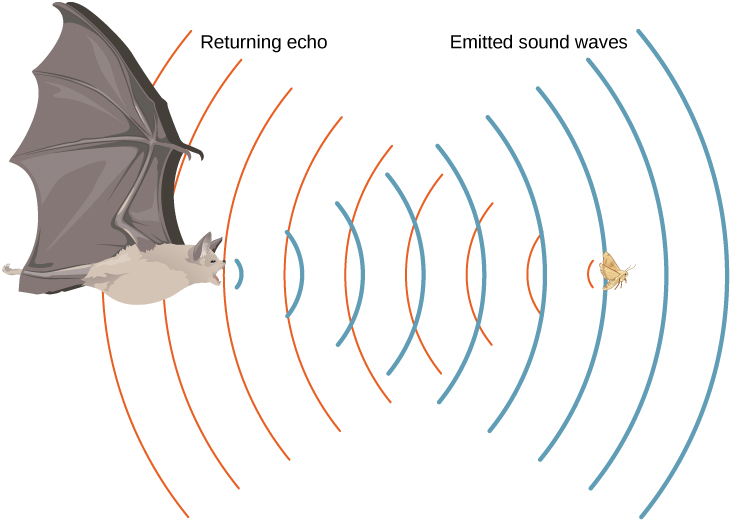
where the temperature in the first equation (denoted as ) is in degrees Celsius and the temperature in the second equation (denoted as ) is in kelvins. The speed of sound in gases is related to the average speed of particles in the gas, where is the Boltzmann constant and m is the mass of each (identical) particle in the gas. Note that v refers to the speed of the coherent propagation of a disturbance (the wave), whereas describes the speeds of particles in random directions. Thus, it is reasonable that the speed of sound in air and other gases should depend on the square root of temperature. While not negligible, this is not a strong dependence. At , the speed of sound is 331 m/s, whereas at , it is 343 m/s, less than a increase. Figure 17.6 shows how a bat uses the speed of sound to sense distances.
英語のヒント
最初の式の温度は摂氏、二番目の式の温度はケルビンで表す。気体中の音速は、気体粒子の平均的な速さに関係する。ここではボルツマン定数、mは同種の各粒子の質量である。vは、まとまった乱れ、つまり波が伝わる速さを表す。これに対しは、不規則な方向へ動く粒子の速さを表す。したがって、空気などの気体中の音速が、温度の平方根に依存するのは合理的である。この依存性は無視できないが、それほど強くはない。での音速は331 m/s、では343 m/sであり、増加は未満である。図17.6は、コウモリが音の速さを利用して距離を感じ取る様子を示す。
OpenStax / Rice University, University Physics Volume 1, CC BY 4.0. Source-book artwork retained. · CC BY 4.0 · Source出典

Figure 17.6図 17.6
A bat uses sound echoes to find its way about and to catch prey. The time for the echo to return is directly proportional to the distance.
英語のヒント
コウモリは音の反響を使って進路を知り、獲物を捕らえる。反響が戻るまでの時間は、距離に正比例する。