第17章音
17.3 Sound Intensity17.3 音の強度
Learning Objectives学習目標
Learning Objectives学習目標
By the end of this section, you will be able to:
英語のヒント
この節を終えると、次のことができるようになる。
- Define the term intensity
英語のヒント
強さという用語を定義する。 - Explain the concept of sound intensity level
英語のヒント
音の強さレベルの概念を説明する。 - Describe how the human ear translates sound
英語のヒント
人間の耳がどのように音を変換するかを述べる。
In a quiet forest, you can sometimes hear a single leaf fall to the ground. But when a passing motorist has their stereo turned up, you cannot even hear what the person next to you in your car is saying (Figure 17.12). We are all very familiar with the loudness of sounds and are aware that loudness is related to how energetically the source is vibrating. High noise exposure is hazardous to hearing, which is why it is important for people working in industrial settings to wear ear protection. The relevant physical quantity is sound intensity, a concept that is valid for all sounds whether or not they are in the audible range.
英語のヒント
静かな森では、葉が一枚地面に落ちる音を聞けることがある。しかし、通り過ぎる車の運転者がステレオの音量を上げていると、自分の車の隣の席の人の話さえ聞こえなくなる(図17.12)。音の大きさはよく知っている感覚であり、音源の振動の激しさに関係することも分かる。大きな騒音にさらされることは聴覚に有害なので、工業の現場で働く人は耳を保護することが重要である。これに関係する物理量が、音の強度である。可聴範囲にあるかどうかにかかわらず、すべての音に適用できる概念である。
Image omitted because its reuse rights could not be verified.権利の確認ができないため画像を割愛。
Figure 17.12図 17.12
Noise on crowded roadways, like this one in Delhi, makes it hard to hear others unless they shout. (credit: “Lingaraj G J”/Flickr)
英語のヒント
デリーのこの道路のように混雑した場所の騒音では、大声を出さなければ他の人の声が聞き取りにくい。(「Lingaraj G J」/Flickr)
In Waves, we defined intensity as the power per unit area carried by a wave. Power is the rate at which energy is transferred by the wave. In equation form, intensity I is
英語のヒント
「波」では、強度を、波が運ぶ単位面積当たりのパワーとして定義した。パワーは、波がエネルギーを伝える速さである。強度Iを式で表すと、次のようになる。
(17.8)
where P is the power through an area A. The SI unit for I is If we assume that the sound wave is spherical, and that no energy is lost to thermal processes, the energy of the sound wave is spread over a larger area as distance increases, so the intensity decreases. The area of a sphere is As the wave spreads out from to the energy also spreads out over a larger area:
英語のヒント
ここでPは面積Aを通るパワーで、IのSI単位はである。音波が球面波で、熱過程によるエネルギーの損失がないとすると、距離が増すにつれてエネルギーが広い面積へ分散し、強度が下がる。球面の面積はである。波がからへ広がると、エネルギーも次のように、より広い面積へ分散する。
The intensity decreases as the wave moves out from the source. In an inverse square relationship, such as the intensity, when you double the distance, the intensity decreases to one quarter,
英語のヒント
波が音源から離れると、強度は下がる。強度のような逆二乗の関係では、距離を2倍にすると、値は4分の1になる。
Generally, when considering the intensity of a sound wave, we take the intensity to be the time-averaged value of the power, denoted by divided by the area,
英語のヒント
通常、音波の強度を考えるときは、パワーを時間平均した値を、面積で割った量を用いる。
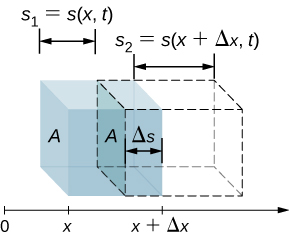
The intensity of a sound wave is proportional to the change in the pressure squared and inversely proportional to the density and the speed. Consider a parcel of a medium initially undisturbed and then influenced by a sound wave at time t, as shown in Figure 17.13.
英語のヒント
音波の強度は圧力変化の二乗に比例し、密度と音速に反比例する。図17.13のように、初めは乱れのない媒質の小さな部分が、時刻tに音波の影響を受ける場合を考える。
OpenStax / Rice University, University Physics Volume 1, CC BY 4.0. Source-book artwork retained. · CC BY 4.0 · Source出典

Figure 17.13図 17.13
An undisturbed parcel of a medium with a volume shown in blue. A sound wave moves through the medium at time t, and the parcel is displaced and expands, as shown by dotted lines. The change in volume is , where is the displacement of the leading edge of the parcel and is the displacement of the trailing edge of the parcel. In the figure, and the parcel expands, but the parcel can either expand or compress , depending on which part of the sound wave (compression or rarefaction) is moving through the parcel.
英語のヒント
初めに乱れのない、体積の媒質の小さな部分を青で示す。時刻tに音波が通ると、その部分は破線のように変位し、膨張する。体積変化はで、は前側の面、は後ろ側の面の変位である。図ではで膨張しているが、音波の密部と疎部のどちらが通るかによって、膨張することも、圧縮することもある。
As the sound wave moves through the parcel, the parcel is displaced and may expand or contract. If , the volume has increased and the pressure decreases. If the volume has decreased and the pressure increases. The change in the volume is
英語のヒント
音波が通ると、媒質の小さな部分は変位し、膨張したり縮んだりする。なら体積が増して圧力は下がり、なら体積が減って圧力は上がる。体積の変化は次のようになる。
The fractional change in the volume is the change in volume divided by the original volume:
英語のヒント
体積変化の割合は、体積変化を元の体積で割った値である。
The fractional change in volume is related to the pressure fluctuation by the bulk modulus Recall that the minus sign is required because the volume is inversely related to the pressure. (We use lowercase p for pressure to distinguish it from power, denoted by P.) The change in pressure is therefore If the sound wave is sinusoidal, then the displacement as shown in Equation 17.2 is and the pressure is found to be
英語のヒント
体積変化の割合と圧力変動は、体積弾性率によって関係する。体積と圧力は逆向きに変化するため、負号が必要である。なお、圧力には小文字pを使い、大文字Pで表すパワーと区別する。したがって、圧力変化はである。音波が正弦波なら、式17.2の変位はであり、圧力は次のようになる。
The intensity of the sound wave is the power per unit area, and the power is the force times the velocity, Here, the velocity is the velocity of the oscillations of the medium, and not the velocity of the sound wave. The velocity of the medium is the time rate of change in the displacement:
英語のヒント
音波の強度は単位面積当たりのパワーで、パワーは力と速度の積だから、となる。ここでの速度は、媒質の振動の速度であり、音波が伝わる速度ではない。媒質の速度は、変位の時間変化率である。
Thus, the intensity becomes
英語のヒント
したがって、強度は次のようになる。
To find the time-averaged intensity over one period for a position x, we integrate over the period, Using and we obtain
英語のヒント
位置xでの、1周期にわたる強度の時間平均を求めるため、その周期にわたって積分すると、を得る。、、を用いると、次のようになる。
That is, the intensity of a sound wave is related to its amplitude squared by
英語のヒント
つまり、音波の強度と振幅の二乗は、次のように関係する。
Here, is the pressure variation or pressure amplitude in units of pascals (Pa) or . The energy (as kinetic energy ) of an oscillating element of air due to a traveling sound wave is proportional to its amplitude squared. In this equation, is the density of the material in which the sound wave travels, in units of and v is the speed of sound in the medium, in units of m/s. The pressure variation is proportional to the amplitude of the oscillation, so I varies as This relationship is consistent with the fact that the sound wave is produced by some vibration; the greater its pressure amplitude, the more the air is compressed in the sound it creates.
英語のヒント
ここでは圧力変動、すなわち圧力振幅で、単位はパスカル(Pa)またはである。進行する音波によって振動する空気の要素のエネルギー(運動エネルギー)は、その振幅の2乗に比例する。この式のは音波が伝わる物質の密度で、単位はである。また、vは媒質中の音速で、単位はm/sである。圧力変動は振動の振幅に比例するため、Iはに比例して変化する。この関係は、音波が何らかの振動によって作られ、圧力振幅が大きいほど、その音の中で空気が強く圧縮されるという事実と整合する。