第17章音
Hearing and Pitch聴覚と音の高さ
The human ear has a tremendous range and sensitivity. It can give us a wealth of simple information—such as pitch, loudness, and direction.
英語のヒント
人間の耳は、驚くほど広い範囲と高い感度をもつ。音の高さ、大きさ、方向など、基本的な情報を豊富に伝えてくれる。
The perception of frequency is called pitch. Typically, humans have excellent relative pitch and can discriminate between two sounds if their frequencies differ by 0.3% or more. For example, 500.0 and 501.5 Hz are noticeably different. Musical notes are sounds of a particular frequency that can be produced by most instruments and in Western music have particular names, such as A-sharp, C, or E-flat.
英語のヒント
周波数を知覚したものを「音の高さ」という。一般に人間は優れた相対音感をもち、周波数が0.3%以上異なれば、二つの音を聞き分けられる。たとえば500.0 Hzと501.5 Hzの違いは認識できる。音楽の音は、たいていの楽器で出せる特定の周波数の音であり、西洋音楽では嬰イ(Aシャープ)、ハ(C)、変ホ(Eフラット)などの固有の音名が付いている。
The perception of intensity is called loudness. At a given frequency, it is possible to discern differences of about 1 dB, and a change of 3 dB is easily noticed. But loudness is not related to intensity alone. Frequency has a major effect on how loud a sound seems. Sounds near the high- and low-frequency extremes of the hearing range seem even less loud, because the ear is less sensitive at those frequencies. When a violin plays middle C, there is no mistaking it for a piano playing the same note. The reason is that each instrument produces a distinctive set of frequencies and intensities. We call our perception of these combinations of frequencies and intensities tone quality or, more commonly, the timbre of the sound. Timbre is the shape of the wave that arises from the many reflections, resonances, and superposition in an instrument.
英語のヒント
音の強さを知覚したものを「音の大きさ」という。周波数が一定なら約1 dBの差を聞き分けられ、3 dBの変化には容易に気付く。しかし、音の大きさは強さだけで決まるわけではない。周波数は、どれほど大きな音に聞こえるかに強く影響する。耳は可聴範囲の高周波側と低周波側の両端では感度が低いため、その付近の音はさらに小さく聞こえる。バイオリンが中央のCの音を出しても、同じ音を弾くピアノと聞き間違えることはない。楽器ごとに、周波数と強さの組合せが特有のものになるためである。こうした周波数と強さの組合せの知覚を音質、より一般には「音色」という。音色とは、楽器内の多くの反射、共鳴、重ね合わせから生じる波の形である。
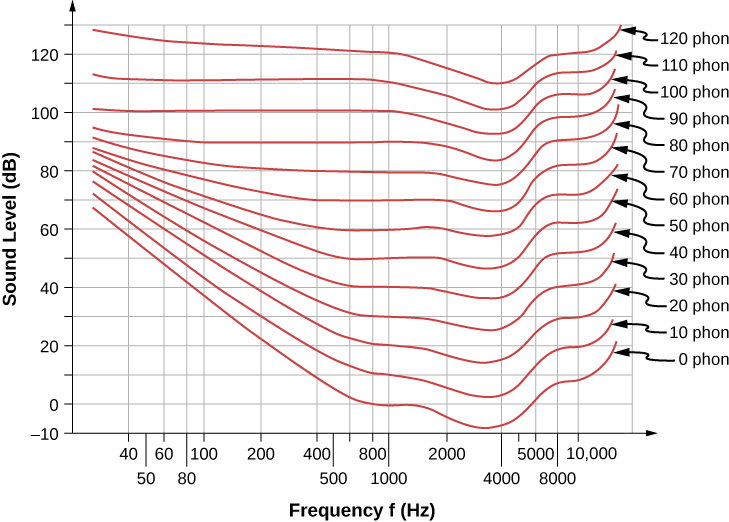
A unit called a phon is used to express loudness numerically. Phons differ from decibels because the phon is a unit of loudness perception, whereas the decibel is a unit of physical intensity. Figure 17.15 shows the relationship of loudness to intensity (or intensity level) and frequency for persons with normal hearing. The curved lines are equal-loudness curves. Each curve is labeled with its loudness in phons. Any sound along a given curve is perceived as equally loud by the average person. The curves were determined by having large numbers of people compare the loudness of sounds at different frequencies and sound intensity levels. At a frequency of 1000 Hz, phons are taken to be numerically equal to decibels.
英語のヒント
音の大きさを数値で表すには、フォンという単位を使う。フォンは音の大きさの知覚を表す単位であり、物理的な強さを表すデシベルとは異なる。図17.15に、聴覚が正常な人について、音の大きさと強さ(または強さレベル)、周波数の関係を示す。曲線は等ラウドネス曲線であり、それぞれにフォンで表した音の大きさが記されている。同じ曲線上の音は、平均的な人には等しい大きさに聞こえる。これらの曲線は、多数の人に異なる周波数と音の強さレベルの音を聞かせ、その大きさを比較してもらうことで求められた。周波数1000 Hzでは、フォンの数値をデシベルと等しく取る。
OpenStax / Rice University, University Physics Volume 1, CC BY 4.0. Source-book artwork retained. · CC BY 4.0 · Source出典

Figure 17.15図 17.15
The relationship of loudness in phons to intensity level (in decibels) and intensity (in watts per meter squared) for persons with normal hearing. The curved lines are equal-loudness curves—all sounds on a given curve are perceived as equally loud. Phons and decibels are defined to be the same at 1000 Hz.
英語のヒント
聴覚が正常な人について、フォンで表した音の大きさと、音の強さレベル(デシベル)、強さ(1平方メートルあたりのワット数)の関係。曲線は等ラウドネス曲線であり、同じ曲線上の音はすべて等しい大きさに知覚される。1000 Hzではフォンとデシベルの値が同じになるように定義される。
Example 17.4例題 17.4
Measuring Loudness音の大きさを測る
(a) What is the loudness in phons of a 100-Hz sound that has an intensity level of 80 dB? (b) What is the intensity level in decibels of a 4000-Hz sound having a loudness of 70 phons? (c) At what intensity level will an 8000-Hz sound have the same loudness as a 200-Hz sound at 60 dB?
英語のヒント
(a) 強さレベルが80 dBの100 Hzの音の大きさは、何フォンか。(b) 大きさが70フォンの4000 Hzの音について、強さレベルをデシベルで求めよ。(c) 8000 Hzの音が、60 dBの200 Hzの音と同じ大きさになるのは、どの強さレベルか。
Strategy方針
The graph in Figure 17.15 should be referenced to solve this example. To find the loudness of a given sound, you must know its frequency and intensity level, locate that point on the square grid, and then interpolate between loudness curves to get the loudness in phons. Once that point is located, the intensity level can be determined from the vertical axis.
英語のヒント
この例題を解くには、図17.15のグラフを参照する。ある音の大きさを求めるには、その周波数と強さレベルを知り、方眼上の対応する点を見つけてから、等ラウドネス曲線の間を補間してフォンの値を得る必要がある。点の位置が決まれば、強さレベルは縦軸から求められる。
Solution解答
- Identify knowns: The square grid of the graph relating phons and decibels is a plot of intensity level versus frequency—both physical quantities: 100 Hz at 80 dB lies halfway between the curves marked 70 and 80 phons.
Find the loudness: 75 phons.英語のヒント
既知量を確認する。フォンとデシベルを関係付ける方眼のグラフは、どちらも物理量である強さレベルと周波数を軸に取っている。100 Hz、80 dBの点は、70フォンと80フォンの曲線の中間にある。音の大きさは75フォンである。 - Identify knowns: Values are given to be 4000 Hz at 70 phons.
Follow the 70-phon curve until it reaches 4000 Hz. At that point, it is below the 70 dB line at about 67 dB.
Find the intensity level: 67 dB.英語のヒント
既知量を確認する。4000 Hz、70フォンが与えられている。70フォンの曲線を4000 Hzの位置までたどる。その点は70 dBの線より下で、約67 dBにある。したがって、強さレベルは67 dBである。 - Locate the point for a 200 Hz and 60 dB sound.
Find the loudness: This point lies just slightly above the 50-phon curve, and so its loudness is 51 phons.
Look for the 51-phon level is at 8000 Hz: 63 dB.英語のヒント
200 Hz、60 dBの点を見つける。この点は50フォンの曲線のわずか上なので、音の大きさは51フォンである。8000 Hzで51フォンに当たるレベルを探すと、63 dBとなる。
Significance考察
These answers, like all information extracted from Figure 17.15, have uncertainties of several phons or several decibels, partly due to difficulties in interpolation, but mostly related to uncertainties in the equal-loudness curves.
英語のヒント
これらの答えには、図17.15から読み取るほかの情報と同様に、数フォンまたは数デシベルの不確かさがある。補間の難しさも一因だが、主な原因は等ラウドネス曲線自体の不確かさである。
In this section, we discussed the characteristics of sound and how we hear, but how are the sounds we hear produced? Interesting sources of sound are musical instruments and the human voice, and we will discuss these sources. But before we can understand how musical instruments produce sound, we need to look at the basic mechanisms behind these instruments. The theories behind the mechanisms used by musical instruments involve interference, superposition, and standing waves, which we discuss in the next section.
英語のヒント
この節では音の性質と聞こえ方を扱ったが、聞こえてくる音はどうやって作られるのだろうか。興味深い音源として楽器と人の声があり、これらをこれから取り上げる。ただし、楽器がどのように音を出すかを理解する前に、その基本的な仕組みを調べる必要がある。楽器の仕組みに関わる理論には、干渉、重ね合わせ、定常波があり、次の節で論じる。