第17章音
Derivation of the Observed Frequency due to the Doppler Shiftドップラーシフトによる観測振動数の導出
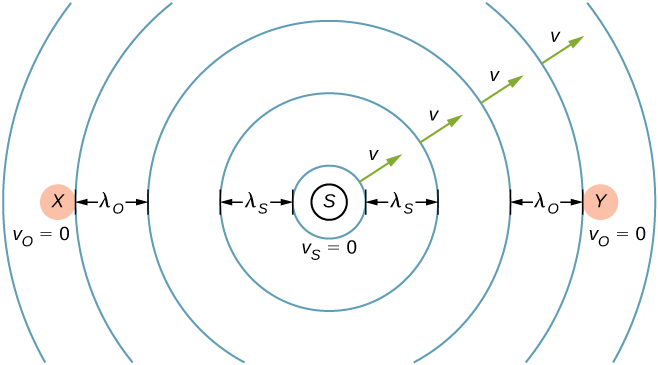
Consider two stationary observers X and Y in Figure 17.31, located on either side of a stationary source. Each observer hears the same frequency, and that frequency is the frequency produced by the stationary source.
英語のヒント
図17.31で、静止した音源の両側にいる、静止した二人の観測者X、Yを考える。二人が聞く振動数は同じで、静止した音源が出す振動数に等しい。
OpenStax / Rice University, University Physics Volume 1, CC BY 4.0. Source-book artwork retained. · CC BY 4.0 · Source出典

Figure 17.31図 17.31
A stationary source sends out sound waves at a constant frequency with a constant wavelength at the speed of sound v. Two stationary observers X and Y, on either side of the source, observe a frequency , with a wavelength
英語のヒント
静止した音源は、一定の振動数、一定の波長の音波を音速vで送り出す。音源の両側の静止した観測者X、Yは、振動数、波長を観測する。
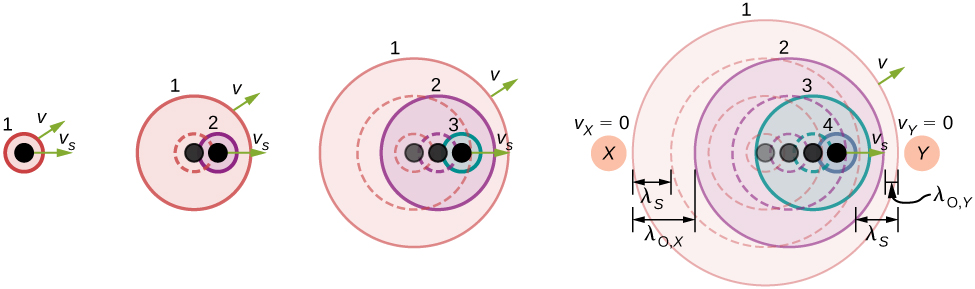
Now consider a stationary observer X with a source moving away from the observer with a constant speed (Figure 17.32). At time , the source sends out a sound wave, indicated in black. This wave moves out at the speed of sound v. The position of the sound wave at each time interval of period is shown as dotted lines. After one period, the source has moved and emits a second sound wave, which moves out at the speed of sound. The source continues to move and produce sound waves, as indicated by the circles numbered 3 and 4. Notice that as the waves move out, they remained centered at their respective point of origin.
英語のヒント
次に、静止した観測者Xから音源が一定の速さで遠ざかる場合を考える(図17.32)。時刻に、音源は黒で示す音波を出し、波は音速vで広がる。周期ごとの波の位置を点線で示す。1周期後、音源は移動して第2の音波を出し、それも音速で広がる。音源は移動しながら音波を出し続け、3、4の円はそれを示す。広がる各波の中心は、それぞれの発生点に保たれる。
OpenStax / Rice University, University Physics Volume 1, CC BY 4.0. Source-book artwork retained. · CC BY 4.0 · Source出典

Figure 17.32図 17.32
A source moving at a constant speed away from an observer X. The moving source sends out sound waves at a constant frequency with a constant wavelength , at the speed of sound v. Snapshots of the source at an interval of are shown as the source moves away from the stationary observer X. The solid lines represent the position of the sound waves after four periods from the initial time. The dotted lines are used to show the positions of the waves at each time period. The observer hears a wavelength of .
英語のヒント
観測者Xから一定の速さで遠ざかる音源。動く音源は、一定の振動数、一定の波長の音波を音速vで送り出す。静止した観測者Xから遠ざかる音源を、間隔で示す。実線は初めから4周期後の音波の位置、点線は各周期での波の位置を示す。観測者が聞く波長はである。
Using the fact that the wavelength is equal to the speed times the period, and the period is the inverse of the frequency, we can derive the observed frequency:
英語のヒント
波長が速さと周期の積であり、周期が振動数の逆数であることを使うと、観測振動数を導ける。
As the source moves away from the observer, the observed frequency is lower than the source frequency.
英語のヒント
音源が観測者から遠ざかると、観測振動数は音源の振動数より低くなる。
Now consider a source moving at a constant velocity moving toward a stationary observer Y, also shown in Figure 17.32. The wavelength is observed by Y as Once again, using the fact that the wavelength is equal to the speed times the period, and the period is the inverse of the frequency, we can derive the observed frequency:
英語のヒント
次に、同じ図17.32で、音源が静止した観測者Yへ一定の速度で近づく場合を考える。Yが観測する波長はである。再び、波長が速さと周期の積であり、周期が振動数の逆数であることから、観測振動数を導ける。
When a source is moving and the observer is stationary, the observed frequency is
英語のヒント
音源が動き、観測者が静止しているとき、観測振動数は次のとおりである。
where is the frequency observed by the stationary observer, is the frequency produced by the moving source, v is the speed of sound, is the constant speed of the source, and the top sign is for the source approaching the observer and the bottom sign is for the source departing from the observer.
英語のヒント
ここでは静止した観測者が観測する振動数、は動く音源が出す振動数、vは音速、は音源の一定の速さである。上の符号は音源が観測者へ近づく場合、下は遠ざかる場合に用いる。
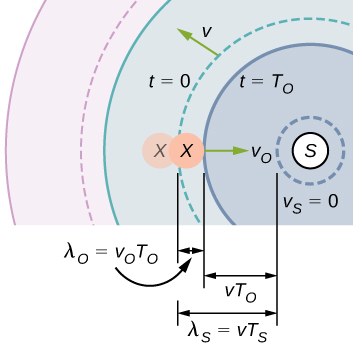
What happens if the observer is moving and the source is stationary? If the observer moves toward the stationary source, the observed frequency is higher than the source frequency. If the observer is moving away from the stationary source, the observed frequency is lower than the source frequency. Consider observer X in Figure 17.33 as the observer moves toward a stationary source with a speed . The source emits a tone with a constant frequency and constant period The observer hears the first wave emitted by the source. If the observer were stationary, the time for one wavelength of sound to pass should be equal to the period of the source Since the observer is moving toward the source, the time for one wavelength to pass is less than and is equal to the observed period At time the observer starts at the beginning of a wavelength and moves toward the second wavelength as the wavelength moves out from the source. The wavelength is equal to the distance the observer traveled plus the distance the sound wave traveled until it is met by the observer:
英語のヒント
観測者が動き、音源が静止している場合はどうだろうか。静止した音源へ観測者が近づけば観測振動数は音源より高く、遠ざかれば低くなる。図17.33で、観測者Xが速さで静止した音源へ近づく場合を考える。音源は一定の振動数、一定の周期の音を出す。観測者は音源が出した最初の波を聞く。もし静止していれば、1波長の音が通過する時間は音源の周期に等しいはずである。しかし音源へ向かって動いているので、通過時間はより短く、観測周期に等しい。時刻に観測者は1波長の始点から出発し、波が音源から広がる間に次の波長へ向かって移動する。波長は、観測者が進んだ距離と、観測者に出会うまで音波が進んだ距離の和に等しい。
OpenStax / Rice University, University Physics Volume 1, CC BY 4.0. Source-book artwork retained. · CC BY 4.0 · Source出典

Figure 17.33図 17.33
A stationary source emits a sound wave with a constant frequency , with a constant wavelength moving at the speed of sound v. Observer X moves toward the source with a constant speed , and the figure shows the initial and final position of observer X. Observer X observes a frequency higher than the source frequency. The dotted lines show the position of the waves at . The solid lines show the position of the waves at .
英語のヒント
静止した音源は、一定の振動数、一定の波長の音波を音速vで出す。観測者Xは一定の速さで音源へ向かう。図はXの初めと終わりの位置を示す。Xは音源より高い振動数を観測する。点線は、実線はにおける波の位置を示す。
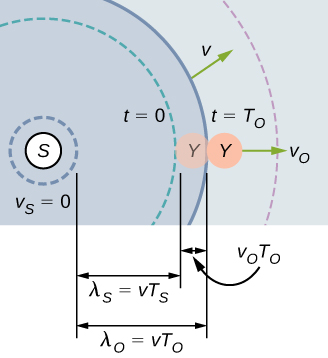
If the observer is moving away from the source (Figure 17.34), the observed frequency can be found:
英語のヒント
観測者が音源から遠ざかる場合(図17.34)、観測振動数は次のように求められる。
OpenStax / Rice University, University Physics Volume 1, CC BY 4.0. Source-book artwork retained. · CC BY 4.0 · Source出典

Figure 17.34図 17.34
A stationary source emits a sound wave with a constant frequency , with a constant wavelength moving at the speed of sound v. Observer Y moves away from the source with a constant speed , and the figure shows initial and final position of the observer Y. Observer Y observes a frequency lower than the source frequency. The dotted lines show the position of the waves at . The solid lines show the position of the waves at .
英語のヒント
静止した音源は、一定の振動数、一定の波長の音波を音速vで出す。観測者Yは一定の速さで音源から遠ざかる。図はYの初めと終わりの位置を示す。Yは音源より低い振動数を観測する。点線は、実線はにおける波の位置を示す。
The equations for an observer moving toward or away from a stationary source can be combined into one equation:
英語のヒント
観測者が静止した音源へ近づく場合と遠ざかる場合の式は、一つにまとめられる。
where is the observed frequency, is the source frequency, is the speed of sound, is the speed of the observer, the top sign is for the observer approaching the source and the bottom sign is for the observer departing from the source.
英語のヒント
ここでは観測振動数、は音源の振動数、は音速、は観測者の速さである。上の符号は観測者が音源へ近づく場合、下は遠ざかる場合に用いる。
Equation 17.18 and Equation 17.19 can be summarized in one equation (the top sign is for approaching) and is further illustrated in Table 17.4:
英語のヒント
音源が動く場合の式と観測者が動く場合の式は、一つの式にまとめられる。上の符号は近づく場合を表す。表17.4にさらに示す。
Doppler shift ドップラーシフト |
Stationary observer 静止した観測者 |
Observer moving towards source 英語のヒント音源へ近づく観測者 |
Observer moving away from source 英語のヒント音源から遠ざかる観測者 |
|---|---|---|---|
Stationary source 静止した音源 |
|||
Source moving towards observer 英語のヒント観測者へ近づく音源 |
|||
Source moving away from observer 英語のヒント観測者から遠ざかる音源 |
where is the observed frequency, is the source frequency, is the speed of sound, is the speed of the observer, is the speed of the source, the top sign is for approaching and the bottom sign is for departing.
英語のヒント
ここでは観測振動数、は音源の振動数、は音速、は観測者の速さ、は音源の速さである。上の符号は近づく場合、下は遠ざかる場合に用いる。
Additional Resources追加教材
Example 17.8例題 17.8
Calculating a Doppler Shiftドップラーシフトの計算
Suppose a train that has a 150-Hz horn is moving at 35.0 m/s in still air on a day when the speed of sound is 340 m/s.
英語のヒント
音速340 m/sの日に、150 Hzの警笛を持つ列車が、静止した空気の中を35.0 m/sで走っているとする。
(a) What frequencies are observed by a stationary person at the side of the tracks as the train approaches and after it passes?
英語のヒント
(a) 線路の脇に静止した人は、列車が近づくときと通過した後に、それぞれどの振動数を観測するか。
(b) What frequency is observed by the train’s engineer traveling on the train?
英語のヒント
(b) 列車に乗って移動する運転士は、どの振動数を観測するか。
Strategy方針
To find the observed frequency in (a), we must use because the source is moving. The minus sign is used for the approaching train, and the plus sign for the receding train. In (b), there are two Doppler shifts—one for a moving source and the other for a moving observer.
英語のヒント
(a)の観測振動数を求めるには、音源が動いているのでを使う。近づく列車には負号、遠ざかる列車には正号を使う。(b)では、動く音源によるものと、動く観測者によるものの、二つのドップラーシフトがある。
Solution解答
- Enter known values into
英語のヒント
へ既知の値を代入する。Calculate the frequency observed by a stationary person as the train approaches:英語のヒント
列車が近づくとき、静止した人が観測する振動数を計算する。Use the same equation with the plus sign to find the frequency heard by a stationary person as the train recedes:英語のヒント
同じ式の正号を使い、列車が遠ざかるときに静止した人が聞く振動数を求める。Calculate the second frequency:英語のヒント
2番目の振動数を計算する。 - Identify knowns:
英語のヒント
既知量を確認する。- It seems reasonable that the engineer would receive the same frequency as emitted by the horn, because the relative velocity between them is zero.
英語のヒント
運転士と警笛の相対速度はゼロなので、運転士が警笛の出す振動数と同じものを受け取ると考えるのは妥当である。 - Relative to the medium (air), the speeds are
英語のヒント
媒質である空気に対する速さは、である。 - The first Doppler shift is for the moving observer; the second is for the moving source.
英語のヒント
最初のドップラーシフトは動く観測者によるもので、二つ目は動く音源によるものである。
Use the following equation:英語のヒント
次の式を使う。The quantity in the square brackets is the Doppler-shifted frequency due to a moving observer. The factor on the right is the effect of the moving source.
Because the train engineer is moving in the direction toward the horn, we must use the plus sign for however, because the horn is also moving in the direction away from the engineer, we also use the plus sign for But the train is carrying both the engineer and the horn at the same velocity, so As a result, everything but cancels, yielding英語のヒント
角括弧の中の量は、観測者の運動でドップラーシフトした振動数である。右の因子は動く音源の効果を表す。運転士は警笛へ向かう向きに動いているので、には正号を使う。しかし警笛も運転士から離れる向きに動くので、にも正号を使う。列車は運転士と警笛を同じ速度で運んでいるため、となる。その結果、以外はすべて約分され、次式を得る。
Significance考察
For the case where the source and the observer are not moving together, the numbers calculated are valid when the source (in this case, the train) is far enough away that the motion is nearly along the line joining source and observer. In both cases, the shift is significant and easily noticed. Note that the shift is 17.0 Hz for motion toward and 14.0 Hz for motion away. The shifts are not symmetric.
英語のヒント
音源と観測者が一緒には動かない場合、計算した値が成り立つのは、音源である列車が十分遠く、その運動方向が音源と観測者を結ぶ直線にほぼ沿うときである。近づく場合も遠ざかる場合も、ずれは大きく、容易に分かる。近づくときのずれは17.0 Hz、遠ざかるときは14.0 Hzであり、対称ではない。
For the engineer riding in the train, we may expect that there is no change in frequency because the source and observer move together. This matches your experience. For example, there is no Doppler shift in the frequency of conversations between driver and passenger on a motorcycle. People talking when a wind moves the air between them also observe no Doppler shift in their conversation. The crucial point is that source and observer are not moving relative to each other.
英語のヒント
列車の運転士については、音源と観測者が一緒に動くので、振動数は変わらないと予想できる。これは経験とも一致する。例えばオートバイの運転者と同乗者の会話の振動数には、ドップラーシフトはない。人の間の空気が風で動いていても、会話にドップラーシフトは観測されない。要点は、音源と観測者が互いに対して動いていないことである。