第17章音
Derivation of the Speed of Sound in Air空気中の音速の導出
As stated earlier, the speed of sound in a medium depends on the medium and the state of the medium. The derivation of the equation for the speed of sound in air starts with the mass flow rate and continuity equation discussed in Fluid Mechanics.
英語のヒント
先に述べたように、媒質中の音速は、媒質とその状態に依存する。空気中の音速の式は、「流体力学」で扱った質量流量と連続の式から導く。
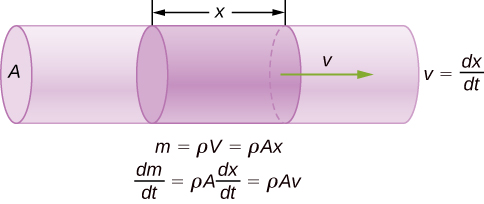
Consider fluid flow through a pipe with cross-sectional area A (Figure 17.7). The mass in a small volume of length x of the pipe is equal to the density times the volume, or The mass flow rate is
英語のヒント
断面積Aの管を通る流体を考える(図17.7)。管の長さxの小さな部分に含まれる質量は、密度と体積の積である。質量流量は次のようになる。
The continuity equation from Fluid Mechanics states that the mass flow rate into a volume has to equal the mass flow rate out of the volume,
英語のヒント
「流体力学」の連続の式は、ある領域へ入る質量流量と出る質量流量が等しいことを表す。すなわち、である。
OpenStax / Rice University, University Physics Volume 1, CC BY 4.0. Source-book artwork retained. · CC BY 4.0 · Source出典

Figure 17.7図 17.7
The mass of a fluid in a volume is equal to the density times the volume, The mass flow rate is the time derivative of the mass.
英語のヒント
ある領域に含まれる流体の質量は、密度と体積の積である。質量流量は、質量の時間微分である。
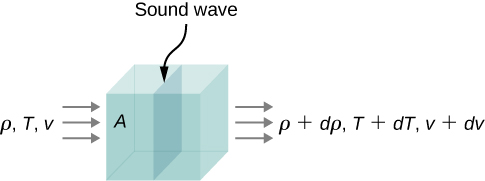
Now consider a sound wave moving through a parcel of air. A parcel of air is a small volume of air with imaginary boundaries (Figure 17.8). The density, temperature, and velocity on one side of the volume of the fluid are given as and on the other side are
英語のヒント
次に、小さな空気塊を通る音波を考える。空気塊とは、仮想的な境界で囲んだ小さな体積の空気である(図17.8)。一方の面での流体の密度・温度・速度を、反対の面での値をとする。
OpenStax / Rice University, University Physics Volume 1, CC BY 4.0. Source-book artwork retained. · CC BY 4.0 · Source出典

Figure 17.8図 17.8
A sound wave moves through a volume of fluid. The density, temperature, and velocity of the fluid change from one side to the other.
英語のヒント
音波が流体の領域を通る。流体の密度・温度・速度は、一方の面から反対の面へ変化する。
The continuity equation states that the mass flow rate entering the volume is equal to the mass flow rate leaving the volume, so
英語のヒント
連続の式によれば、領域へ入る質量流量は、そこから出る質量流量に等しい。したがって、
This equation can be simplified, noting that the area cancels and considering that the multiplication of two infinitesimals is approximately equal to zero:
英語のヒント
面積を約分し、二つの微小量の積をほぼゼロ、とみなすと、式は次のように簡単になる。
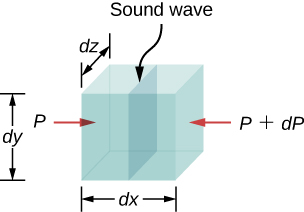
The net force on the volume of fluid (Figure 17.9) equals the sum of the forces on the left face and the right face:
英語のヒント
流体の領域に働く合力(図17.9)は、左の面と右の面に働く力の和に等しい。
OpenStax / Rice University, University Physics Volume 1, CC BY 4.0. Source-book artwork retained. · CC BY 4.0 · Source出典

Figure 17.9図 17.9
A sound wave moves through a volume of fluid. The force on each face can be found by the pressure times the area.
英語のヒント
音波が流体の領域を通る。各面に働く力は、圧力と面積の積で求められる。
The acceleration is the force divided by the mass and the mass is equal to the density times the volume, We have
英語のヒント
加速度は力を質量で割った値であり、質量は密度と体積の積に等しい。したがって、
From the continuity equation , we obtain
英語のヒント
連続の式から、次の関係を得る。
Consider a sound wave moving through air. During the process of compression and expansion of the gas, no heat is added or removed from the system. A process where heat is not added or removed from the system is known as an adiabatic system. Adiabatic processes are covered in detail in The First Law of Thermodynamics, but for now it is sufficient to say that for an adiabatic process, where p is the pressure, V is the volume, and gamma is a constant that depends on the gas. For air, . The density equals the number of moles times the molar mass divided by the volume, so the volume is equal to The number of moles and the molar mass are constant and can be absorbed into the constant Taking the natural logarithm of both sides yields Differentiating with respect to the density, the equation becomes
英語のヒント
空気中を伝わる音波を考える。気体が圧縮・膨張する過程では、系へ熱を加えたり、系から熱を取り去ったりしない。系と外部の間に熱の出入りがない過程を断熱過程という。断熱過程は「熱力学第1法則」で詳しく扱う。ここでは、断熱過程でとなることを使えばよい。pは圧力、Vは体積、ガンマは気体によって決まる定数である。空気ではとなる。密度は、物質量とモル質量の積を体積で割った値なので、である。物質量とモル質量は一定だから定数へ含めることができ、となる。両辺の自然対数を取ると、を得る。密度で微分すると、次の式になる。
If the air can be considered an ideal gas, we can use the ideal gas law:
英語のヒント
空気を理想気体とみなせるなら、理想気体の状態方程式を使える。
Here M is the molar mass of air:
英語のヒント
ここでMは空気のモル質量である。
Since the speed of sound is equal to , the speed is equal to
英語のヒント
音速はなので、次のようになる。
Note that the velocity is faster at higher temperatures and slower for heavier gases. For air, and If the temperature is the speed of sound is
英語のヒント
温度が高いほど音速は大きく、重い気体ほど小さくなる。空気では、、である。温度がなら、音速はとなる。
The equation for the speed of sound in air can be simplified to give the equation for the speed of sound in air as a function of absolute temperature:
英語のヒント
空気中の音速の式を整理すると、絶対温度の関数として次のように表せる。
One of the more important properties of sound is that its speed is nearly independent of the frequency. This independence is certainly true in open air for sounds in the audible range. If this independence were not true, you would certainly notice it for music played by a marching band in a football stadium, for example. Suppose that high-frequency sounds traveled faster—then the farther you were from the band, the more the sound from the low-pitch instruments would lag that from the high-pitch ones. But the music from all instruments arrives in cadence independent of distance, so all frequencies must travel at nearly the same speed. Recall that
英語のヒント
音の重要な性質の一つは、その速さが周波数にほぼ依存しないことである。屋外の空気中を伝わる可聴域の音では、確かにそうなる。もし違っていれば、例えばフットボール競技場のマーチングバンドの音楽を聞いたとき、はっきり気付くだろう。高周波の音ほど速く伝わると仮定しよう。その場合、バンドから遠くなるほど、低い音の楽器の音が、高い音の楽器の音に遅れて届くはずである。しかし実際には、どの楽器の音も距離によらず拍子がそろって届く。したがって、どの周波数もほぼ同じ速さで伝わるはずである。次の関係を思い出そう。
In a given medium under fixed conditions, v is constant, so there is a relationship between f and the higher the frequency, the smaller the wavelength (Figure 17.10).
英語のヒント
条件が一定の媒質ではvが一定なので、fとには関係があり、周波数が高いほど波長は短くなる(図17.10)。
Image omitted because its reuse rights could not be verified.権利の確認ができないため画像を割愛。
Figure 17.10図 17.10
Because they travel at the same speed in a given medium, low-frequency sounds must have a greater wavelength than high-frequency sounds. Here, the lower-frequency sounds are emitted by the large speaker, called a woofer, whereas the higher-frequency sounds are emitted by the small speaker, called a tweeter. (credit: modification of work by Jane Whitney)
英語のヒント
同じ媒質では同じ速さで伝わるので、低周波の音は、高周波の音より波長が長い。図では、低周波の音はウーファーと呼ぶ大きなスピーカー、高周波の音はツイーターと呼ぶ小さなスピーカーから出る。(ジェーン・ホイットニーの作品を改変)
Example 17.1例題 17.1
Calculating Wavelengths波長の計算
Calculate the wavelengths of sounds at the extremes of the audible range, 20 and 20,000 Hz, in air. (Assume that the frequency values are accurate to two significant figures.)
英語のヒント
温度の空気中で、可聴範囲の両端である20 Hzと20,000 Hzの音の波長を求めよ。周波数の値は有効数字2桁とする。
Strategy方針
To find wavelength from frequency, we can use
英語のヒント
周波数から波長を求めるには、を使える。
Solution解答
- Identify knowns. The value for v is given by
英語のヒント
既知の量を確認する。vは次の式で与えられる。 - Convert the temperature into kelvins and then enter the temperature into the equation
英語のヒント
温度をケルビンへ換算し、その値を式に代入する。 - Solve the relationship between speed and wavelength for λ:
英語のヒント
速さと波長の関係を、λについて解く。 - Enter the speed and the minimum frequency to give the maximum wavelength:
英語のヒント
音速と最小の周波数を代入して、最大波長を求める。 - Enter the speed and the maximum frequency to give the minimum wavelength:
英語のヒント
音速と最大の周波数を代入して、最小波長を求める。
Significance考察
Because the product of f multiplied by equals a constant, the smaller f is, the larger must be, and vice versa.
英語のヒント
fとの積が一定なので、fが小さいほどは大きくなり、逆も成り立つ。
The speed of sound can change when sound travels from one medium to another, but the frequency usually remains the same. This is similar to the frequency of a wave on a string being equal to the frequency of the force oscillating the string. If v changes and f remains the same, then the wavelength must change. That is, because , the higher the speed of a sound, the greater its wavelength for a given frequency.
英語のヒント
音がある媒質から別の媒質へ移ると、音速は変わることがあるが、周波数は通常同じままである。これは、弦の波の周波数が、弦を振動させる力の周波数と等しいことに似ている。vが変わり、fが同じままなら、波長が変わらなければならない。つまり、なので、周波数が一定のとき、音速が大きいほど波長が長い。
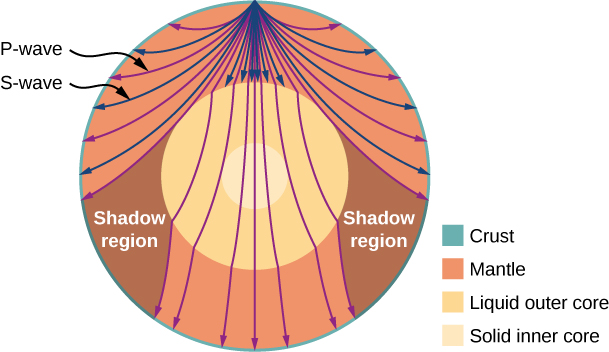
Although sound waves in a fluid are longitudinal, sound waves in a solid travel both as longitudinal waves and transverse waves. Seismic waves, which are essentially sound waves in Earth’s crust produced by earthquakes, are an interesting example of how the speed of sound depends on the rigidity of the medium. Earthquakes produce both longitudinal and transverse waves, and these travel at different speeds. The bulk modulus of granite is greater than its shear modulus. For that reason, the speed of longitudinal or pressure waves (P-waves) in earthquakes in granite is significantly higher than the speed of transverse or shear waves (S-waves). Both types of earthquake waves travel slower in less rigid material, such as sediments. P-waves have speeds of 4 to 7 km/s, and S-waves range in speed from 2 to 5 km/s, both being faster in more rigid material. The P-wave gets progressively farther ahead of the S-wave as they travel through Earth’s crust. The time between the P- and S-waves is routinely used to determine the distance to their source, the epicenter of the earthquake. Because S-waves do not pass through the liquid core, two shadow regions are produced (Figure 17.11).
英語のヒント
流体中の音波は縦波だが、固体中では縦波と横波の両方が伝わる。地震波は、本質的には地震が地殻中に作る音波であり、音速が媒質の硬さに依存する興味深い例である。地震は縦波と横波の両方を生み、それぞれ異なる速さで伝わる。花崗岩の体積弾性率は剛性率より大きい。そのため、花崗岩中の地震の縦波、すなわち圧力波(P波)は、横波、すなわちせん断波(S波)よりかなり速い。堆積物のように剛性が低い材料では、どちらの波も遅くなる。P波の速さは4〜7 km/s、S波は2〜5 km/sで、どちらも硬い材料ほど速い。地殻中を伝わるにつれ、P波はS波より次第に先へ進む。両波の到着時間差は、発生源である震央までの距離を求めるために日常的に使われる。S波は液体の核を通らないため、二つの影の領域ができる(図17.11)。
OpenStax / Rice University, University Physics Volume 1, CC BY 4.0. Source-book artwork retained. · CC BY 4.0 · Source出典

Figure 17.11図 17.11
Earthquakes produce both longitudinal waves (P-waves) and transverse waves (S-waves), and these travel at different speeds. Both waves travel at different speeds in the different regions of Earth, but in general, P-waves travel faster than S-waves. S-waves cannot be supported by the liquid core, producing shadow regions.
英語のヒント
地震は縦波(P波)と横波(S波)を生み、両者は異なる速さで伝わる。地球内部の領域によってどちらの速さも変わるが、一般にP波はS波より速い。液体の核はS波を伝えられず、影の領域ができる。
Seismologists and geophysicists use properties and velocities of earthquake waves to study the Earth's interior, which due to it's depth and pressure is not observable through many other means. In fact, the discoveries of the structure of the Earth, illustrated in the figure above, resulted from earthquake observations. In 1914, Beno Gutenberg used differences in wave speeds to determine that there must be a liquid core within the mantle. In 1936, Inge Lehmann began investigating P-waves from a New Zealand earthquake that had unexpectedly reached Europe, which should have been in the shadow region. Up until that point, seismologists had explained such shadow waves as being caused by some type of diffraction (as Gutenberg himself assumed) or a result of faulty seismometers. However, Lehmann had installed the European instruments herself, and so trusted their accuracy. She calculated that the amplitude of the waves must be caused by the existence of a solid inner core within the liquid core. This model has been accepted and reinforced by decades of subsequent calculations, including those from nuclear test explosions, which can be measured very precisely.
英語のヒント
地震学者や地球物理学者は、地震波の性質と速さを使って地球内部を調べる。内部は深く、圧力も高いため、他の多くの方法では観察できない。実際、上図に示した地球内部の構造は、地震の観測から明らかになった。1914年、ベノー・グーテンベルクは波の速さの違いから、マントルの内側に液体の核が存在するはずだと判断した。1936年、インゲ・レーマンは、ニュージーランドの地震によるP波が、影の領域にあるはずのヨーロッパへ予想外に届いたことを調べ始めた。それまで地震学者は、このような波を、グーテンベルク自身も考えたような何らかの回折、または地震計の不具合で説明していた。しかし、ヨーロッパの装置はレーマン自身が設置しており、彼女はその精度を信頼していた。計算から、観測された波の振幅は、液体の核の内側に固体の内核があるために生じるはずだと判断した。このモデルは受け入れられ、その後数十年の計算で裏付けられてきた。その中には、非常に精密に測定できる核実験の爆発からの計算も含まれる。
As sound waves move away from a speaker, or away from the epicenter of an earthquake, their power per unit area decreases. This is why the sound is very loud near a speaker and becomes less loud as you move away from the speaker. This also explains why there can be an extreme amount of damage at the epicenter of an earthquake but only tremors are felt in areas far from the epicenter. The power per unit area is known as the intensity, and in the next section, we will discuss how the intensity depends on the distance from the source.
英語のヒント
音波がスピーカーや地震の震央から離れると、単位面積当たりのパワーが減る。そのため、スピーカーの近くでは音が大きく、離れるほど小さくなる。震央で甚大な被害が生じても、遠い場所では弱い揺れだけを感じることも、これで説明できる。単位面積当たりのパワーを強度と呼ぶ。次の節では、強度が発生源からの距離にどう依存するかを調べる。